
🌊 Executive Marine Engineering Summary: For luxury beachfront hotel operators, oceanfront wedding event coordinators, and marine architecture specifiers, materials placed along coastline environments face relentless salt spray, high atmospheric humidity, and abrasive sea breezes. When investigating does salt water cause teak wood to rot or erode over time?, marine wood science proves that genuine Grade-A teak heartwood is virtually immune to saltwater decay and sodium chloride degradation. Unlike standard softwoods and metals that rust or crumble under salt exposure, teak's inner core holds high concentrations of natural latex rubber (caoutchouc), bioactive tectoquinone, and microscopic silica deposits. Instead of causing rot, ocean brine acts as a natural antiseptic against wood-destroying fungi, while teak's dense grain prevents salt crystallization from eroding structural fibers.

1. 🧪 Marine Biochemistry: Why Ocean Salt Water Does Not Rot Teak Wood
To understand why teak thrives on oceanfront decks where other wood species degrade within seasons, engineers examine the interaction between sodium chloride brine and wood cellular structures.
💡 The Natural Marine Protection Matrix:
Hydrophobic Latex Barrier (Caoutchouc) ──► Dense natural rubber seals cellular lumens, blocking salt water absorption.
Bioactive Antiseptic Extracts (Tectoquinone) ──► Inhibits wood-rot basidiomycetes fungi that require fresh moisture to survive.
Mineralized Silica Armor ──► Microscopic silica crystals reinforce cell walls against airborne sand and salt spray abrasion.
Low Salt-Crystallization Stress ──► Hydrophobic grain stops salt crystals from forming inside wood cells and popping timber fibers apart.
🦠 Salt Water as a Natural Antiseptic
Wood rot is caused by living organisms-primarily decay fungi like basidiomycetes-that digest cellulose and lignin. These fungi require sustained fresh moisture, oxygen, and moderate pH levels. Sodium chloride in sea water disrupts fungal cellular osmotic pressure, effectively inhibiting biological growth. Consequently, far from causing rot, ambient salt spray acts as a mild natural antiseptic on genuine teak.
🧂 Haloclasty Resistance: Preventing Surface Salt Erosion
When salt water soaks into porous woods and evaporates, salt crystals expand inside the wood pores-a destructive mechanical weathering process known as haloclasty. Teak resists this surface erosion because its tight grain and high equilibrium moisture content stability prevent liquid brine from penetrating deep into the cellular structure.

2. Marine Stressors vs. Teak Resistance Mechanism
Evaluating does salt water cause teak wood to rot or erode over time? requires mapping specific marine atmospheric hazards against internal wood chemistry:
| 🌊 Marine Hazard | 🧪 Chemical / Physical Threat | 🛡️ Teak Heartwood Defense Mechanism | 📈 Long-Term Structural Outcome |
| Direct Saltwater Splash | Sodium chloride penetration & cellular swelling | Hydrophobic caoutchouc rubber content repels liquid brine | 🟢 Zero internal rot; wood remains dimensionally stable |
| Salt Spray Atomization | Salt crusting on horizontal surfaces | Non-porous heartwood surface prevents salt crystal expansion | 🟢 No surface flaking, pitting, or fiber delamination |
| High Coastal Humidity | Sustained moisture triggering fungal rot | Natural tectoquinone repels biological decay organisms | 🟢 Class 1 Very Durable rating (EN 350-2 standard) |
| Wind-Borne Sand Abrasion | Surface wear and mechanical erosion | High Janka hardness & embedded silica absorb friction | 🟢 Minimal surface wear; smooth silver patina retained |
3. 🏖️ Coastal Hospitality Design: Specifying Heavy-Duty Oceanfront Lounges
Commercial outdoor spaces in coastal resorts demand furniture that combines ocean-grade durability with refined guest comfort.
🛋️ Deep Seating for Oceanfront Hotel Balconies and Beach Clubs
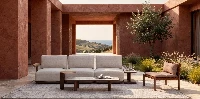
Placing a robust teak wood loveseat patio configuration on private hotel balconies facing the sea provides guests with intimate, panoramic ocean views.
Unlike powder-coated metal seating that develops rust bubbles beneath painted surfaces when salt air penetrates micro-cracks, solid teak remains entirely unaffected by atmospheric salt mist. Over months of sea exposure, the outer wood layer oxidizes gracefully into a soft, silvery-grey patina that seals the underlying timber against further weathering.

4. Material Survival Comparison in Oceanfront Environments
Selecting outdoor materials for beachfront hotels requires balancing longevity, maintenance labor, and corrosion vulnerability:
| 🪵 Material Category | 🌊 Saltwater Rot Resistance | 🧂 Salt Spray Corrosion Risk | ⏱️ Expected Oceanfront Lifespan | 🛠️ Resort Maintenance Overhead |
| Grade-A Teak Heartwood | 🟢 Exceptional (Natural rot repelling oils) | 🟢 Zero corrosion risk | 🟢 30 to 50+ Years | 🟢 Minimal (Rinse with fresh water) |
| Powder-Coated Aluminium | 🟢 Impervious to rot | 🟡 Oxidation & paint bubbling at joints | 🟡 5 to 10 Years | 🟡 Moderate (Touch up powder coating) |
| Stainless Steel Frame (304 Grade) | 🟢 Impervious to rot | 🔴 Severe tea-staining & pitting rust | 🔴 3 to 5 Years | 🔴 High (Frequent passivation polishing) |
| Synthetic PE Wicker | 🟢 Impervious to rot | 🟡 UV brittleness under sea glare | 🔴 2 to 5 Years | 🟡 Moderate (Clean salt crust out of weaves) |
5. 💒 Oceanfront Commercial Applications: Event Venues & Beachside Dining
High-traffic hospitality venues along coastlines require commercial-grade engineering that withstands continuous salt exposure, sand friction, and daily dining spills.
💒 Oceanfront Event Venues: Commercial Teak Sofa for Outdoor Hotel Wedding Ceremony Lounge Settings
Luxury resorts host oceanfront events where furniture sits directly on sandy lawns or beach decks. Specifying a commercial teak sofa for outdoor hotel wedding ceremony lounge areas guarantees that frames can withstand ocean spray, spilled champagne, and constant foot traffic without sagging or staining.
Using heavy-duty frame joinery anchored by internal dowels ensures structural rigidity, while 316 marine grade stainless steel hardware eliminates unsightly rust bleeding onto light wedding upholstery fabrics.
🍽️ Maintenance Protocols: How to Prevent Food Stains on Restaurant Outdoor Teak Dining Tables Alongside Teak Garden Dining Sets
Oceanfront restaurants utilizing teak garden dining sets encounter dual environmental challenges: airborne salt spray from the ocean and greasy food spills from guests.
Understanding how to prevent food stains on restaurant outdoor teak dining tables requires applying a breathable, water-based teak shield or teak protector. These specialized coatings form an invisible oleophobic barrier over the wood grain. This prevents salad oils, red wine, and citrus juices from penetrating the timber pores, allowing waitstaff to wipe tables clean using a simple damp microfiber cloth without stripping the wood's natural salt resistance.

6. Resort Maintenance Schedule for Oceanfront Teak Assets
Establishing clear housekeeping protocols ensures coastal teak assets maintain peak aesthetic appearance without unnecessary chemical treatments:
| 🗓️ Operational Frequency | 🧼 Housekeeping & Maintenance Task | ⏱️ Staff Effort per Unit | 💰 Estimated Annual Material Cost | 🛡️ Protection Result |
| 🌊 Weekly Routine | Rinse frames with low-pressure fresh water to remove salt crusting | 🟢 5 Minutes | 🟢 $0 (Fresh water rinse) | Clears ambient salt deposits; keeps grain clean |
| 🧼 Monthly Cleaning | Wash with soft brush & mild pH-neutral soap; rinse thoroughly | 🟢 15 Minutes | 🟢 Under $5 (Soap solution) | Removes sea airborne grime and surface grease |
| 🛡️ Bi-Annual Sealing | Apply water-based teak shield to dining tabletops | 🟡 30 Minutes | 🟡 $15 – $25 per table | Prevents oil and wine stain absorption in wood pores |
| 🔄 Annual Restoration | Scrub with eco-friendly teak cleaner to restore golden tone (optional) | 🟡 1 Hour | 🟡 $20 – $30 per set | Reverses silver patina if golden honey look is preferred |
⚠️ Coastal Resort Care Warning:
Resort maintenance crews must never use high-pressure power washers on outdoor teak furniture along the beach. High pressure strips away soft earlywood fibers, creating a rough, raised grain texture that traps sand and salt. Always use low-pressure hose water and soft bristle scrub brushes. Furthermore, never apply synthetic organic teak oil in humid marine climates, as unevaporated oil combines with salt mist to create a sticky surface that attracts mold spores.
7. ⚓ Marine Hardware & Manufacturing Standards for Coastal Durability
The long-term performance of wooden outdoor furniture in severe salt air depends equally on precision factory manufacturing and corrosion-proof hardware selection:
316 Marine Grade Stainless Steel: All structural bolts, brackets, and screws must utilize 316 marine grade stainless steel containing molybdenum, which prevents pitting corrosion and tea-staining caused by marine salt spray.
Traditional Mortise and Tenon Joinery: Interlocking wood joints secured with teak dowels allow the furniture frame to flex naturally with marine humidity changes without loosening over time.
Computerized Steam Kiln Drying: Factory timber dried down to eight to twelve percent equilibrium moisture content stabilizes the internal grain before assembly, ensuring frames do not twist or split when exposed to ocean breezes.
Zero Sapwood Tolerance: Premium manufacturing strictly excludes outer sapwood, utilizing 100% Grade-A teak heartwood to ensure maximum concentrations of natural oil and silica.

8. 📜 Compliance Testing & International Marine Certifications
Commercial hospitality buyers sourcing furniture for beachfront resorts should verify compliance with internationally recognized quality and environmental standards:
ASTM B117: Standard Practice for Operating Salt Spray (Fog) Apparatus, verifying that hardware and finished timber surfaces resist accelerated corrosion and salt degradation.
EN 350-2: European standard certifying Class 1 Durability (the highest official rating for natural wood resistance to decay organisms).
ASTM D143: Standard Test Methods for Small Clear Specimens of Timber, testing Janka hardness, shear strength, and structural resilience under environmental stress.
FSC certification: Forest Stewardship Council certification guaranteeing timber is harvested from responsibly managed plantations.
SVLK timber legality: Indonesia's timber legality assurance system verifying ethical, legal wood origins.
ISO 9001: Quality management system standard governing precision factory woodworking, kiln drying accuracy, and hardware inspection.
❓ FAQ:
Q1: Does salt water cause teak wood to rot or erode over time in oceanfront hotels?
No, salt water does not cause genuine teak wood to rot or erode over time. Grade-A teak heartwood contains high concentrations of natural rubber resins (caoutchouc), tectoquinone, and silica, making it naturally hydrophobic and resistant to sodium chloride decay. Ocean salt water actually acts as a mild natural antiseptic against decay fungi, while teak's tight cell structure prevents salt crystal expansion from eroding structural fibers.
Q2: Why do luxury yacht builders use teak decks if sea water is constantly splashing on them?
Yacht builders historically choose teak because it is the ultimate marine-grade timber. Teak does not warp, rot, or become slick when wet with sea water. Its high natural oil content repels liquid brine, while its dense wood fibers provide exceptional non-skid traction and long-term dimensional stability under intense ocean exposure.
Q3: How should beach resort staff clean salt buildup off outdoor teak furniture?
Resort staff should simply rinse teak frames with clean, low-pressure fresh water once a week to wash away accumulated salt crusts. For general dirt or food grease, wash frames with a soft bristle brush and mild pH-neutral soapy water, then rinse thoroughly. Avoid using high-pressure power washers, which can damage natural wood fibers.
Q4: Does ocean salt spray make teak wood turn silvery-grey faster?
Yes, ocean salt spray combined with intense beach sunlight accelerates the natural oxidation of surface lignin, causing teak to develop its classic silver-platinum patina faster than inland installations. This silver surface layer is purely cosmetic and forms a protective outer shield that leaves the internal structural integrity completely unharmed.
Q5: What type of hardware is required for teak furniture used directly on sandy ocean beaches?
Furniture installed on sandy ocean beaches must use 316 marine grade stainless steel fasteners. Standard steel or lower-grade 304 stainless steel will develop pitting rust and tea-staining when exposed to salty air, causing ugly brown rust bleeds across the timber frame.