

Sourcing custom commercial outdoor furniture is not simply a matter of choosing an attractive design and asking a factory to reproduce it. For a hotel, resort, restaurant, or multi-property development, the purchasing decision also affects manufacturing schedules, material consistency, maintenance requirements, and the ability to replace products later.
Working with a custom outdoor furniture manufacturer requires buyers to understand the difference between a visual reference and a production-ready specification. Dimensions, frame construction, surface finishes, fabric selection, fasteners, and packaging all need to be defined before a supplier can provide a meaningful quotation.
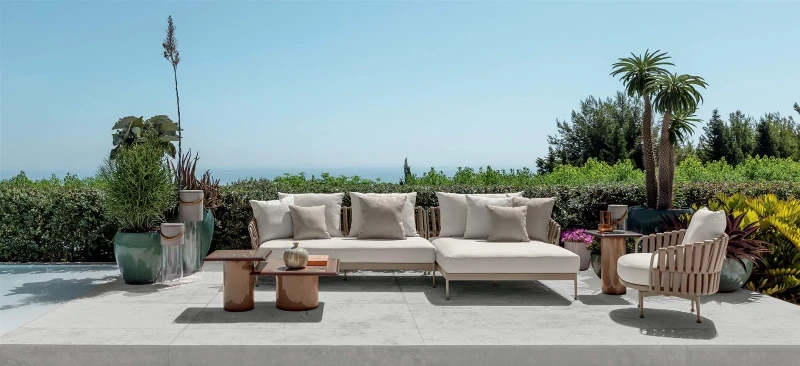
Projects involving contract outdoor furniture introduce another consideration: the products must suit the intended use environment. Furniture installed on a sheltered hotel terrace may face very different conditions from seating beside a swimming pool, on a coastal promenade, or on an exposed rooftop.
The description commercial grade outdoor furniture is useful when discussing product positioning, but it is not a complete technical specification. Buyers should verify which characteristics have been designed or tested for the intended application instead of relying on a broad durability claim.
For hotel developments, hotel FF&E outdoor furniture should be coordinated with the wider furnishing schedule, including approved finishes, delivery sequencing, installation responsibilities, and future replacement requirements. Furniture cannot be evaluated in isolation if a delay could affect an opening date or disrupt other contractors.
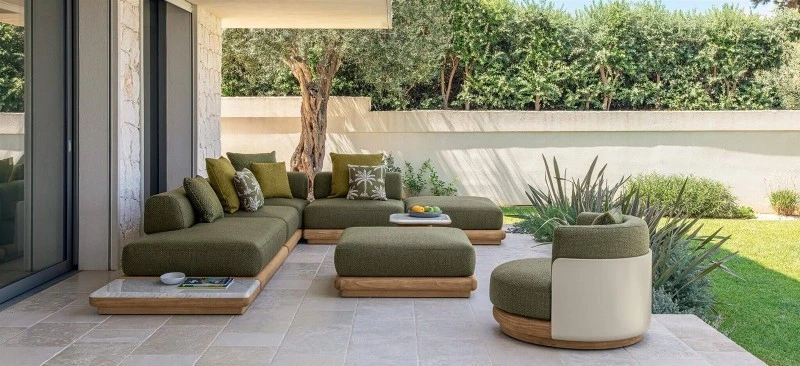
This guide explains how to define your project brief, evaluate minimum order quantities, plan lead times, select materials for demanding environments, establish quality-control requirements, and protect the long-term value of your investment.
The Sourcing Decision at a Glance
🧭 Define the brief: Confirm product quantities, site conditions, dimensions, finish requirements, and customization boundaries.
📦 Control production: Agree on MOQ rules, sample approvals, material availability, manufacturing milestones, and change management.
🔍 Verify the result: Establish inspection criteria, request applicable test evidence, document acceptance, and plan for after-sales support.
The objective is not to make every purchase as complicated as possible. It is to identify the requirements that genuinely matter to the project and control them before production begins.
1. How to Evaluate a Custom Outdoor Furniture Manufacturer
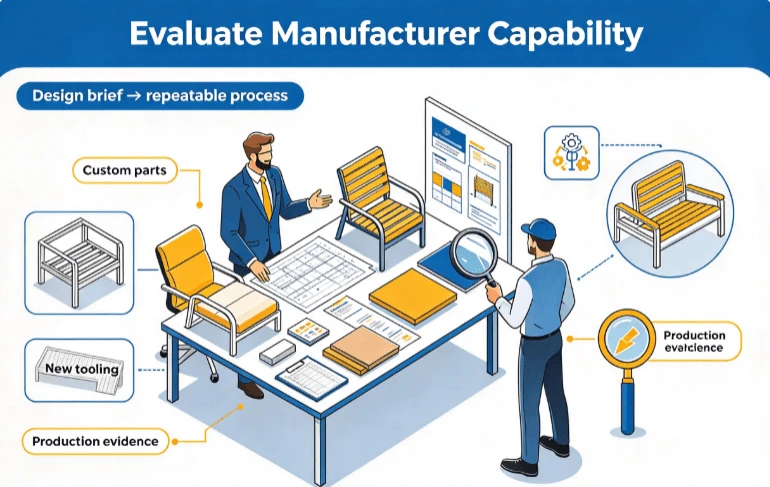
A supplier's catalogue can demonstrate its design range, but it does not necessarily show how well the business manages customized production. Before comparing quotations, evaluate whether the factory can translate a design brief into a repeatable manufacturing process.
Start with manufacturing capability, not just product appearance
Ask which parts of the proposed furniture can be customized using existing components and which require new engineering or tooling.
A manufacturer may be able to change a frame color, upholstery fabric, cushion dimensions, or tabletop finish with relatively little design work. A completely new chair silhouette, revised frame geometry, or bespoke mold may require additional development and testing.
These differences affect more than price. They can influence the minimum order quantity, sample schedule, sourcing risk, and ease of placing repeat orders.
Request examples of the supplier's relevant capabilities, such as:
Existing models that can be adapted to your design.
Production methods available for the requested frame and tabletop materials.
Options for custom upholstery, cushions, weaving, and finishes.
Processes for recording approved samples and technical revisions.
Availability of replacement components and repeat-order specifications.
Quality inspection procedures and documentation for the proposed product category.
The information should relate to the actual order under consideration. A factory may have experience manufacturing aluminum dining chairs, for example, without having demonstrated the same capability for a large upholstered modular sofa.
Assess whether the supplier understands the project environment
Manufacturing capability and site suitability are different questions. A supplier should understand where the furniture will be used, how frequently it will be occupied, and what maintenance resources will be available.
A beachfront resort may prioritize corrosion resistance, cleanable surfaces, and replaceable soft components. A restaurant terrace may require easy movement, consistent table stability, and finishes that can tolerate frequent cleaning. A rooftop lounge may need a separate review of wind exposure, anchoring, and site safety.
Ask the supplier to identify any specification decisions that cannot be finalized without further information about the installation location. A manufacturer that raises these questions early can help prevent expensive changes after production has started.
Verify what each quotation includes
Two quotations can appear comparable while covering different products. One may include standard fabric and basic packaging, while another includes custom upholstery, upgraded hardware, a physical prototype, and a documented inspection process.
Before comparing prices, confirm that each quotation states the same essential requirements: materials, dimensions, finishes, quantity, customization scope, inspection responsibilities, packaging, delivery terms, and warranty conditions.
The lowest figure is not necessarily the lowest-risk purchase. The supplier's ability to explain its assumptions is part of the evaluation.
2. MOQ for Custom Outdoor Furniture: What Buyers Should Know
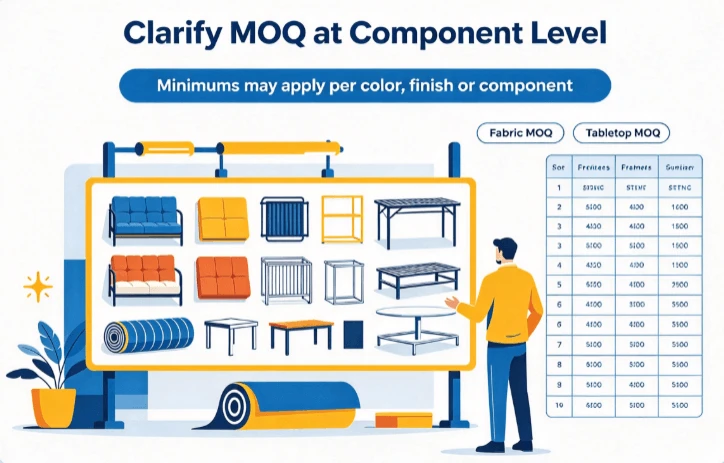
MOQ means minimum order quantity. In commercial furniture manufacturing, the minimum may depend on the model, material, finish, fabric, or custom component. It is not always a single quantity covering the entire purchase order.
A buyer ordering several hundred items may still encounter a separate minimum for a particular fabric color. Similarly, a project with a modest number of dining chairs could require a larger commitment if it introduces a custom frame component or a specially manufactured tabletop.
How customization affects MOQ
| Customization route | Typical production implications | MOQ questions to ask | Main trade-off |
|---|---|---|---|
| Standard model and standard finish | Existing design and established materials simplify planning | Is the model available for repeat production? | Less design flexibility, potentially simpler sourcing |
| Existing model with custom color or fabric | Special material purchases, coating batches, or color approvals may be needed | Does the minimum apply per finish, fabric, or model? | Greater design control with additional coordination |
| Semi-custom furniture | Revised dimensions, components, or configurations may need engineering work | Are development charges, samples, or component minimums required? | A closer fit to the project, with added approval responsibilities |
| Fully bespoke furniture | New tooling, prototypes, or unique construction may be involved | Who owns the tooling, and what are the conditions for repeat production? | Maximum design freedom with greater development and sourcing risk |
The table describes common planning considerations rather than universal factory rules. Every supplier should confirm its own MOQ policy in writing.
Clarify the minimum at component level
Imagine a resort requiring lounge seating in several colors. The factory may accept the overall project quantity but require a separate minimum for each fabric. If the buyer approves several upholstery colors without checking the material purchasing conditions, the order may become more expensive or leave unused fabric inventory.
The same issue can affect powder-coated frames, woven components, custom hardware, and large-format tabletops.
Request a breakdown of the minimum quantities for each relevant variant. Where multiple colors are essential, ask whether the supplier can offer an existing material option with a more flexible order structure.
Do not assume that a production minimum also defines the most economical shipping quantity. Manufacturing, packaging, freight, and warehouse constraints are separate considerations and should be visible in the quotation.
Is a pilot order worth considering?
For a new design or an unfamiliar production process, a pilot order can reveal practical issues before a larger commitment. It may expose assembly difficulties, inconsistent finishes, cushion fit problems, or packaging weaknesses that were not apparent in a rendering.
However, pilot production has its own costs and scheduling requirements. Before approving it, agree on the pilot's specification, inspection criteria, commercial terms, and whether its materials and manufacturing methods will be representative of the main order.
A successful prototype is useful only when the factory can reproduce the approved characteristics consistently at production scale.
Ready to Start Your Commercial Outdoor Project?
Howvin provides full-service custom manufacturing, CAD design support, and strict quality control for luxury hotels and resorts worldwide.
👉 [Request a Custom Quote & Material Samples]
3. How Contract Outdoor Furniture Lead Times Should Be Planned
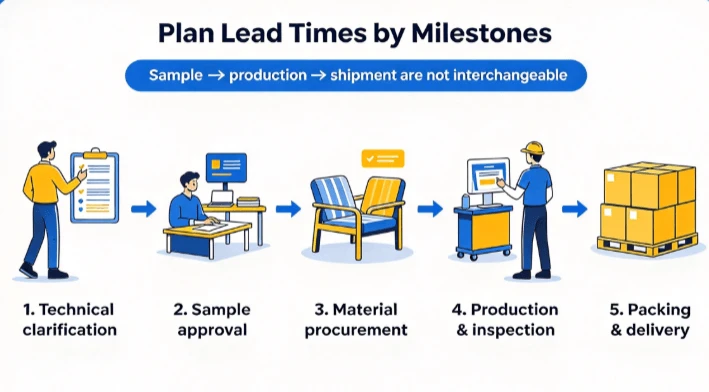
A production estimate is meaningful only when the supplier explains what it covers. Some quotations describe the period required to manufacture goods after approval; others discuss the wider process from sampling through shipment. Buyers should not treat those timelines as interchangeable.
The most reliable planning approach is to divide the order into milestones and identify the evidence required to move from one stage to the next.
Stage 1: Technical clarification
Confirm the drawings, dimensions, materials, upholstery, finishes, hardware, applicable tests, and packaging requirements. Resolve conflicting instructions before the supplier begins custom development.
An unclear specification at this point may lead to revised samples, material waste, or disputes about whether the finished goods match the original request.
Stage 2: Sample development and approval
Review samples for both appearance and construction. Check that the product can be manufactured as specified, that relevant dimensions are correct, and that finishes and materials are suitable for the intended environment.
A sample approval should record the product identification, material references, finish codes, revision status, and any approved deviations. Photographs help document appearance, but they cannot replace physical checks for stability, dimensions, or assembly.
Stage 3: Material procurement
Confirm which materials are in stock, which must be purchased, and which depend on the buyer's final approval.
Special finishes, less common fabrics, and custom components may introduce supply dependencies that do not apply to standard models. Suppliers should identify these dependencies instead of leaving buyers to discover them through unexplained schedule changes.
Stage 4: Production and inspection
The production plan should identify important manufacturing operations, inspection points, and the person responsible for releasing the goods. First-article approval and in-process checks are especially useful when construction or finishing problems would be costly to correct after the whole batch is complete.
Stage 5: Packing, shipping, and site delivery
The supplier should define when the goods are considered ready for dispatch and whether the quoted schedule includes transport to the final destination.
Packaging, export documentation, freight arrangements, customs clearance, unloading access, and site readiness may each affect the delivery plan. A factory completion date should never be presented as a confirmed installation date without accounting for these separate activities.
What causes avoidable lead-time delays?
Several recurring issues deserve attention:
Late design changes. A revised cushion dimension or frame finish can affect material orders and production sequencing. Changes should be reviewed for their impact before implementation.
Unclear approval responsibility. When the factory, designer, owner, and purchasing team all comment on a sample without one designated approver, decisions can stall or conflict.
Unapproved substitutions. Replacing an unavailable material may appear convenient, but it can invalidate the approved sample or create a visible mismatch across the project.
Production-ready assumptions. A supplier may quote on the assumption that all drawings and materials are approved. If they are not, the schedule may need to be revised.
Logistics uncertainty. Port handling, transport arrangements, customs responsibilities, and site access are not controlled solely by the factory.
Ask for a milestone schedule, the assumptions behind it, and an agreed process for notifying the buyer when a milestone is at risk. A useful schedule does not just state dates; it makes dependencies visible.
4. Material Selection for Commercial Grade Outdoor Furniture
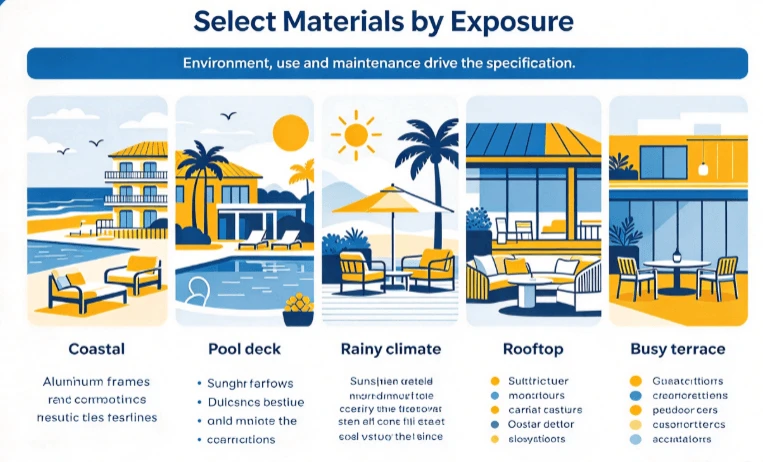
Outdoor exposure affects material performance in different ways. Salt deposits may accelerate corrosion problems, ultraviolet radiation can contribute to fading and polymer degradation, and repeated moisture exposure can affect finishes, joints, and soft furnishings. Cleaning chemicals and frequent movement introduce additional wear in hospitality environments.
Material selection should therefore begin with an exposure assessment.
Compare materials against the installation environment
| Installation environment | Main risks | Material and design considerations | Useful evidence to request |
|---|---|---|---|
| Coastal resort or beachfront property | Salt deposits, humidity, wind-driven moisture | Appropriate metal grades, compatible fasteners, suitable surface protection, and easy-to-clean joints | Coating specifications, relevant corrosion-test reports, and maintenance instructions |
| Sunny pool deck | Strong UV exposure, water, sunscreen, and high surface temperatures | UV-resistant textiles and polymers, suitable cushion construction, and finishes intended for outdoor exposure | Weathering data, colorfastness evidence, and cleaning guidance |
| Rainy or humid climate | Water retention, slow drying, and possible mildew development | Drainage paths, ventilated cushion construction, suitable joints, and accessible maintenance areas | Cushion construction details, drying guidance, and care requirements |
| Rooftop terrace | Wind, rain, direct sun, and exposure to changing conditions | Appropriate stability, secure connections, suitable positioning, and site-specific anchoring where required | Stability assessment, installation guidance, and relevant testing |
| Busy restaurant terrace | Abrasion, impacts, spills, frequent movement, and cleaning | Durable joints, repairable components, easy-clean surfaces, and replaceable wear parts | Inspection criteria, maintenance guidance, and spare-part availability |
No material is maintenance-free under every condition. The right specification reduces foreseeable risks, but it cannot compensate for unsuitable use, incorrect cleaning, or a lack of maintenance.
Aluminum frames and powder-coated finishes
Aluminum alloy is widely used for outdoor furniture because it combines relatively low weight with useful design flexibility. Its resistance to corrosion does not mean the complete frame is immune to surface damage or corrosion problems.
Performance depends on the exact alloy, fabrication quality, surface preparation, coating system, joint design, and environmental exposure.
Powder coating can provide a decorative finish and a protective layer, but the name of the process does not establish the durability of the finished item. Ask the supplier to identify the coating specification, pretreatment process, relevant adhesion and corrosion requirements, and the criteria used to accept the finish.
For coastal furniture, examine the fasteners and contact points as carefully as the visible frame. 316 stainless steel hardware may be appropriate for demanding salt-exposure conditions, depending on the design and maintenance plan, but it should not be treated as a universal guarantee against corrosion.
Where dissimilar metals meet, the design should consider material compatibility, moisture retention, and the protection of contact areas. A frame that looks good in a showroom may behave differently when exposed to persistent salt deposits.
Teak and other timber furniture
Teak is selected for many premium hospitality environments because it offers a distinctive natural appearance and can perform well outdoors when appropriately sourced, designed, and maintained.
Buyers should specify the timber identification, grade, joinery, finish, acceptable natural variation, and relevant sourcing documentation. Timber can change color with sunlight and weather exposure. Some owners prefer its naturally weathered appearance, while others expect a more consistent tone and are prepared to maintain the finish.
Poor drainage or inadequate joint detailing may allow moisture to remain where it is difficult to remove. Changes in moisture conditions can also influence the appearance and dimensions of timber components.
For a large hotel order, it is important to establish acceptable color and grain variation before production. A visual reference and written acceptance criteria help avoid disagreements when the furniture arrives.
A supplier claiming FSC chain-of-custody certification should be able to support the relevant sourcing claim with documentation. The scope of that certification is different from a test of mechanical performance or weather resistance.
Woven furniture, fabrics, and cushions
PE wicker is a common name for synthetic woven furniture material. Its performance depends on the formulation, strand construction, UV stabilization, weaving method, supporting frame, and care routine.
Ask the supplier to identify the material used in the actual model. Two products described as synthetic wicker may have different specifications and different behavior under outdoor exposure.
For upholstered seating, solution-dyed acrylic may be suitable where color retention and outdoor use are important. The finished result still depends on the fabric specification, seam quality, cushion construction, and maintenance conditions.
Quick-dry foam can be part of an outdoor cushion designed to release water and dry more effectively than conventional absorbent cushioning. Its performance depends on the foam, cover, drainage, ventilation, and how the furniture is stored or positioned. No cushion should be assumed to tolerate continuous wetness without care.
These details matter in poolside and resort applications where cushions may be exposed to rain, splashes, sunscreen, and frequent cleaning. Consider whether covers can be removed, replaced, or cleaned according to the operator's routine.
Account for climate, not just material names
A product described as weather-resistant may still be unsuitable for a particular project. Weather exposure varies, and a general label does not specify the test method, acceptance criteria, or expected performance under every condition.
Ask suppliers to explain which test evidence relates to the exact material or component being offered. Where the intended installation presents demanding exposure, make the environmental requirements part of the purchase specification and inspection plan.
5. Quality Control: What to Verify Before Production and Shipment
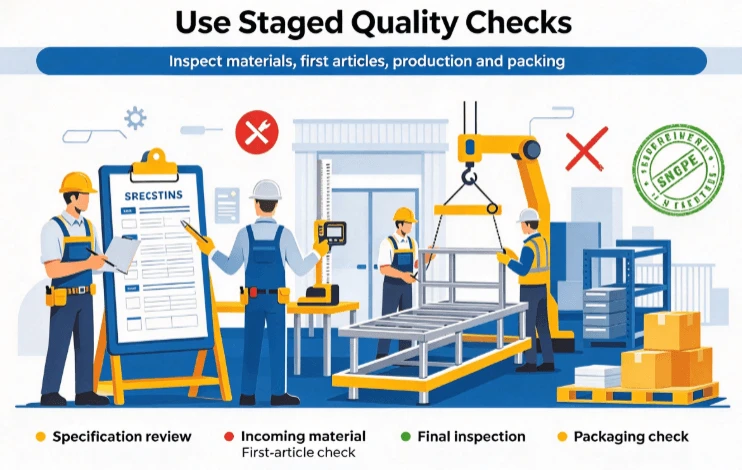
Quality control is most effective when agreed in advance. A final inspection can identify defects, but it may not recover time lost to incorrect material purchases or an unresolved construction problem.
The supplier and buyer should agree on an inspection plan that specifies what will be checked, when it will be checked, who is responsible, and how unacceptable results will be handled.
Use staged quality checks
1. Specification review
Confirm the approved technical drawings, materials, dimensions, finishes, fabrics, hardware, tolerances, and packaging requirements. Make sure all teams are working from the same revision.
2. Incoming material inspection
Check the identity and condition of materials before they enter production. Depending on the product, this may involve timber documentation, metal and hardware specifications, fabric references, color approval, and coating information.
3. First-article inspection
Review the first representative unit or component against the approved requirements. Examine the fit, finish, dimensions, assembly, usability, and any relevant performance characteristics before a large production run proceeds.
4. In-process inspection
Inspect operations where defects could be expensive to correct later. For metal furniture, this may involve frame alignment, weld quality, surface preparation, and coating condition. For upholstered or woven items, the review may cover seam consistency, cushion dimensions, weave tension, and component fit.
5. Final inspection
Check the completed furniture against the agreed criteria. Look for damage, instability, misalignment, inconsistent finishes, incomplete hardware, defects affecting operation, and deviations from the approved specification.
6. Packaging inspection
Confirm that vulnerable surfaces are protected, individual parts are secured, and assembly hardware and product labels are correctly packed. Furniture that passes the factory inspection can still arrive damaged if the packaging does not suit the transport route.
Use an agreed reference sample
A documented golden sample provides a common reference for the buyer and manufacturer. It should be linked to a model, material schedule, finish references, and revision status.
The reference sample helps resolve appearance and construction questions during production. It is especially valuable when an order includes several finishes or when the furniture will be purchased again in the future.
If a change is necessary, document the proposed revision and obtain the required approval before it is implemented. A supplier should not substitute an unapproved fabric, fastener, coating, or structural component simply because the preferred item is temporarily unavailable.
Define acceptance and rejection rules
For larger orders, buyers may consider AQL (Acceptable Quality Limit) sampling as part of an agreed inspection plan. AQL is a sampling approach; it does not mean that every product has been individually inspected or that a shipment is guaranteed to be defect-free.
Before inspection begins, agree on the sampling method, defect categories, acceptance criteria, and actions required if the result is unacceptable. Important functional or safety-related defects should not be treated in the same way as minor cosmetic differences.
Also clarify who pays for reinspection, rework, replacement, and any additional handling when the goods fail the agreed requirements. These responsibilities should be settled before dispatch, not after a disagreement has arisen.
6. Certifications and Test Reports: What They Actually Prove

There is no single certificate that proves every outdoor furniture item is suitable for every application. The relevant requirements depend on the product category, installation environment, destination market, contract specification, and claims being made.
Buyers should distinguish among product safety standards, component tests, material sourcing certification, management-system certification, and distribution packaging tests.
Outdoor furniture safety and mechanical requirements
The EN 581 series covers outdoor seating and tables for camping, domestic, and contract use. Relevant parts address general safety and mechanical requirements for specified seating and table categories. Buyers should establish which parts apply to their actual products and requirements.
Reference: BSI - EN 581 outdoor furniture standards.
In the United States, ASTM International publishes standards for specific product categories. ASTM F1838 addresses performance requirements for adult and children's plastic chairs intended for outdoor use, including aspects of weathering, impact, and structural performance. Its scope excludes chaises, multi-positional chairs, upholstered chairs, and other furniture types, so it should not be presented as a universal standard for sofas, loungers, or daybeds.
Reference: ASTM F1838.
In either case, ask for evidence applicable to the actual model and intended use. A report for a plastic chair does not establish the performance of an upholstered sofa made by the same supplier.
Corrosion testing for metal frames and finishes
ISO 9227 specifies methods for salt spray testing used to evaluate the corrosion resistance of metallic materials and protective coatings.
Reference: ISO 9227 - Corrosion tests in artificial atmospheres.
A salt spray test can provide information about the performance of a specified test specimen under the prescribed laboratory conditions. It should not be treated as a direct prediction of the furniture's outdoor service life or as an automatic ranking of materials for every environment.
Ask for the test method, specimen description, exposure conditions, evaluation criteria, and results. Confirm whether the tested sample represents the coating and component being supplied for the project.
Timber sourcing and traceability
The Forest Stewardship Council (FSC) operates a chain-of-custody certification system for forest-based materials. It can support applicable claims about the sourcing and tracking of certified material through relevant stages of the supply chain.
Reference: FSC - Chain of Custody Certification.
Buyers should verify the certificate holder, scope, validity, product claim, and supporting transaction documents. A timber sourcing certificate does not, on its own, demonstrate mechanical performance or resistance to outdoor exposure.
Factory quality management
ISO 9001 concerns quality management systems. A valid certificate may provide evidence that an organization has a quality management system within the documented scope.
Reference: ISO - Quality management systems.
This is not the same as a product test report. Ask which legal entity and manufacturing site are covered by the certificate, verify its validity, and confirm the relevant certification body's credentials. Product inspection and model-specific performance evidence are still necessary where the purchase specification requires them.
Coating quality and transportation packaging
QUALICOAT operates a quality-label scheme for coatings on aluminum used in architectural applications. Its technical scope needs to be checked carefully before using a coating-related claim for furniture. An architectural coating approval should not automatically be treated as certification of a complete furniture item.
Reference: QUALICOAT - Assured Quality.
The International Safe Transit Association (ISTA) develops packaging performance test procedures for distribution environments. A suitable procedure can help buyers evaluate whether a product and its packaging are prepared for the expected shipping and handling conditions.
Reference: ISTA - Design and Testing.
In practical terms, the buyer should request the documents that match the project's real risks. That may mean structural test reports for a relevant seating category, coating data for metal frames, sourcing documentation for timber, or packaging test records for a vulnerable shipment. More certificates do not automatically mean a more suitable product.
7. Protect Project ROI Through Lifecycle Planning
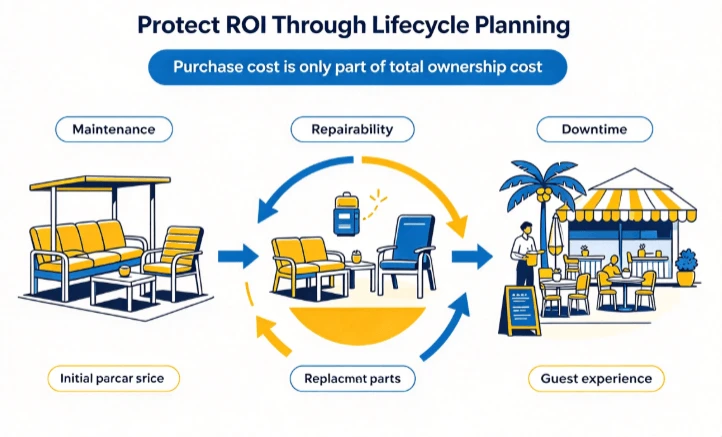
The return on investment from commercial outdoor furniture is influenced by more than the initial purchase price. Furniture affects daily maintenance, replacement planning, presentation, staffing, and the availability of usable seating.
A cheaper product can still be a sensible choice in a sheltered, lightly used location. In an exposed coastal resort or a busy restaurant, however, the same product may impose greater maintenance demands or prove difficult to repair.
The right decision depends on the environment, service expectations, and the owner's operating model.
Compare the ownership implications
| Purchasing decision | Potential short-term advantage | Possible lifecycle concern | Question for the buyer |
|---|---|---|---|
| Lowest initial price | Lower immediate purchasing commitment | Material limitations, repair difficulty, or earlier replacement may reduce long-term value | Does the specification satisfy the actual use and exposure requirements? |
| More durable specified components | Higher upfront investment may be justified by relevant performance evidence | Additional cost may provide little benefit in a sheltered or lightly used setting | Does the upgrade address a demonstrated project risk? |
| Replaceable cushions and wear parts | Repairs may be easier to manage without replacing the complete item | Replacement parts may not remain available or may not match later production | Can the supplier confirm part identification and future availability? |
| Standardized models and finishes | Repeat orders may be easier to coordinate | Limited customization may not meet all design objectives | Can the project use a practical common specification across different areas? |
| Carefully specified custom furniture | Better fit with the design, site, or operational needs | More development work and material coordination can introduce schedule and sourcing risk | Are the benefits substantial enough to justify the additional complexity? |
Maintenance is a real operating cost
Furniture requiring frequent treatment, complicated cleaning, or specialist repair can consume staff time that is needed elsewhere. A product designed with accessible joints, replaceable wear components, and clearly documented care requirements may be easier to manage.
That does not mean the most expensive furniture always has the lowest ownership cost. A premium material can be unnecessary where exposure is low, while an apparently economical choice may create avoidable work under demanding conditions.
Ask the supplier to explain the maintenance routine and which parts are expected to require periodic attention. Build the information into the property's operating procedures rather than leaving it with the purchasing team.
Repairability and replacement availability matter
For larger hospitality projects, the purchase order should identify models and components clearly enough for later replacement. Record approved fabric references, finish specifications, product codes, and relevant revisions.
Confirm whether the supplier expects to keep replacement feet, cushion covers, hardware, or other serviceable components available, and whether repeat orders will require new setup work or material minimums.
A replacement purchased later may not be identical to the original if materials or finishes have changed. Written specifications and retained reference information reduce this risk, although they cannot guarantee that every material will remain available indefinitely.
Consider downtime and guest experience
When furniture is damaged or unavailable, the consequences may extend beyond the repair bill. A hotel could lose usable poolside seating, a restaurant may need to rearrange tables, or a resort may have to remove furniture from an area while waiting for replacement components.
Reliable specifications, sensible material choices, adequate inspection, and protective packaging help reduce these operational risks. Their value is particularly important where a disruption would affect guest experience or interfere with a planned opening.
A sound investment decision connects each upgraded feature to a real need. If better corrosion protection is selected, explain the exposure it addresses. If removable cushion covers are specified, connect that choice to the cleaning routine. If spare parts are included, establish how they will be identified and reordered.
This turns the purchase from a general promise of quality into a decision the owner can justify and manage.
8. Prepare an RFQ That Makes Supplier Quotes Comparable
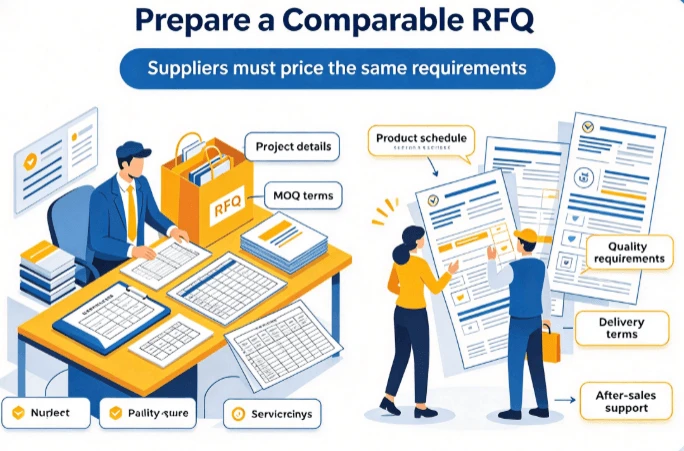
A request for quotation (RFQ) should give shortlisted suppliers enough detail to price the same product and the same responsibilities.
A practical RFQ package includes:
Project details: Property type, installation locations, destination, intended use, quantities, and required delivery milestones.
Product schedule: Model or reference code, dimensions, drawings, configuration, materials, finishes, fabrics, and approved alternatives.
Customization scope: Which components must be custom-made and which may use standard factory options.
MOQ and development terms: Minimum quantities for each relevant variant, sample costs, tooling charges, and any conditions for repeat orders.
Quality requirements: Reference sample, inspection points, acceptance criteria, relevant test reports, required documentation, and defect-resolution responsibilities.
Delivery and packing: Packaging expectations, shipping arrangements, agreed delivery terms, unloading constraints, and installation responsibilities.
After-sales support: Warranty scope, maintenance guidance, spare-part availability, and the procedure for reporting defects.
The RFQ should also state what is still undecided. Asking a supplier to price a provisional concept is reasonable, but the quotation should distinguish its assumptions from confirmed specifications.
Once quotations arrive, review the differences line by line. A supplier may appear cheaper because its offer excludes a custom fabric, a required inspection, or protective packaging. Resolve those differences before making the purchasing decision.
9. What to Require From a Custom Resort Outdoor Furniture Factory
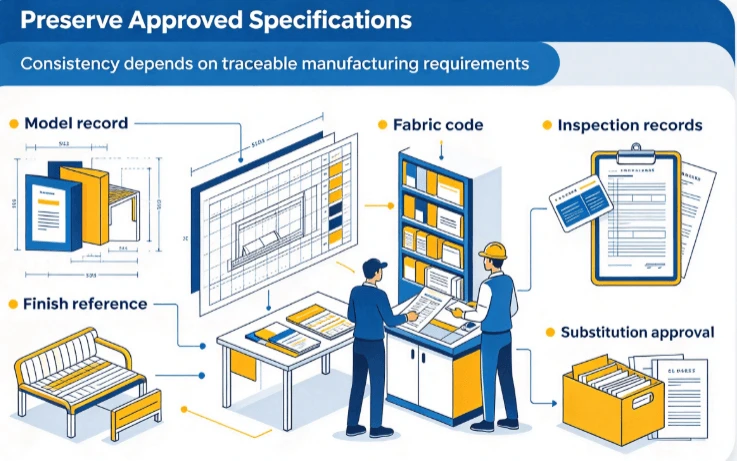
A project involving multiple outdoor areas often requires more than a good initial production run. The furniture may need to be repeated for future guest rooms, an expanded pool deck, a new restaurant, or another property within the same group.
Buyers should therefore establish how the supplier will preserve the approved specification.
Request a record identifying the model, dimensions, frame material, finish, fabric, cushion construction, relevant hardware, and any agreed tolerances. Keep the final approved drawings and sample records with the purchase documentation.
Ask how the supplier manages discontinued materials, production changes, and substitutions. If a component becomes unavailable, the supplier should identify the difference and seek approval before using an alternative that could affect appearance, function, or performance.
For multi-phase developments, it may be useful to standardize shared components where doing so meets the design requirements. That can simplify maintenance and improve consistency, while still allowing distinctive finishes or configurations in areas where they have a clear design purpose.
The supplier should also identify which documents will accompany the shipment and who will receive them. Inspection records, packing lists, product identification, maintenance instructions, and applicable test documentation are easier to verify when their delivery is part of the agreed order process.
Consistency is not achieved merely by repeating a product name. It requires the original manufacturing requirements to remain traceable.
10. Final Checklist Before Confirming the Order
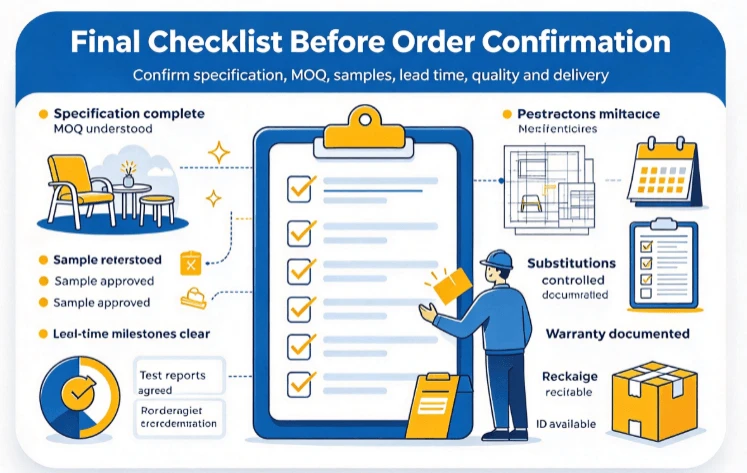
Before releasing the purchase order, make sure the team has resolved the following questions:
Is the technical specification complete enough for manufacturing?
Are MOQ rules understood for every relevant model, material, and finish?
Has the design sample been approved and recorded?
Are lead-time milestones and approval dependencies documented?
Does the material specification reflect the actual installation environment?
Have the necessary inspection criteria and test reports been agreed?
Are substitutions subject to written approval?
Are packaging, shipping responsibilities, and destination requirements clear?
Are warranty, maintenance, and replacement terms documented?
Can the same specification be identified if another order is required later?
Not every project requires the same level of complexity. A small purchase of a standard product may need a relatively straightforward process, while a multi-property development with custom finishes and staged delivery requires more formal controls.
The goal is to apply the right level of discipline to the actual project risk.
For Howvin buyers and other hospitality procurement teams, the strongest purchasing process is one in which design intent, production requirements, evidence, and delivery responsibilities are agreed before they become expensive problems.
When preparing your next project inquiry, share the product schedule, intended installation environment, customization needs, quantity by model, and target delivery window. These details provide a more useful starting point for discussing feasibility and quotation scope.
FAQ:
1. What determines the MOQ for custom outdoor furniture?
MOQ depends on the model, production setup, raw material availability, customization level, and minimum purchasing requirements for fabrics, coatings, or special components. Ask whether each minimum applies to the whole order or to individual models and material variations.
2. How should buyers estimate the lead time for custom outdoor furniture?
Request a milestone schedule covering technical clarification, sampling, material procurement, production, inspection, packing, and delivery. Confirm when the production clock begins, which approvals are still outstanding, and whether the quoted period includes transport to the project destination.
3. What should be included in a custom furniture RFQ?
Provide drawings, dimensions, quantities by model, material and finish requirements, upholstery details, installation conditions, required documentation, inspection expectations, packaging needs, delivery destination, and schedule constraints. Ask every shortlisted supplier to quote against the same scope.
4. How can a buyer verify quality before shipment?
Agree on a documented reference sample, measurable acceptance criteria, inspection stages, and defect classifications before production. Depending on the product, verification may include incoming material checks, first-article inspection, in-process checks, final inspection, and packaging assessment.
5. Which standards and certificates are relevant to commercial outdoor furniture?
The applicable evidence depends on the product and destination market. Relevant documents may include an applicable EN 581 or ASTM product test report, corrosion testing for a specified finish, timber traceability documents, a valid ISO 9001 certificate, or appropriate packaging test records. Confirm what each document covers rather than treating any certificate as universal proof of product quality.
6. How can hotel and resort buyers protect furniture ROI?
Choose materials and construction for the actual environment, agree on inspection criteria, clarify maintenance needs, and evaluate replacement support alongside the purchase price. A higher initial investment may be justified when it addresses a demonstrated operational risk, but upgrades should be supported by relevant specifications and evidence.
Planning Outdoor Projects?
Contact Our Engineering Team for Custom 3D Layouts & Project Quotations.