

For hotels, resorts, restaurants, and event venues, furniture must withstand repeated use without making everyday operations unnecessarily difficult. Commercial chair weight capacity is an important purchasing consideration, but it should never be evaluated separately from product weight, structural design, storage requirements, and the way employees handle each chair.
A chair that looks exceptionally sturdy may be awkward to move across a large terrace. A lighter model may be easier to carry but lack the documented load performance or stability required by the venue. The challenge is to specify seating that performs reliably under its intended use while remaining practical for the people responsible for daily setup.

When comparing lightweight commercial patio chairs, procurement teams should look beyond catalogue photographs and advertised capacities. They need to understand how the frame is constructed, how the chair behaves during repeated handling, and whether its materials suit the local environment.
The same principle applies to mobile commercial outdoor furniture used in changing hospitality layouts. Furniture that works well in a sheltered restaurant may require a different mobility solution on an exposed rooftop or a wet pool deck.
For venues that reset their layouts throughout the day, stackable commercial outdoor seating can simplify storage and handling. In other settings, purpose-designed transport equipment or a more manageable chair geometry may produce a better operational result.
The objective is not to choose the lightest chair available. It is to find the right balance between documented strength, controllable movement, weather resistance, and long-term operating value.
1. What Does a 300+ lbs Commercial Chair Weight Capacity Actually Mean?
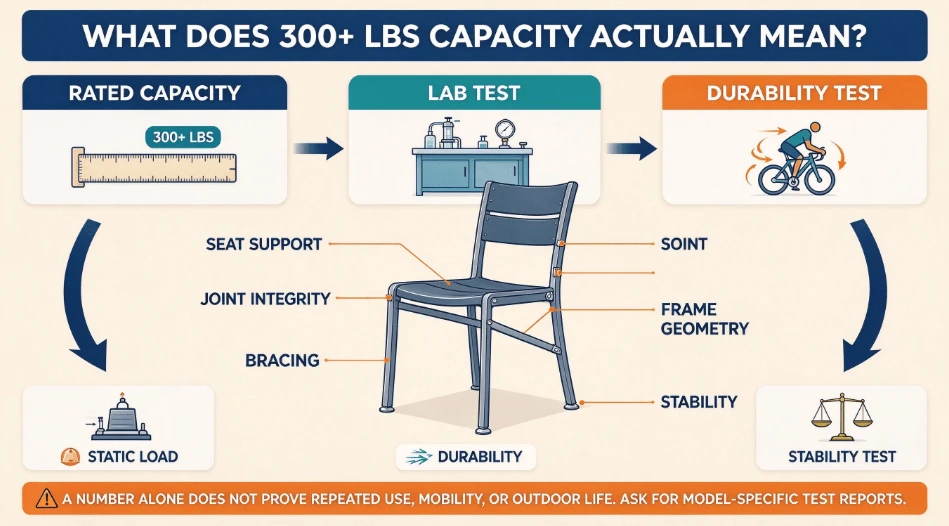
A stated capacity is useful only when the buyer understands what it represents. A manufacturer's claimed occupant capacity, the load applied during a laboratory test, and the performance demonstrated by a durability assessment are different pieces of information.
Distinguish rated capacity from tested performance
A product specification should identify the intended user load and any applicable use conditions. A test report should explain what was tested, how the load was applied, which model was assessed, and what the results demonstrate.
The figure "300+ lbs" should not automatically be interpreted as proof that a chair can tolerate every kind of repeated loading, impact, misuse, or outdoor exposure. Nor does the number establish how easy the chair will be for staff to handle.
For a hotel or restaurant project, ask the supplier to provide model-specific documentation supporting the stated capacity. If the same chair is offered with different frames, joints, seat materials, or configurations, confirm that the evidence covers the version being purchased.
Evaluate the entire load-bearing structure
A chair supports its user through a connected structural system. The seat, frame rails, legs, braces, fasteners, and joints must work together. A strong-looking frame cannot compensate for a poorly designed connection.
Pay particular attention to:
Frame geometry: whether the structure transfers loads through its intended support points.
Joint integrity: whether welds, screws, bolts, and other connections are suitable for the design.
Seat support: whether the seat panel and its attachment points distribute the intended load appropriately.
Stability: whether the chair remains stable under relevant sitting, standing, and normal movement conditions.
Repeated-use durability: whether the structure maintains its intended function after the applicable cycling or fatigue assessment.
A reinforced frame does not have to be unnecessarily heavy. Carefully placed cross-members, appropriate connection design, and sensible material selection may offer a better balance than adding material indiscriminately.
Understand the different kinds of testing
A static load test evaluates a product under a specified load and test configuration. A dynamic strength or durability test examines how a product responds to repeated or moving loads under a defined procedure. Stability testing addresses a different set of risks.
These tests complement one another; they are not interchangeable. Passing a single test does not establish that a chair has passed every test relevant to its intended application.
Before ordering, request the applicable test method, report scope, tested product identification, and stated limitations. If a report covers an indoor seating model, do not assume it automatically verifies a differently constructed outdoor version.
2. Staff Mobility During Daily Setup: Choose a Handling System, Not Just a Chair
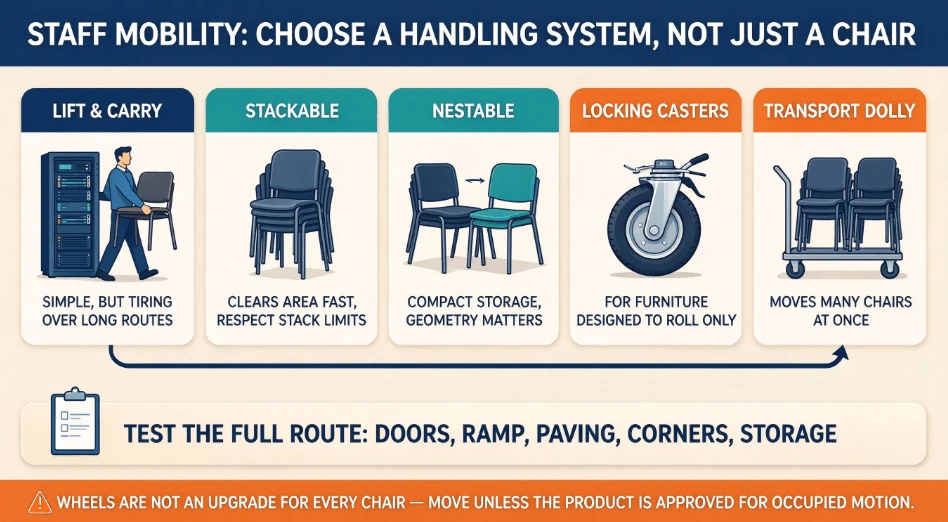
The right mobility solution depends on the venue's layout, staff routine, and ground conditions. A small café that moves a few chairs between service periods has different operational needs from a resort that rearranges an entire pool terrace.
Compare the main handling options
| Handling method | Advantages | Limitations | Potential applications |
|---|---|---|---|
| Lift and carry | Simple product construction; no moving hardware | Repeated handling can be tiring, especially over long routes | Compact dining chairs and short-distance moves |
| Stackable design | Helps clear service areas and consolidate storage | Stack height, weight, and stability limits must be respected | Restaurants, cafés, and multipurpose terraces |
| Nestable design | Can make storage more compact when frames are compatible | Not every chair geometry can nest efficiently | Selected hospitality and event spaces |
| Product-specific casters | Can reduce effort for furniture designed to roll | Require suitable surfaces, inspection, and control | Designated mobile furniture |
| Dedicated transport dolly | Can move multiple compatible items together | Requires storage space and an appropriate route | Banquet seating and large furniture fleets |
The best choice is not necessarily the one that makes movement feel easiest during a short showroom demonstration. It must remain controllable on the actual route and work with the site's storage arrangements.
When should outdoor furniture have locking casters?
Lockable casters can be useful for furniture that is specifically designed to roll, but they are not an automatic upgrade for every outdoor dining chair.
Casters introduce additional parts that may collect grit, wear, or become difficult to operate. Wheels that function well on smooth indoor floors may struggle on textured paving, timber decking, grout joints, or drainage transitions.
Check the intended wheel surface, the manufacturer's stated load limits, brake operation, and access for cleaning and replacement. The capacity of the caster assembly should be appropriate for the assembled product and its intended handling conditions.
Unless a product is expressly designed and approved for movement while occupied, move it unoccupied. Do not assume a chair is safe to roll with a user sitting in it simply because it has wheels.
When are transport carts a better investment?
Commercial furniture transport carts may be a more effective solution when the venue needs to move multiple compatible chairs regularly.
A correctly specified cart can reduce individual trips and help establish a more consistent handling process. However, the purchasing decision should include the cart's capacity, compatible chair dimensions, wheel suitability, braking or restraint arrangements, and storage footprint.
The route also matters. Narrow doorways, ramps, uneven paving, tight corners, and busy service passages may limit the usefulness of a cart that performs well on a clear, level floor.
For hotel and event teams, conduct a practical handling trial before committing to a complete furniture fleet. Ask employees to move the selected chair through the real route, set up the area, clean the product, and return it to storage. Observe the whole workflow rather than testing lifting effort alone.
3. Outdoor Furniture Materials: Balancing Frame Strength, Weight, and Weather Exposure

Material selection affects frame construction, mobility, corrosion behavior, maintenance, and appearance. Nevertheless, a material name does not establish an individual chair's occupant capacity or expected service life.
Compare common materials for commercial use
| Material | Potential advantages | Environmental considerations | What buyers should verify |
|---|---|---|---|
| Aluminum alloy | Can offer a favorable balance of structural design and manageable weight | Coating damage, joint construction, and contact with dissimilar metals can matter | Frame specifications, joints, finish, and model-specific test evidence |
| Stainless steel | Useful when a robust metal structure is required | Performance depends on grade, exposure, surface condition, and maintenance | Actual grade, hardware specification, and compatibility with other metals |
| Teak | Natural appearance for premium hospitality settings | Weathering, moisture cycles, and maintenance affect appearance | Construction details, sourcing documentation, drainage, and care instructions |
| High-density polyethylene (HDPE) | Suitable for selected outdoor seating designs | Heat, UV exposure, formulation, and structural geometry affect performance | Product-specific load evidence, outdoor suitability, and cleaning guidance |
| Woven outdoor rope | Offers flexibility in appearance and seating design | UV exposure, dirt, moisture retention, and damage to individual strands require attention | Fiber specification, attachment details, outdoor performance evidence, and repair options |
Aluminum frames and surface protection
Aluminum is often worth considering for dining chairs that employees move frequently. However, a lightweight frame still needs appropriate structural design and reliable joints.
A powder-coated finish can help protect a compatible metal substrate and create a consistent surface. Its performance depends on the complete coating system, preparation, application quality, handling, and maintenance.
A damaged finish should not be ignored merely because the underlying material is commonly described as corrosion resistant. Buyers should understand how scratches, exposed edges, fasteners, and dissimilar-metal contact are addressed in the proposed design.
Stainless steel, hardware, and corrosion control
Stainless steel is not a single uniform material grade. Its suitability depends on the selected alloy, the environment, surface condition, and the way it interacts with surrounding materials.
For coastal and poolside projects, obtain the actual hardware and material specifications rather than relying on generic descriptions such as "rustproof." Cleaning procedures and the treatment of damaged components also matter.
Teak, rope, and replaceable components
Wooden seating can complement resort terraces and villa environments, but natural weathering should be considered alongside maintenance expectations. Buyers should also establish how wood components are sourced and whether replacement parts can be obtained.
For woven seating, assess not only the initial appearance but also the rope attachment system, wear points, drainage, cleaning access, and availability of replacement components. A design that allows practical inspection and repair may be more manageable over the course of a project.
How the local environment changes your specification
Outdoor furniture experiences more than repeated user loads. Weather and surface conditions can gradually affect materials, connections, and staff handling.
Coastal locations: Salt carried by wind may settle on exposed metal, fasteners, and joints. Scratches and damaged coatings can create vulnerable areas, while incompatible metal combinations can contribute to corrosion. Specify suitable materials and maintenance procedures for the actual exposure.
Humid and rainy environments: Moisture may collect around joints, hollow sections, woven materials, and poorly drained connections. Product details should allow appropriate drainage, cleaning, inspection, and drying.
High-UV environments: Strong sunlight may affect textile color, polymer components, and some exposed finishes. Where cushions are specified, assess appropriate outdoor fabrics, including solution-dyed acrylic, according to their documented performance and care requirements.
Poolside environments: Chlorinated splash water, sunscreen, cleaning chemicals, and frequent rinsing create additional maintenance demands. Consider the entire product, including frame finish, fasteners, feet, rope, cushions, and care instructions.
Temperature changes: Repeated expansion and contraction can place demands on joints and connections. If the site experiences large daily temperature changes, review the construction and maintenance requirements for that specific application.
Wind-exposed areas: Furniture must remain appropriately positioned and controlled under the site's operating conditions. A lighter chair should not be assumed to be safer or more suitable where wind exposure, movement, and storage requirements create additional risks.
The useful procurement question is not simply whether a material is suitable for outdoor use. It is whether the complete product has been specified, tested, maintained, and approved for the intended environment.
4. Testing Standards and Certification: What Should a Commercial Buyer Verify?

Product performance claims, independent testing, management-system certification, and responsible-material sourcing address different questions. A manufacturer may be able to provide one type of evidence without possessing every other type.
The following distinctions help procurement teams ask for the right documents.
| Organization or reference | Relevant role | Important limitation |
|---|---|---|
| ANSI/BIFMA | Provides furniture standards for specific product categories and intended uses | A particular standard must match the product; it is not a universal outdoor chair certificate |
| ASTM International | Publishes test methods and practices, including corrosion-related testing | A test result does not automatically guarantee real-world service life |
| SGS | Provides furniture testing and related assessment services | The service provider's name alone does not prove that a specific product passed a particular test |
| Intertek | Offers product testing and performance verification programs for applicable furniture claims | Verification applies to defined claims and the relevant tested product; scope must be checked |
| ISO 9001 | Addresses an organization's quality management system | It does not independently establish a particular chair's weight capacity |
| Forest Stewardship Council (FSC) | Provides certification systems supporting eligible forest-material sourcing and supply-chain claims | It does not certify furniture structural strength or weather resistance |
Which seating standard should apply?
Start with the product category and the intended market. The ANSI/BIFMA standards cover specific types of furniture rather than every possible seating application.
For example, the published scope of X5.4 concerns public and lounge seating typically found in indoor public spaces. It should not automatically be presented as the applicable standard for every outdoor dining chair or poolside lounger. The correct standard depends on the furniture type, applicable requirements, and intended use. See the BIFMA standards information.
What can a salt-spray test tell you?
ASTM B117 describes a controlled salt-spray exposure practice used to obtain relative corrosion-resistance information for metal and coated-metal specimens.
Its results should be interpreted within the scope of the test. ASTM explains that salt-spray results used alone have seldom correlated reliably with performance in natural environments. Consequently, a statement about passing a salt-spray test should not be converted into an unsupported guarantee of outdoor lifespan.
Read the ASTM B117 standard description to understand the purpose and limitations of this test method.
What can independent laboratories verify?
Organizations such as SGS provide testing services for relevant indoor and outdoor furniture products, including mechanical performance, durability, finishes, and materials.
Intertek's furniture performance program offers verification of defined performance claims within its program scope. Buyers should establish exactly which product and functional claim have been assessed instead of assuming that the presence of a testing organization's name on a supplier document proves every possible product attribute.
Independent testing is most useful when the report identifies the product, method, test conditions, results, and relevant limitations. Ask the supplier to connect the evidence to the actual model and configuration in the quotation.
Quality management and responsible sourcing are different
ISO 9001 is a quality management system standard. A relevant certificate can help buyers understand an organization's certified management-system scope, but it is not a substitute for product-specific structural evidence.
For wood-based materials, the Forest Stewardship Council (FSC) Chain of Custody system supports eligible sourcing and traceability claims along the supply chain. Check the relevant certificate scope and product claim instead of assuming that any supplier-level certification automatically applies to every furniture item.
Useful resources include the ISO quality management overview and FSC Chain of Custody information.
Before purchasing, request the load-capacity specification, relevant test reports, material and finish details, maintenance instructions, warranty terms, and any sourcing documents required by the project. Verify that the paperwork covers the selected model rather than another product in the same collection.
5. How to Improve Staff Mobility Without Compromising Safety

The most effective mobility improvement often comes from coordinating the furniture, handling equipment, storage location, and staff routine.
For restaurant terraces, appropriately stackable chairs and clear storage routes can make setup easier. For event spaces, a compatible transport cart may be more practical than fitting wheels to every chair. For resort pool decks, the chosen handling method must also suit the surface, moisture exposure, and cleaning routine.
Rapid-reset outdoor dining furniture should be evaluated through real tasks rather than marketing descriptions.
During a trial, observe the following:
✅ Can employees grip, lift, or move the item without awkward handling?
✅ Does it pass through the actual doors, passages, and service routes?
✅ Can it be positioned around tables without repeated adjustments?
✅ Can employees stack or store it within the manufacturer's instructions?
✅ Does the handling system remain controllable across the site's surfaces?
✅ Can staff clean and inspect moving parts, glides, joints, and exposed finishes?
✅ Is the product easy to return to its designated storage position?
Where several furniture styles are used, standardizing compatible models and handling equipment may reduce confusion. However, standardization should not force the same chair or mobility solution into every environment if the operating conditions differ.
Employee feedback is particularly valuable. A brief showroom inspection may reveal whether a chair feels solid, but a real setup trial can show whether its handles, balance, nesting arrangement, and transport method work during normal service.
6. The ROI Perspective: Measure More Than the Purchase Price
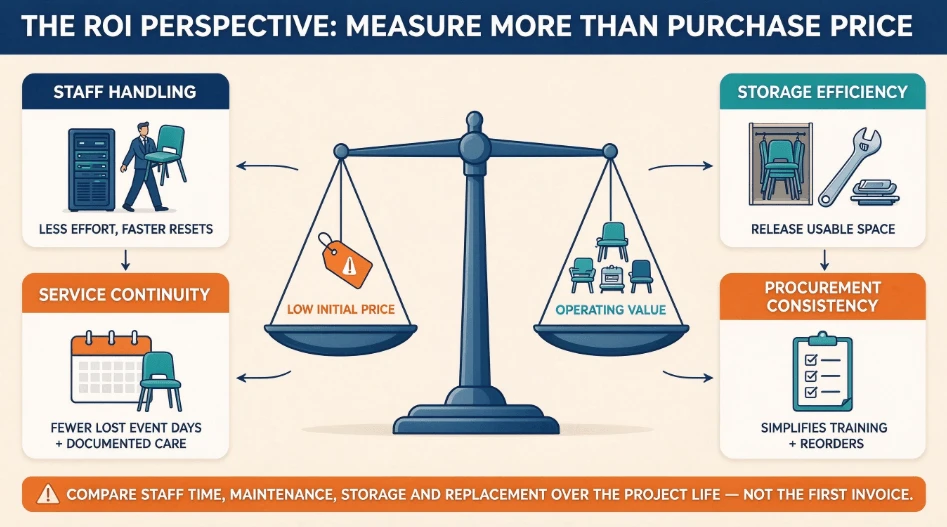
For commercial furniture buyers, long-term value depends on the complete operating experience. A product with a lower initial price may require more handling effort, maintenance, storage space, or replacement work. A more expensive option does not automatically produce better value either; the difference needs to be evaluated in the context of the project.
Where better design can create operating value
Staff handling: Furniture that is easier to grip, carry, stack, or transport may help simplify repeated setup tasks. The benefit depends on how frequently the site resets its layout and how far the furniture must travel.
Storage efficiency: A compatible stackable or nestable design can help release usable space. Buyers should evaluate the actual stored arrangement, including access, stack limits, and the route needed to return items to storage.
Maintenance planning: Replaceable glides, accessible hardware, documented finish care, and available spare parts may make routine maintenance easier. The value depends on whether those parts can actually be obtained and serviced when needed.
Service continuity: Reliable furniture and a clear maintenance process can reduce the disruption associated with damaged or unavailable seating. A backup plan may be especially valuable in venues with frequent events or intensive seasonal use.
Procurement consistency: Standardized specifications across suitable areas can simplify staff training, inventory control, and future purchasing. Different environmental conditions may still justify separate specifications.
How to assess ROI in a real project
Start by selecting representative furniture and testing it in the intended environment. Observe the setup routine, employee handling, storage procedure, cleaning process, and the product's interaction with the ground surface.
Record operational observations over a meaningful trial period. These may include setup difficulties, staff feedback, maintenance requests, finish damage, replacement-part needs, storage issues, and interruptions caused by unavailable furniture.
Then compare the observations with the supplier's stated specifications, after-sales support, and expected maintenance requirements. Where staff time is a major concern, review the actual task duration and handling frequency from the venue's own records.
Do not assume a universal reduction in labor cost or a guaranteed service life. Such outcomes depend on the site, staffing, product design, maintenance quality, and use intensity. A documented comparison of the shortlisted products provides a more credible basis for procurement than unsupported savings claims.
7. Commercial Outdoor Seating Buying Checklist
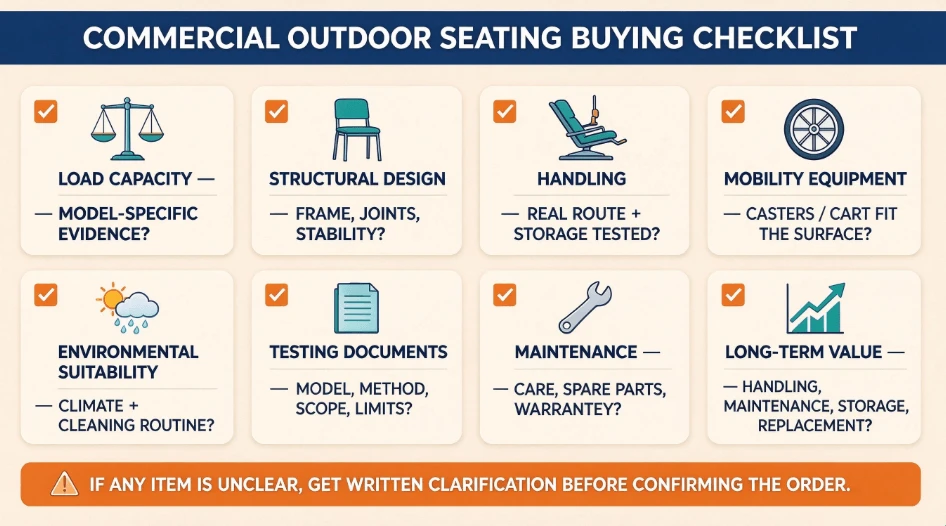
Before approving a bulk purchase for a hotel, resort, restaurant, or event venue, use this checklist:
✅ Load capacity: Is the stated occupant capacity supported by suitable model-specific evidence?
✅ Structural design: Have the frame, joints, seat support, and stability been assessed for the intended application?
✅ Handling: Can staff move, position, and store the product along the actual route?
✅ Mobility equipment: Are the selected casters, glides, or transport carts appropriate for the ground conditions?
✅ Environmental suitability: Are the materials, finishes, and hardware appropriate for the site's climate and cleaning routine?
✅ Testing documents: Do the reports identify the tested model, procedure, scope, and limitations?
✅ Maintenance: Are care instructions, spare parts, and warranty arrangements clearly documented?
✅ Long-term value: Has the team considered handling, maintenance, storage, and replacement alongside the purchase price?
If a requirement remains unclear, request written clarification before confirming the order. This is particularly important when a project contains different seating categories or includes both sheltered and exposed outdoor areas.
Frequently Asked Questions
1. Does a 300+ lbs rating guarantee that a chair is suitable for commercial hospitality use?
No. It is a capacity claim that must be interpreted alongside the intended use, product design, applicable test evidence, and relevant limitations. Buyers should confirm that the documentation covers the exact model being considered.
2. Are lighter commercial outdoor chairs always easier for staff to move?
No. Weight is only one factor. Grip, balance, frame geometry, stacking behavior, storage access, and ground conditions all affect handling. A suitable transport cart or more practical storage design may be more useful than choosing the lightest chair.
3. Should commercial outdoor dining chairs have casters?
Only when the chair is designed for that purpose and the wheels suit the venue's surface and operating conditions. Conventional dining chairs may be easier to manage through stacking, nesting, or compatible transport carts. Casters also require inspection and maintenance.
4. Which materials should buyers consider for coastal hotel projects?
Consider the complete product construction rather than choosing by material name alone. Assess the metal grade, coatings, hardware, joints, wood maintenance, exposed fasteners, and local cleaning routine. Relevant testing and documented care requirements should support the specification.
5. Which tests and certificates should a commercial furniture supplier provide?
Start with documents supporting the load-capacity claim and relevant structural performance. Depending on the project, buyers may also need evidence for corrosion, finish durability, material sourcing, and quality management. Each document should be checked against the relevant product, requirement, and scope.
6. How can hotels reduce setup effort without compromising furniture safety?
Map the handling route, test representative products with staff, review stacking or nesting options, and assess compatible transport equipment. Provide clear operating instructions and ensure the furniture and handling system are used within their stated limitations.
Final Takeaway: Specify for Strength, Handling, and Long-Term Value
Balancing heavy-duty seating with staff mobility is not about choosing the heaviest frame or the lightest chair. It is about matching verified structural performance to the intended use, then making the furniture manageable to move, store, inspect, and maintain.
For commercial projects, the best decision comes from combining reliable product documentation with a practical handling trial and a realistic assessment of long-term operational needs.
Howvin works with commercial outdoor furniture project requirements. When reviewing options for a hotel, restaurant, resort, or event venue, share the intended application, seating needs, ground conditions, handling routine, and documentation requirements with your supplier. These details provide a sound starting point for discussing a suitable specification without relying on appearance or unsupported capacity claims.