

Outdoor dining furniture is expected to handle rain, splashes, changing temperatures, and daily cleaning. Yet some products still hold puddles long after a shower has passed. The problem is not always the material itself. Surface geometry, hidden joints, seat tension, and the route water takes through the frame can be equally important.
For hospitality buyers, drainage is a practical specification issue. Furniture on a hotel terrace or restaurant patio must dry predictably without sacrificing tabletop stability, seating comfort, appearance, or ease of maintenance.
An aluminum outdoor dining table can offer a durable, relatively low-maintenance construction, but its performance depends on the top profile, edge detailing, coating, fasteners, and frame design-not merely the metal.
A teak outdoor dining table needs a different review. Board spacing, end-grain exposure, natural wood movement, and the way the tabletop is supported can affect how rainwater leaves the surface and how the product behaves through repeated wet and dry periods.

The same principle applies to seating. An outdoor rope dining chair may allow water to pass through its open construction, but closely spaced strands or a poorly ventilated support can retain moisture and debris.
A woven outdoor dining chair also needs to be evaluated as a complete assembly. Weave density, seat shape, support panels, cushion construction, and access for cleaning all affect how quickly moisture can escape.
The goal is not to make outdoor furniture impervious to rain. It is to design furniture that sheds water efficiently, avoids unnecessary water traps, and remains suitable for the conditions in which it will actually be used.
1. How Tabletop Geometry Prevents Standing Water
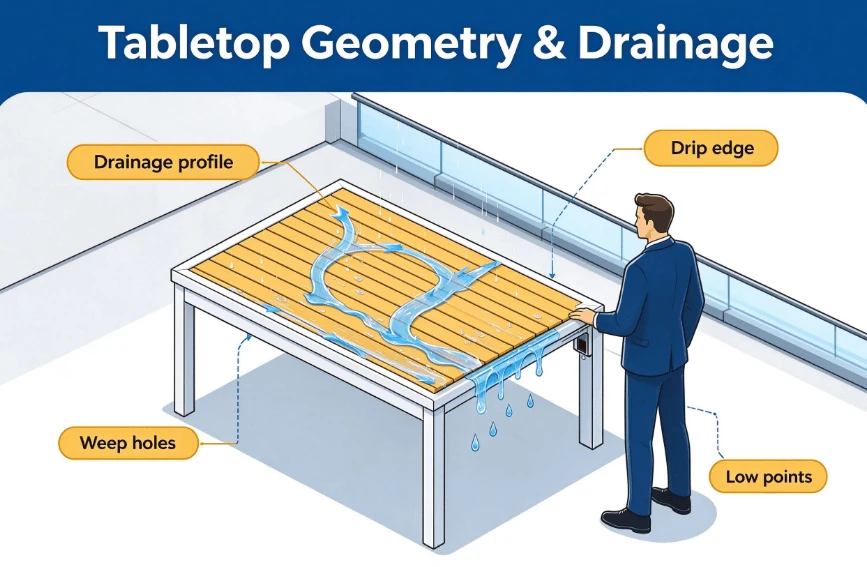
Water collects when a surface directs it toward a low point without providing a clear route out. Decorative features that look subtle in a product photograph can become reservoirs after repeated rainfall.
A good design review starts with the path water follows across the surface, over the edge, and away from the frame.
Give the tabletop a deliberate drainage profile
A carefully controlled surface pitch can encourage water to move toward an open edge. A shallow crowned profile may also help water run away from a central area.
Neither approach should be applied indiscriminately. A tabletop that slopes too much can make glasses unstable, cause liquid to run toward diners, and affect the usability of the dining surface. The appropriate geometry depends on table size, intended use, installation conditions, and the tolerance of the materials and assembly.
On a smooth, solid tabletop, pay particular attention to the center, corners, perimeter, and any transitions between separate materials. A decorative insert that sits slightly lower than the surrounding surface can collect water even when the main tabletop drains well.
Raised rims deserve similar scrutiny. Unless there is a suitable outlet, a raised edge can turn a tabletop into a shallow tray.
Compare solid, slatted, and perforated tops
| Tabletop construction | How it handles water | Main limitation | What buyers should inspect |
|---|---|---|---|
| Solid surface with a drainage-friendly profile | Directs water toward an edge when the geometry is correct | Shallow depressions or raised borders can retain puddles | Low points, edge transitions, stability of tableware, ease of wiping |
| Slatted or boarded top | Allows water to pass between boards or slats | Food debris and leaves can lodge in the gaps | Gap consistency, structural support, cleaning access |
| Perforated surface | Allows water to pass through purpose-designed openings | Openings may affect appearance, cleaning, or small tableware | Hole placement, opening size, structural integrity |
| Recessed top with a raised border | Can retain water unless a clear drainage route is incorporated | The border may act as a barrier to runoff | Drainage outlets, low points, residue collection |
An open construction does not automatically provide better performance. Narrow gaps may clog with fine debris, while large gaps can make serving trays and smaller tableware less stable. The right design must work for the way a restaurant or resort actually uses its furniture.
Keep the edge and underside working together
A tabletop should not simply send water to the perimeter and leave the underside to chance.
A well-designed edge profile releases water away from the underside. A suitable drip edge can help prevent water from tracking back along a lower surface. Any supporting rail, decorative collar, or mounting bracket should be checked for recessed pockets that may collect moisture.
Where water can enter hollow frame members, appropriately positioned weep holes may provide an escape route. These openings need to remain accessible for inspection and cleaning. They must also be compatible with the frame's structural requirements and protective finish.
A further detail is a capillary break, which interrupts water travelling along a narrow contact surface. Its effectiveness depends on the geometry and the materials involved; it should not create another recess where water and debris can accumulate.
The practical question is always the same: after water leaves the visible surface, where does it go next?
2. Rope Outdoor Dining Chair Seat Geometry
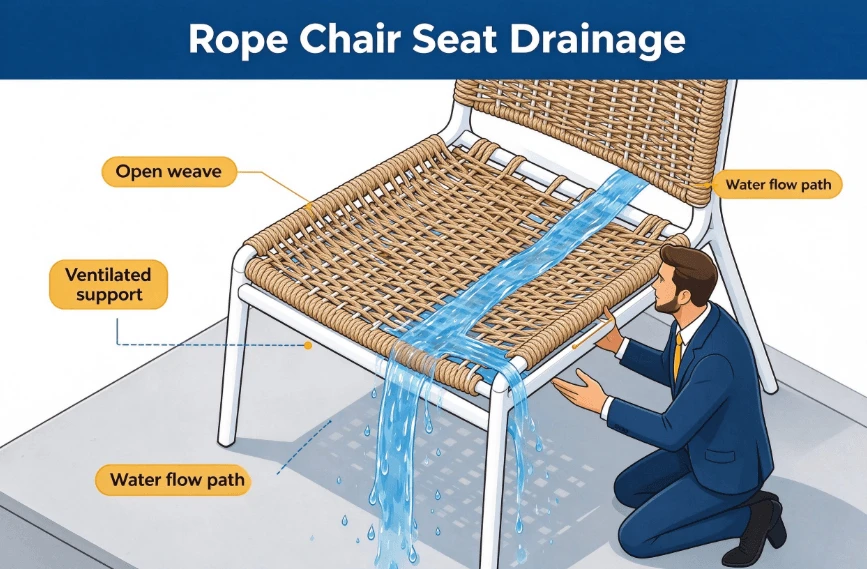
A chair seat must drain while supporting body weight and remaining comfortable. These requirements are closely connected because the seating surface can deform under load, creating a low point that was not obvious when the chair was empty.
An open seating construction can be effective when there is a continuous route for water to pass through and sufficient clearance beneath the seat.
Open seats need the right support
Slings, spaced slats, and tensioned rope can allow water to pass through rather than remain on an impermeable panel. However, the support beneath the seat is just as important as the top surface.
If a solid panel blocks the openings, or if the frame forms a closed recess, water may still accumulate below an apparently open seat. Poorly supported seating can also sag and create a shallow basin when occupied.
During sample inspection, check the chair from above, below, and from the sides. Look for areas where water can enter but cannot escape. Inspect the intersections between the seating material and the supporting frame, including end caps and recessed fasteners.
For projects with frequent turnover, also consider how staff will remove leaves, food particles, and dust. A seat that drains well but is difficult to clean may create a different maintenance problem.
Woven construction and cushions require separate checks
An open weave can help water pass through, but excessively dense weaving may retain moisture and debris. Very large openings, on the other hand, can affect comfort, support, and the suitability of the chair for a particular dining setting.
Cushions must be assessed as a complete assembly. The cover, filling, seams, underside, and supporting seat all influence moisture management. A breathable cover does not guarantee that the filling will dry quickly, and a quick-drying filling cannot compensate for an enclosed seat base that traps water.
Ask suppliers whether the cushion is removable, how it should be dried and cleaned, and whether replacement covers and fillings are available. In commercial settings, serviceability is part of the product specification rather than an optional extra.
3. Teak Outdoor Dining Table: Wood Movement, Edges, and Drying
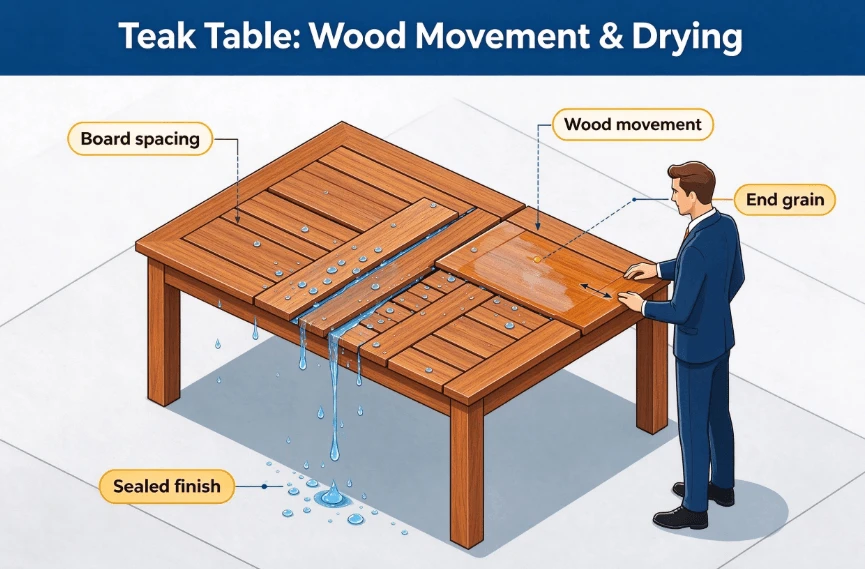
Wood requires a different approach from metal or molded synthetic materials. It responds to changes in moisture content, and repeated wetting and drying can affect dimensions, joints, surface appearance, and the fit of connected components.
Board spacing must accommodate the intended construction without compromising dining usability. Gaps that are too narrow may retain debris; gaps that are too wide may affect tableware placement and the visual continuity of the surface.
Inspect exposed end grain, joint details, the interface between the top and its support frame, and any coated or sealed areas where water may remain. A finish can influence moisture uptake and appearance, but it does not replace sound tabletop geometry.
Routine care matters. Organic debris should be removed before it holds moisture against the wood. Cleaning products and refinishing methods should follow the manufacturer's instructions, since inappropriate treatment can damage the surface or create uneven results.
For project buyers, the right question is not simply whether a wood is suitable for outdoor use. It is whether the particular construction, finish, installation, and maintenance plan match the climate and expected usage.
4. Environmental Exposure and Outdoor Furniture Materials
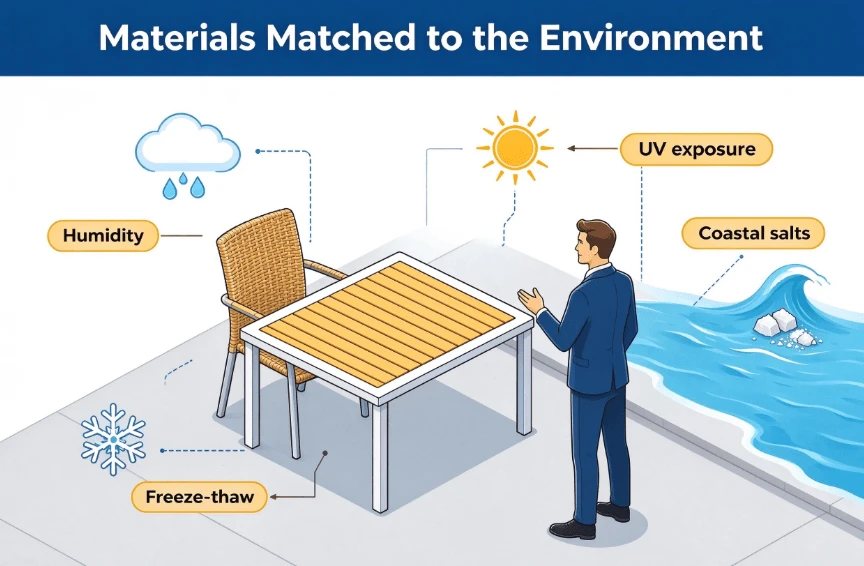
Drainage and durability are related, but they are not interchangeable. A product can shed rain effectively and still suffer from corrosion, fading, deformation, or finish deterioration if its materials are poorly matched to the environment.
Match the material to the site
| Material or construction | Environmental issues to consider | Useful procurement checks |
|---|---|---|
| Aluminum frame or tabletop | Coating damage, trapped moisture, and incompatible connections between metals | Finish continuity, edge protection, fastener compatibility, drainage access |
| Solid teak and other hardwoods | Moisture-related movement, checking, discoloration, and changes at joints | Board spacing, end-grain details, support structure, maintenance instructions |
| Powder-coated steel | Damaged coatings and water trapped near joints may increase corrosion risk | Coating condition, cut-edge protection, weld areas, accessible drainage |
| 316 stainless steel hardware | Chloride exposure and unsuitable material pairings can affect corrosion performance | Confirm grade, compatibility with the frame, cleaning guidance, documented test scope |
| Synthetic wicker and rope | Debris trapped within the weave, ultraviolet exposure, and retained moisture at supports | Opening size, cleanability, material specification, exposed terminations |
| Solution-dyed fabric and seat mesh | Sunlight, dirt, prolonged dampness, and poor ventilation can affect appearance and drying | Material evidence, seat ventilation, care guidance, cushion construction |
| Quick-dry foam | Drying performance depends on the full cushion assembly and its ability to release water | Filling specification, cover construction, drainage beneath the cushion |
| High-pressure laminate (HPL), porcelain, stone, or glass | Surface geometry, exposed edges, joints, and support details can govern water retention | Edge and joint design, structural support, stability, cleaning access |
No single material is the best option for every site. Selection should reflect the whole assembly, not just the name of the main material.
Rainfall, humidity, and shaded areas
In humid climates, drying can remain slow after visible puddles disappear. Covered balconies, sheltered restaurant corners, and furniture placed close to walls may receive less airflow than exposed terraces.
In these settings, open drainage routes and adequate ventilation beneath seats can be especially useful. Cleaning teams should be able to reach drainage openings and remove organic debris before it begins to obstruct them.
The surrounding site also matters. If a patio has poor drainage or regularly floods, furniture design alone cannot solve the underlying problem. Buyers should consider furniture placement, floor slope, surface drainage, and the exposure of the furniture to runoff.
Marine grade outdoor furniture for coastal exposure
🌊 Coastal projects require closer attention to salts, moisture, finish damage, and the interfaces between different materials.
The term marine grade outdoor furniture should not be interpreted as a guarantee that every component will resist corrosion indefinitely. The frame alloy, fasteners, coatings, exposed edges, and weld areas must all be considered.
For metal furniture, ask what material and finish are actually specified rather than relying on a general claim of weather resistance. Regular fresh-water cleaning can help remove deposited salts when carried out in accordance with the manufacturer's care instructions, but it does not eliminate the need for appropriate materials and maintenance.
Sunlight, temperature changes, and freezing conditions
☀️ UV exposure can affect susceptible plastics, fabrics, coatings, and other exposed components. Changes in flexibility, appearance, or material integrity can also affect the fit of connected parts and the ease of cleaning.
❄️ In climates with freezing conditions, moisture retained in joints and recesses may create additional concerns during freeze–thaw cycles. A well-drained design reduces unnecessary water retention, but it does not make every material or joint immune to temperature-related damage.
The most useful approach is to match the product's test evidence and maintenance instructions to the conditions expected at the installation site.
5. Commercial Grade Patio Furniture: Standards and Test Evidence

Buyers should distinguish between mechanical safety, weathering, corrosion resistance, responsible material sourcing, and actual drainage behavior. Each addresses a different part of the purchasing decision.
There is no universal certificate that, by itself, proves an outdoor dining table or chair will never hold standing water.
| Standard, organization, or scheme | What it helps buyers evaluate | What it does not prove by itself |
|---|---|---|
| EN 581 outdoor furniture standards | Applicable general and mechanical safety requirements for outdoor tables and seating, depending on the relevant part | A guarantee that water cannot pool or that a finish will last for a particular period |
| ASTM F1838 | Performance requirements for applicable adult and children's plastic chairs intended for outdoor use | Compliance of all furniture types; its scope excludes certain seating types, including upholstered chairs and chaises |
| ISO 4892-2 | A method for exposing plastic specimens to xenon-arc light in the presence of moisture to assess weathering effects | A universal finished-furniture certificate or a guaranteed service life |
| ISO 9227 | Salt-spray test methods for evaluating corrosion behavior of metallic materials and protective systems under defined conditions | A reliable prediction of real-world outdoor service life or proof of indefinite corrosion resistance |
| FSC Chain of Custody | Traceability and control of eligible forest-based material through the relevant supply chain | Drainage performance, structural strength, or weather resistance of finished furniture |
The scope of each reference matters. For instance, ASTM F1838 addresses specified plastic-chair categories rather than every outdoor dining chair. ISO salt-spray testing is useful for evaluating defined corrosion behavior, but it should not be used alone to predict long-term performance across different outdoor environments. The Forest Stewardship Council's chain-of-custody certification concerns material sourcing and supply-chain controls, not the drainage performance of a table.
For a product being considered for a contract project, ask the supplier to provide the actual test report or certificate, identify the model and materials covered, and confirm that the documentation applies to the item being ordered. Where an independent laboratory is involved, verify its competence and the scope of accreditation when relevant.
How to verify drainage on an assembled sample
🔎 A buyer-defined drainage check can provide useful product-specific evidence when carried out consistently.
First, review the drawing. Identify the intended drainage direction, openings, raised borders, enclosed cavities, and locations where water may be retained.
Next, inspect the fully assembled product. The table or chair should be set up according to the installation instructions on an appropriate test surface. Record any slope or assembly condition that could influence drainage.
Apply water consistently. Use the same practical spray or pouring method on the samples being compared. Avoid judging one product after light misting and another after a heavy pour.
Observe the entire assembly. Check the tabletop or seat, underside, edge details, frame intersections, and any openings. For seating, consider how ordinary use may change the seat's shape.
Record the result. Note the observation interval, locations where water remains, accessibility for cleaning, and any areas that repeatedly retain moisture. Take photographs and attach the findings to the product specification.
The acceptance criteria should be agreed before evaluating samples. This is a purchasing assessment, not a substitute for formal mechanical safety testing or a universal certification.
6. Outdoor Furniture ROI: What Hospitality Buyers Should Measure

For hotels, resorts, restaurants, and rooftop venues, the purchase price is only one element of the furniture investment. The broader concept is total cost of ownership: what it takes to acquire, maintain, clean, repair, and eventually replace the furniture over its intended service life.
Better drainage can support value in several ways, although the benefits depend on the venue.
Staff time: If employees repeatedly wipe wet chair seats and tabletops before service, the task can consume time that could be used for other operational work.
Readiness after rain: Furniture that dries predictably may be easier to prepare for guests, particularly in exposed dining areas.
Moisture-related upkeep: Reducing unnecessary water retention may help limit avoidable problems around joints and recesses, but it cannot eliminate corrosion, material ageing, or routine cleaning.
Appearance and guest experience: Water marks, trapped debris, and persistently damp seating can affect presentation even when the furniture remains structurally serviceable.
Repair and replacement planning: Accessible joints and replaceable components can make inspection and maintenance easier than complex assemblies with hidden moisture traps.
The return will differ by project. An exposed coastal restaurant that experiences frequent rain has different needs from a shaded hotel terrace with modest exposure. The number of chairs, local labor costs, cleaning procedures, frequency of service, availability of replacement parts, and expected usage all influence the decision.
There can also be trade-offs. Slatted surfaces may collect food debris, perforations may be less convenient for particular table settings, and elaborate edge details may create additional cleaning work.
Rather than assuming the product with the most drainage openings is automatically the best investment, compare how the design performs under realistic conditions. Ask staff to review the sample, examine the cleaning process, and identify problems that would create work during a busy service.
A suitable specification balances drainage, comfort, stability, cleanability, appearance, durability, and maintenance cost.
7. What to Include in an Outdoor Furniture Hardware Specs Review

For large commercial orders, drainage should be a verifiable design feature rather than a vague product description.
The buyer's technical review should address:
Construction details: Tabletop material, seat type, edge profile, surface geometry, openings, and the intended direction of water flow.
Frame and hardware: Material grades, fastener compatibility, exposed joints, end caps, coatings, and access to drainage points.
Cleaning access: Whether staff can reach areas where leaves, pollen, food particles, or dust may accumulate.
Environmental suitability: Exposure to rainfall, humidity, coastal salts, strong sunlight, and freezing conditions where applicable.
Test documentation: Which safety, weathering, corrosion, or sourcing documents apply to the actual model and its components.
Sample acceptance: The agreed inspection method, drainage observations, photographic records, and any corrective work required before production approval.
After-sales support: Warranty scope, replacement components, care instructions, and maintenance responsibilities.
The phrase outdoor furniture hardware specs is particularly relevant to project procurement because small components can influence both moisture retention and repairability.
Do not approve a large order solely from a rendering or a general "all-weather" claim. Where drainage is important to venue operations, review the assembled sample, confirm the technical documentation, and establish acceptance criteria before production.
Conclusion
Effective water management starts with the structure. A tabletop with suitable geometry, a chair seat that does not form a shallow basin, well-designed edges, accessible drainage routes, and appropriately detailed frame joints can all help prevent unnecessary water retention.
Materials must then be selected for the actual environment. Humidity, coastal salts, sunlight, freezing conditions, cleaning routines, and the frequency of use influence how well a furniture assembly performs over time. Relevant tests and certifications strengthen the procurement process, but their scope must be understood and cannot replace product-specific drainage checks.
For hospitality buyers, the best choice is not necessarily the furniture with the most openings or the most elaborate claims. It is the product that balances water shedding, comfort, stability, cleaning access, material suitability, and lifecycle cost in the intended setting.
Howvin can discuss project-specific material and construction options with hospitality buyers. A clear technical specification and an assembled-sample review should remain part of the approval process, regardless of the supplier.
FAQ:
1. What tabletop design helps prevent standing water outdoors?
A solid tabletop with carefully controlled geometry can direct water toward an edge, while slatted and perforated tops allow water to pass through. The appropriate choice depends on tableware stability, appearance, cleaning requirements, and the environment.
2. Do drainage holes guarantee that an outdoor chair seat will dry quickly?
No. Water can remain in a low point, be blocked by an underlying support panel, or collect around the frame. Buyers should review the complete assembly and consider whether the seat changes shape under normal use.
3. Which materials are suitable for outdoor dining furniture in rainy climates?
Aluminum, suitable hardwoods, properly specified metal hardware, and outdoor-rated woven or fabric constructions can all be considered. The frame details, finish, fasteners, ventilation, and cleaning requirements are just as important as the main material.
4. What should buyers check when specifying coastal outdoor dining furniture?
Review the frame material, protective finish, hardware grade, exposed edges, and connections between different metals. Request applicable corrosion-test documentation and confirm the care instructions. A marine-grade claim alone does not prove that every component is suited to the site's conditions.
5. Can a furniture certificate prove that a table or chair will not retain standing water?
Not by itself. Mechanical safety, weathering, corrosion, and responsible-sourcing documents address different requirements. Buyers should verify the scope of each document and separately inspect the drainage performance of the actual product.
6. How can better drainage improve the return on a commercial outdoor furniture investment?
It may reduce repetitive wiping, help furniture become ready for service more predictably, and reduce avoidable moisture retention around joints. The benefit depends on site exposure, labor routines, furniture quantity, cleaning needs, maintenance, and replacement planning. Sample testing and site-specific assessment are more reliable than assuming that any single feature will guarantee savings.