

Hospitality buyers can find B2B outdoor furniture manufacturers in Asia through specialist furniture fairs, verified exhibitor directories, referrals from project partners, and direct manufacturer websites.
China offers a large, integrated supplier base for mixed outdoor furniture packages. Vietnam, Malaysia, and Indonesia provide additional options for export furniture, timber products, woven furniture, and regional production.
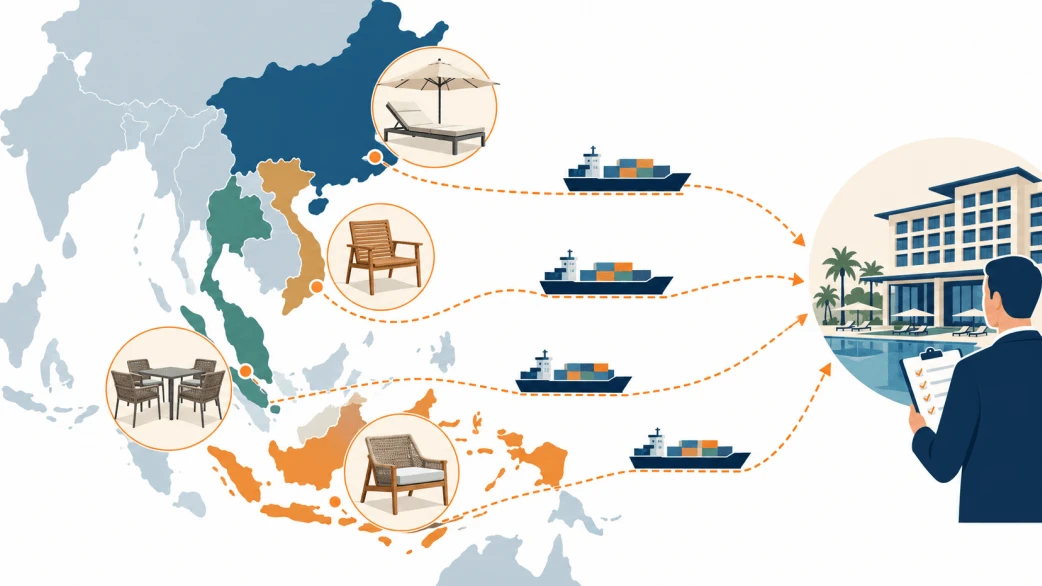
However, location is only the starting point. A reliable shortlist depends on verifying the legal entity, actual production site, relevant manufacturing processes, approved samples, and evidence behind every performance claim.
The practical answer is therefore not a ranked list of "best" factories. It is a sourcing route followed by a controlled qualification process.
A polished website, marketplace badge, or trade-fair booth may create a useful lead. None of these alone proves that the seller owns the factory, controls the necessary production processes, or can reproduce an approved hospitality specification at scale.
Start With the Right Asian Sourcing Channel

The fastest way to build a defensible shortlist is to use channels that reveal company names, product categories, and manufacturing locations, then verify each candidate independently.
For China, the official CIFF Guangzhou Outdoor & Leisure exhibitor directory is more useful than a generic web search because buyers can filter companies by the relevant outdoor sector.
Vietnam's VIFA Expo exhibitor and factory-visit resources can connect a trade-show visit with production-site visits. The MIFF exhibitor list provides a similar starting point for Malaysia.
In Indonesia, furniture exhibitions, trade associations, designers, and established hospitality referrals can help identify teak, woven, and craft-oriented suppliers. Buyers must still verify timber legality, chain-of-custody claims, kiln control, joinery, finishing, and export experience.
| Sourcing base | Often useful for | Strong discovery route | What buyers must still verify |
|---|---|---|---|
| Guangdong and nearby Chinese clusters | Mixed-category packages, aluminum furniture, rope, synthetic wicker, loungers, dining furniture, shade products, and customization | Specialist fair directories, direct factory websites, and project referrals | Legal entity, factory ownership, in-house processes, subcontracting, material specifications, test scope, capacity, and export packaging |
| Southern Vietnam | Export furniture, timber and mixed-material production, upholstery, and regional project supply | Furniture-fair directories and pre-booked factory visits | Timber and component sources, moisture control, coating, upholstery, sample repeatability, and shipment planning |
| Malaysia | Export-oriented furniture and selected contract suppliers | Official fair directories and trade introductions | Outdoor specialization, process ownership, test evidence, minimum-order structure, and after-sales support |
| Indonesia | Teak, woven, and craft-intensive outdoor furniture | Industry fairs, associations, designers, and hospitality referrals | Legal timber documents, wood grading, moisture control, hardware, finishing, packing, and replacement-part consistency |
Do not select a country first and force the furniture specification to fit it. Begin with the product and risk profile.
A resort purchasing powder-coated aluminum loungers, teak dining furniture, upholstered sofas, and engineered shade may need one project coordinator but several manufacturing processes. A supplier may subcontract some categories, but the subcontracting arrangement, inspection responsibility, and warranty route should be transparent.
Prove "Direct Factory" Before Comparing Prices
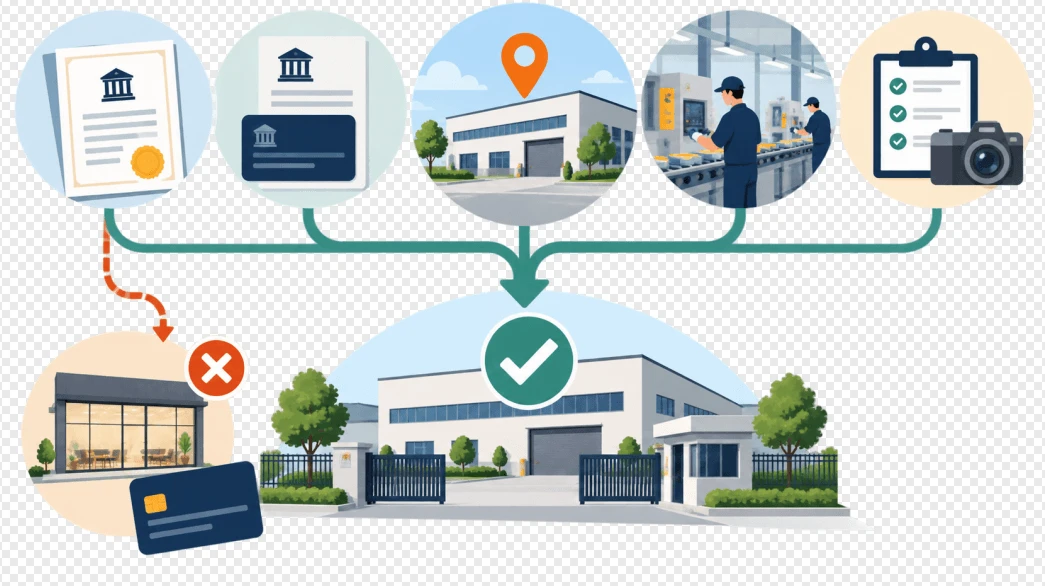
A direct-factory claim should survive a document-to-factory cross-check.
Match the registered company name and address against the quotation, contract, bank beneficiary, invoice, export documents, website, and facility signage. Then confirm that the audited plant performs the processes relevant to the order.
A showroom, sample room, or warehouse does not prove that the company controls welding, powder coating, timber drying, weaving, sewing, foam cutting, assembly, or export packing.
Use the following six checks before comparing quotations:
Business registration and registered address: Establish the legal counterparty and stated business scope. Investigate different company names that have no documented relationship.
Bank-beneficiary confirmation: Confirm whether payment will go to the contracted company or a properly documented affiliate. Stop the transaction if an unexplained personal or last-minute beneficiary change appears.
Live or independent factory audit: Confirm the site, machinery, workforce, process flow, capacity indicators, and subcontracting arrangements. A reused video or showroom-only tour is insufficient.
Process-specific records: Review incoming inspection, production, finishing, assembly, and packing controls. A generic quality manual without order-level evidence has limited value.
Permission-cleared project references: Look for experience with comparable products, quantities, climates, and delivery complexity. Hotel logos alone do not prove what the company supplied.
Sample and production records: Confirm that the approved construction can be frozen and repeated. Investigate samples made by another workshop or undocumented material changes.
Howvin publishes a first-party manufacturing and project-supply overview for buyers considering a Guangzhou supplier.
Treat this information as the beginning of due diligence rather than final approval. Ask Howvin-or any candidate factory-for its legal entity details, relevant production map, product-specific specification, sample plan, test documents, quality checkpoints, packaging proposal, and contract terms for the exact order.
Convert the Hotel Use Case Into a Controllable RFQ
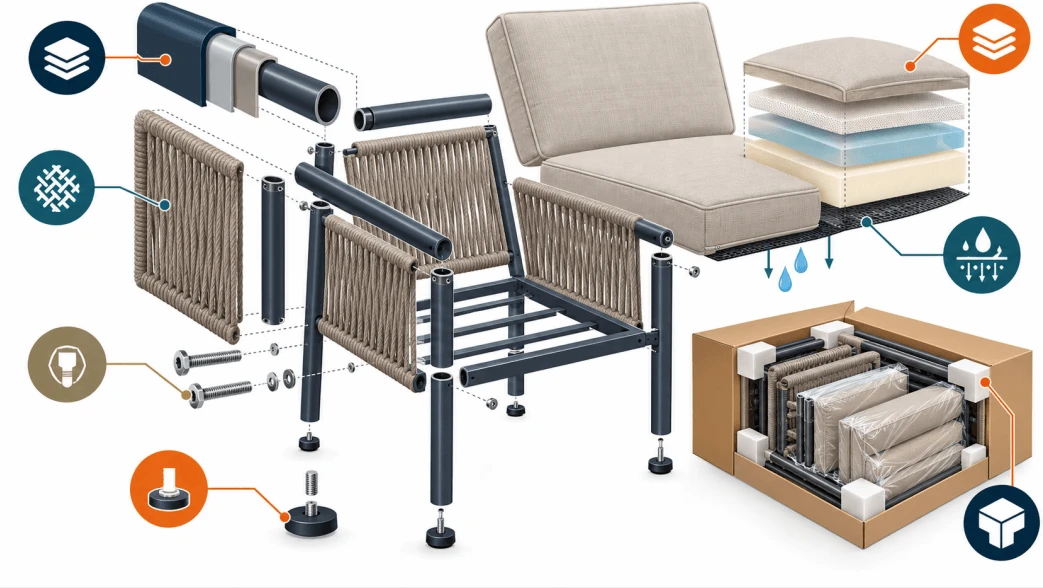
Factories can quote more accurately when the request describes the operating environment instead of relying on terms such as "premium," "commercial grade," or "all weather."
The RFQ should state:
Property and project type
Installation zone
Expected usage intensity
Climate and exposure conditions
Cleaning chemicals and procedures
Seasonal storage requirements
Destination market
Product quantities
Required documents
Delivery and installation sequence
A buyer can use Howvin's commercial outdoor furniture catalogue to identify relevant categories. However, the final RFQ should define every item in sufficient detail.
Specifications may need to cover:
Overall dimensions and tolerances
Frame materials and sections
Surface preparation and coating
Timber species and grade
Fastener materials
Rope or wicker references
Fabric and color references
Cushion and foam construction
Drainage requirements
Glides and floor protection
Assembly method
Packaging and labeling
Spare and replacement parts
For custom or OEM/ODM work, also define who owns the drawings and tooling, how revisions are approved, which tolerances are critical, and what constitutes an acceptable color or texture range.
Replacement parts should remain compatible with future production whenever this is commercially important.
Without formal change control, a supplier may deliver furniture that looks similar to the approved sample while using a different tube wall, weld preparation, fastener, fabric lot, foam, weave profile, or packing method.
Match Materials to Exposure and Daily Operations
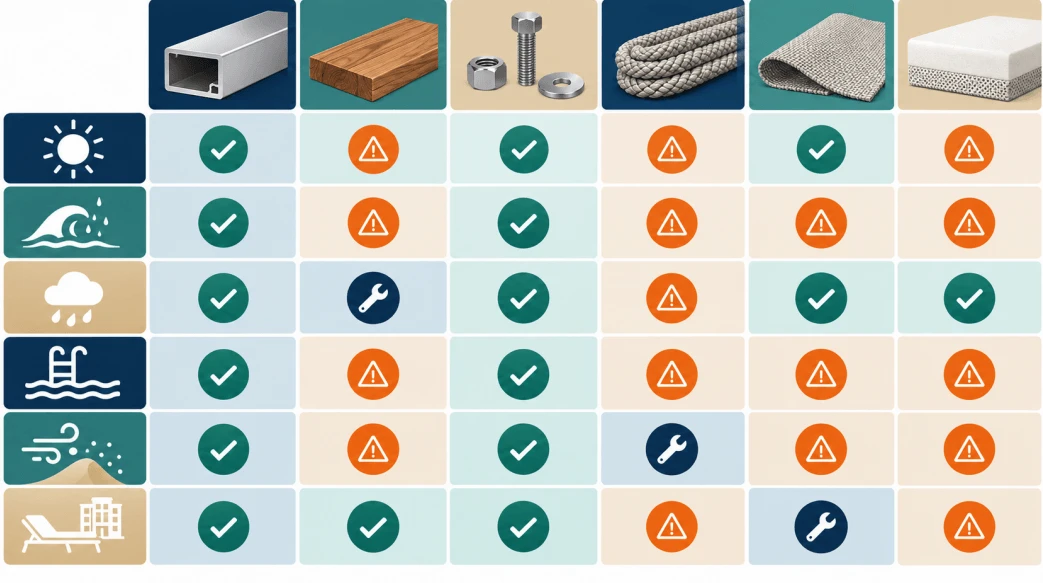
Material names alone do not establish suitability.
Aluminum performance depends on the alloy, section design, drainage, weld quality, pretreatment, coating system, edge coverage, and procedures for repairing damaged finishes.
Teak and other hardwoods depend on species, grade, moisture control, joinery, surface finish, and maintenance expectations.
Stainless-steel hardware needs a declared grade and must be evaluated together with adjacent metals. Rope, synthetic wicker, outdoor fabric, foam, tabletops, adhesives, and plastic glides require their own specifications and replacement plans.
| Project exposure | Specification questions | Operational consequence if missed |
|---|---|---|
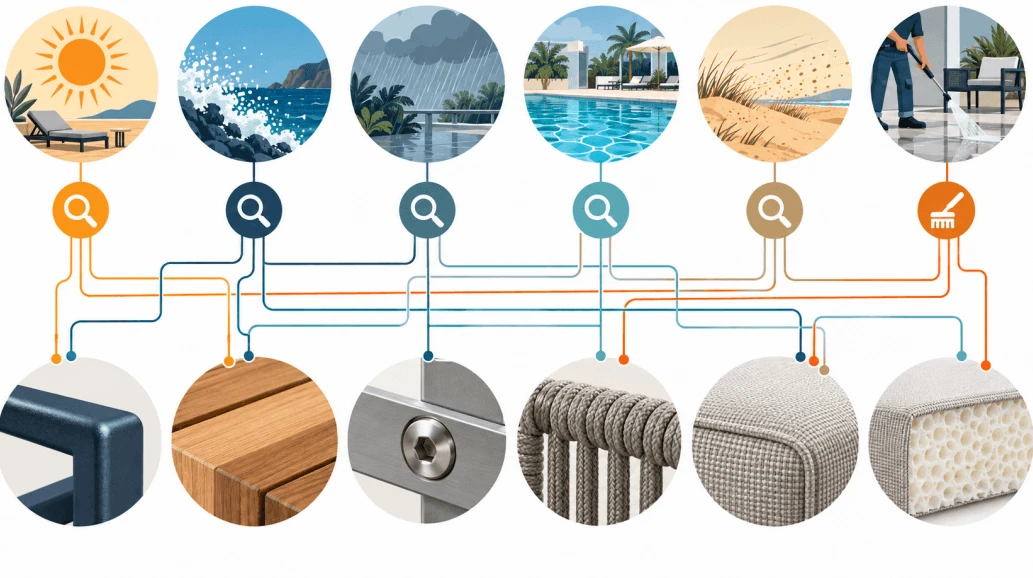
| Coastal salt spray and wind-driven sand | What frame, pretreatment, coating, fastener, and drainage details are proposed? How were specimens and acceptance criteria defined for corrosion testing? | Corrosion at joints or damaged edges, abrasive wear, staining, and more frequent inspections |
| Pool deck and chlorinated cleaning | Are fabrics, threads, foam, glides, and finishes compatible with the cleaning regime? Can cushions drain and dry in their installed position? | Odor, moisture retention, staining, fabric damage, and slow deck resets |
| High UV exposure and heat | What exact fabric, rope, wicker, coating, and color references will be supplied? Is the evidence tied to those references? | Uneven fading, brittleness, hot surfaces, and mismatched replacement pieces |
| Heavy restaurant or terrace turnover | Are chairs stable, stackable where required, easy to lift, cleanable, and protected against floor damage? | Higher labor, breakage, noise, blocked circulation, and storage problems |
| Seasonal rain, freeze-thaw, or off-season storage | Can water escape from frames, cushions, and tabletops? What must be covered, tilted, removed, or stored? | Water retention, cracking, staining, internal corrosion, and avoidable handling |
Category pages can help buyers identify possible configurations. For example, Howvin's outdoor sofa collections for hospitality spaces show options for terraces, lounges, and pool-adjacent spaces.
A coastal resort should still request the exact frame, coating, hardware, textile, foam, drainage, cleaning, and replacement-cover information for the selected model.
Request Standards and Certificates With the Correct Scope
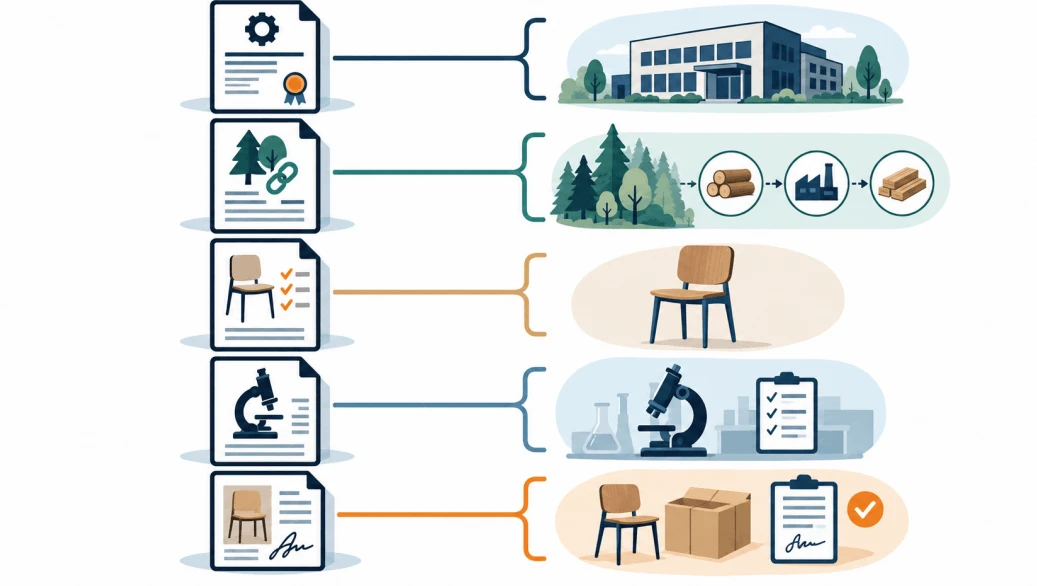
For every certificate or test report, ask:
What does the document cover?
Who issued it?
Which company and factory address does it name?
Which product, component, or specimen was evaluated?
Which standard and edition were used?
Does the laboratory's accreditation scope include the test?
Does the tested construction match the product being purchased?
ISO guidance on certification makes an important distinction: ISO develops standards but does not certify companies.
ISO 9001 concerns an organization's quality management system. It is not automatic certification of every chair, table, coating, or shipment produced by that organization.
For European contract seating and tables, the EN 581 series overview helps buyers identify potentially relevant general and mechanical-safety requirements.
The purchase specification should identify the applicable product, use category, standard parts, report, and acceptance requirements. A generic statement that furniture is "EN 581 compliant" may not provide enough information.
For metals and coated specimens, ASTM B117 defines a salt-spray apparatus and testing practice.
ASTM also explains that stand-alone salt-spray results do not reliably predict natural-environment performance. A useful report therefore needs a defined specimen, preparation method, exposure period, evaluation procedure, and buyer-approved acceptance criterion.
The phrase "passed salt spray" is incomplete without this information.
For timber claims, FSC chain-of-custody certification concerns eligible forest-based materials moving through certified supply chains.
It does not certify the metal, fabric, foam, structural performance, or weather resistance of the complete furniture item.
For test reports, buyers can use the ILAC MRA and signatory directories and the relevant national accreditation-body directory to check the laboratory and its accredited scope.
A familiar laboratory logo does not prove that the exact test falls within the laboratory's accredited scope.
Lock the Sample, Inspect Production, and Control Loading
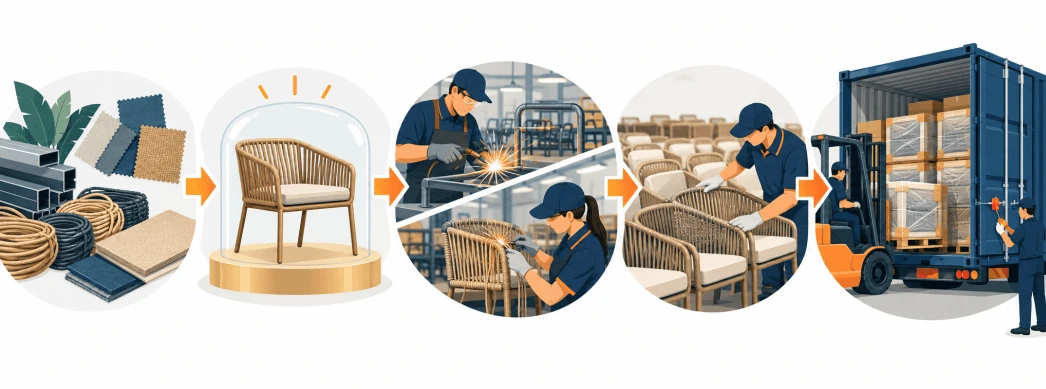
The approved sample should become a controlled reference rather than a visual memory.
Record its:
Dimensions
Weight where useful
Materials
Finish codes
Fabric and rope references
Hardware
Cushion construction
Comfort and stability
Workmanship
Labels
Assembly method
Packaging
Photograph critical details, sign the specification and sample record, retain approved material swatches, and define what happens when a specified component becomes unavailable.
Quality control should then be divided into separate gates.
Incoming-material inspection reduces the risk of incorrect components entering production.
Early or in-line inspection can identify process drift while rework is still practical.
Final random inspection checks finished quantities and agreed workmanship against the purchase specification.
Loading supervision confirms quantities, carton condition, relevant moisture or cleanliness concerns, container condition, bracing, and seal details.
No single inspection replaces all the others.
A third-party inspector also needs the approved specification and acceptance criteria. Product photographs alone are not enough for consistent inspection decisions.
Compare Lifecycle Workload, Not Only Factory Price
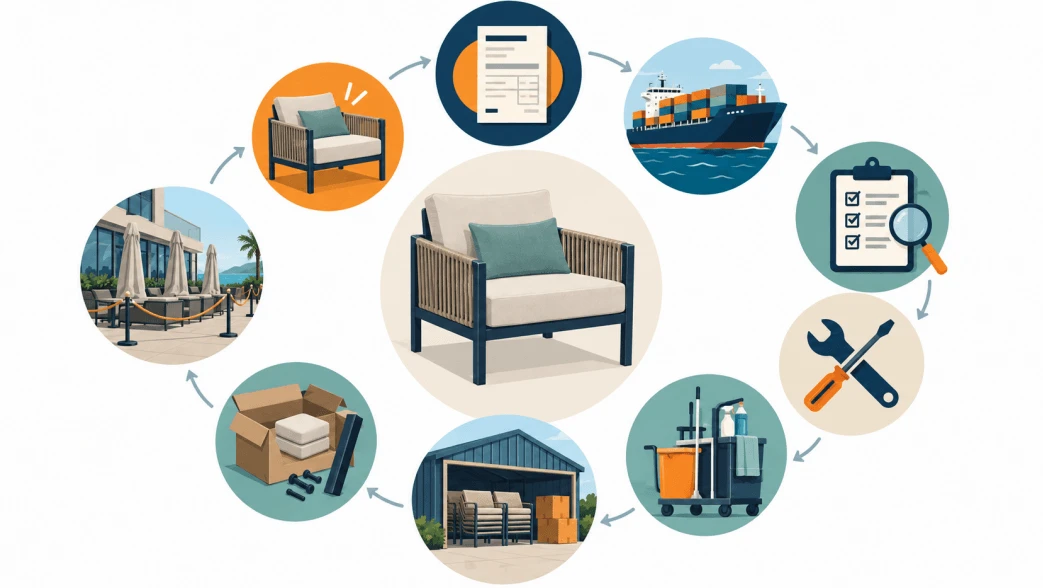
The lowest quotation may become the highest-operating-burden option after freight, duties, inspection, installation, cleaning labor, cushion handling, seasonal storage, spare parts, repairs, downtime, and replacement disruption are considered.
When reliable cost data are unavailable, use a qualitative lifecycle comparison. State the assumptions and ask each supplier to respond to the same packing, service, replacement-part, warranty, and operating scenarios.
| Procurement option | Initial-price tendency | Management burden | Typical hidden exposure | Best fit when |
|---|---|---|---|---|
| Lowest-price unverified supplier | Often lowest | High | Rework, inconsistent materials, weak packaging, unclear recourse, and replacement mismatch | Rarely appropriate for guest-facing or schedule-critical hospitality areas |
| Verified specialist factory | Moderate and specification-dependent | Moderate | Buyer must still manage testing, approvals, inspections, and logistics | A defined product family matches the factory's proven processes |
| Project coordinator with disclosed subcontractors | Moderate to higher | Potentially lower for a broad package | Additional margin, dependency, and less direct process visibility | One accountable package manager is valuable and subcontracting is transparent |
| Regional distributor or established contract brand | Often higher | Lower for local service | Less customization or less factory-direct pricing | Local inventory, installation, warranty response, and replacement speed outweigh unit cost |
Reliability is ultimately a control system consisting of a suitable factory, executable specification, verified evidence, approved sample, inspection gates, and enforceable commercial terms.
Removing any one of these controls increases the chance that the purchasing team will inherit a quality or schedule problem later.
A Practical Shortlist-to-Order Workflow

Use the following sequence when sourcing hospitality outdoor furniture in Asia:
Define the operating environment, product scope, quantity, destination market, installation date, and documentation requirements.
Build a longlist using specialist fair directories, project referrals, direct manufacturer websites, and qualified local partners.
Match the legal entity, bank beneficiary, export identity, factory address, and claimed production processes.
Issue the same structured RFQ and evidence request to each serious candidate.
Audit the relevant production facility and disclose subcontracted processes.
Approve materials and a controlled sample against measurable acceptance criteria.
Use a pilot order when the project risk justifies it, then freeze approved changes before full-scale production.
Inspect incoming materials or early production, finished goods, packaging, and loading according to the project risk.
Retain specifications, reports, approvals, inspection records, shipment evidence, spare-parts commitments, and warranty contacts in the project file.
Frequently Asked Questions
1. Which Asian country is best for hotel outdoor furniture sourcing?
There is no universal best country.
China is often efficient for broad mixed-material packages and customization. Vietnam, Malaysia, and Indonesia can be strong for particular export, timber, woven, or craft-intensive requirements.
Choose according to the product, process, environment, volume, documentation, logistics, and service model-not the country label.
2. How can I tell whether a supplier is a factory or a trading company?
Match the legal entity and bank beneficiary, verify the production address, audit the equipment and process flow relevant to the order, review production records where permitted, and identify subcontractors.
A trading company is not automatically unsuitable. Its role, margin, quality responsibility, and warranty route should be explicit.
3. Does an exhibitor listing mean the company is a verified manufacturer?
No.
An official directory confirms that a company is listed by the event organizer. It does not necessarily prove factory ownership, capacity, product compliance, or suitability for a hotel project.
Use the listing to create a lead and then complete independent due diligence.
4. What documents should a contract outdoor furniture manufacturer provide?
Request entity records, signed item specifications, drawings, material and finish references, applicable test reports, certificate copies with their scopes, sample approvals, quality plans, inspection records, packing details, commercial terms, spare-parts information, and warranty procedures.
The required document set depends on the product, destination market, and project contract.
5. Is ISO 9001 enough to approve an outdoor furniture supplier?
No.
A valid ISO 9001 certificate can support confidence in a supplier's quality management system, but it does not certify every product.
Verify the certificate and its scope, then evaluate product specifications, relevant test evidence, factory processes, samples, production controls, and shipment records.
6. When should a hospitality buyer use a third-party inspection company?
Use an independent inspector when the order value, distance, schedule, product complexity, new-supplier risk, or internal resource limitations justify additional checks.
The inspector must work from the approved specification and acceptance criteria. Independence is useful, but it cannot repair an incomplete RFQ or ambiguous contract.
Conclusion: Source Widely, Approve Narrowly
Hospitality buyers can source capable B2B outdoor furniture manufacturers in Asia through official trade directories, factory visits, direct manufacturer websites, and trusted project networks.
The commercial advantage comes from narrowing that broad market through evidence.
Verify who will contract and manufacture the furniture, specify products for the real operating environment, confirm the scope of tests and certificates, control the approved sample, inspect production, and compare lifecycle workload alongside the factory price.
If Howvin is included in your shortlist, send the team a BOQ, drawings or reference schedule, destination market, project location, exposure conditions, quantities, delivery window, and documentation requirements.
Request a product-specific proposal and supporting evidence package before treating any website statement as an approved project requirement.