
Buying commercial outdoor furniture based solely on the initial PO price is a quick way to inflate long-term operational budgets. Cheap frames look fine on purchase orders. Out on a coastal resort deck, salt fog, blistering sun, and daily guest turnover quickly expose material weaknesses.
Calculating What is the total cost of ownership (TCO) for teak outdoor furniture over 10 to 20 years? requires factoring in structural replacement cycles, field maintenance hours, and residual liquidation asset values. Metal and synthetic composite options promise low entry prices, yet they break down within four to seven years. Grade-A teak heartwood requires higher upfront capital expenditure, but its natural density and organic resin content keep it in continuous service for decades without structural replacement.

1. Capex vs. Opex: 20-Year Financial Lifecycle Architecture
Low upfront price tags are misleading. Aluminum frames coated in polyester powder paint perform reasonably well inland. Place them near ocean spray, and moisture creeps beneath the coating through micro-fissures created by thermal expansion. This triggers internal galvanic corrosion, bubbling the surface finish until the paint flakes off in sheets.
High-density polyethylene (HDPE) plastics face a different failure mode. Exposure to direct solar radiation causes thermal creep, a permanent physical warping under continuous weight. Long table surfaces drop in the middle, and chair legs bow outward.
Replacing damaged furniture three or four times across a twenty-year timeframe accumulates substantial freight, installation, and disposal costs. A single purchase of dense teak avoids these recurring expense rounds entirely.
2. 10-to-20 Year Commercial TCO & Financial Matrix
| 📐 Evaluation Metric | 🪵 Grade-A Teak Heartwood | 🦾 Powder-Coated Aluminum | 🛢️ HDPE Poly Lumber |
| Initial Purchase Capex | Higher upfront outlay | Low to moderate initial cost | Moderate initial cost |
| Expected Structural Lifespan | 30 to 50+ Years | 4 to 6 Years in coastal zones | 5 to 7 Years before thermal sag |
| 20-Year Replacement Frequency | 0 Replacements required | 3 Full Replacement Cycles | 2 to 3 Replacement Cycles |
| Annual Maintenance Labor | Minimal (Occasional soft washing) | Paint touch-ups & joint tightening | High-pressure cleaning required |
| Surface Thermal Comfort | Stays cool under midday sun | Heat absorption causes skin discomfort | Retains solar heat; softens |
| End-of-Life Residual Value | 40%–60% retained asset value | Zero (Scrap metal value only) | Zero (Landfill waste) |

3. Executive Hospitality Terraces: Deploying Premium Lounge Assets
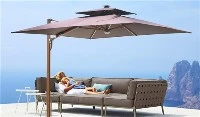
High-floor VIP terraces and oceanfront executive lounges require seating that maintains structural integrity under constant wind pressure and intense UV exposure.
Figure 1: Specifying premium teak seating across executive terraces ensures structural elegance that weathers coastal salt air without degradation.
Outfitting private guest areas with outdoor teak club chairs and matching sofa for executive terrace applications provides property managers with a solid, high-density timber frame that resists tipping during sudden gust storms. Unlike hollow aluminum tubing, thick teak frames stay firmly grounded while offering a warm, natural feel to touch.
For larger gathering spaces, specifying a custom outdoor teak sectional sofa gives venue operators modular layout options. Sections can be locked together for corporate events or separated for smaller private parties. The underlying wood structure handles heavy dynamic weight loads without flexing at connection points.
4. 20-Year Environmental Degradation Profile
| ☀️ Environmental Stress Factor | 🪵 Grade-A Teak Heartwood | 🦾 Powder-Coated Aluminum | 🛢️ HDPE Poly Lumber |
| Direct UV Radiation (20 Years) | Forms protective silver patina layer | Powder coating chalks & peels | Polymer bonds break; becomes brittle |
| High Humidity & Salt Fog | Protected by native caoutchouc oils | Flaking paint & white aluminum rust | Impervious to rust |
| Heavy Guest Dynamic Loads | Secured by mortise and tenon joinery | Welded seams crack under stress | Fasteners strip out of soft plastic |
| Surface Scratches & Dents | Field-repairable via fine sanding | Exposes bare metal to rust | Creates permanent burrs & rough edges |

5. Wellness Resorts & Non-Toxic Timber Chemistry
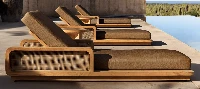
Eco-luxury retreats and wellness sanctuaries operate under strict material transparency guidelines that rule out off-gassing plastics or heavy chemical preservatives.
Figure 2: Integrating chemical-free natural teak furniture aligns with wellness resort standards by offering non-gassing, organic outdoor seating.
Properties focused on environmental health specify chemical free natural teak outdoor furniture for wellness resorts to avoid synthetic emissions. Synthetic wicker and painted metals release noticeable odors under hot midday sun.
Teak wood naturally secretes internal latex resins (caoutchouc) and microscopic silica deposits (silica). These internal compounds render the timber unpalatable to insects and resistant to rot without requiring pressure treatment with copper or arsenic solutions.
6. High-Traffic Bar & Dining Zones: Commercial Durability
Open-air bars, poolside dining decks, and outdoor cafes demand furniture that withstands constant movement, dropped glassware, and beverage spills.
Figure 3: Installing heavy-duty teak bar furniture handles food acidic spills and heavy commercial usage without surface pitting.
Placing a solid teak outdoor bar table in active beverage zones gives staff a durable workhorse piece. High-turnover dining areas suffer frequent alcohol spills, citrus acid contact, and heavy plate drag that strip soft painted finishes.
Teak handles these abuses due to its dense grain structure and high Janka hardness rating. When deep scratches occur from commercial use, maintenance workers do not need to send the unit off-site. A quick pass with fine sandpaper removes localized damage right on the terrace.
Routine cleaning requires only a wash with a pH-neutral teak cleaner and a soft-bristle brush to clear dust and food residues. Left untreated outdoors, the wood naturally transitions into a sleek silver patina that shields lower fiber layers from UV damage.

7. Maintenance Requirements & Asset Liquidation Comparison
| 📋 Asset Management Category | 🪵 Grade-A Teak Heartwood | 🦾 Powder-Coated Aluminum | 🛢️ HDPE Poly Lumber |
| Routine Cleaning Protocol | Wash with neutral cleaner | Soft cloth and soap wash | Requires high-pressure washing |
| On-Site Field Repairability | 100% Repairable (Sandable on-site) | Non-repairable (Requires factory re-coat) | Non-repairable (Scratches are permanent) |
| 20-Year Maintenance Labor Hours | Very Low (Less than 2 hours per year) | Moderate (Touch-up work) | Moderate (Dirt removal in plastic grain) |
| Asset Balance Sheet Treatment | Long-term capital asset with residual value | Fast-depreciating short-term expense | Fast-depreciating short-term expense |
8. Precision Woodworking & Kiln Drying Standards
Raw teak timber must undergo proper factory seasoning before reaching the workbench, or joints will fail as humidity shifts.
Computerized Kiln Drying: Green timber contains high moisture content. Raw planks undergo computer-controlled kiln drying over several weeks to lower moisture down to an 8%–12% equilibrium moisture content. Skipping this step leads to wood warping, checking, and split frames when furniture ships to arid desert or freezing alpine regions.
Structural Joinery: Fastening joints with surface metal screws causes loose frames over time as wood naturally expands and contracts. Commercial contract pieces rely on deep mortise and tenon joinery fitted with solid wood dowels, creating interlocking timber bonds that withstand heavy daily seating loads.

9. International Certifications & Contract Compliance Standards
Specifying commercial teak furniture for resort developments requires verifying that manufacturing facilities meet rigorous global compliance guidelines:
ASTM D143: Standard testing methods for clear wood specimens assessing shear strength, bending limits, and structural density.
EN 581-1: European safety requirements covering general outdoor contract furniture used in commercial spaces.
EN 581-2: European mechanical safety and stability testing standards for contract seating assets under severe load conditions.
ISO 9001: Quality management certification guaranteeing consistent woodworking tolerances and automated kiln moisture verification.
FSC certification: Forest Stewardship Council endorsement proving timber is legally harvested from sustainably managed plantations.
SVLK timber legality: Indonesia's mandatory timber legality assurance system verifying legal chain-of-custody from forest to port.
ISO 14001: Environmental management system certification ensuring zero toxic discharge during manufacturing.
REACH: European Union regulation confirming all finishes and components are free from heavy metals or hazardous chemicals.
FAQ:
Q1: What is the total cost of ownership (TCO) for teak outdoor furniture over 10 to 20 years compared to aluminum or synthetic plastic?
Over a 10-to-20-year period, teak outdoor furniture costs significantly less overall than aluminum or plastic options. Aluminum and synthetic plastic pieces require complete replacement every 4 to 7 years due to paint peeling, weld cracking, and sun-induced sagging. Teak lasts 30 to 50+ years without structural replacement, drastically reducing long-term capital expenditure and ongoing labor hours.
Q2: How does raw teak furniture retain resale value on hotel balance sheets over a 20-year period?
Unlike metal or composite furniture that carries zero scrap value after years of heavy use, solid teak furniture retains 40% to 60% of its original asset value. Because solid wood can be sanded and restored back to factory fresh condition on-site, pre-owned commercial teak furniture remains in high demand across secondary hospitality liquidation markets.
Q3: Why do wellness resorts choose untreated teak over painted or pressure-treated wood?
Wellness resorts choose untreated natural teak because it contains no synthetic chemicals, toxic paints, or off-gassing plastics. Teak's natural internal rubber resins and silica protect the wood against rot and insect attack naturally, meeting strict environmental health standards without artificial chemical coatings.
Q4: What routine maintenance keeps commercial teak furniture functional over two decades?
Teak requires very little maintenance. Maintenance teams simply wash the wood once or twice a year using a mild teak cleaner and a soft brush to remove accumulated dust and organic dirt. Properties can let the wood weather into a grey patina or apply a water-based sealer annually if they prefer to maintain a golden-brown tone.
Q5: Can damaged commercial teak tables and chairs be repaired on-site?
Yes. Deep scratches, wine rings, or burn marks can be sanded out locally with fine 220-grit sandpaper along the grain line. Because the material is solid wood throughout, repairs are completed on-site without sending furniture off to specialized refinishing shops or purchasing replacement units.