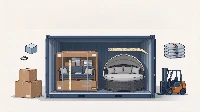

To optimize CBM and container space for bulky outdoor sofas and daybeds, work from the final packed dimensions of every component, reduce the packing envelope where the product design allows it, and test the complete order in a realistic loading plan. Then check protection, restraint, weight and unloading access before accepting the result.
That last step matters. A smaller carton is not automatically a cheaper shipment, and a container with very little visible empty space is not automatically well packed. For a hotel opening or a distributor's delivery programme, the useful measure is complete, undamaged furniture ready for installation-not simply the highest number of cartons behind the doors.
Start with the shipment, not the showroom dimensions

Measure the final outer package
CBM means cubic metres. For a rectangular package, use its outside length, width and height, converted to metres, to establish its volume. Include the carton, protective corners and any external skid or crate. A sofa's catalogue dimensions describe the furniture, not necessarily the space its export package occupies.
Use measurements from the proposed production packing specification, then recheck a finished packed sample. Protruding handles, bowed carton walls and a pallet extending beyond the box can change the usable footprint. An irregularly wrapped daybed also needs a practical outer envelope; measuring only the frame's material volume will understate the space it needs.
The distinction applies when reviewing Howvin's commercial outdoor sofas: configuration and finished dimensions help select the seating, but the shipment still needs a separate packaging schedule.
Count every carton and nested component
Furniture CBM should cover the complete supplied item. A smaller frame carton is only part of the answer if cushions, back panels, legs or hardware now travel separately. Record each package type, how many are needed per finished unit, and how many units or components each package contains.
Here is a hypothetical comparison, using invented dimensions solely to illustrate the accounting. It is not Howvin product data or a tested packing proposal. Both options are assumed to contain the same complete sofa, with all components accounted for.
| Packing item | Assembled option | Part-disassembled option |
|---|---|---|
| Main carton, external dimensions | 220 × 100 × 90 cm | 220 × 100 × 60 cm |
| Main carton volume | 1.980 CBM | 1.320 CBM |
| Separate components carton | None | 60 × 40 × 30 cm; 0.072 CBM |
| Total packed volume per complete sofa | 1.980 CBM | 1.392 CBM |
| Total packed volume for ten complete sofas | 19.800 CBM | 13.920 CBM |
The difference is 5.880 CBM across ten sofas. That establishes a volume difference, not a container saving: the alternative still needs engineering, protection, assembly and layout approval.
Nested goods need equally careful accounting. If an accessory carton sits inside a frame's existing shipping envelope, do not add its volume again to the geometric footprint. Still list its contents, quantity and weight. The packing list must reconcile the goods even when their shipping envelopes overlap.
Choose equipment around the actual load

Compare standard and high-cube equipment
A high-cube container adds height, not a wider floor. It can help when an approved stack can use that height; it may offer little practical benefit when broad daybeds must remain in a single layer.
The following are equipment examples published by Hapag-Lloyd, not guaranteed loading allowances:
| Container | Published internal capacity | Example internal height | Example door height |
|---|---|---|---|
| 20ft standard | 33.2 CBM | 2,395 mm | 2,292 mm |
| 40ft standard | 67.7 CBM | 2,395 mm | 2,292 mm |
| 40ft high cube | 76.3 CBM | 2,700 mm | 2,597 mm |
Sources: Hapag-Lloyd's 20ft standard, 40ft standard and 40ft high-cube specifications. The carrier notes that equipment varies by manufacturer.
Select the equipment after comparing feasible layouts and current quotations for the route. Confirm availability, actual dimensions and applicable weight restrictions with the carrier or forwarder. Published internal capacity includes space that your particular packages may not be able to use.
Check the doorway and the whole loading path
Volume alone cannot answer whether a package fits. For a simple example, two cartons each 1.20 metres wide need 2.40 metres side by side. They cannot occupy one straight row across an interior approximately 2.35 metres wide in that orientation, however much unused volume remains elsewhere.
The doorway creates another restriction: the example high cube above has a lower door opening than its internal roof height. Check the package's permitted entry orientation and the movement needed to position it inside. A plan that requires rotation also needs enough clear space to make that rotation.
Include the loading ramp, handling equipment and destination route in this review. A carton that enters the container may still fail to pass through the receiving warehouse door, service lift or hotel corridor. Allow the clearance the handling method needs; a nominal dimensional fit is not a working clearance. Do not rely on tipping furniture unless its packaging and handling instructions permit it.
Reduce the furniture's packed envelope

Remove only components designed to come off
Removable legs, backs or arms can reduce the outer package, but only where the furniture was engineered for that assembly method. Do not treat a welded frame as a knock-down product simply because disassembly would make the loading diagram look better.
For knock-down outdoor furniture, request the assembly drawing, joint specification, component labels and hardware list alongside the packing proposal. Have the receiving team review the actual assembly sequence. Can they reach the fasteners? Are special tools needed? Can they identify left- and right-hand modules without opening every box?
Compare complete configurations, not just main cartons. Detaching a backrest may reduce height while creating a second awkward package. A change is worthwhile only if the combined packages load better and the finished product still meets the project's approved specification. Any proposed structural alteration needs fresh engineering review, not merely a revised carton drawing.
Treat round daybeds and nesting as separate engineering problems
A round daybed is not a round hole in the container. Its enclosing package may leave corners that cannot accept another substantial item. A canopy, projecting arm or non-removable back can make the effective shipping envelope larger still.
Request a packing drawing showing whether the canopy, base, cushions and any side tables travel together or separately. A product page such as the Sea View Room Grey Garden Daybed is a starting point for product selection-not proof of packed size, nesting capability or loading quantity.
Where nesting is proposed, require a trial with the actual protective separators. Confirm insertion clearance, contact points and removal access. Do the parts separate without dragging across a finished surface? Can the receiver extract the inner item without cutting protection against the frame? Empty-looking space is useful only when something can occupy it without creating damage or an unloading problem.
Keep protection and stackability in the plan

Establish where the weight can travel
Do not infer stackability from a square carton or a metal frame. Obtain the permitted orientation, maximum stack arrangement and allowable load above each package. Ask what supports that load: the carton walls, an internal support, a purpose-built skid or a verified part of the frame.
The CTU Code's packing guidance, particularly Annex 7, addresses package strength, compatible mixed loads and the transfer of weight through stacked cartons. It does not supply a universal stack height for outdoor furniture.
For powder-coated frames, teak, rope and woven surfaces, include contact-point inspection in the packing trial. Check where separators, straps, detached parts and neighbouring packages touch the product. Reject a layout that depends on an unverified armrest or woven seat acting as a support shelf. Keep the trial record specific to the packaging version; a thinner carton or different internal support can change the arrangement that was approved.
Do not solve cushion volume by creating a moisture problem
Cushions deserve their own packing decision. Ask the foam and upholstery supplier whether the proposed compression, duration and storage conditions are acceptable, and test recovery on the actual cushion construction. Check shape, seams, piping and appearance after unpacking-not just whether the cushion becomes smaller inside a bag.
Moisture needs a separate control. TT Club explains that temperature changes, damp wooden packing and containers that have not dried properly can contribute to condensation damage. See its guidance on climatic risks in the logistics supply chain.
Require dry goods and suitable packaging conditions before sealing. Have the packaging specialist specify the moisture-control approach for the cargo and route; do not copy a universal desiccant quantity from another shipment. Outdoor-use fabric does not, by itself, establish that a sealed cushion package can tolerate trapped moisture throughout storage and transport.
Make the mixed-load plan executable

Give loading software the constraints it cannot guess
A three-dimensional loading model is useful when its inputs describe the shipment accurately. Along with dimensions and quantities, supply gross weights, permitted rotations, non-stackable items, top-load limits, package groupings and required access for handling and restraint.
For sofa container loading, distinguish a seating module from a complete set. A diagram may place all the seat bases while leaving out the cushion cartons, connectors or tables needed to finish the order. Require the output to reconcile with the package-level packing list, including any intentionally unallocated cargo.
Read the proposed loading sequence as well as the final picture. Can the loading crew place each package with the equipment available, or does the model effectively drop boxes through the roof? Record assumptions and unresolved items. Software shows a proposed arrangement; the packer must still confirm that it is practical and safe.
Plan for the first item the receiver must remove
The highest-density arrangement may conflict with a hotel's installation sequence. Pool-deck furniture might be needed first while rooftop seating remains in storage. If the pool furniture is inaccessible behind unrelated packages, the receiver may need extra handling and temporary storage before installation can begin.
Agree priorities with the receiving team before finalizing the layout. Where feasible and safe, place early-access packages where they can be removed without disturbing the rest of the load. That preference must remain subordinate to safe weight distribution and restraint.
Use package identifiers tied to the project area, item code and carton sequence. Keep assembly kits traceable to their furniture, even when shipped elsewhere in the container. For multiple suppliers, appoint one consolidator to reconcile the complete cargo list and loading revision. Several individually reasonable packing plans do not automatically combine into one workable container.
Leave room for safe transport

Reserve space for restraint and verify the weight
A void is not always wasted space. The packer may need room for protective separation, blocking or other restraint. Do not replace a specified restraint arrangement with extra saleable goods just to increase the fill figure.
The joint IMO/ILO/UNECE CTU Code is a non-mandatory global code of practice, not a furniture certification. Use qualified packing personnel to determine suitable securing and safe unloading arrangements. Do not assume closing the doors resolves cargo movement.
Volume and mass also need separate checks. Adding dense tabletops or other heavy accessories to a bulky seating shipment changes the weight distribution. Confirm equipment and inland transport limits. For shipments covered by SOLAS VGM requirements, follow the applicable verification method and submission process; the declaration is not merely the furniture's net weight. The IMO's VGM explanation sets out the shipper's responsibility and the loading condition.
Check timber packaging before adding crates or skids
A wooden crate or skid changes more than the CBM total. It changes gross weight, handling arrangements and potentially the shipment's phytosanitary obligations. Treat it as part of the approved package, not an item the loading crew can add without updating the records.
ISPM 15 addresses regulated wood packaging material used in international trade, including relevant raw-wood pallets, crates and dunnage. The standard has exemptions, including qualifying packaging made wholly from processed wood such as plywood. It is not a blanket requirement to fumigate every piece of wooden furniture, nor a certificate of furniture quality.
Confirm the proposed packaging construction and destination requirements with the supplier and responsible freight or phytosanitary adviser. A plywood panel does not establish that every timber component of a mixed-material crate is exempt.
Decide whether the change actually saves money

Identify the container-booking threshold
For an FCL quotation, distinguish the charge for booked equipment from charges that vary with the shipment. If the order still needs the same container type and count after a packaging change, lower CBM does not automatically produce an equivalent reduction in the ocean-freight bill.
The practical questions are more specific: does the revised, verified plan avoid an additional container, allow different equipment, or create room for other items the project genuinely needs? Compare quotations for those actual alternatives, including handling and destination costs. Do not convert a percentage reduction in carton volume directly into a percentage freight saving.
Return to the hypothetical ten-sofa example. Its 5.880 CBM reduction could be useful, but it tells us nothing about container count until the rest of the order and the feasible layout are known. Ordering unwanted stock to fill the gap is not necessarily an improvement.
Price the installation and operating consequences
Less assembly at the factory may mean more assembly at the property. Before choosing the smallest package, price the receiving team's labour, tools, work area, unpacking, waste removal and inspection. For a resort with limited storage or a narrow installation window, these are delivery conditions, not minor extras.
Compare the alternatives through a trial assembly of the supplied configuration. Record missing-part risks, instructions, access to joints and the checks required before guest use. Ask who resolves damaged components or incompatible fittings and whether replacement parts are actually available for that model.
Keep maintenance in view as well. If the proposed design introduces joints or fasteners with additional inspection requirements, obtain the manufacturer's instructions and include that work in the operating plan. A compact shipment is valuable when the installation and ongoing use remain practical-not when the saving depends on overlooking work at destination.
Release a packing specification, not a promise

Request a package-level approval file
An estimated total CBM is useful for an early enquiry. Before production packing and container booking are committed, move to a file that purchasing, the factory, the packer and the receiver can all read against the same revision.
The following is a buyer's approval checklist, not a claim that every supplier already provides these records:
| Record | What it should establish | Who should confirm it |
|---|---|---|
| Package-level schedule | External dimensions, gross weight, contents, quantities and packages per complete unit | Supplier and buyer |
| Packing drawings and trial record | Protection, nested parts, orientation, supports and approved stacking | Supplier's packaging/engineering team |
| Loading plan | Equipment assumptions, positions, sequence, restraint allowances and any excluded cargo | Responsible packer and forwarder |
| Receiving plan | Unloading equipment, access dimensions, staging and assembly sequence | Project logistics/installation team |
| Final shipment record | Actual package count, changes, loading photographs, container/seal details and required weight documentation | Shipper and responsible loading team |
Do not let "approximately one container" stand in for these decisions. Where a field remains unconfirmed, identify its owner and resolve it before relying on the loading count in a purchase or delivery commitment.
Validate the final arrangement before dispatch
Use a finished packed sample to verify dimensions, orientation, component protection and assembly. For a new packing configuration or a tight load, agree an appropriate physical loading trial or other verification with the packaging and logistics specialists. Check the cushioning and recovery after unpacking as well as the closed package. The test should address the uncertainty in that shipment, not simply produce a reassuring photograph.
Then control changes. If the factory adds a skid, changes the carton wall or separates cushions into another package, revise the schedule and rerun the affected layout. A loading plan for an earlier package is no longer a reliable basis for the final count.
During loading, reconcile actual cartons with the plan and record significant departures before the container is sealed. Send the receiver the final packing list and relevant unloading information. The purpose of container space optimization is a shipment that works at both ends, not a drawing that becomes obsolete on dispatch day.
FAQ:
How many outdoor sofas fit in a 40ft container?
There is no reliable universal count. It depends on external package dimensions, cartons per complete sofa, permitted orientations, stacking, restraint and the other goods in the load. Request a layout for the actual order and equipment. Dividing published container capacity by a sofa's catalogue volume is not enough.
Is a high-cube container always the better choice?
No. Extra height is useful only when the approved packages and stacking arrangement can use it. Broad, non-stackable daybeds may remain floor-space limited. Compare feasible counts, equipment availability, route quotations and receiving conditions rather than choosing solely from the published CBM capacity.
Is knock-down packing always cheaper overall?
No. It can reduce the shipping envelope, but it also changes assembly, inspection and component management. Compare the complete packed configuration and installed cost. The product must be designed for the proposed joints and assembly method; a smaller carton does not establish equivalent finished-product performance.
Can cushions and accessories travel inside sofa frames?
Sometimes, if the packing design provides suitable space, separation, support and removal access. Include every item in the contents and weight records, while avoiding double-counting an already occupied outer shipping envelope. Do not use the cushion or woven seat as unverified load-bearing packing material.
Can outdoor sofa cushions be vacuum packed?
Only where the foam, fabric and finished cushion construction are suitable for the specified process. Obtain the supplier's approval and test recovery after representative compression and storage conditions. Without that evidence, do not assume vacuum packing will preserve shape, appearance or comfort, or resolve moisture risks.
Does lower CBM automatically reduce an FCL freight bill?
No. The bill may remain similar if the same equipment and number of containers are still booked. Establish whether the revised plan changes the actual booking or another chargeable service. A packaging-volume improvement and a verified freight-cost saving are separate results.
Conclusion: buy usable capacity
The strongest loading plan starts before cartons are ordered. Measure the complete shipment, challenge avoidable packing volume, and verify the physical layout without sacrificing protection or receiving access. Judge the result by complete furniture delivered and installed, not by a headline fill percentage.
For a Howvin project enquiry, share your sofa and daybed shortlist, quantities and receiving constraints. Request confirmation of the model-specific packing details before accepting a container quantity. Exact loading counts and any claimed savings need the actual packaging specification, shipment mix and approved plan.