Buy commercial patio umbrellas as complete shade systems: canopy, frame, base or anchor, installation interface and operating instructions. A large canopy and a heavy base, purchased separately, do not by themselves establish that the combination suits a hotel terrace.
For hospitality projects in the UAE and Saudi Arabia, begin with where shade is needed and when, then resolve the mounting arrangement and documented operating conditions. Only after those decisions should colours, branding and optional accessories be finalised.
This is a procurement guide for movable commercial parasols and their interfaces. It does not provide structural calculations, approve roof fixings or replace local project requirements. A ground-level courtyard, beachfront restaurant and rooftop pool need separate consideration. "Suitable for the Middle East" is not a sufficient installation brief.
Specify the shade guests will actually receive

Map occupied shade through the intended service hours
Mark the seats, tables or loungers that need shade, together with the hours and seasons when those positions are used. Ask the designer or supplier to check the proposed canopy position against that brief. A canopy's dimensions describe its fabric envelope; they do not guarantee that every position below it remains shaded throughout service.
ARPANSA's guidance on shade identifies positioning, canopy height, sun direction and the person's location as relevant to coverage, alongside scattered and reflected ultraviolet radiation. Translate that into a practical layout review rather than a claim of complete protection. Nor should a shade layout be sold as a guaranteed reduction in air temperature or a promise that the terrace will be comfortable in every condition.
Choose the support position around the furniture and circulation
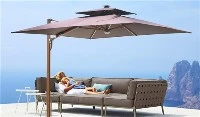
A centre-pole umbrella places its support beneath the canopy's centre. A cantilever or offset model moves the main support to the side. The latter may help where a central pole conflicts with the intended arrangement, but its mast and base still occupy space elsewhere.
Draw the complete assembly into the furniture plan, including the base, closed position and any permitted rotation. Check chair pull-back, lounger adjustment, service access and neighbouring structures. Do not assume that a table hole provides sufficient support, or that an offset canopy leaves the entire surrounding floor unobstructed. Ask for the exact model drawing rather than planning around a generic umbrella symbol.
| Arrangement | Layout advantage to assess | What still needs checking |
|---|---|---|
| Centre-pole model | Support can align with a planned table or between seating positions | Pole/base compatibility, legroom, table interface and opening clearance |
| Cantilever model | Main support can sit outside the central seating arrangement | Mast/base footprint, permitted rotation, clearances and approved mounting |
| Freestanding weighted system | May allow repositioning where the approved design permits it | Correct ballast configuration, floor suitability and instructed movement |
| Fixed base, plate or socket | Can suit a deliberately coordinated permanent location | Supporting structure, installation detail, approvals and responsibility for the building interface |
These are not interchangeable performance categories. Confirm the combinations actually offered and supported by the manufacturer.
Resolve the base and building interface early

Buy an approved combination, not a weight from a generic chart
Ask the supplier to identify the complete configuration: canopy size and shape, frame, mast, base or anchor, required ballast and relevant operating instructions. The evidence should correspond to that combination. If the quoted base changes, ask what that change means for the supplied documentation and permitted use.
Avoid turning a general online weight recommendation into a project approval. Confirm the base's footprint, assembly, filling requirements where applicable and the way it secures the mast. Make clear whether the delivery includes all ballast and connecting components. A base described as "included" can still leave unanswered questions about what arrives, what must be supplied locally and who checks the completed assembly.
Coordinate fixed mounts with the responsible project team
Before selecting a fixed system, provide the relevant project team with the proposed position, umbrella configuration and manufacturer's installation requirements. The responsible designer or engineer should determine the appropriate supporting detail and any necessary verification. Procurement should not choose fasteners or foundations from a marketing photograph.
On roofs and podiums, explicitly address the structure, waterproofing, services, access and permitted installation work. Paving or a decorative finish is not enough information to approve a fixing. Agree who designs the interface, obtains required approvals, installs it, inspects it and deals with any building warranty implications. If those responsibilities are unresolved, the umbrella package is not ready for unconditional installation approval.
Separate wind-test claims from operating rules

Ask what was tested and what the result permits
"Wind-tested" should lead to a document request, not the end of the discussion. Ask for the model, canopy, mounting arrangement, test method, report identity and the manufacturer's written operating limits. Clarify whether the information concerns an open canopy, a closed assembly or another condition, and whether the quoted configuration differs from the tested one.
ASTM F3512 is a published test method addressing wind safety and durability of market umbrellas; naming it is not proof that a product has been tested or certified. Separately, Tuuci's care and operating guidance distinguishes test statements from collection- and anchoring-dependent use limits. Request equally clear instructions for the product you are considering, without transferring another brand's limits to it.
Make closing the umbrellas an assigned operating task
The purchasing team needs to know how the property will implement the supplied restrictions. Identify who monitors conditions, who decides to close the umbrellas, which staff are trained to do it and what happens when the responsible person is unavailable. Include any overnight or unattended-use instructions from the manufacturer.
Do not treat the highest test number in a brochure as the point at which staff should begin reacting. Have the operator and responsible advisers agree a procedure consistent with the actual product and site. If a proposed model cannot be closed and secured in a workable manner, reconsider the arrangement before ordering. Additional ballast is not a substitute for resolving an impractical operating plan.
Ask precise questions about canopy performance

Check the scope behind a UV-protection label
If a canopy is advertised with a UV-protection rating, request the actual report, test standard, material reference and colour. Understand whether the claim describes transmission through a fabric sample or something else. It does not, by itself, approve the position and coverage of the complete installed umbrella.
ARPANSA's shade-fabric testing service uses an Ultraviolet Effectiveness, or UVE, rating under AS 4174 and explains why its clothing-standard UPF scheme does not apply to shade fabrics. That is a reason to check a rating's method and scope-not to declare every UPF-labelled canopy worldwide invalid. For a Gulf project, agree which evidence the specification requires and verify that the supplied canopy matches it.
Keep fading, water resistance and project fire requirements separate
A UV-transmission result does not answer every canopy question. Request the evidence appropriate to the intended claims about colour retention, water resistance and other specified properties. Identify the fabric, finish, stitching and any branding process being supplied, and ask whether changes affect the relevant documentation or warranty.
If the project requires fire-performance evidence, have the responsible consultant identify the applicable requirement and acceptable report scope. Do not assume a fabric name, a coating description or a general "commercial grade" label settles that issue. Similarly, do not promise that a water-resistant canopy creates a fully weatherproof dining area. The buyer needs clear limits on what the product is intended to do.
| Sales claim | Useful follow-up | What it does not establish alone |
|---|---|---|
| Wind-tested | Report, tested configuration and written operating instructions | Permission to leave any size or mounting arrangement open in all conditions |
| UV-protective fabric | Test method, rating scope and matching material/colour identity | Full-time protection at every seat beneath the installation |
| Water-resistant canopy | Relevant material evidence and intended-use limitations | A waterproof outdoor room |
| Commercial grade | Identifiable specification, documents and supported operating use | A universal certification or maintenance-free product |
| Heavy-duty base | Exact compatible assembly, required ballast and installation instructions | Suitability for every surface or exposed site |
Specify materials for inspection and maintenance

Obtain a component schedule for coastal or dusty positions
Ask for the frame and mast materials, surface treatment, connecting hardware, moving components, canopy and base construction. Tell the supplier about the actual exposure and cleaning routine, then request the relevant suitability and maintenance information. A coastal position should not be approved merely because a brochure uses the phrase "marine grade".
Include the less visible parts in the review: hubs, joints, locks, sleeves and the connection to the base. Ask which areas require inspection, what deterioration should trigger action and how a damaged finish is assessed. The objective is a maintainable assembly with documented instructions, not a list of supposedly superior materials without product-level evidence.
Establish what can be repaired without replacing the whole system
Request an illustrated parts list or another clear component-identification system. Check whether the canopy, ribs, operating mechanism, connecting hardware and protective cover can be ordered separately where relevant. Ask what tools, instructions and authorised repair arrangements are required.
Review the practical consequence of a failure. A replaceable canopy is useful only if the replacement fits the frame and the property has a workable route to obtain and install it. Record fabric and finish references and ask about compatibility if the model changes later. Do not assume that a similarly sized canopy from another supplier will fit, or that a verbal promise of "spares available" guarantees indefinite future stock.
Test the daily operation on a complete sample

Demonstrate opening, closing and adjustment in the proposed position
Have staff operate the actual model according to its instructions. Check the reach needed, control position, locking sequence and clearance throughout movement. Where tilt or rotation is offered, establish which positions are permitted and what space they require. Include the furniture arrangement during the demonstration rather than testing the umbrella in an empty area.
Verify that closing does not require an impractical rearrangement of tables or loungers every evening. Confirm where the fabric sits when secured and how the protective cover is fitted, if supplied. If the mechanism needs more effort or access than the operating team can reasonably provide, address that before approving a large quantity. A convenient showroom demonstration is not the same as a workable service routine.
Write a care and storage plan the team can follow
Obtain instructions for the canopy, frame, mechanisms and base separately where their care differs. Confirm approved cleaning products and methods with the supplier. Tuuci's published guidance, for example, includes anchor checks, component inspection and specific cleaning restrictions; it illustrates why the product's instructions belong in the operating handover rather than only with procurement.
Decide where removed covers or canopies will be cleaned, dried and stored under the supplied instructions. Establish how closed units will be secured and whether any proposed relocation is permitted. Do not invent a universal Gulf cleaning interval: use the manufacturer's requirements and the property's observed conditions to build a workable schedule, then review it when inspection findings justify a change.
Compare complete quotations and control changes

Ask every bidder to price the same installed scope
Separate the umbrella itself from the base, ballast, anchor, installation work, protective cover and optional equipment. Require bidders to identify exclusions and responsibilities clearly. Otherwise, an apparently cheaper quotation may simply omit the components or site work another bidder included.
When exploring Howvin's commercial umbrella range, provide the layout, destination, exposure, quantities and known mounting constraints. Ask which configurations and supporting documents can be confirmed; do not assume that every category-page option is available on every model. If lighting or other powered accessories are proposed, include their interfaces and the relevant project review instead of treating them as decorative extras.
| Quotation or handover item | Clarification required |
|---|---|
| Shade assembly | Model, canopy dimensions/shape, colour, material and permitted adjustments |
| Ground interface | Exact base/anchor, ballast, connection components and supporting-surface requirements |
| Installation | Design, approvals, site work, assembly, inspection and each party's responsibility |
| Operation | Instructions, restrictions, staff demonstration and closing/securing procedure |
| Accessories | Covers, branding, lighting or other options, with compatibility and relevant documents |
| Delivery | Packaging, access, unloading, storage, assembly location and discrepancy process |
| Support | Component references, maintenance instructions, warranty conditions and confirmed service arrangements |
Keep the approved configuration intact through delivery
Record the approved drawings, fabric references, finish, mounting arrangement and accepted deviations. If a supplier proposes a change to canopy size, mast, base or mechanism, ask which approvals and evidence need to be revisited. Do not accept a structurally relevant substitution as a minor aesthetic change.
Coordinate delivery with the readiness of the installation positions. Establish what must be complete before assembly, who provides lifting or handling equipment where needed and where unopened packages can be stored. For multi-phase projects, preserve item identities across shipments. Matching colours are not enough if later units arrive with different mechanisms or mounting requirements that the maintenance team has not been told about.
Make handover an operating approval, not just a delivery receipt

Close out installation and training records before use
Collect the installation and assembly records required by the project, including confirmation that the supplied components match the approved arrangement. Have the responsible parties resolve outstanding questions about the base, supporting surface, fixing or operating condition before the umbrellas are released for service.
Give the operating team the relevant instructions and a practical demonstration. Record who is responsible for checks, closing, securing and reporting faults. Where the project requires additional professional approval, a supplier's delivery signature does not replace it. Do not ask staff to compensate for an unresolved installation issue by "being careful", and do not alter components on site without an approved response from the responsible parties.
Budget for upkeep, replacement and unavailable shade
Compare acquisition and installation costs with the work needed to inspect, clean, operate, store and repair the system. Consider the effect of taking an umbrella out of service: is the furniture beneath still usable under the property's operating plan, or must that position close until a repair is complete?
Use confirmed part prices, service arrangements and the operator's staffing information where available. Avoid universal payback periods or promises that a higher-priced model will never need replacing. Clarify warranty conditions, including installation, exposure, maintenance and damage exclusions. The better purchase is the documented system the site can support-not necessarily the biggest canopy, heaviest advertised base or most dramatic wind claim.
Frequently asked questions
Are cantilever umbrellas better than centre-pole umbrellas for hotels?
They solve different layout problems. A cantilever model moves the support away from the canopy centre but still needs space for its mast, base and permitted movement. Choose using the actual furniture plan, mounting options, operating requirements and documented configuration rather than assuming one type is universally superior.
How heavy should a commercial umbrella base be?
Use the manufacturer's specified base and ballast for the exact umbrella and approved arrangement, with the necessary site review. Canopy dimensions alone are not enough to prescribe a safe weight. Confirm what the package includes and who supplies, assembles and verifies any ballast or anchoring components.
Can a wind-tested umbrella remain open overnight?
Not on that description alone. Follow the product's instructions for unattended use, weather and closing. A test result does not automatically permit every operating condition. Assign trained staff to carry out the property's agreed procedure and confirm how closed units must be secured.
Does a UPF label prove the whole seating area is protected?
No. Check the report and rating scope, then assess coverage at the occupied positions and relevant times. A fabric result is not a measurement of every guest's exposure beneath the installed umbrella. Do not turn a canopy label into a promise of complete protection.
Can umbrella bases be fixed directly to a hotel roof or deck?
Only through a project-approved arrangement. The responsible team must address the supporting structure, surface, waterproofing and manufacturer's requirements, with the necessary approvals. This is not a decision to make from a generic online fixing diagram or an assumed concrete layer beneath the paving.
What should a hotel send with an umbrella quotation request?
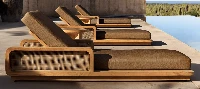
Provide the site and destination, intended operating times, furniture layout, required shade positions, quantity, exposure and known installation constraints. Include requested finishes and documents, and ask bidders to identify exclusions. Where umbrellas accompany poolside loungers and daybeds, coordinate both footprints in the same layout review.
Approve the shade system, not just the canopy
A useful umbrella specification connects shade coverage, the complete assembly, the building interface and the daily operating routine. Resolve those connections before treating the order as ready for installation.
For a Howvin enquiry, send the project layout and operating brief alongside the desired quantities and design direction. Ask Howvin to confirm the proposed configurations, available evidence and supply scope. Keep engineering, installation and local approval responsibilities explicit rather than assuming they are included with the product.