

For a production-ready full-container order built from established commercial resort furniture, current supplier-published evidence supports using 35–60 days as a factory-production discussion window. That does not mean every FCL should be promised in 35–60 days. The range is credible only when the designs are settled, the deposit has cleared, the drawings and materials are approved, and the factory has confirmed capacity for the actual SKU schedule.
The distinction matters. Howvin's published hospitality-furniture guidance states 35–45 days for standard contract designs and 50–60 days for complex, fully customized mass production. Its clock starts after deposit confirmation and shop-drawing approval, and it excludes ocean freight. Another resort-furniture manufacturer, SOVAA, publishes 6–8 weeks after sample approval and deposit confirmation for a standard FCL.
Those are supplier-published planning anchors, not an audited industry average and not a substitute for a live quotation. A newly engineered collection, unresolved upholstery, special tabletops, fresh tooling, late buyer changes, or failed inspection can push the cargo-ready date beyond the published band. Conversely, stock and tightly restricted quick-ship programs can move faster because they remove choice and development work.
The most useful question is not simply, "How many days?" It is: What has to be true before day one, and what exactly will be complete on the final day?
Why public lead-time numbers seem to contradict one another
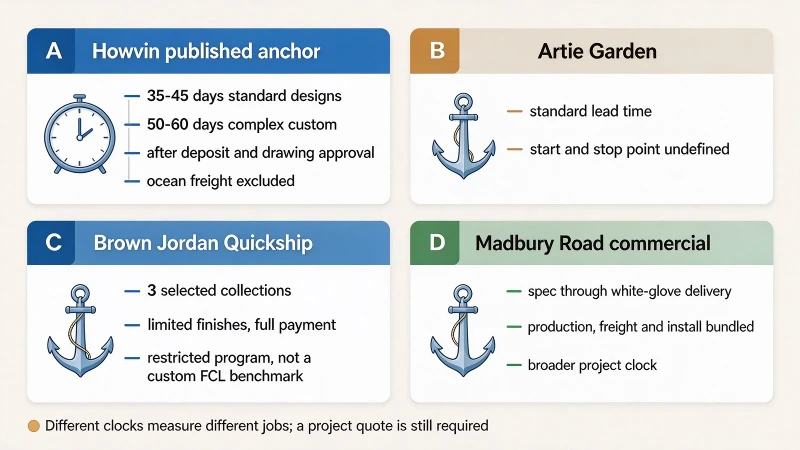
Four current supplier pages illustrate the problem. Their figures are real, but they do not measure the same job.
| Published statement | What the number covers | Why it is not directly comparable |
|---|---|---|
| Howvin: 35–45 days for standard designs; 50–60 days for complex custom mass production | Production after deposit and shop-drawing approval; ocean freight excluded | Does not state whether "days" means working or calendar days; a project quote is still required |
| Artie Garden: 45–60 days | Described as a standard lead time | The page does not define its start point, stop point, product mix, or transport scope |
| Brown Jordan Quick Ship: 6–8 weeks | Three selected collections with limited finishes, no substitutions, and full payment | A restricted program is not a benchmark for a custom mixed-SKU FCL |
| Madbury Road: 3–4 months | Approved specification through white-glove delivery, with production, freight, and installation coordination | This is a broader project-delivery clock, not factory production alone |
A buyer who compares only the bold numbers could conclude that the market ranges from two weeks to four months. The better conclusion is that the word lead time is too vague to put into a purchase order without a definition.
Start the production clock only when the order is genuinely ready
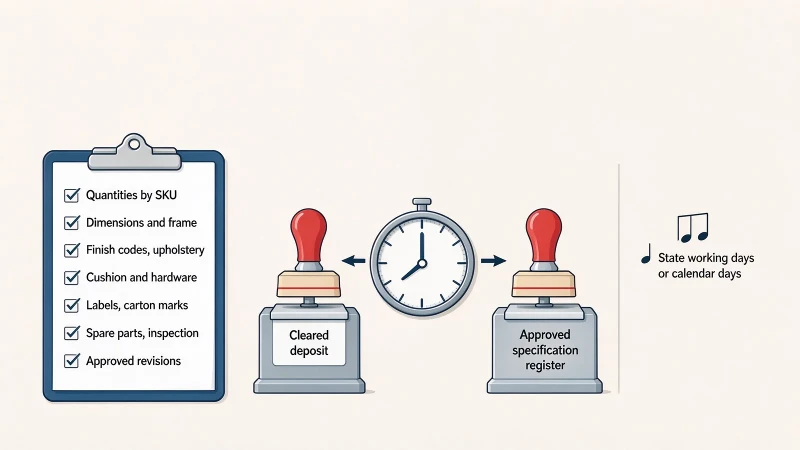
Issuing a PO does not necessarily release production. A factory cannot build consistently from a mood board, an old drawing, and a message saying the fabric is "something close to beige." For a resort project, the release package should identify quantities by SKU, dimensions, frame construction, finish codes, upholstery, cushion construction, hardware, labels, carton marks, spare parts, inspection rules, and approved revisions.
If the order needs a physical prototype, finish panel, fabric cutting, tabletop sample, or revised shop drawing, decide whether that work sits before the production clock or inside it. Most schedule disputes begin when the buyer counts from the PO date while the supplier counts from the final approval.
Use separate schedule terms:
| Clock | Start | Finish |
|---|---|---|
| Product development | Complete design brief received | Prototype or control sample approved |
| Factory production | Written release trigger, usually cleared deposit plus approved specification | Finished units reach the agreed production-completion gate |
| Cargo ready | Production release | Accepted goods are corrected where required, packed, marked, documented, and available for handover |
| Transport | Carrier handover or agreed shipment event | Named port, warehouse, or project destination |
| Site delivery | Agreed commercial start | Furniture is received and accepted at the nominated location, with installation included only if contracted |
Also ask whether quoted days are working days or calendar days. Do not leave that point to interpretation.
An FCL is a shipping unit, not a manufacturing specification
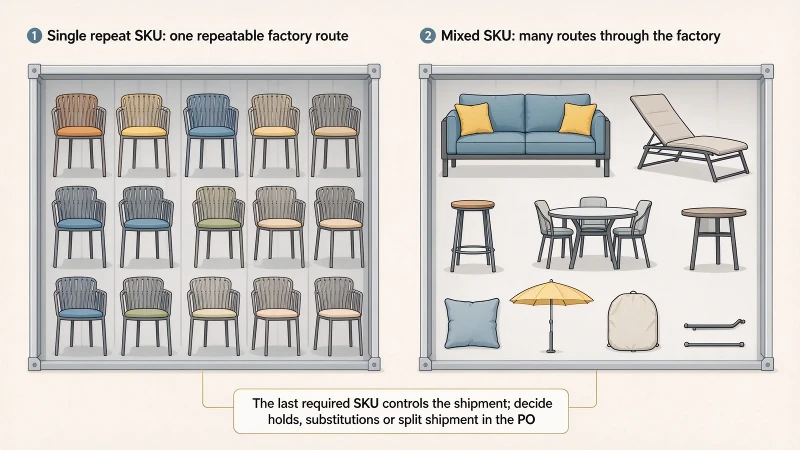
A 40-foot container of one repeat dining chair is a different production job from a container holding sofas, loungers, dining sets, bar stools, side tables, cushions, parasols, spare covers, and replacement glides. Both are FCLs. Only one has a single, repeatable route through the factory.
Howvin's commercial outdoor-furniture categories show the range that can appear in a resort package. Aluminum frames move through cutting, welding, surface preparation, coating, and assembly. Rope or woven products add handwork. Teak and other wood components bring material selection, machining, sanding, and finishing. Upholstered pieces depend on fabric approval, foam, sewing, fit, and drainage details. Stone, ceramic, glass, or compact-laminate tops may come from a separate component supplier.
The site environment can add further approval work. A beachfront scheme may need a more carefully documented coating, fastener, and maintenance specification. Poolside cushions require decisions about fabric, foam, drainage, cleaning, and replacement covers. These requirements do not have a universal number of extra days, but they need to be settled before the date is credible.
In a mixed container, the last required SKU usually controls the shipment. An almost-complete container cannot leave without the buyer making a conscious choice to hold it, remove the late line, approve a substitution, or pay for a separate shipment. That decision rule belongs in the PO before it becomes urgent.
Build a milestone schedule that produces evidence
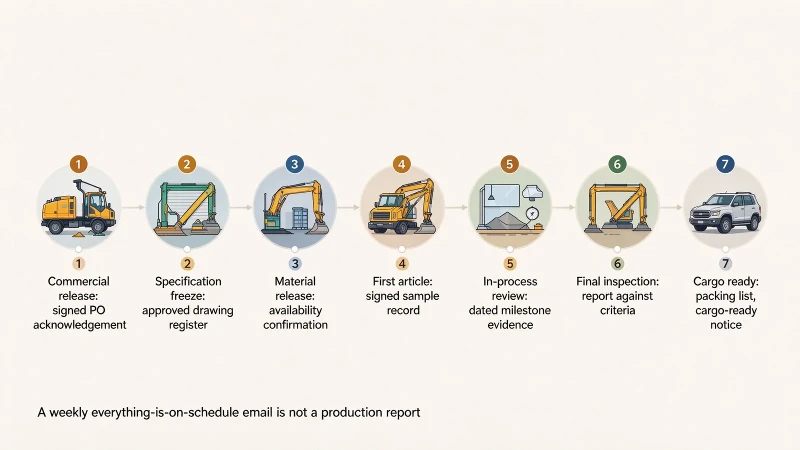
A weekly email saying "everything is on schedule" is not a production report. Each milestone should leave behind something the buyer can review.
| Gate | What must be settled | Evidence to request | Typical reason to stop |
|---|---|---|---|
| Commercial release | Price, SKU quantities, payment trigger, trade term, target cargo-ready date | Signed quotation or PO acknowledgement with revision number | Different assumptions in buyer and supplier documents |
| Specification freeze | Dimensions, materials, colors, fabric, construction, hardware, labels, packaging | Approved drawing and specification register | Open comments or conflicting revisions |
| Material release | Finish chips, fabric, rope or weave, timber or tabletop references as relevant | Approval log plus written material-availability confirmation | Unapproved shade, texture, substitution, or component |
| First article | Appearance, dimensions, comfort, function, critical construction, packing concept | Signed sample record, measurements, photographs, and deviation list | Rejected sample or incomplete corrective action |
| In-process review | Frame work, coating, weaving, woodworking, sewing, assembly | Dated, PO- and SKU-linked milestone evidence | Process issue or missing component |
| Final inspection | Quantity, workmanship, dimensions, function, appearance, accessories, labels, packing | Inspection report against agreed criteria | Failed acceptance or open corrective action |
| Cargo ready | Corrections closed, goods packed, counts and marks confirmed, documents prepared | Packing list, closure evidence, package records, written cargo-ready notice | Rework, incomplete packing, or document mismatch |
This schedule also exposes the real critical path. If a special fabric has not been ordered, photographs of welded frames do not prove that the shipment date is safe. If all furniture is assembled but the carton marks are wrong, the goods may be physically finished and still not be ready for handover.
Changes, materials, and factory capacity move the date
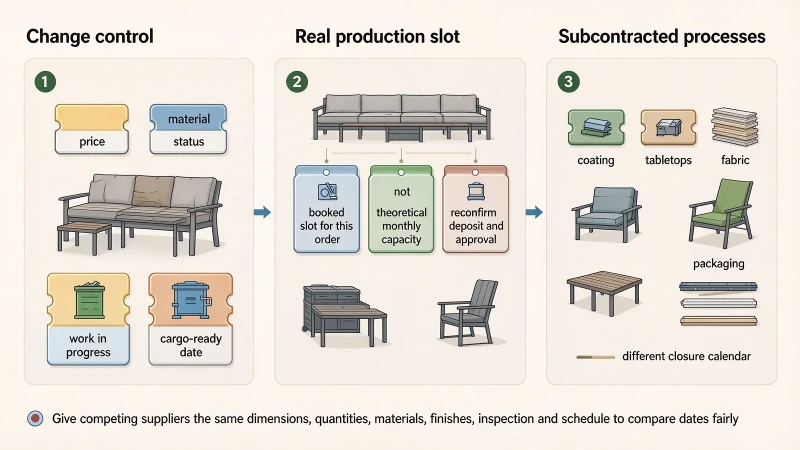
Some delays belong to the buyer, some to the supplier, and some to neither party. The schedule should make that visible.
After the specification freeze, require every change to carry a written effect on price, material status, work in progress, and cargo-ready date. A new frame color may look minor in a design meeting, yet it can affect coating procurement, sample approval, and items already fabricated. A replacement fabric may change not only sewing but also cushion appearance and the approved control sample.
Capacity needs equally precise language. Ask the factory to confirm the production slot for the order-not its theoretical monthly capacity. Then ask which processes are subcontracted and whether coating, tabletops, fabric, packaging, or other component suppliers follow a different closure calendar. Reconfirm the slot when the deposit and approval package are complete; an old quotation does not reserve capacity indefinitely.
Howvin's guide to a production-ready custom brief recommends giving competing suppliers the same dimensions, quantities, materials, finishes, upholstery, inspection, packaging, destination, and schedule requirements. That is the only sensible way to compare dates. Otherwise, the fastest quotation may simply exclude the most work.
Inspection and packaging are part of the production plan
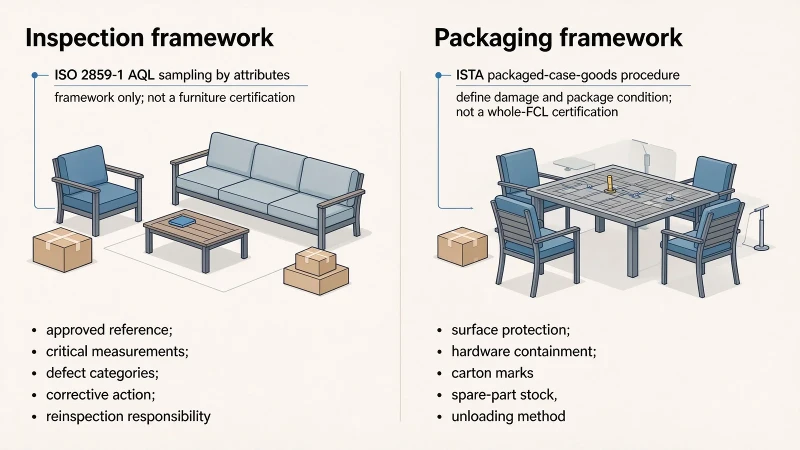
Do not wait until the container is booked to decide what a failed inspection means. The PO should identify the approved reference, critical measurements, functional checks, appearance rules, defect categories, sampling plan, corrective-action procedure, and who pays for reinspection when applicable.
The ISO 2859-1 acceptance-sampling standard describes AQL-indexed sampling schemes for lot-by-lot inspection by attributes. It is a sampling framework. It does not certify the furniture, decide the buyer's defect limits, prove every unit is defect-free, or guarantee on-time completion.
Packaging needs the same discipline. The ISTA 2C overview covers individual packaged furniture case goods and requires the shipper to define product damage, allowable damage, and acceptable package condition. It should not be turned into a vague claim that an entire mixed FCL is "ISTA certified." The proposed procedure must fit the actual furniture, package, handling, and distribution route.
For a resort order, approve surface protection, hardware containment, assembly instructions, carton identification, handling marks, spare-part placement, and the planned unloading method before bulk packing. A late carton redesign can affect protection and container quantity even when the furniture itself is complete.
Production complete is not the same as vessel departed
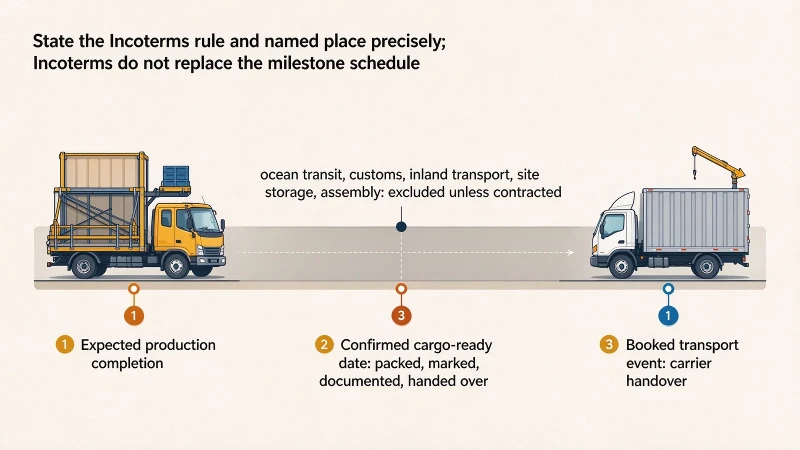
Ocean transit, customs, inland transport, site storage, assembly, and final acceptance are not part of factory production unless the contract explicitly bundles them. Container booking and carrier cut-offs can also occur on a different schedule from manufacturing.
State the agreed Incoterms rule and named place precisely. The International Chamber of Commerce's Incoterms checklist makes clear that delivery, risk, cost, transport, and documentation depend on the selected rule and location. Incoterms do not replace a production milestone schedule; the two documents solve different problems.
For planning purposes, keep at least three dates visible: expected production completion, confirmed cargo-ready date, and booked transport event. Treating them as one date invites trouble.
A short quotation can become an expensive schedule
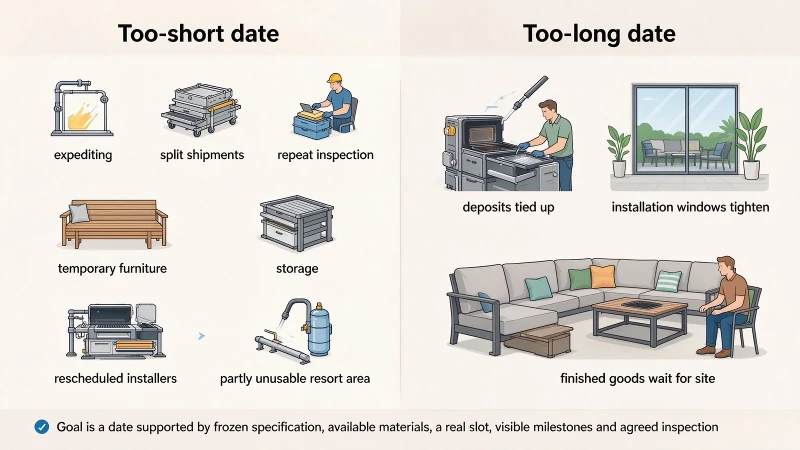
An optimistic date may later reappear as expediting, split shipments, repeat inspection, temporary furniture, storage, rescheduled installers, or a partially unusable resort area. A long date has costs too: deposits remain tied up, installation windows tighten, and finished goods may wait for a site that is not ready.
The goal is not the smallest number. It is a date supported by a frozen specification, available materials, a real production slot, visible milestones, agreed inspection, and a clear response when one SKU falls behind.
What to put in the RFQ or purchase order
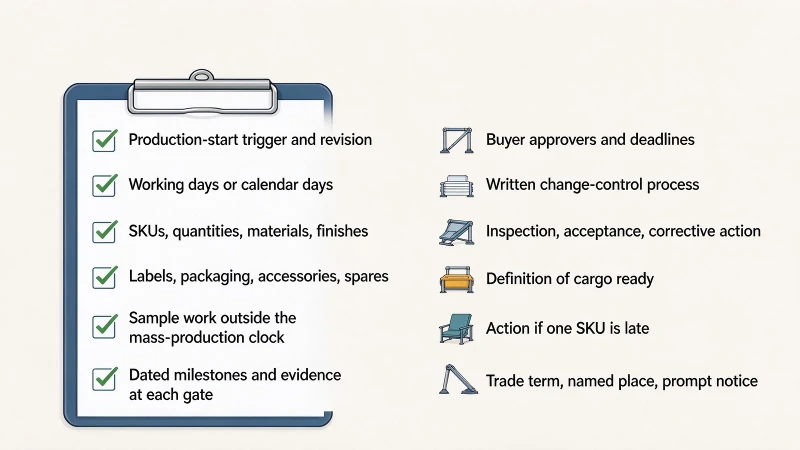
At minimum, record the following:
the exact production-start trigger and approved document revision;
whether the quoted duration uses working or calendar days;
all included SKUs, quantities, materials, finishes, fabrics, labels, packaging, accessories, and spare parts;
sample requirements and whether development is outside the mass-production clock;
dated milestones and the evidence required at each gate;
buyer approvers and response deadlines;
a written change-control process;
final-inspection timing, acceptance criteria, corrective action, and reinspection responsibility;
the definition of cargo ready;
the action if one SKU is late;
the trade term and named place; and
a prompt-notice rule when a milestone threatens the confirmed date.
A practical clause can say that production begins only after the cleared deposit and the buyer-approved specification register are confirmed in writing, and ends only when the agreed production, inspection, corrective-action, packing, and cargo-ready conditions have been met. Adapt that language to the transaction and obtain appropriate commercial or legal review; it is not a universal contract clause.
Frequently Asked Questions
1. Is 35–60 days a guaranteed lead time for every resort-furniture FCL?
No. It is a useful supplier-published planning band for standard and complex-custom production routes under stated release conditions. The binding date must come from a written quotation for the actual SKUs, materials, approvals, quantity, factory slot, inspection, and packing scope.
2. Does a 40-foot container automatically take longer than a 20-foot container?
No. Container size alone does not determine production time. A larger load of one repeat model may be simpler to schedule than a smaller container with many materials, finishes, suppliers, and custom SKUs. Ask for a line-level plan rather than estimating from container size.
3. Should sample development be included in the production lead time?
Only if the quotation says so. For a new or modified design, it is usually clearer to show drawing, prototype, finish, and control-sample approval as pre-production milestones. The mass-production clock then begins from an identifiable approved baseline.
4. Can all SKUs in a mixed FCL be finished at the same time?
They can be coordinated to a common cargo-ready date, but they may not follow the same process. The schedule should identify each SKU's material and production route, the likely critical-path item, and what happens if one line misses the consolidation date.
5. Does an AQL inspection mean every item is defect-free?
No. AQL inspection evaluates a sample from a lot under an agreed plan. Buyers still need defect definitions, correct lot information, critical checks, qualified inspection, and an agreed disposition for a rejected lot. Some safety or regulatory checks may require different treatment.
6. Does factory production lead time include ocean freight and customs?
Not unless the contract explicitly says it does. Howvin's published production figures exclude ocean freight. Carrier handover, port operations, sea transit, customs clearance, inland delivery, unloading, assembly, and site acceptance should be shown separately.
The realistic answer, in one line
For a released, production-ready FCL of commercial resort furniture, use 35–60 days as a discussion range, not a promise. Put development before it, cargo-ready requirements at the end of it, and transport after it. Then ask the supplier to replace the range with a dated, PO-specific milestone schedule.
When requesting a quotation from Howvin, send the quantity by SKU, drawings or dimensions, material and finish selections, upholstery, packaging requirements, destination, inspection expectations, and required on-site date. The useful output is not merely a fast number; it is a schedule that shows exactly what will happen before the container is ready to move.