
A custom outdoor furniture MOQ is not governed by one universal industry number. For a catalog model in an existing finish, a supplier may accept a relatively modest quantity. A new frame, mold, color, fabric, package, or branded component can create a different minimum. Some factories define MOQ by model and color, some by pieces per model, and others by container volume.
In other words, the minimum order quantity for custom-designed commercial outdoor furniture is project-specific. A hotel, resort, restaurant group, distributor, or importer should not build a budget around a generic online range. The dependable answer is the minimum quoted for a defined product, specification, variant mix, and shipping plan.
What Is a Typical MOQ for Custom Outdoor Furniture?
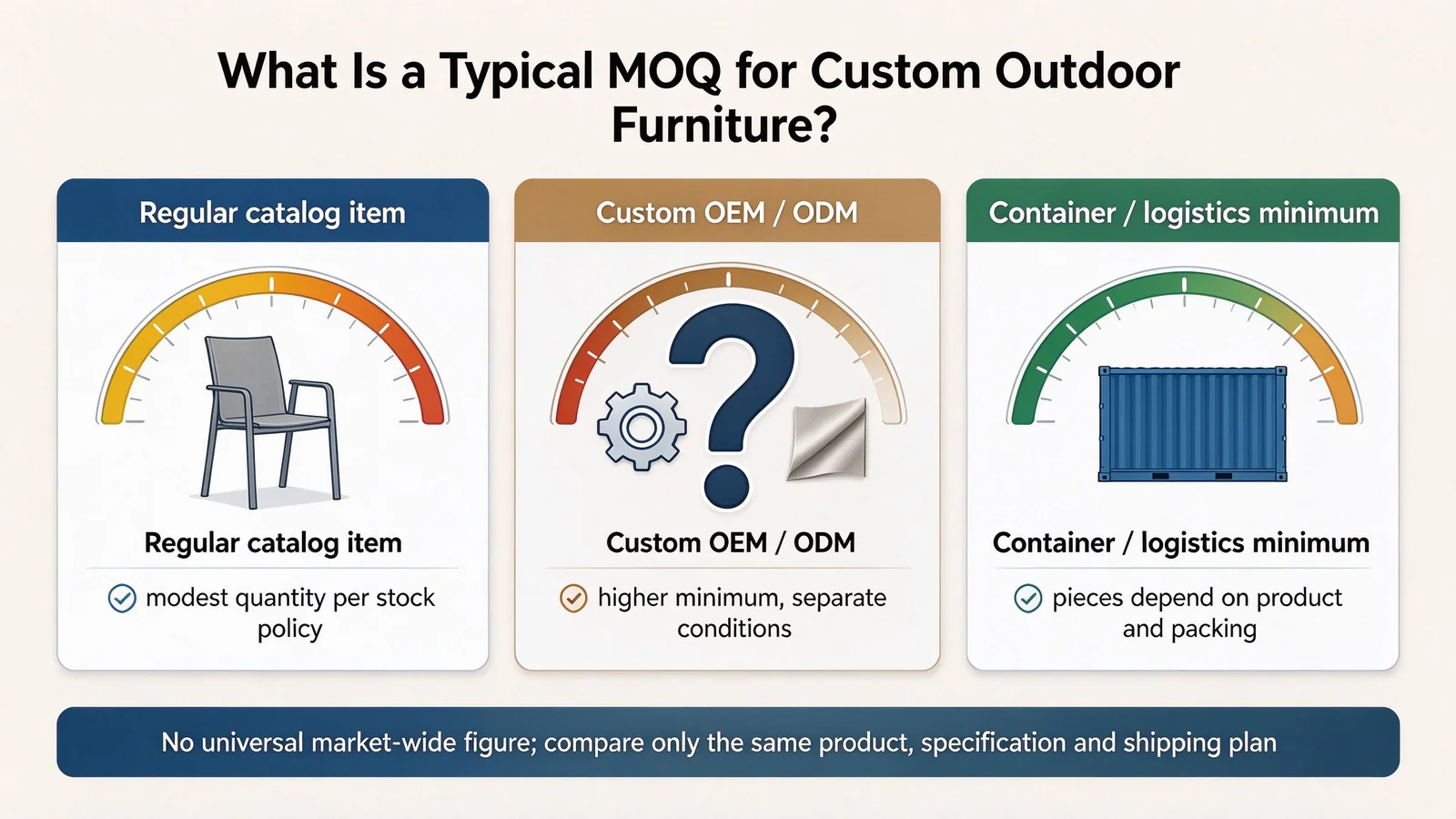
There is no defensible market-wide figure. Published supplier policies show why:
| Published policy | Scope stated by the supplier | Correct buyer interpretation |
|---|---|---|
| 10 units per model and color for most regular items | The supplier separately says custom orders have higher MOQs and additional requirements | Useful as an example of a regular-item policy, not a fully custom benchmark |
| 200 pieces per model for custom manufacturing | Customization includes branding, colors, fabrics, structure, packaging, and tooling | A verified policy for that supplier's service, not an industry average |
| One full 20-foot general-purpose container | The supplier also offers OEM and ODM adjustments | A logistics-based minimum whose piece count depends on products and packing |
These figures do not create a meaningful "10-to-200-unit industry range." They measure different products and commercial conditions. A regular dining chair, a custom modular sofa, and a container of mixed furniture cannot be compared until the unit and specification are the same.
Supplier policies can also change. Reconfirm the applicable terms before using a published number in a tender, budget, or purchase order. None of these examples represents a Howvin quotation.
MOQ Is Usually a Stack of Minimums
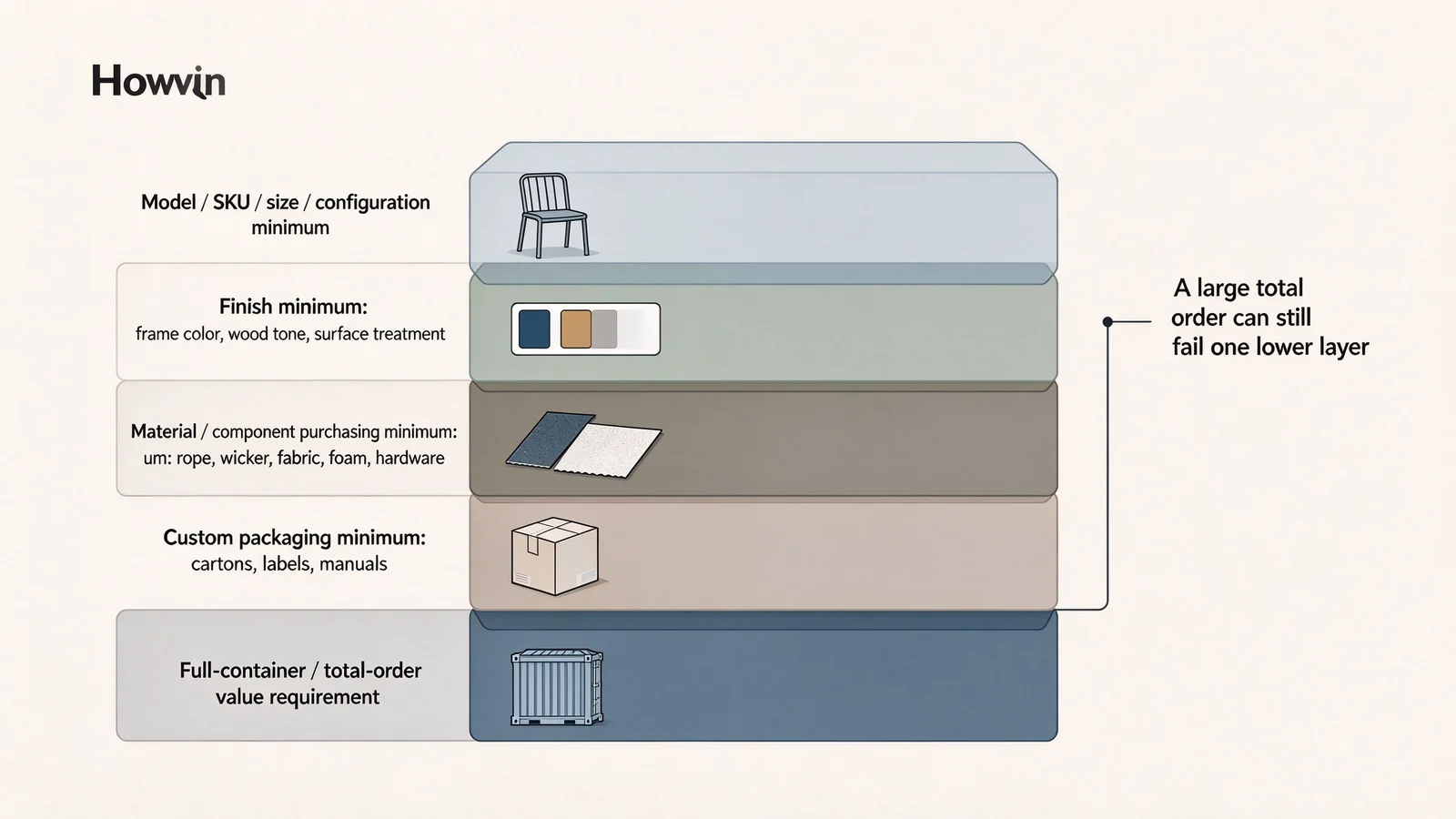
MOQ is commonly discussed as though it were one factory number. In practice, an outdoor furniture order can contain several overlapping minimums.
The model minimum applies to one SKU, size, or configuration. A separate finish minimum can apply to each frame color, wood tone, rope, wicker, or fabric. Materials or components may have purchasing minimums of their own. Printed cartons, labels, and manuals can introduce a packaging threshold. The supplier may then add a total-order value or full-container requirement.
This explains why a large project can still fail one MOQ condition. A resort may order hundreds of pieces overall but specify only a small quantity of one sofa in one fabric. The total order is large, yet that upholstery variant may remain below the material or production minimum.
Howvin's broader guide to sourcing custom commercial outdoor furniture similarly explains that MOQ may depend on the model, material, finish, fabric, or custom component-not only the purchase order total.
Before comparing quotations, ask each supplier to separate:
MOQ per model, size, and configuration
MOQ per frame finish and surface treatment
Minimums for rope, wicker, sling, fabric, foam, tabletop, or hardware
Private-label and custom-packaging minimums
Total-order or order-value requirements
Container, mixed-load, or other shipment conditions
If the supplier cannot state which minimum drives the quotation, the buyer does not yet have a comparable offer.
How Customization Depth Changes MOQ
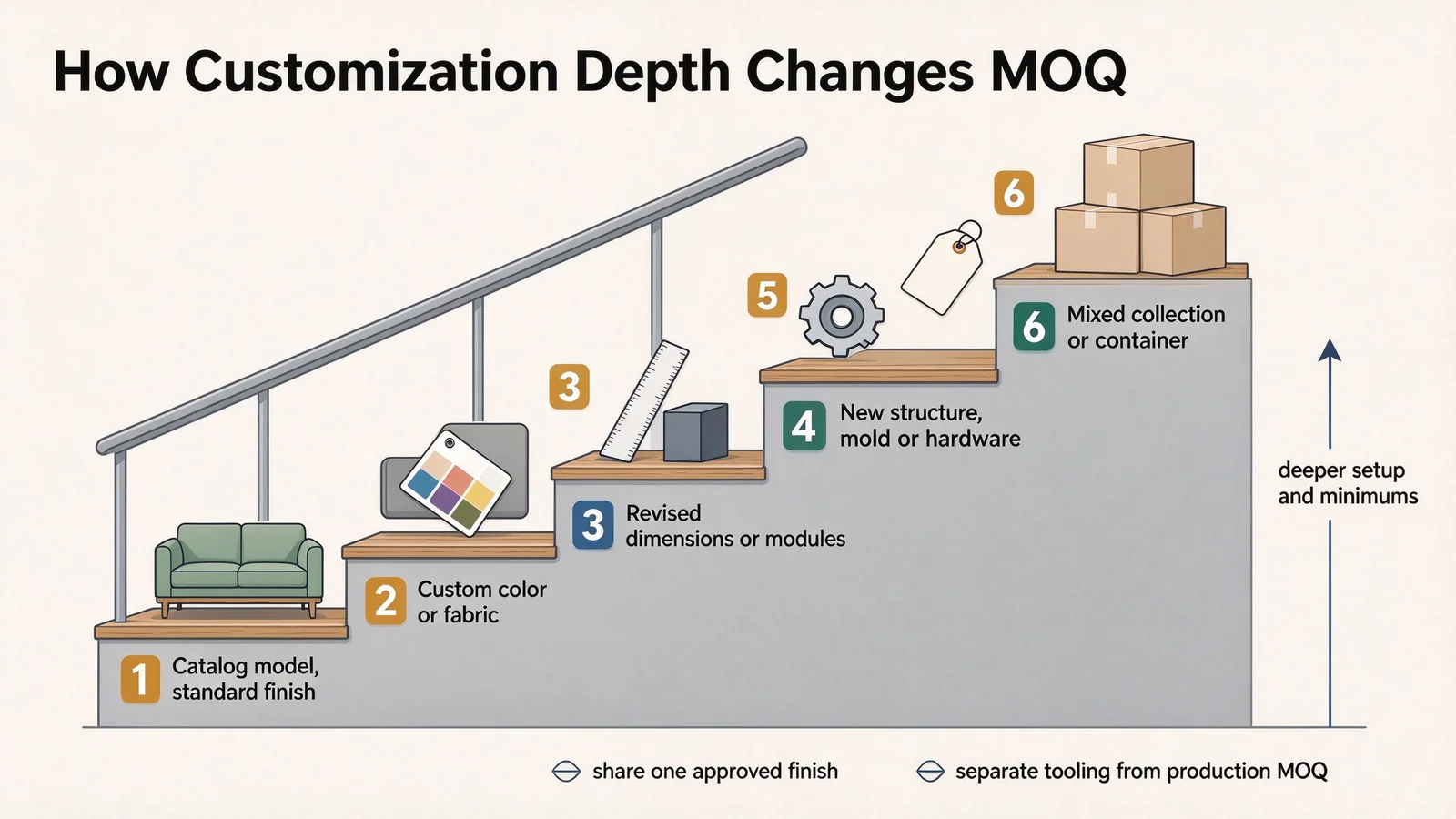
"Custom furniture" can mean a standard sofa in a different fabric, a changed frame dimension, or a completely new product. These requests do not have the same production implications.
| Customization level | What may create the minimum | Questions for the supplier | Lower-commitment option to consider |
|---|---|---|---|
| Catalog model, standard finish | Production scheduling and product availability | Is MOQ per piece, set, model, or total order? | Use the established specification if it meets the project brief |
| Catalog model, custom color or fabric | Color batching, material purchasing, sample approval, and changeover | Is the minimum per model, shade, or material code? | Share one approved finish across compatible models or choose a stocked option |
| Revised dimensions or modules | Drawing control, engineering review, component changes, sampling, and revised packaging | Does the change create a new SKU or require new verification? | Retain proven frames or components where the design permits |
| New structure, mold, extrusion, or hardware | Tooling, prototypes, process setup, validation, and repeat-production controls | What is the tooling term, production MOQ, ownership, and storage arrangement? | Separate one-time development costs from recurring production MOQ |
| Custom logo, labels, or cartons | Artwork, printing setup, label or carton purchasing | Does packaging MOQ exceed furniture MOQ? | Use neutral export packaging if brand requirements allow it |
| Mixed collection or container | Several SKU minimums plus carton and loading constraints | Which products may be mixed, and which must meet individual minimums? | Consolidate compatible finishes and request a model-by-model loading plan |
A buyer browsing Howvin's commercial outdoor sofa collection should therefore request the minimum for each selected model and configuration. A sofa, dining chair, table, sun lounger, and daybed use different processes, materials, carton volumes, and loading space.
How Materials and Outdoor Conditions Affect the Decision
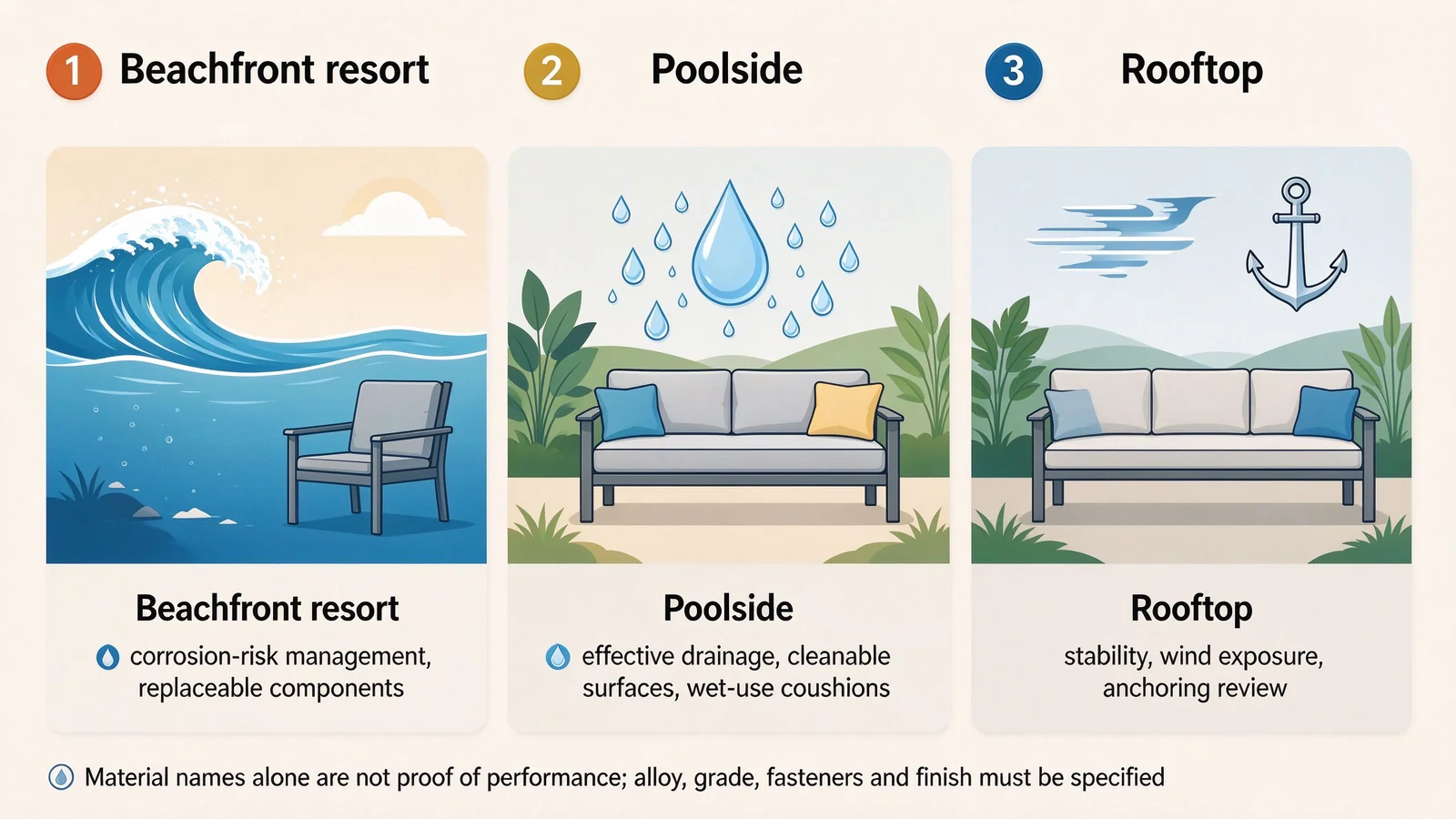
Material choices do not automatically determine a fixed MOQ, but they can create separate purchasing or processing constraints. A custom powder-coat color may require its own batch. Outdoor rope, synthetic wicker, sling, upholstery fabric, quick-dry foam, tabletop material, or special hardware can each carry a different supplier minimum.
The installation environment also limits which substitutions are acceptable. A beachfront resort may prioritize corrosion-risk management and replaceable components. Poolside furniture may require effective drainage, cleanable surfaces, and cushion construction suited to wet use. Rooftop furniture may need a project-specific review of stability, wind exposure, and anchoring.
If a supplier suggests a standard material to reduce MOQ, check whether it still meets the project specification, maintenance plan, destination requirements, and intended commercial use. A lower quantity is not an advantage if it produces an unsuitable finish, more maintenance work, unavailable replacements, or guest-area downtime.
Material names alone are not proof of performance. "Aluminum," "teak," "outdoor fabric," or "stainless steel" does not define alloy or grade, construction, finish preparation, fasteners, drainage, maintenance, or test scope. Keep these details in the approved specification even when negotiating quantity.
Samples and Production MOQ Are Different Decisions
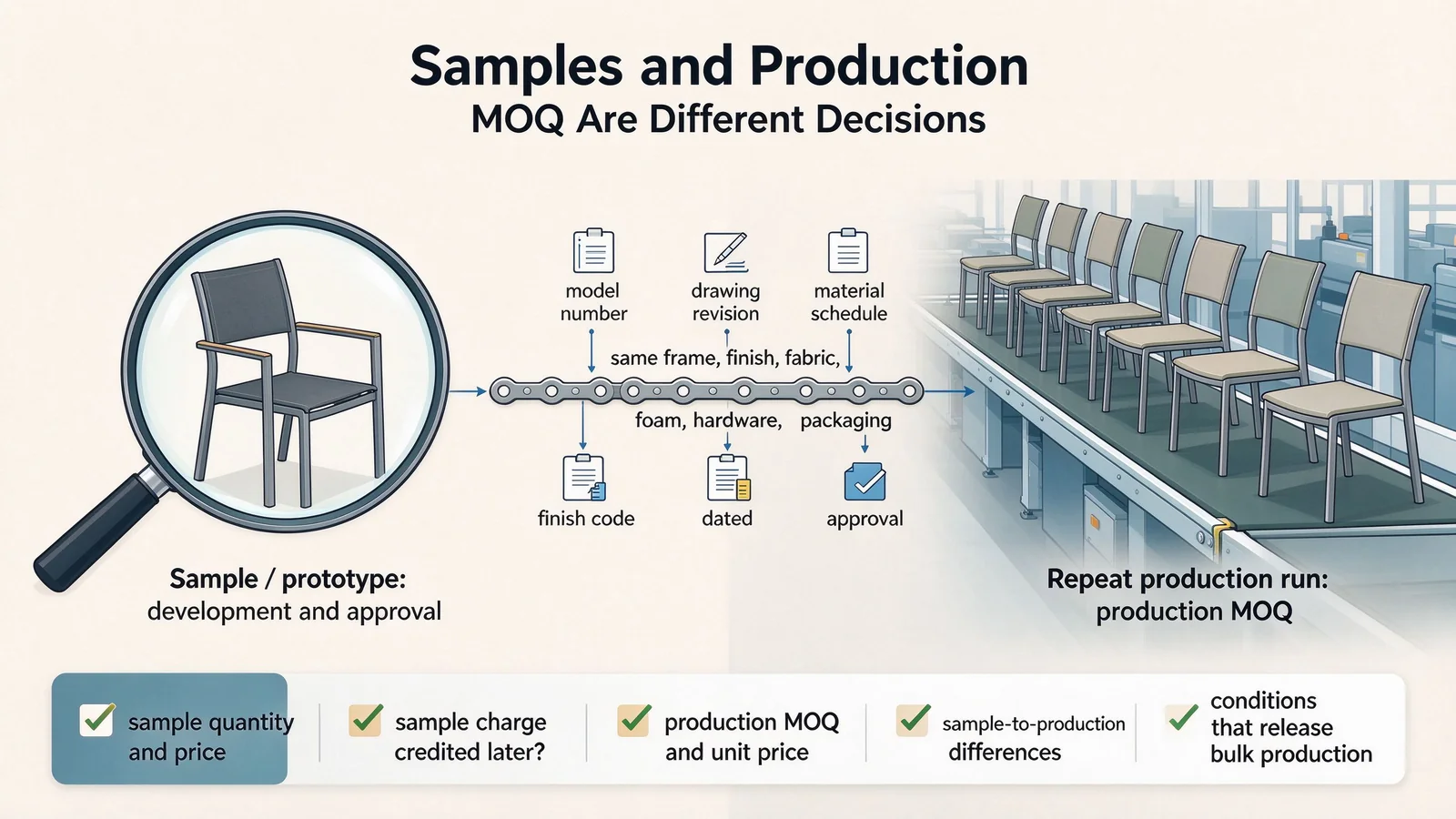
A supplier may agree to make one prototype without accepting a one-unit production order. A custom sample is normally part of development and approval, while MOQ applies to the repeatable manufacturing run.
Confirm whether the sample uses the same frame construction, finish, fabric, foam, rope or wicker, hardware, tabletop, and packaging planned for bulk production. Temporary sample materials should be recorded rather than silently accepted as the production reference.
Link the approved sample to a model number, drawing revision, material schedule, finish code, and dated approval record. Then ask the supplier to state separately:
Sample quantity and price
Whether sample charges are credited later
Production MOQ and unit price
Differences between sample and production materials or processes
Approval conditions that release bulk production
A pilot order can help evaluate an unfamiliar design or package, but it must be representative. Confirm whether it uses production equipment and final materials, whether a surcharge applies, and whether leftover custom material will be stored, transferred, or charged to the buyer.
What a Reliable MOQ Quotation Should Include
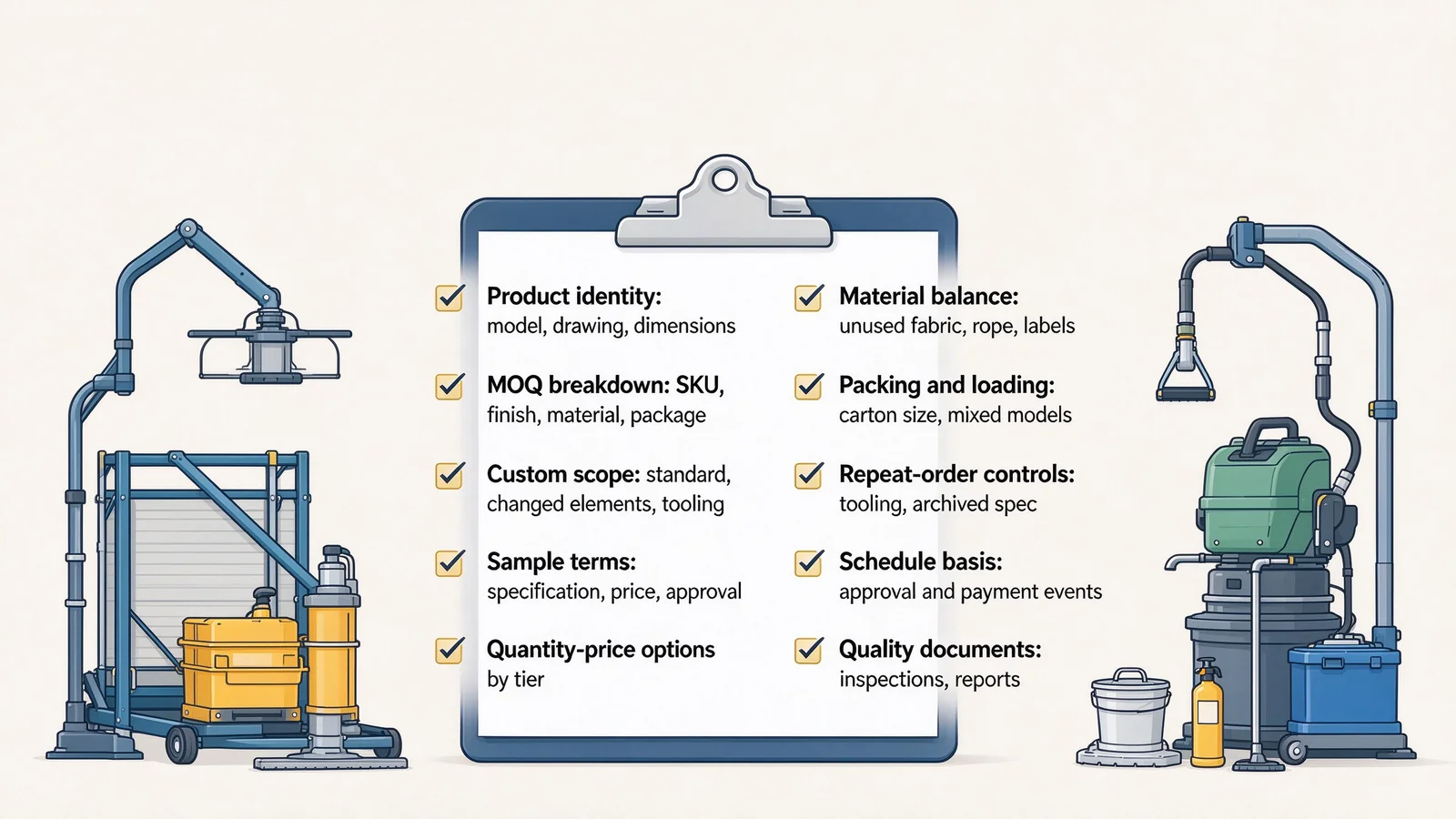
The purpose of an RFQ is to make shortlisted suppliers price the same product and responsibilities. Send the quantity by model, finish, and project area-not only one total number.
| Quotation field | Required detail | Buyer purpose |
|---|---|---|
| Product identity | Model, drawing revision, dimensions, configuration, and unit of measure | Prevent confusion between pieces, modules, and sets |
| MOQ breakdown | Per SKU, finish, material, component, package, total order, and shipment | Identify the actual constraint |
| Custom scope | Standard selections, changed elements, new tooling, and exclusions | Compare equivalent products |
| Sample terms | Sample specification, price, approval record, and production representation | Separate development from bulk commitment |
| Quantity-price options | Price at the requested quantity and relevant alternative tiers | Show the commercial trade-off transparently |
| Material balance | Ownership or treatment of unused fabric, powder, rope, labels, or cartons | Avoid storage and reorder disputes |
| Packing and loading | Carton dimensions, packages per unit, loading estimate, and mixed-model rules | Distinguish production MOQ from freight efficiency |
| Repeat-order controls | Tooling ownership, archived specification, discontinued inputs, and future minimums | Protect phased projects and replacements |
| Schedule basis | Approval and payment events that start material purchasing and production | Prevent quantity discussions from becoming unsupported delivery promises |
| Quality documents | Approved reference, inspections, applicable reports, packing checks, and destination documents | Keep quantity separate from product acceptance and compliance |
For hotels and resorts, divide quantities by area: pool deck, restaurant terrace, rooftop, balcony, villa, spa, or beach club.
For distributors, list each SKU and color.
For a phased development, distinguish confirmed quantities from forecasts. The factory can then identify which batches may be combined and which cannot.
How to Negotiate a Lower MOQ Responsibly
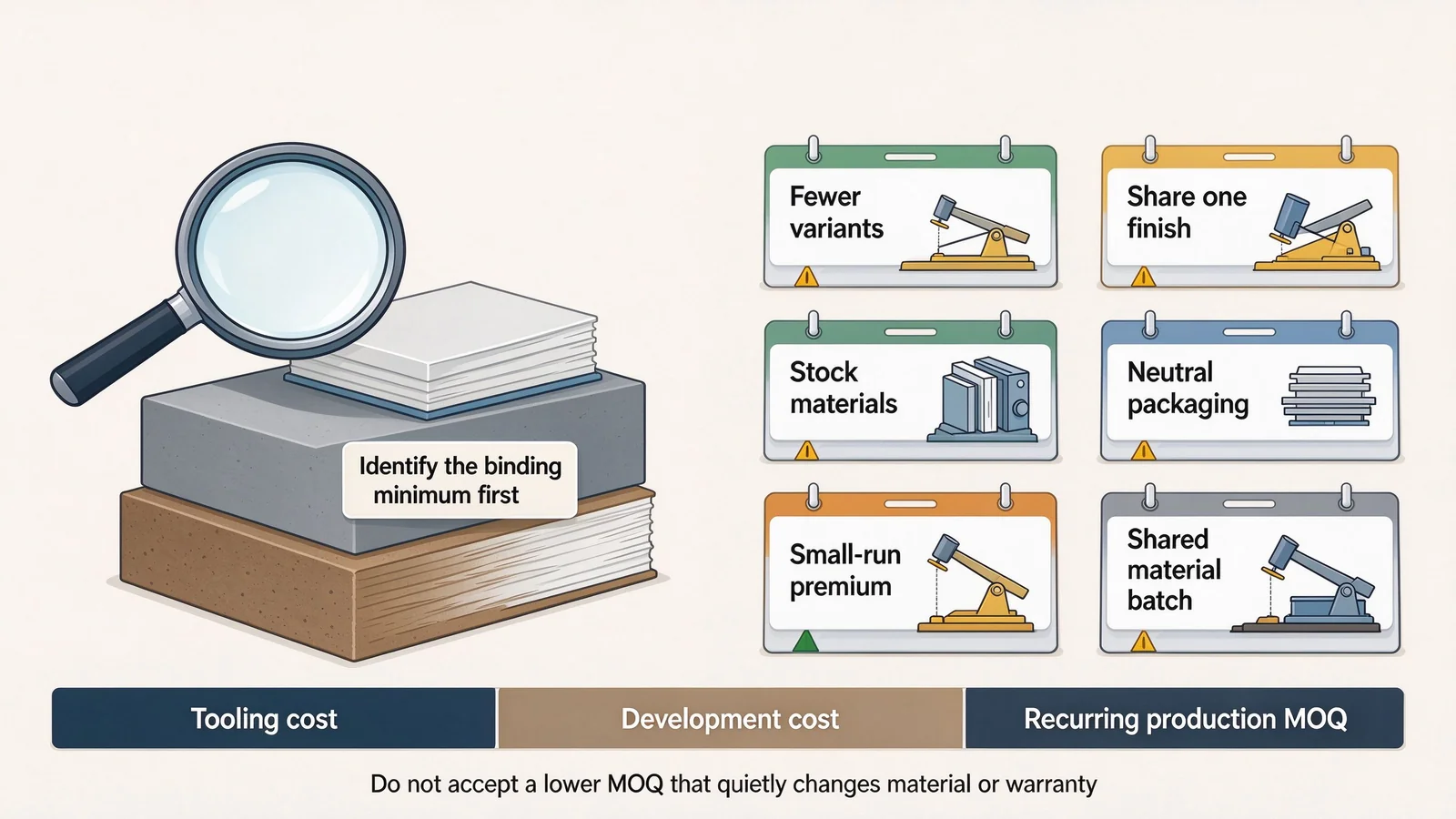
The most productive discussion identifies the constraint behind the number. If custom fabric is the problem, changing carton artwork will not solve it. If the minimum is based on a full container, reducing colors may improve production efficiency without solving the shipment requirement.
Conditional options include reducing the number of variants, sharing one finish across compatible products, selecting approved stock materials, using neutral packaging, or paying a transparent small-run premium. Buyers may also ask whether compatible SKUs can share a material batch or mixed shipment.
For a new design, request separate prices for tooling, development, and production. This can reveal whether a one-time charge makes a smaller recurring batch workable. If excess custom material is unavoidable, document who owns it, where it will be stored, how it is identified, and whether it can be used for a later order.
Do not accept a lower MOQ if the quotation quietly changes the material, construction, inspection, packaging, or warranty scope. The revised offer must still correspond to the approved product.
Why the Lowest MOQ May Not Produce the Lowest Project Cost
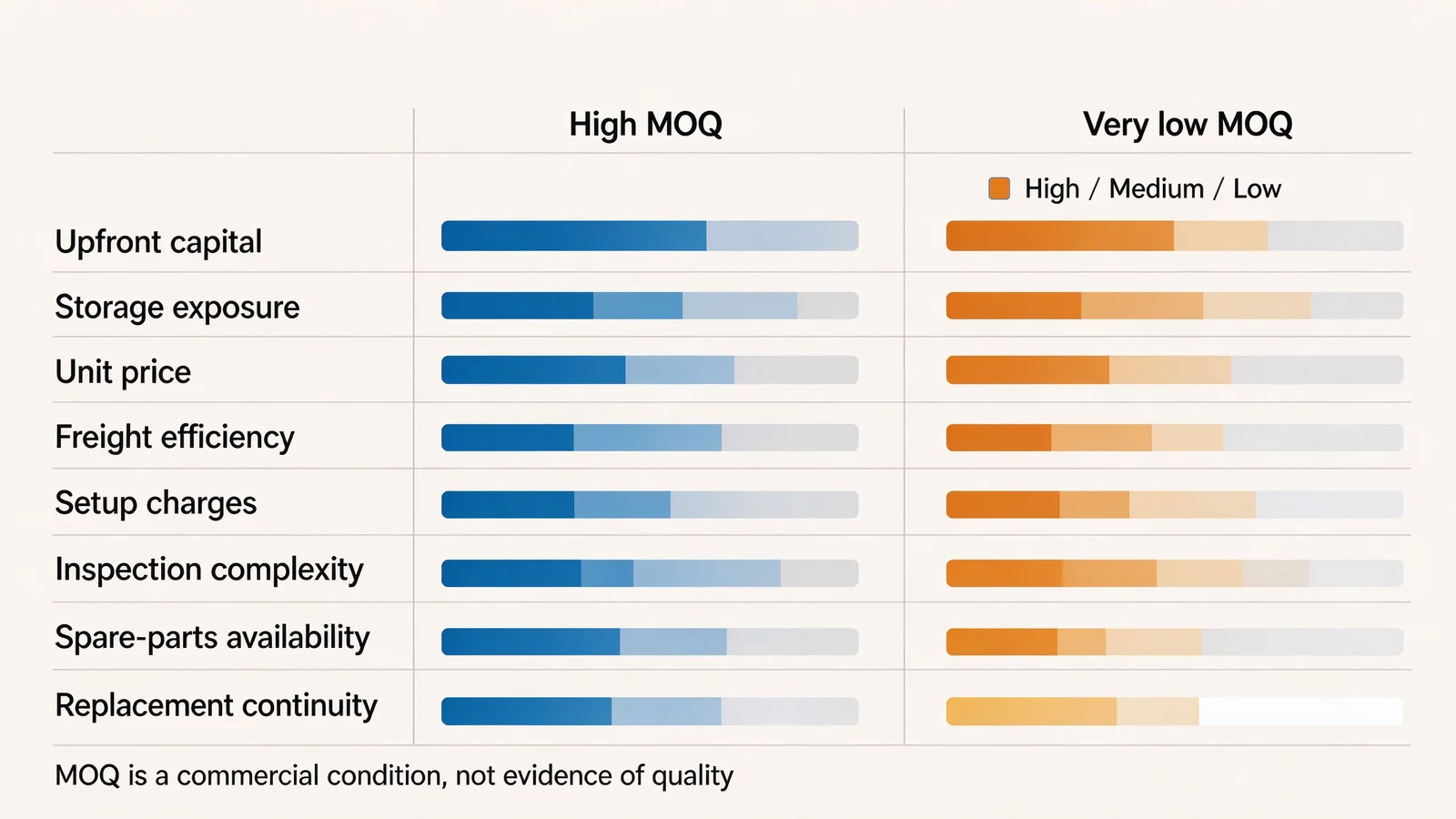
A high minimum can tie up capital, consume storage space, and increase inventory exposure. A very low minimum may bring a higher unit price, inefficient freight, extra setup charges, or more complex inspections. Neither result is automatically better.
Commercial buyers should compare:
Initial purchase
Sampling and tooling
Freight and installation
Storage requirements
Cleaning and maintenance
Spare parts
Replacement availability
Operational disruption
For hospitality operators, a missing replacement sofa or mismatched fabric can affect the appearance and availability of a revenue-generating guest area.
Future orders matter as well. Ask whether the supplier can reproduce the approved finish and construction, whether the same minimum will apply, and how discontinued components will be managed. Any spare-parts or attic-stock quantity should follow an operating plan rather than an unsupported percentage.
MOQ is a commercial condition, not evidence of quality or compliance. A large order does not prove that furniture is suitable for intensive outdoor use.
Request drawings, material and finish records, inspection criteria, maintenance guidance, destination documents, and applicable model-specific test reports. Confirm what each document covers instead of treating a broad certificate or factory claim as proof for every product.
How to Request a Project-Specific Howvin MOQ
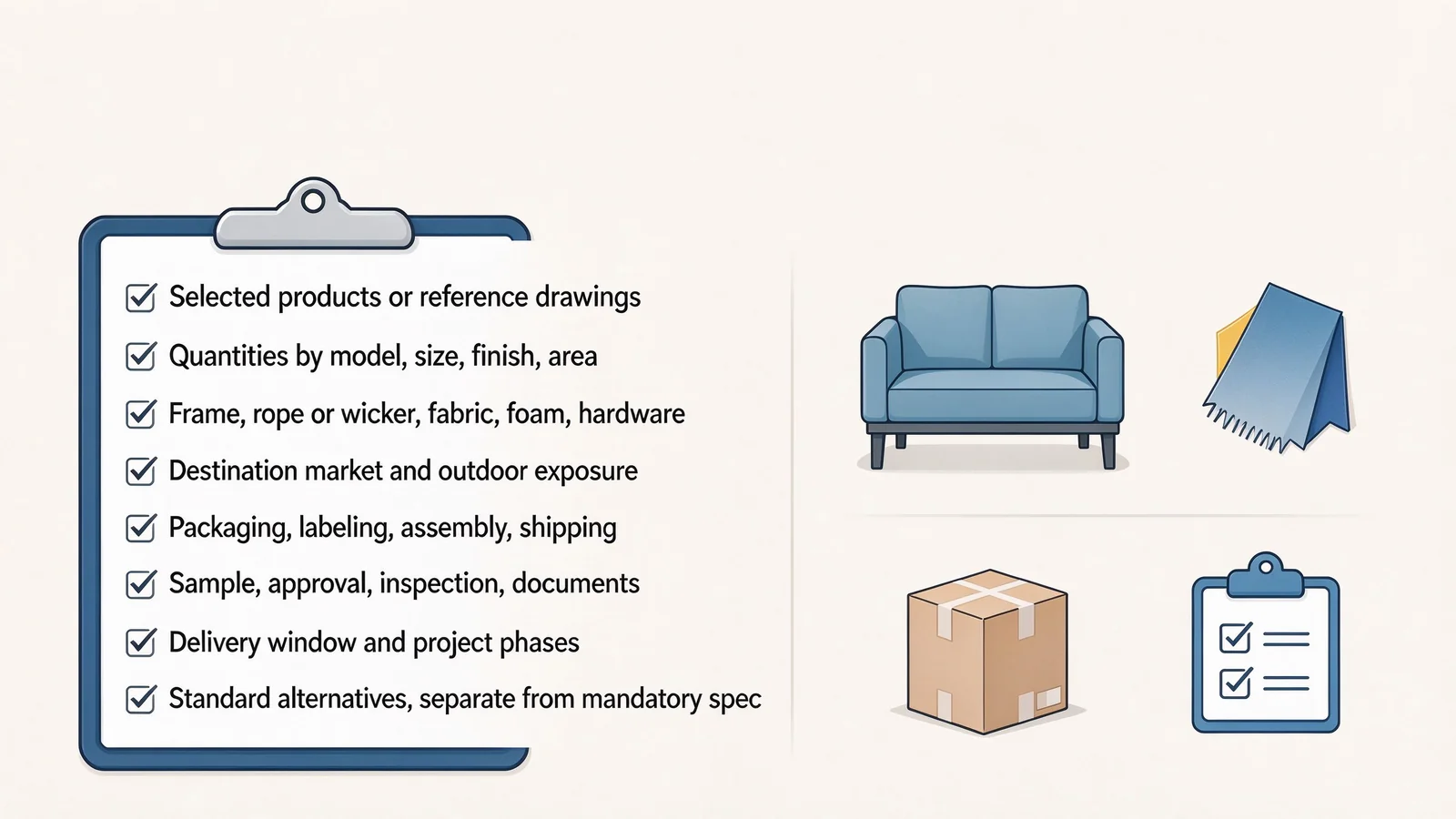
No verified universal numerical Howvin MOQ was available for this article. A project-specific inquiry should include:
Selected products or clearly marked reference drawings
Quantities by model, size, configuration, finish, and installation area
Required frame, rope or wicker, fabric, foam, tabletop, hardware, and branding
Destination market and outdoor exposure
Packaging, labeling, assembly, and shipping expectations
Sample, approval, inspection, and documentation requirements
Target delivery window and confirmed project phases
Acceptable standard alternatives, separated from mandatory specifications
This information allows the binding minimum to be identified and makes competing quotations more comparable.
Frequently Asked Questions
1. What is a typical custom outdoor furniture MOQ?
There is no universal quantity. One inspected supplier publishes a model-and-color minimum for regular items, another publishes 200 pieces per custom model, and another uses a full-container requirement.
These are supplier-specific examples, not an industry average. Request a quotation for the exact product and specification.
2. Is MOQ calculated per model or for the total order?
It can include both. A supplier may require an overall order or container threshold while also setting minimums for every model, size, color, fabric, or finish.
Ask for a written MOQ matrix that lists each layer.
3. Does a custom sample count toward production MOQ?
Usually, the sample and production order should be treated separately unless the quotation says otherwise.
Confirm the sample specification and price, whether it represents mass production, and the MOQ that applies after approval.
4. Can different furniture models share one MOQ?
Sometimes, but a mixed order does not automatically remove model, color, or material minimums.
Compatible products may share a finish batch or shipment, subject to the supplier's production and purchasing conditions.
5. Can a hotel or distributor negotiate a lower MOQ?
Possibly. Fewer variants, shared finishes, stocked materials, neutral packaging, mixed loading, or a transparent small-run premium may help.
The supplier must confirm feasibility without changing the approved specification or quality requirements.
6. What information is needed for an accurate MOQ quotation?
Provide the model or drawing, quantities by variant, dimensions, materials, finishes, fabrics, branding, packaging, destination, site exposure, documentation needs, sample requirements, and schedule.
Identify mandatory specifications and acceptable standard alternatives.
Conclusion
A reliable custom outdoor furniture MOQ is not a generic market number. It is the result of a defined product, material selection, variant plan, packaging specification, production process, and shipping strategy.
Commercial buyers should ask for every MOQ layer in writing, keep samples separate from production commitments, and compare quantity with freight, inventory, maintenance, replacement, and continuity risks.
When the RFQ is complete, contact Howvin for a project-specific quotation. Confirm the assumptions, minimums, approved alternatives, and sample requirements before authorizing production.