
When architects and procurement managers evaluate architectural shading for high-exposure hospitality venues, the singular metric that dictates long-term survival is Commercial Pergola Aluminum Thickness. A flimsy structure will shudder under light gusts; a properly engineered system will withstand coastal typhoons.
A recurring horror story in the commercial hospitality sector involves a coastal resort that installed retail-grade aluminum cabanas. Within months, the 1.2mm frame profiles buckled under unexpected gale-force winds, crushing the high-end patio furniture underneath. This is why institutional buyers no longer look at aesthetics alone-they look at mill certificates, cross-sectional profiles, and structural deflection limits.
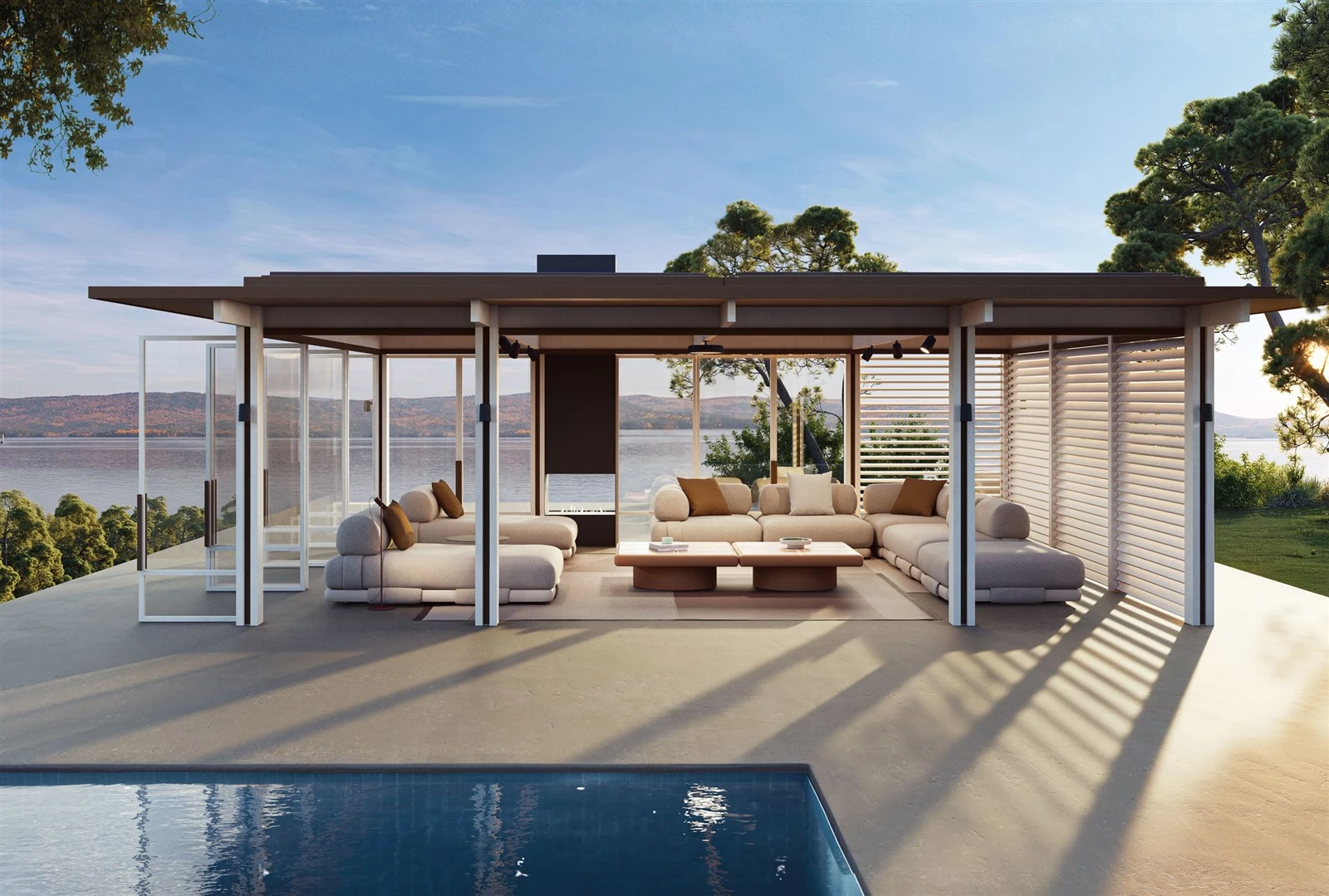
🏗️ 1. The Metallurgy Matrix: Why 6063-T5 is the Contract Standard
Not all aluminum is created equal. For heavy-duty architectural extrusions, the structural backbone must be aviation-grade aluminum alloy, specifically 6063-T5.
Why this specific designation?
Aluminum 6063 features magnesium and silicon as its primary alloying elements, providing an optimized balance of excellent extrudability, high corrosion resistance, and superb surface finish capabilities. The T5 tempering signifies that the metal has been cooled directly from an elevated temperature shaping process and then artificially aged. This specific thermal treatment locks the molecular structure, elevating its tensile yield strength to a minimum of 110 MPa.
If a vendor offers 6060 or 6061 without understanding the application, be cautious. While 6061 offers higher tensile strength, it is far more brittle and harder to extrude into complex, multi-cavity louvers. Conversely, 6063-T5 provides the precise elasticity required to absorb kinetic energy from high wind loads without structural failure, making it the ideal raw material for any premium Club outdoor lounge manufacturer.
📏 2. Demystifying the Wall Thickness: 1.5mm vs. 2.5mm+
In the commercial landscape, thickness translates directly to moment of inertia and structural rigidity. Main pillars and load-bearing horizontal beams carry massive dead loads (the weight of the motorized louver system) and live loads (wind, rain, and snow).
Our engineering data indicates that any profile under 1.5mm wall thickness is a liability in public or commercial zones.
📊 Wall Thickness Specifications by Project Application
| Profile Type | Thickness Range | Structural Role | Ideal Commercial Setting | Wind Resistance Rating |
| Residential Grade | 1.0mm – 1.4mm | Light domestic shade | Private backyard patios | Low (Up to Class 6) |
| Standard Commercial | 1.5mm – 1.9mm | Primary pillars for standard spans | Boutique hotel balconies, cafe dining zones | Medium (Up to Class 9) |
| Heavy-Duty Commercial | 2.0mm – 2.5mm | Oversized spans, integrated gutter beams | High-traffic beachfront resorts, public plazas | High (Up to Class 11) |
| Extreme Engineering | > 2.5mm | Custom structural nodes, heavy snow-load zones | Sky-rise rooftops, alpine open-air lounges | Hurricane Grade (Class 12+) |
When a brand operates as a specialized Rooftop bar furniture supplier, they must account for the venturi effect-where wind speeds accelerate sharply between high-rise buildings. On a 30th-floor rooftop terrace, a pillar with a Commercial Pergola Aluminum Thickness of less than 2.5mm will suffer from micro-oscillations, eventually fatiguing the anchor bolts and destroying the surrounding garden sofa configurations.
🔬 3. Structural Rigidity and Deflection Engineering
Let's look at the math. The deflection ($f$) of a horizontal pergola beam under a uniform load is calculated using the structural formula:
Where:
w = uniform load per unit length
L = span length between pillars
E = Modulus of elasticity (approx. 70,000 MPa for 6063-T5)
I = Moment of Inertia (which increases exponentially with wall thickness)
If you double the span ($L$) without upgrading your Commercial Pergola Aluminum Thickness from 1.5mm to 2.5mm, your deflection increases sixteen-fold ($2^4$). This causes the motorized louvers to jam, water to pool in the middle, and the entire system to fail. For projects incorporating large layouts of an expansive outdoor dining set or multiple heavy-duty sun lounger stations, maintaining a strict deflection limit of $L/180$ is mandatory to ensure guest safety.

🛡️ 4. Surface Coatings and Compliance Certificates
Anodizing or powder coating isn't just about color matching your custom cantilever umbrella setups; it is a critical defense mechanism against galvanic and atmospheric corrosion. Commercial systems must be certified by global testing bodies to guarantee that the aluminum maintains its structural integrity over decades.
📊 International Testing & Certification Matrix for Architectural Aluminum
| Certification Body | Standard / Code | Verification Metric | Practical Benefit for Commercial Buyers |
| Qualicoat | Class 2 / Class 3 | Seaside-grade powder coating adhesion | Prevents chalking, peeling, and blistering in high-salinity marine environments. |
| SGS | EN 755-2 | Mechanical property verification | Independently confirms that the tensile strength matches 6063-T5 specs. |
| TUV Rheinland | EN 1090-1 | Structural steel/aluminum execution | Guarantees compliance with European structural safety and load-bearing laws. |
| CE | EN 13659 | Wind load performance criteria | Verifies the fully assembled motorized louver system can handle specified wind pressures. |
| ASTM International | ASTM B221 | Standard specification for extruded bars/shapes | Ensures dimensional tolerances and chemical compositions are precise. |
📋 5. The B2B Procurement SOP: How to Inspect and Choose
Before signing off on a container-load purchase for a commercial property, enforce these inspection steps:
Demand the Mill Test Report (MTR): Ensure the alloy states 6063-T5 and references ASTM B221 or equivalent European standards.
Verify via Vernier Caliper: Do not measure the thickness at a welded joint or an end-cap flange. Measure the raw cross-section of an un-assembled pillar profile. A true commercial pillar must register between 1.5mm and 2.5mm across all internal webs.
Check the Coating Grade: Look for the Qualicoat hologram sticker or documentation on the profile batch.
Inspect the Internal Stiffeners: High-end extrusions do not feature empty, hollow squares. Look for internal screw ports and structural cross-ribs that multiply the profile's resistance to twisting forces.
❓ Industry-Specific FAQ
Q1: Can I use residential-grade 1.2mm aluminum pergolas for a commercial outdoor restaurant?
❌ No. Public spaces are subject to strict structural liabilities. A 1.2mm frame lacks the moment of inertia to handle the frequent cycling of motorized louvers and the wind loads of open commercial spaces, risking catastrophic collapse and massive insurance liabilities.
Q2: Why is 6063-T5 preferred over 6061-T6 for motorized commercial pergolas?
⚙️ 6063-T5 offers superior surface extrusion quality and optimal ductility. While 6061-T6 has higher absolute strength, it is more difficult to extrude into the complex, hollow, multi-channel profiles required for integrated drainage gutter beams and louver seals. 6063-T5 provides the ideal structural elasticity to buffer wind shocks.
Q3: Does a thicker aluminum wall guarantee rust prevention?
🌊 Thickness protects against mechanical failure, not chemical reaction. Rust and oxidation protection comes down to the surface treatment. For commercial projects, ensure the profiles carry a Qualicoat certification, which guarantees the architectural powder coating can withstand thousands of hours of salt-spray testing without corroding.
Q4: What is the maximum safe span for a 1.5mm vs a 2.5mm thick aluminum beam?
📐 A 1.5mm thick beam is typically limited to a safe span of 3 to 4 meters under standard loads. Upgrading to a heavy-duty Commercial Pergola Aluminum Thickness of 2.0mm–2.5+mm, combined with internal structural ribbing, allows engineers to safely clear-span 6 to 7 meters without requiring intermediate vertical pillars.
Q5: How do I verify that the supplier isn't shipping sub-standard recycled aluminum?
🔬 Request independent third-party testing reports from bureaus like SGS or Intertek. Legitimate commercial manufacturers run optical emission spectrometry tests on every batch to confirm that trace elements (Iron, Copper, Manganese) remain within the strict limits allowed for aviation-grade or architectural alloys.
Q6: Do motorized louvers require thicker aluminum than fixed-roof frames?
🔄 Yes, absolutely. Motorized systems introduce dynamic torque and rotational stresses to the frame every time they open and close. If the frame suffers from wall-thickness deflection, the louver pivot pins will misalign, causing the motor to burn out or the roof to leak water.