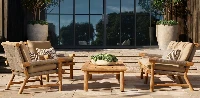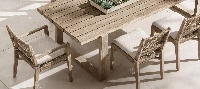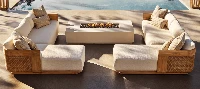

Teak (Tectona grandis) remains the gold standard timber for luxury commercial outdoor furniture. However, not all teak timber arriving at commercial manufacturing facilities performs equally. Procurement managers, resort developers, and trade buyers frequently encounter drastic price discrepancies across suppliers. These price gaps stem directly from timber grading.
Understanding the structural, visual, and biochemical differences between Premium Grade A, Standard Grade A, Grade B, and Grade C teak is essential for protecting long-term project ROI.

The Anatomic Spectrum of Teak Wood: Heartwood vs. Sapwood
To understand timber grading, you have to look at the cross-section of a mature teak log. Teak trees mature over decades, forming two distinct physiological zones: the inner heartwood and the outer sapwood.
🔬 Heartwood (Core): The dense center of a tree aged 30 to 50+ years. Heartwood produces natural tectoquinone (teak oil) and silica, making it naturally impervious to rot, termites, and salt spray.
🌿 Sapwood (Outer Ring): The living outer layer of a young tree or outer ring of a mature trunk. Sapwood carries sap and moisture. It lacks natural protective oils, remains soft, and rots quickly when exposed to rain or intense UV rays.
Breakdown of Teak Furniture Grades
🌟 Premium / Super Grade A Teak
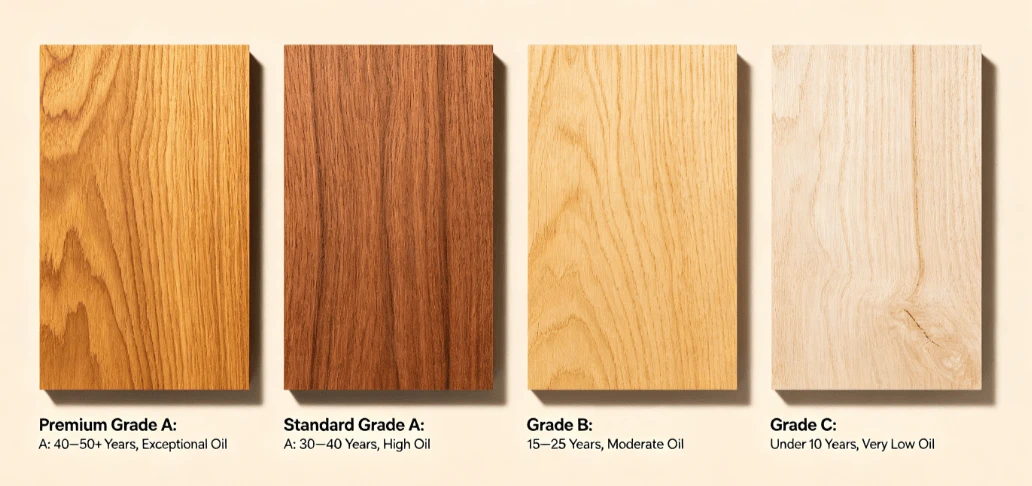
Harvested exclusively from the center heartwood of mature trees grown for over 40 to 50 years in managed plantations. It displays a flawless, warm golden-amber hue with tight, straight grain lines. Oil saturation is at its maximum peak, creating a smooth, waxy feel underhand without synthetic varnishes.
🥇 Standard Grade A Teak
Sourced from 30 to 40-year-old trees, using pure heartwood. Grain patterns remain tight and uniform, with an golden-brown color. Contains high natural oil and rubber content, ensuring decades of weather resistance in demanding commercial installations.
🥈 Grade B Teak
Extracted from the outer heartwood boundary or younger trees (15 to 25 years). The color shifts to a lighter yellow-grey tone with uneven grain. Natural oil content drops significantly, requiring surface sealing or periodic treatment to prevent cracking in outdoor environments.
🥉 Grade C Teak
Composed almost entirely of soft sapwood taken from immature trees (under 10 years). It exhibits a pale cream or off-white tone, dark knotting, and high moisture absorption. Without chemical pressure treatments or synthetic stains, Grade C teak splits, warps, and degrades within 1 to 2 years outdoors.
📊 Comprehensive Teak Timber Comparison
| Technical Property | Premium Grade A Teak | Standard Grade A Teak | Grade B Teak | Grade C Teak |
| Tree Maturity | 40–50+ Years | 30–40 Years | 15–25 Years | Under 10 Years |
| Log Harvest Zone | Center Heartwood | Core Heartwood | Outer Heartwood | Outer Sapwood |
| Natural Oil Content | Exceptional ($\ge 12\%$) | High ($\ge 8\%$) | Moderate ($3–5\%$) | Very Low ($<1\%$) |
| Kiln-Dried Moisture | $8\% - 10\%$ | $10\% - 12\%$ | $12\% - 15\%$ | $>18\%$ (Unstable) |
| Visual Texture | Uniform golden honey | Golden tan, tight grain | Lighter yellow, open grain | Pale cream with knots |
| Outdoor Lifespan | 50+ Years | 30–50 Years | 5–10 Years | 1–3 Years |
| Maintenance Level | Minimal | Low | Moderate | High (Needs sealing) |
Selecting a Teak Outdoor Corner Sofa: Grade Performance in Commercial Spaces
High-traffic commercial spaces-such as hotel pool decks, beachfront lounges, and rooftop bars-demand structural stability. Sourcing a teak outdoor corner sofa constructed from unseasoned or lower-grade timber leads to joint separation and frame sagging under continuous guest usage.
A commercial-grade weatherproof outdoor teak corner sofa with olefin cushion covers requires kiln-dried teak timber with moisture levels stabilized below 12%. When Grade A Grade B Grade C outdoor teak furniture frames are paired with high-performance fabrics, structural performance increases significantly:
🌧️ Water & UV Shielding: High oil content in Grade A heartwood prevents rainwater penetration, while solution-dyed acrylic fabric or olefin cushion covers resist fading under intense sunlight.
🛡️ Joint Stability: Grade A heartwood holds mortise and tenon joinery tightly. Lower grade timbers shrink over time, loosening wood dowels and weakening frame joints.
🧼 Bacterial Resistance: High natural silica levels hinder mold growth inside deep cushion seating wells.

Longevity Metrics for a Teak Outdoor Chaise Lounge in Luxury Hospitality
Poolside environments present harsh conditions: constant water splashes, chlorine exposure, tanning oils, and direct solar exposure. Installing a teak outdoor chaise lounge built with Grade B or C timber quickly results in surface splintering, which can injure hotel guests.
Resort operators managing large estates prefer low maintenance grade A teak outdoor furniture for short term rentals to keep labor costs down. Over time, genuine Grade A teak develops a silvery-grey patina without losing its internal structural strength.
📊 Maintenance Requirements & Lifespan Expectancy
| Maintenance Protocol | Grade A Teak | Grade B Teak | Grade C Teak |
| Initial Sealing Required | Optional | Recommended | Mandatory immediately |
| Annual Maintenance Routine | Wash with mild soap & water | Apply protective teak sealer | Sanding, chemical stain, water sealer |
| Splintering Risk | Virtually Zero | Low to Moderate | High (Soft sapwood breaks down) |
| Resistance to Termites/Rot | Complete natural immunity | Partial resistance | None (Attracts moisture & pests) |
| Patina Aging Quality | Smooth, elegant silver hue | Rough, blotchy graying | Darkens, discolors, develops rot |
International Certifications & Factory Verification Standards
When importing teak furniture, written factory declarations are not enough. B2B importers must demand independent third-party certifications and testing records to confirm timber origin and physical durability:
🌲 FSC (Forest Stewardship Council): Verifies that timber originates from responsibly managed plantations, preventing illegal deforestation.
🇮🇩 SVLK Certification: Mandatory Indonesian timber legality verification system ensuring legal supply chain traceability.
🔬 SGS Mechanical Testing: Confirms structural load capacity, drop tests, and joint endurance.
🏛️ EN 581 European Standard: Specifies general safety, strength, and durability requirements for outdoor commercial seating and tables.
⚙️ ISO 9001: Ensures the factory maintains consistent manufacturing processes, kiln-drying controls, and quality management.

Factory Audit Checklist for Teak Importers
| Inspection Parameter | Target Specification | Risk Signal / Red Flag |
| Moisture Meter Test | 8% - 12% Internal Moisture | >15% moisture (Will warp in dry climates) |
| Color & Grain Check | Consistent golden-brown heartwood | Chemical smell or dark dye (Masking Grade C sapwood) |
| Hardware Grade | Marine-grade 316 stainless steel | Plated iron or low-grade steel (Will rust) |
| Joinery Precision | Flawless interlocking mortise & tenon | Excess liquid glue visible around open gaps |
FAQs:
How can procurement managers distinguish chemically dyed Grade C teak from genuine Grade A teak?
Factories sometimes apply dark wood stains or oil dyes to pale Grade C sapwood to mimic Grade A heartwood. To spot this, check end-grain cross-sections and screw hole cutouts where dye fails to penetrate deeply. Unfinished Grade A teak feels naturally oily and smooth, whereas dyed Grade C teak feels dry, chalky, or chemically coated.
Does Grade A outdoor teak furniture require immediate sealing or varnishing?
No. Grade A teak contains sufficient natural oils and rubber resins to withstand rain, UV rays, and extreme temperatures without oiling or sealing. Leaving Grade A teak untreated allows it to naturally weather into an elegant silver-grey patina over 6 to 12 months.
Why is Grade A teak superior to powder-coated aluminum in coastal resort environments?
While high-grade aluminum resists rust, coastal ocean spray carries fine airborne salt that can corrode paint finishes and exposed fasteners over time. Grade A teak resists salt air naturally without oxidizing, flaking, or absorbing heat under direct sunlight, keeping seating surfaces comfortable for guests.
Are FSC and SVLK certifications legally required for commercial teak imports into North America and Europe?
Yes. Importing timber into North America requires compliance with the Lacey Act, while imports into the European Union must comply with the EU Timber Regulation (EUTR) and EUDR. Importers must show verifiable chain-of-custody documents like FSC or SVLK certificates to prevent customs seizures and fines.