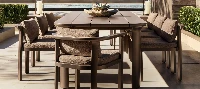

Ocean freight isn't cheap, and shipping empty air is an absolute budget killer for commercial supply chains. When managing procurement pipelines, specifying the right Outdoor space planning furniture involves more than just verifying material sheets. It requires a deep dive into container optimization. For large-scale procurement managers handling Outdoor furniture for architectural projects, the true test of profitability happens on the loading dock. If your warehouse team doesn't understand the exact science of maximizing 40HQ container lounger loading, you are effectively throwing thousands of dollars directly into the sea with every shipment.
Irregularly shaped chaise lounges, curvilinear sunbeds, and oversized daybeds are notorious space-wasters. Their fixed backrests and protruding legs create awkward, un-stackable voids.
Let's look at the cold reality from a port logistics manager's perspective: "A standard 40-foot High Cube container gives you 76 usable cubic meters. If you simply box your loungers individually, you will max out your container volume long before you ever hit the weight limit."
To survive rising maritime overhead, your warehouse must shift away from retail-style boxing toward raw volumetric engineering.

📐 The Geometry of Chaos: Fixed Frames vs. Interlocking Nesting
The primary obstacle with commercial loungers is their fixed geometric profile. Unlike modular deep seating, an ergonomic outdoor sunlounger has a permanently inclined backrest or an S-shaped contour designed for human anatomy, not container walls.
If you pack them face-up in single cartons, your stacking factor drops significantly. The space underneath the backrest and above the footrest becomes completely unusable dead space.
🔄 To beat this, premium contract factories utilize an unboxed, multi-layered interlocking nesting protocol. By removing the wheels and bottom adjusters, the frames can slide directly into one another.
📦 Table 1: Boxed vs. Interleaved Unboxed Volumetric Yield
| Packing Methodology | Units per 40HQ | Average Volume (CBM) Per Unit | Container Volumetric Efficiency | Container Utilization Status |
| 📦 Individual Five-Layer Cartons | 84 Units | 0.88 CBM | 42.3% (Massive dead space) | Volumetrically Blown Out |
| 🔄 Interleaved Frame Nesting (Unboxed) | 210 Units | 0.34 CBM | 91.5% (High density) | Mathematically Optimized |
| 📊 Net Logistics Advantage | +126 Units | -0.54 CBM lower | +49.2% Space Gain | Landed Costs Slashed |
By abandoning traditional boxing for a calculated, raw frame nesting system, a logistics team can nearly triple the total yield inside a single shipping container. This single shift radically redefines your landed cost per unit.
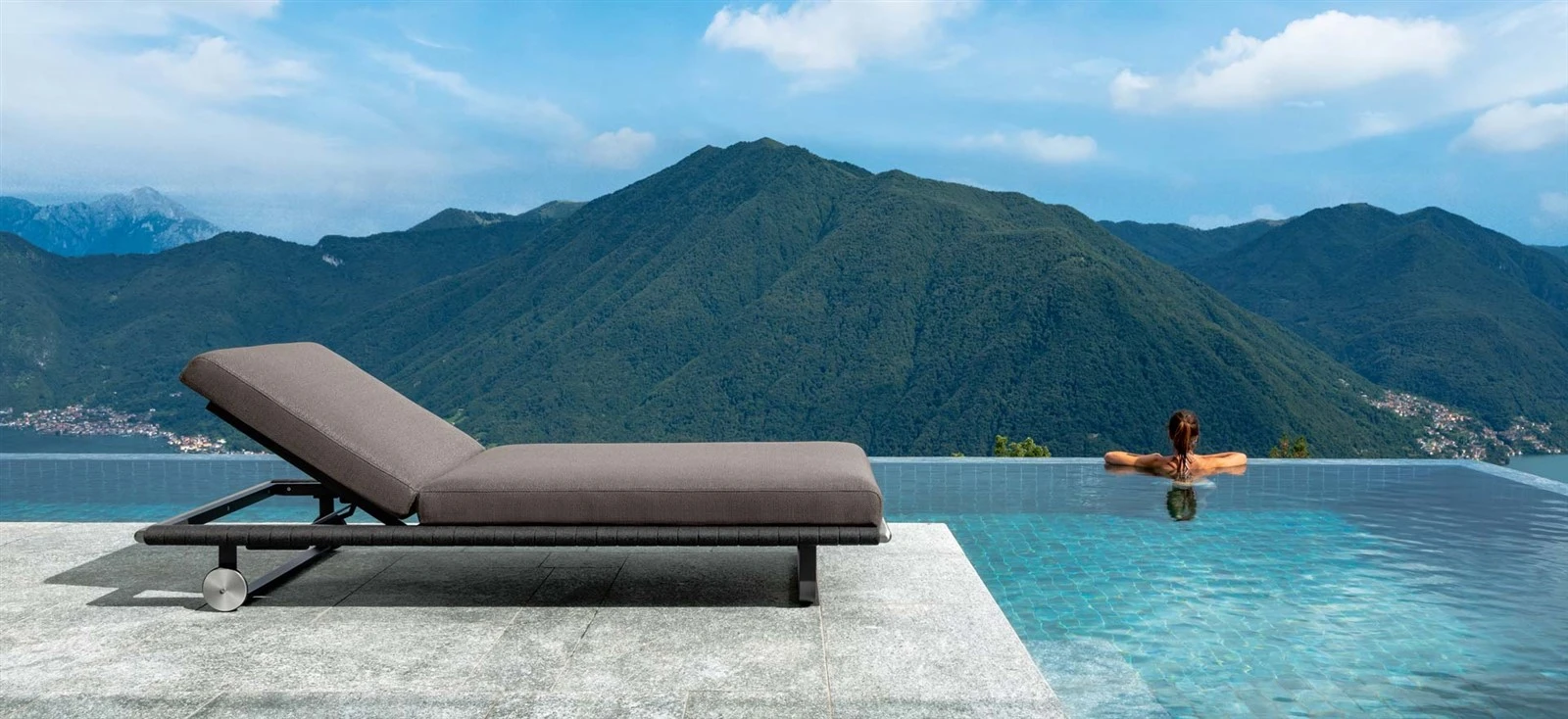
🛠️ The 3-Step "Head-to-Toe" Rotational Stacking Technique
Achieving real density with irregular frames requires a strict mechanical routine on the loading floor. You cannot allow loaders to simply wing it. The most successful configuration follows an inverted, interleaved orientation.
Step 1: Base Matrix Layering 🧩
The first layer must be laid flat on the container floor over heavy-duty slip sheets. Lounger A is placed face up with its headrest near the left wall. Lounger B is then flipped completely upside down, rotated 180 degrees, and nested directly over the top of Lounger A. This effectively squares off the irregular curves, turning two irregular shapes into a rigid, rectangular block.
Step 2: Surface Protection Interleaving 🛡️
Direct metal-to-metal or wicker-to-wicker contact will destroy a finish during a 30-day ocean transit due to continuous engine vibration. Loaders must place tailored, non-abrasive EPE foam sheets between every single nested layer. This protects the specialized powder coating or synthetic weaving from friction scratches without adding measurable thickness to your stack height.
Step 3: Vertical Column Stacking & Anchoring ⚓
Build your interleaved columns up to four or five units high, depending on the ceiling height of the 40HQ container. Because the center of gravity shifts as you stack inverted items, each vertical column must be secured using heavy-duty nylon ratchet straps attached to the container's internal D-rings.
💰 Landed Cost Analysis: The Hard Numbers
Let's calculate the real-world financial impact of executing a disciplined strategy for maximizing 40HQ container lounger loading across a 300-unit resort development project.
💵 Table 2: Financial Matrix of Packing Efficiency (300-Unit Project)
| Expense Category | Boxed Packing (Individual Cartons) | Engineered Interlocking Nesting | Total Project Savings |
| 🚢 Containers Required | 4 Full 40HQ Containers | 1.5 Containers (Booked as 2) | Saves 2 Ocean Freight Bookings |
| 💸 Total Ocean Freight Outlay | $26,000 ($6,500 per box) | $13,000 | Save $13,000 instantly |
| 🛃 Port Handling & Customs Fees | $3,600 | $1,800 | Cut customs processing by 50% |
| 🚛 Inland Destination Trucking | $4,800 | $2,400 | Halve domestic drayage costs |
| 🗑️ On-Site Trash/Cardboard Disposal | $1,200 (Massive volume) | $150 (Minimal wrap) | Eliminate site cleanup overhead |
| 📈 Total Landed Logistics Cost | $35,600 | $17,350 | Net Savings: $18,250 |
The math is undeniable. Packing efficiency is not just a warehousing preference; it is an aggressive pricing weapon that lowers project overhead.
🔒 Commercial Rigidity, Compliance, & Structural Survival
A common concern among procurement executives is structural integrity. Does squeezing 200+ unboxed units into a container risk bending the aluminum frames or snapping the internal adjustment mechanisms?
If you buy from low-grade residential factories, yes. However, commercial contract-grade loungers are engineered from the ground up to handle high-load stacking stresses.
To safeguard your investment, ensure your manufacturing partner holds rigorous, verified testing documentation from top-tier international certification bodies:
EN 581-2: The definitive European safety standard specifying structural requirements and mechanical testing limits for contract-grade outdoor seating.
SGS Salt Spray Testing: Confirming the underlying anti-corrosion pretreatments can withstand moisture collection within a sealed, humid ocean container without blistering.
TÜV Rheinland Load-Bearing Validation: Ensuring the frame can endure static downward forces without structural deformation when acting as a base layer in a high-density stack.
To prevent shifting during rough sea transits, the final gap between your furniture stacks and the container doors must be filled with heavy-duty, pressurized dunnage bags. These inflatable bladders lock the cargo into place, eliminating the longitudinal movement that causes 90% of all import transit damage.
💬 FAQ: What Logistics & Procurement Teams Need to Know
Q1: Will unboxed nested stacking void our product warranty if surface scratches occur during transit?
Not if the loading plan follows approved factory guidelines. Commercial suppliers use specialized, high-density EPE foam wrap and custom-fit protective sleeves across all contact points. This ensures full coverage protection, keeping your factory warranty completely intact.
Q2: How do we handle loose components like cushions and wheels during high-density loading?
Cushions should never be left on the frames during a nested stack. They must be compressed and packed separately into heavy-duty clear vacuum bags, which are then used as defensive padding to fill the small, remaining peripheral gaps along the container walls. Wheels and adjustment pins are uninstalled at the factory, labeled, and stored in centralized hardware crates placed at the center of the container.
Q3: Does unboxed nesting increase the labor time needed to unload at the resort site?
Actually, it often decreases total unpacking time. While moving individual units out of the container requires care, your team completely avoids the tedious, hours-long process of cutting open, unboxing, and flattening hundreds of massive cardboard cartons. It also dramatically cuts your local landfill or recycling disposal fees.
Q4: Can we mix loungers with other outdoor space planning furniture in the same 40HQ?
Yes. In mixed containers, the heavy, flat items-like dining table bases or nested loungers-form the foundational bottom layer. Lighter, bulkier items like woven dining chairs are nested and placed directly on top, or strapped into place on a split mezzanine level.
Q5: What happens if the container encounters extreme humidity and heat in tropical transit zones?
Sealed ocean containers can reach internal temperatures exceeding 60°C (140°F). Low-grade plastics and cheap powder coatings will fuse together under pressure at these temperatures. This is why contract-grade furniture must utilize high-bake polyester powder coatings and premium UV-stabilized polymers verified by independent labs like SGS.
Q6: How do we verify that the cargo won't exceed maritime container weight limits when maximizing volume?
Aluminum outdoor loungers are highly volumetric but physically light. A typical commercial aluminum sunbed weighs between 12 to 16 kg. Even if you pack 250 units into a single 40HQ container, your total cargo weight will hover around 4 metric tons-well below the standard maximum legal highway and ocean weight limits of roughly 26 metric tons.