
When high-end commercial buyers source outdoor shade structures, they often stress over structural dimensions while completely overlooking the surface finish. That is a multi-million dollar mistake. For a Spa outdoor furniture supplier or an international procurement manager, understanding the raw chemistry of the aluminum pergola coating process is what separates a structure that retains its pristine finish for decades from one that bubbles, cracks, and peels within eighteen months of sun, rain, and coastal salt exposure.

🧪 1. Liquid Paint vs. Powder Coating vs. PVDF: The Cold Hard Facts
Many commercial clients ask us: "Aluminum doesn't rust like steel, so why does the paint peel?"
The answer lies in filiform corrosion and poor interfacial bonding. While aluminum forms a natural oxide layer that prevents structural red rust, it will rapidly develop a chalky white sub-surface oxidation if moisture penetrates a weak coating. This oxidation physically pushes the paint film away from the metal matrix.
Three primary coating technologies dominate the market, but only two belong in a commercial specification document.
📊 Structural Surface Finish Comparison Matrix
| Technical Parameter | Standard Liquid Spray Paint | Architectural Powder Coating | PVDF (Fluorocarbon) Coating |
| Chemical Base | Acrylic / Alkyd resins | Polyurethane / Super-durable Polyester | Polyvinylidene Fluoride (Kynar 500) |
| Film Thickness ($\mu\text{m}$) | $20 - 35 \, \mu\text{m}$ | $60 - 90 \, \mu\text{m}$ | $35 - 50 \, \mu\text{m}$ |
| UV Degradation Resistance | Poor (Fades within 2 years) | High (Class 2 / Super-Durable) | Exceptional (Meets AAMA 2605) |
| Salt Spray Resistance | < 500 Hours | $1,500 - 3,000$ Hours | > 4,000 Hours (ISO 9227) |
| 10-Year Peel Guarantee? | ❌ Absolutely Not | Yes (Qualicoat Class 2) | Yes (Extreme Marine Grade) |
| Environmental Impact | High VOC emissions | Zero VOC (Eco-friendly) | Low-to-medium VOC during baking |
Standard wet spraying relies on volatile organic solvents that evaporate during drying, leaving behind microscopic pinholes. Moisture inevitably finds these paths. For any reputable Beach club furniture manufacturer, electrostatic powder application or fluorocarbon baking are the only acceptable methodologies to pass commercial scrutiny.
⚙️ 2. The Powder Coating Gold Standard: Decoding Qualicoat Class 2
For inland commercial properties, high-traffic wellness retreats, and upscale country clubs, an electrostatic architectural powder coating is the most cost-effective, high-durability solution. But you cannot simply accept a supplier's verbal promise of "powder coated." You must demand independent certification.
The global benchmark for this is Qualicoat, an international quality label based in Zurich. They categorize powder finishes into three performance tiers based on real-world weathering tracking:
Class 1 (Standard): Designed primarily for interior use or mild European climates. Under aggressive sun, it loses 50% of its gloss within one year. Avoid this for commercial projects.
Class 2 (Super-Durable): The minimum baseline for contract-grade infrastructure. It utilizes modified polyester matrices that withstand heavy UV radiation, retaining gloss and color structural integrity for over ten years.
Class 3 (Hyper-Durable): Fluoropolymer-based powders engineered for extreme high-rise applications, offering unparalleled wear resistance.
To evaluate color degradation under prolonged solar exposure, laboratories measure color variance using the CIELAB Delta E ($\Delta E$) formula:
$$\Delta E = \sqrt{(\Delta L^*)^2 + (\Delta a^*)^2 + (\Delta b^*)^2}$$
While a Class 1 finish can experience a drastic color shift ($\Delta E > 5$) within a few seasons, a certified Class 2 finish keeps color drift virtually unnoticeable to the human eye ($\Delta E < 1.5$) over a ten-year cycle, ensuring your pergolas perfectly complement your premium sun lounger layouts year after year.
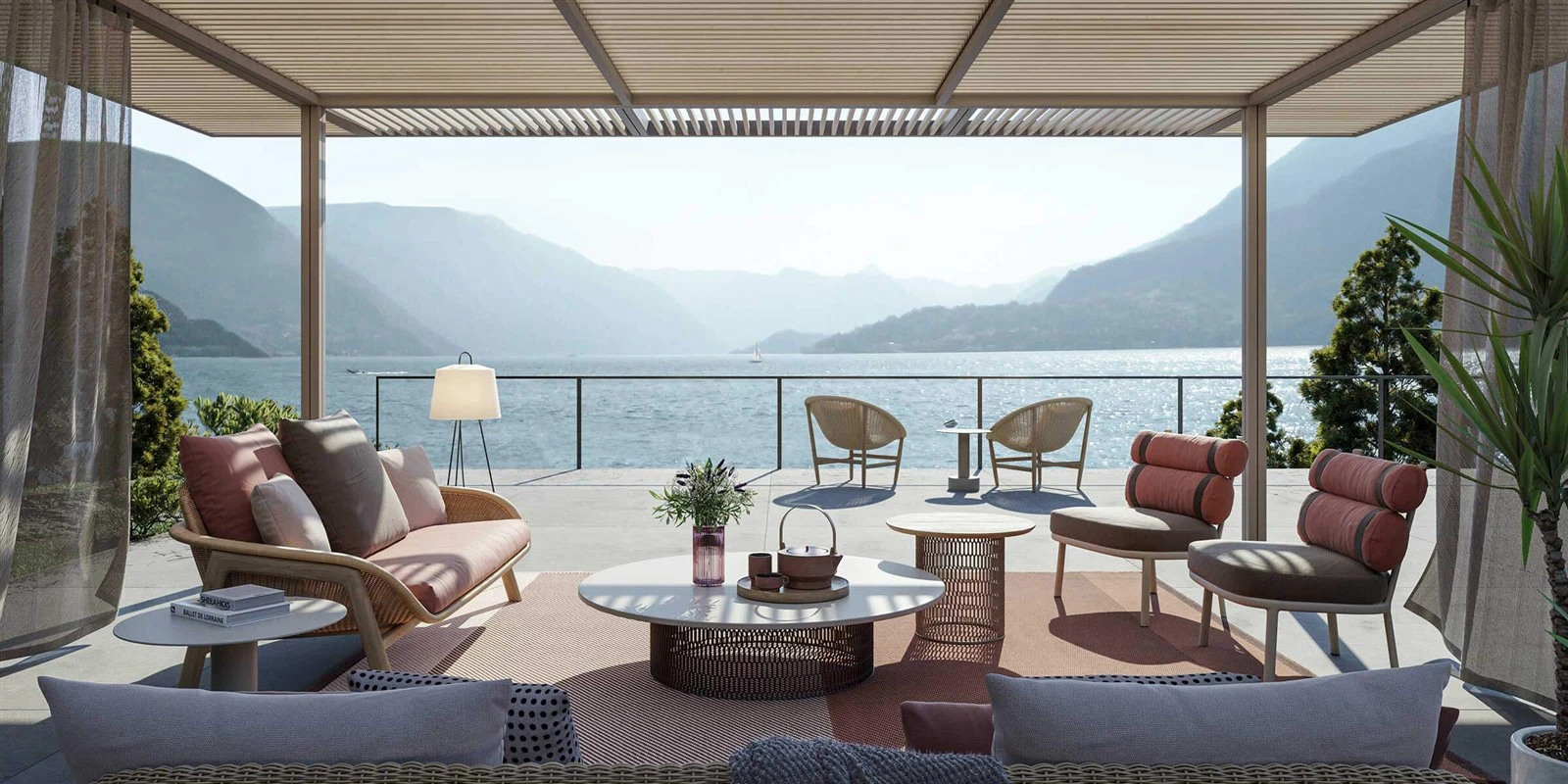
🌊 3. PVDF Fluorocarbon: The Ultimate Shield for Coastal Marine Projects
If your project sits within 500 meters of the ocean high-tide line, standard coatings will struggle. Salt spray combined with intense humidity creates a highly corrosive electrochemical cell on metal surfaces. In these environments, the supreme choice for your aluminum pergola coating process is PVDF (Polyvinylidene Fluoride) liquid coating, widely recognized by its trade name Kynar 500.
PVDF is an advanced fluoropolymer containing alternating carbon-fluorine bonds, which are among the strongest chemical bonds known to science. This molecular structure makes the cured film completely inert to chemical attack, acid rain, bird droppings, and intense UV degradation.
A high-performance PVDF finish must comply with AAMA 2605, the stringent voluntary specification managed by the Fenestration & Glazing Industry Alliance. To achieve this rating, the finish must survive a grueling 4,000-hour salt spray test and 10 years of real-world exposure testing in South Florida without blistering, chalking, or undergoing significant color shifts. It is the gold standard for oceanfront resorts running heavy-duty outdoor operations.
🏭 4. The Pre-treatment Secret: Why Coatings Actually Succeed or Fail
Here is an industry secret: the absolute best powder or PVDF chemical formulation will peel off like cheap tape if the raw extrusion isn't pre-treated properly. The application of the finish is only 30% of the battle; 70% of the structural longevity happens in the pre-treatment chemical dipping tanks.
📊 Pre-treatment Quality Benchmarks and Failure Modes
| Stage | Industrial Protocol | Target Metric | Failure Consequence if Skipped |
| 1. Degreasing & Etching | Multi-stage acid wash to strip manufacturing oils and the erratic natural oxide layer. | Al7075/6063 surface clean to bare alloy | Trapped mill oils cause localized bubbling and immediate adhesion loss under heat. |
| 2. Conversion Layer | Application of a chrome-free conversion coating (titanium/zirconium technology). | $5 - 15 \, \text{mg/m}^2$ deposition weight | Microscopic moisture penetration causes rampant under-film filiform corrosion. |
| 3. Rinsing | Double rinse utilizing Reverse Osmosis (RO water). | Water conductivity < $30 \, \mu\text{S/cm}$ | Leftover salt ions act as an osmotic pump, pulling moisture right through the outer coating. |
| 4. Curing Quality Check | Cross-hatch adhesion testing via ASTM D3359 tape pull protocol. | 5B Rating (0% coating removal) | Poorly cross-linked polymers chip instantly when hit by an outdoor sectional sofa frame or heavy wind debris. |

🛡️ 5. Procurement Checklist: Verifying the Quality on the Factory Floor
Before approving your commercial outdoor furniture and shading contract, instruct your quality control team or third-party inspection agency (such as SGS or Intertek) to audit these parameters:
Verify Laboratory Testing Logs: Request the factory's daily ISO 9227 salt spray data and their impact resistance test records.
Conduct a Dry Film Thickness (DFT) Test: Use an electromagnetic gauge to verify that the powder coating measures a uniform $60 - 90 \, \mu\text{m}$ across both the structural columns and the internal channels of the motorized louvers.
Cross-Check Certification IDs: If the vendor claims to use AkzoNobel Interpon or Tiger Drylac architectural powders, demand the specific batch numbers and their matching Qualicoat Class 2 certification certificates.
Confirm Hardware Compatibility: Ensure all internal assembly brackets, pins, and screws are made from marine-grade 316 stainless steel. Low-grade fasteners will trigger galvanic corrosion when screwed into aluminum, chewing through the surrounding coating regardless of its quality.
❓ Industry-Focused FAQ
Q1: Will an aluminum pergola rust if installed directly on a beachfront resort?
❌ No, aluminum will never develop structural red rust because it contains no iron. However, if it features a cheap wet-paint finish, salt-water exposure will trigger white sub-surface oxidation (filiform corrosion), causing the paint layer to bubble, crack, and flake off. To prevent this, seaside projects must specify a finish that meets AAMA 2605 or Qualicoat Class 2 marine-grade standards.
Q2: What is the primary difference between powder coating and PVDF for outdoor structures?
⚙️ Powder coating is applied electrostatically as a dry powder and baked to form a thick, hard, scratch-resistant barrier ($60-90\,\mu\text{m}$), making it ideal for high-traffic commercial zones. PVDF is a resin-based liquid fluorocarbon coating that excels in chemical inertness and UV defense ($35-50\,\mu\text{m}$). Powder coating offers better physical scratch resistance, while PVDF provides superior chalking and fading resistance in extreme coastal zones.
Q3: How do I verify that a supplier is genuinely using high-grade outdoor powder instead of cheap indoor alternatives?
🔬 True architectural-grade finishes are backed by formal documentation. Demand a certified mill test report showing compliance with ASTM D3359 (adhesion testing) and independent certification labels from global auditing firms like SGS. Check that the powder formulation is explicitly rated as "Super-Durable Polyester" or carries a verified Qualicoat Class 2 approval number.
Q4: Can we fix scratches on a powder-coated aluminum pergola on-site if a piece of garden dining table hits it?
🔧 Yes, minor transit or installation scratches can be repaired on-site using color-matched air-dry fluoropolymer touch-up pens or specialized acrylic touch-up kits. However, these field-applied fixes only restore aesthetics; they cannot perfectly replicate the factory-baked molecular cross-linking of the original electrostatic application.
Q5: Why is a chrome-free conversion coating step so vital during the pre-treatment phase?
🛡️ Raw aluminum is naturally slick and chemically unstable. A chrome-free conversion coating uses advanced titanium or zirconium chemistry to micro-etch the aluminum surface, creating an ultra-dense, microscopic crystalline structure. This layer serves two roles: it creates an immovable mechanical anchor for the topcoat and forms a passive chemical shield that halts the spread of corrosion if the outer finish is scratched down to the bare metal.
Q6: Does a dark-colored finish fade faster than light colors under intense desert sun?
☀️ Yes, darker pigments (like charcoal grey or deep black) absorb significantly more infrared radiation, raising the surface temperature of the aluminum frame up to $80^\circ\text{C}$. This thermal stress accelerates the breakdown of inferior resin binders. To stop color fading, you must ensure the dark pigment is locked inside a super-durable resin system that conforms to AAMA 2605 parameters, holding a low Delta E variance over a decade.