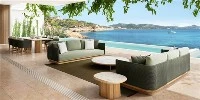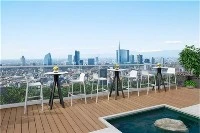

A high-rise rooftop bar presents structural and operational challenges that a ground-level patio never encounters. At 100 feet or higher, outdoor furniture must interact seamlessly with the building's structural capacity, local aerodynamic microclimates, daily hospitality service, and the delicate roof waterproofing assembly.
Specifying wind-resistant outdoor seating is therefore not simply a matter of buying the heaviest chairs on the market. Overly heavy furniture strains structural floor loads, slows down daily cleaning, and creates labor inefficiencies during sudden weather evacuations. Conversely, lightweight residential furniture poses severe safety risks, as high-altitude gusting can transform unsecured pieces into dangerous airborne projectiles.

The most effective strategy is systemic: controlling furniture geometry, wind porosity, base stability, surface friction, selective ballast, micro-climate zoning, and staff operational workflows simultaneously. For hospitality venues, the goal is not to make every piece permanently immovable, but to create a high-performance seating system that remains stable under normal operating wind loads while staying mobile enough for staff to reset, maintain, and store efficiently.
The Aerodynamics of Rooftop Wind: Why "Heavy Enough" Is a Misconception
Wind velocity and turbulence patterns at roof height are vastly different from ground-level airflow. Nearby building geometries, parapet walls, corners, and open-water proximity create complex microclimates.
To evaluate wind forces on rooftop structures and furniture, engineering frameworks such as ASCE 7 (Minimum Design Loads and Associated Criteria for Buildings and Other Structures) assess site-specific wind parameters. The fundamental velocity pressure equation is expressed as:
q_z = 0.00256 K_z K_{zt} K_d V^2
Where q_z is the velocity pressure at height z (\text{lb/ft}^2), V is the basic wind speed (\text{mph}), K_z is the velocity pressure exposure coefficient, K_{zt} is the topographic factor, and K_d is the wind directionality factor.
ASCE 7 categorizes sites into distinct Exposure Categories:
Exposure B: Urban and suburban areas with dense, closely spaced obstructions (lowest wind pressure, K_z = 0.70 at 30 ft).
Exposure C: Open terrain with scattered low obstructions (baseline default, K_z = 0.98 at 30 ft).
Exposure D: Flat, unobstructed coastal areas facing open water within 600 ft or 20h of the shoreline (K_z = 1.16 at 30 ft, producing up to 66% higher wind pressure than Exposure B).
The horizontal aerodynamic wind force F_h acting on a piece of rooftop furniture is calculated as:
F_h = q_h G C_r A_f
Where q_h is velocity pressure at mean roof height, G C_r is the combined pressure coefficient, and A_f is the effective frontal area exposed to the wind.
This formula demonstrates a critical physical principle: reducing the frontal exposed surface area (A_f) and drag coefficient is far more efficient than simply adding dead weight.

The Four Rooftop Movement Risks
High-altitude wind acts on furniture through four distinct failure modes. Understanding these mechanics dictates the appropriate design strategy:
| Risk Mode | Physical Mechanism | Engineering & Design Response |
| Sliding | Horizontal wind force ($F_h$) overcomes static floor friction. | High-friction rubberized foot glides, wider base footprints, and textured floor contact. |
| Tipping | Overturning moment around the leeward edge exceeds the restoring gravity moment. | Lower center of gravity ($h_{cog}$), wider leg base span ($b$), and open-back geometry. |
| Uplift | Negative pressure zones create vertical lift ($F_v$), reducing effective contact weight. | Aerodynamic venting, selective ballast, or approved non-penetrating securement. |
| Uncontrolled Movement | Loose cushions, umbrellas, or light accessories detach during gusts. | Mechanical cushion locks, quick-release toggles, stackable storage, and formal weather protocols. |
Four Engineering Strategies for Wind-Resistant Rooftop Seating
Because exposure levels vary across a single terrace, no single furniture design fits every zone. Commercial venues should utilize a combination of four core strategies:
Strategy 1: Prioritize Aerodynamic Geometry and Lower Center of Gravity
Reducing furniture profile height decreases the moment arm (h_{cog}) that wind uses to tip a chair. Low-slung lounge seating, wide-base lounge chairs, and open-weave backrests (such as braided rope or perforated metal) allow air to pass through freely. Aerodynamic porosity reduces the effective surface area (A_f) by 30% to 50%, dramatically lessening lateral force (F_h) without adding structural weight.
Strategy 2: Implement Targeted Micro-Climate Zoning
Rather than specifying heavy-duty furniture for the entire venue, divide the rooftop into three distinct wind exposure zones:
Zone A - Sheltered (Interior & Courtyards): Protected by core building structures or tall wind screens. Focus on lightweight, stackable aluminum or resin chairs for maximum operational flexibility.
Zone B - Semi-Exposed (Central Dining & Bar Areas): Subject to moderate gusts. Use rigid powder-coated aluminum frames paired with braided rope, wider footprints, and optional weighted base inserts.
Zone C - Highly Exposed (Edges & Perimeter Corners): Subject to maximum wind shear and vortex shedding. Specify low-profile lounge systems, heavy teak or cast aluminum bases, integrated non-penetrating ballast, or mechanical locking systems.

| Rooftop Zone | Micro-Climate Exposure | Ideal Furniture Profile | Key Material System | Operational Mobility Strategy |
| Zone A (Sheltered) | Low wind shear, protected by walls | High-top bar stools, stackable dining chairs | Powder-coated aluminum, HDPE resin | High Mobility: Rapid stacking and flexible layout reconfigurations. |
| Zone B (Semi-Exposed) | Moderate gusts, predictable airflow | Mid-height dining, wide-base bar seating | Aluminum frames with woven rope, teak accents | Medium Mobility: Modular linking connectors and weighted base options. |
| Zone C (Highly Exposed) | Extreme edge gusts, high uplift risk | Low-profile lounge sofas, low coffee tables | Solid teak, heavy cast bases, steel sub-plates | Controlled Mobility: Integrated heavy ballast or non-penetrating floor anchorage. |
Strategy 3: Link Modular Seating into Unified Systems
Single lightweight chairs can shift individually in strong winds. By connecting sectional sofa modules or dining benches together using concealed stainless steel or high-strength polymer interlocking brackets, the combined mass and base width increase significantly. A linked four-piece sectional behaves as a single heavy, stable structure while allowing staff to unclamp and relocate the pieces when needed.

Strategy 4: Apply Selective Non-Penetrating Ballast
Instead of over-engineering the entire frame, add weight specifically where it increases tipping resistance-at the lowest point of the base. Concealed steel plates or concrete ballast weights built into the base frame lower the overall center of gravity (h_{cog})without altering the visual design of the furniture.
Material Selection: Balancing Rooftop Durability and Weight
Rooftop environments expose furniture to a harsh combination of UV radiation, salt fog, thermal expansion, moisture, and high wind fatigue. Choosing the right material requires balancing structural mass with weather resistance.
Powder-Coated Aluminum
Powder-coated aluminum is the industry standard for commercial contract furniture. It offers an exceptional strength-to-weight ratio, high corrosion resistance, and flexible geometric profiling. While light, an engineered aluminum frame paired with an open-weave back and high-friction foot glides provides ideal stability for Zone A and Zone B. Ensure coatings meet architectural-grade fluoropolymer or polyester standards to prevent chalking under intense UV exposure.
Solid Teak (Tectona grandis)
Solid teak provides substantial natural mass, luxurious warmth, and inherent stability against wind tipping. With a dense grain structure rich in natural oils, teak resists rot, moisture, and salt spray. Its higher dead weight makes it inherently suited for Zone C perimeter lounges. Teak requires scheduled maintenance (oiling) to retain its golden-brown color, or it can be allowed to weather naturally into a silver-grey patina.
Outdoor Performance Rope & Resins
High-density polyethylene (HDPE) resin and solution-dyed polypropylene rope offer excellent aerodynamic permeability, allowing wind to flow directly through the seating shell. Rope-wrapped frames provide tactile comfort without the visual or wind-catching bulk of solid upholstered shells.
Quick-Dry Foam & Performance Fabrics
Rooftop cushions must use reticulated polyurethane foam (Quick-Dry Foam) featuring an open-cell structure that permits water and air to drain rapidly. All cushions must be fitted with concealed mechanical attachment systems-such as marine-grade stainless steel snaps, heavy-duty hook-and-loop straps, or toggle pins-to prevent wind gusts from lifting them off the frames.

| Material Type | Mass & Stability Profile | Weather & Salt Resistance | Aerodynamic Wind Performance | Maintenance Requirement |
| Powder-Coated Aluminum | Low to Medium Mass | Exceptional corrosion resistance | Depends on geometry; low wind resistance if open-weave | Low (periodic rinsing) |
| Solid Teak | High Natural Mass | High resistance to moisture & rot | Higher wind drag, but superior inherent gravity stability | Moderate to High (seasonal oiling) |
| Outdoor Performance Rope | Low Added Mass | High UV & tension resistance | Outstanding (high aerodynamic permeability) | Low (brush cleaning) |
| HDPE & Resin | Medium Mass | High chemical & salt resistance | Moderate; requires stable base geometry | Very Low (easy washdown) |
| Quick-Dry Foam + Fabric | Very Low Mass | High water drainage & UV resistance | High lift risk; requires mechanical locking straps | Low (rapid post-rain recovery) |
Rooftop Anchoring vs. Non-Penetrating Sub-Panels
In highly exposed perimeter areas (Zone C), mechanical securement may be necessary. However, drilling anchors directly into a rooftop deck should never be done without a multi-disciplinary engineering review.
Penetrating a roof deck risks puncturing the waterproofing membrane, leading to costly water leaks, structural damage, and voiding building roof warranties.
Approved Securement Options:
Non-Penetrating Weighted Sub-Panels: Heavy steel or concrete base plates sit beneath the decking or on top of high-density neoprene rubber pads. The furniture anchors directly to the panel, protecting the membrane while providing ballast.
Parapet Wall Tie-Offs: Concealed marine-grade stainless steel cables or brackets secure furniture frames directly to structural concrete parapets or steel posts above the waterproofing line.
High-Friction Elastomeric Glides: Specialized vulcanized rubber feet significantly increase the coefficient of friction (\mu), preventing sliding under operational wind gusts.

Commercial Testing Standards and Quality Verification
Commercial buyers should avoid vague claims like "commercial grade" and insist on certified third-party laboratory test reports from accredited bodies (ISO/IEC 17025 accredited labs like SGS, Intertek, or UL).
UL 4041: The standard for outdoor furniture safety, evaluating stability, dynamic load fatigue, structural strength, and glass impact resistance (requiring a 0.54 kg steel ball drop at 6.8 J without breakage).
EN 581 (Parts 1–3): European contract standards verifying mechanical safety, structural reliability, and overturning stability under severe commercial usage.
ANSI/BIFMA X5.4: Evaluated for public and lounge seating, ensuring frame fatigue resistance under high-frequency commercial use.
ASTM B117 & ASTM G154: Environmental testing standards evaluating salt spray corrosion (500–1000 hours) and accelerated UV degradation.
| Certification / Standard | Scope & Focus | Critical Evaluation Metrics | Buyer Verification Action |
| UL 4041 |
Outdoor patio furniture safety & stability |
Overturning resistance, structural load, glass impact |
Request complete test report mapping exact model numbers. |
| EN 581-1 / -2 / -3 |
European contract outdoor furniture |
Mechanical safety, seat durability, table stability |
Verify "Contract / Commercial" pass level rather than domestic. |
| ANSI/BIFMA X5.4 |
Commercial public & lounge seating |
Impact endurance, joint fatigue, arm/back strength |
Confirm static and dynamic load capacity specifications. |
| ASTM B117 |
Salt-fog corrosion resistance |
Coated metal resistance to blistering and rust |
Require minimum 500+ hour salt spray certification. |
| ASTM G154 |
Accelerated UV exposure |
Fabric & polymer resistance to fading and cracking |
Review tensile strength retention after 1000 hours UV. |

Total Cost of Ownership (TCO) and Wind-Response Operating Procedures (WROP)
Evaluating furniture solely on initial purchase price leads to higher operational costs over time. The Total Cost of Ownership (TCO) for rooftop seating includes daily labor, weather downtime, and replacement frequency:
\text{TCO} = P_{\text{initial}} + L_{\text{operational}} + M_{\text{maintenance}} - R_{\text{residual}}
A well-engineered, wind-resistant furniture package lowers L_{\text{operational}} by enabling rapid daily cleaning and minimizing emergency storm evacuation labor.
The 3-Tier Wind Response Operating Procedure (WROP)
Venues should implement a formal weather operational protocol based on real-time anemometer wind speeds:
Level 1 - Normal Operations (< 20 knots / ~37 km/h):
All zones fully operational.
Cushion mechanical lock straps remain fully engaged.
Level 2 - High Wind Advisory (20 to 35 knots / ~37–65 km/h):
Retract all shade umbrellas and pergolas.
Clear loose accessories and non-anchored cushions from Zone C.
Lock modular lounge sectionals together in Zone B & C using interlocks.
Level 3 - Severe Storm Evacuation (> 35 knots / > 65 km/h):
Stack and relocate lightweight Zone A chairs to indoor storage.
Secure Zone C heavy lounge modules with custom weather covers tethered to parapet tie-downs.
Close outdoor terrace to guest access.

What Commercial Buyers Should Include in an Outdoor Furniture RFQ
When submitting a Request for Quotation (RFQ) for high-rise rooftop furniture, avoid generic descriptions. A commercial-grade brief should specify:
Site Parameters: Building floor height, geographical location, ASCE 7 Exposure Category (B, C, or D), and roof loading limits.
Micro-Climate Zones: Quantities required per zone (Zone A, Zone B, Zone C).
Engineering Requirements: Maximum center of gravity height (h_{cog} \le 450 \text{ mm}), open-weave back porosity (\ge 30\%), and non-slip rubber glides.
Material Specifications: Architectural fluoropolymer powder coating, 316 stainless steel hardware, solution-dyed acrylic fabrics, and Quick-Dry reticulated foam.
Testing & Compliance: Mandatory UL 4041 or EN 581 test reports from ISO/IEC 17025 accredited laboratories.
Operational Capabilities: Maximum stacking density (e.g., stackable 4–6 high) and replacement parts availability.
FAQ:
1. Is heavier outdoor furniture always better for a high-rise rooftop bar?
No. Excessive weight creates structural floor loading issues, hinders daily cleaning, and makes emergency weather evacuations extremely labor-intensive. Stability is achieved through low center of gravity, wider base footprints, aerodynamic porosity (open weave), and high-friction foot glides, rather than pure mass alone.
2. How do I stop rooftop cushions from blowing away in strong winds?
Rooftop cushions should utilize mechanical retention systems-such as heavy-duty hook-and-loop straps, marine-grade stainless steel snaps, or concealed toggle pins attached directly to the frame. Never rely on loose gravity cushions or lightweight ties on exposed high-rise terraces.
3. Can I drill anchors directly into my rooftop deck to secure furniture?
Drilling into a roof assembly should be avoided whenever possible, as it damages the waterproofing membrane, causes leaks, and voids building roof warranties. Instead, use non-penetrating weighted sub-panels beneath rubber pads, heavy solid teak construction in perimeter zones, or tether systems anchored to structural parapet walls above the water line.
4. Which materials withstand coastal high-rise conditions best?
Powder-coated architectural aluminum, solid teak wood, high-density polyethylene (HDPE) resin, and solution-dyed polypropylene ropes excel on coastal rooftops. Ensure all metal fasteners are 316 marine-grade stainless steel and powder coatings pass ASTM B117 salt spray corrosion testing.
5. What is the difference between Exposure B, C, and D on a rooftop?
ASCE 7 defines Exposure B as urban/suburban sites with dense buildings. Exposure C applies to open terrain. Exposure D applies to coastal sites within 600 feet of open water, generating up to 66% higher wind pressures. Rooftop furniture in Exposure D zones requires lower profiles, higher base stability, and strict storm response procedures.
Final Takeaway
Designing wind-resistant outdoor seating for high-rise rooftop bars starts with site physics, not catalog aesthetic design alone. By mapping terrace exposure zones, choosing aerodynamic geometries over raw weight, specifying commercial contract materials, verifying third-party test reports, and enforcing structured weather response protocols, venue operators can achieve an optimal balance between luxury aesthetic appeal, guest safety, and daily operational efficiency.