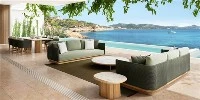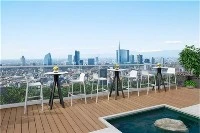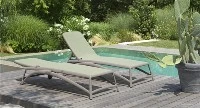

A resort terrace rarely has one permanent purpose. Breakfast service may occupy the space in the morning, poolside lounging may take over later, and an evening reception may require an almost completely different circulation pattern.
The most flexible hospitality outdoor sofas are therefore not simply the sofas with the largest number of pieces. They are the systems that can change shape without creating a second operational problem for housekeeping, event staff or guests.
For buyers evaluating modular outdoor sofa wholesale, the more important question is whether the same furniture package can support several revenue-producing uses without becoming difficult to move, clean, store or repair.

That leads to a practical answer: the strongest general-purpose solution is usually a modular family built around repeatable center sections, corner units, ottomans, independent tables and a reliable connection method. This combination can move between linear seating, L-shaped lounges, U-shaped conversation areas, island groupings and separated VIP zones.
The right configuration depends on more than aesthetics. Floor geometry, event turnover, wind exposure, pool chemicals, UV intensity, salt air, maintenance routines and the way furniture is stored between events can all change the specification.
1.Hospitality Outdoor Sofas: Start With the Event Calendar
An event manager does not think in product categories.
They think:
"Can I open this space for 80 guests?"
"Can I create a quieter VIP zone?"
"Can a wedding ceremony move through without carrying half the furniture away?"
"Can the terrace return to normal service after dinner?"
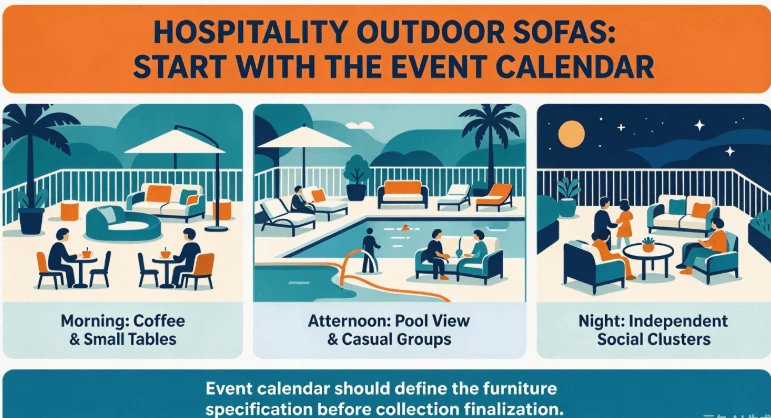
That is why the event calendar should influence the furniture specification before the collection is finalized.
Consider three versions of the same terrace.
In the morning, the seating may need generous spacing and small tables for coffee. During afternoon service, the same space may prioritize pool views and casual groups. At night, the operator may want several independent social clusters with clear paths between them.
A fixed sectional can perform one or two of those jobs well.
A genuinely modular system can cover the transition between them.
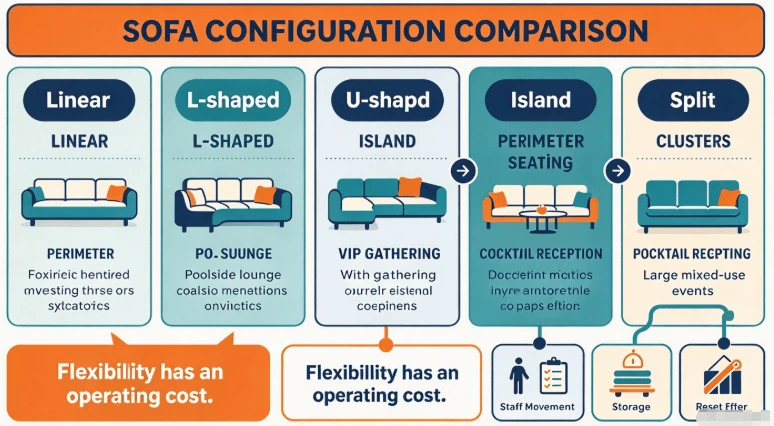
Configuration comparison
| Configuration | Flexibility | Best Use | Main Limitation | Reset Effort |
|---|---|---|---|---|
| Linear | Medium | Perimeter seating, waiting, ceremony | Less intimate | Low |
| L-shaped | High | Poolside lounge, conversation | Occupies a defined corner | Low–Medium |
| U-shaped | High | VIP gathering, private event | Uses more floor area | Medium |
| Island | Very High | Cocktail reception, social zone | Requires careful circulation | Medium |
| Split clusters | Very High | Large mixed-use events | More storage and handling | Medium–High |
The practical lesson is easy to miss:
Flexibility has an operating cost.
If every configuration requires several staff members, awkward lifting or temporary storage in a service corridor, the theoretical flexibility may never be used in practice.
2.Build the System From Repeatable Modules
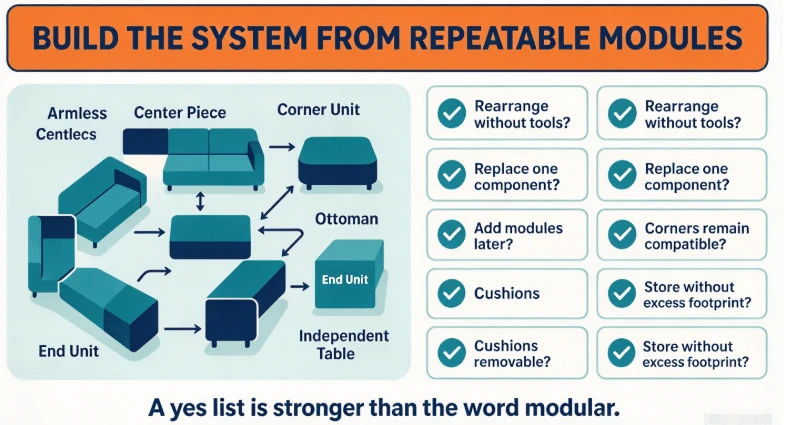
The most useful modular collections usually have a small vocabulary.
An armless center piece is the workhorse.
A corner creates direction.
An ottoman adds capacity without forcing a permanent shape.
A side or end unit finishes an arrangement without making the entire composition dependent on one special component.
Independent tables matter more than many buyers expect. A sofa should not dictate where every drink table or dining surface must sit.
The strongest commercial systems also allow the same visual language to survive when pieces are separated.
That means the sofa still looks intentional when it changes from one twelve-seat composition into three four-seat groups.
A good modular family should answer six questions
Can the modules be rearranged without specialist tools?
Can one damaged component be replaced without replacing the whole set?
Can additional modules be ordered later?
Do corners and center units remain compatible across layouts?
Can cushions be removed individually?
Can the system be stored without creating an unmanageable footprint?
A "yes" to these questions is much more meaningful than simply calling a sofa "modular."
3.Modular Outdoor Sofa Wholesale: Standardize the Parts Before You Standardize the Quantity
Wholesale purchasing often creates a temptation to buy by set count.
For a resort project, that is not always the best way to think.
Suppose the procurement team orders several identical six-seat sets because the drawing looks neat.
Later, the event department discovers that the wedding layout needs four-seat clusters.
Now the property owns several beautiful sofa sets that are locked into a configuration they did not actually need.
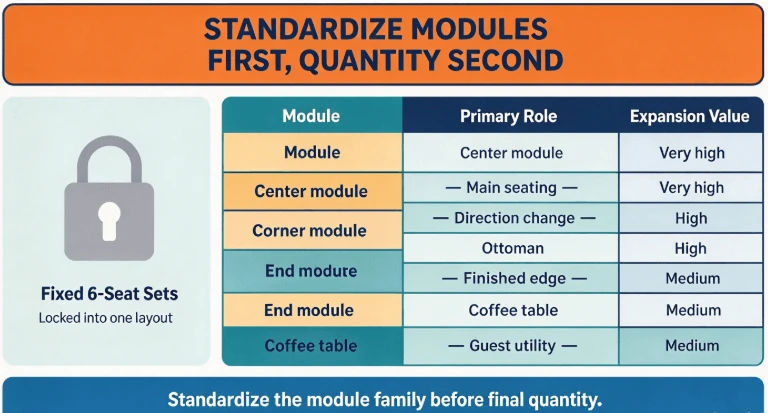
A better purchasing strategy is to standardize the module family first and the final quantity second.
That allows procurement to think in terms of inventory logic:
| Module | Primary Role | Secondary Role | Expansion Value |
|---|---|---|---|
| Center module | Main seating | Standalone bench | Very high |
| Corner module | Direction change | Conversation anchor | High |
| Ottoman | Footrest / seat | Flexible event piece | High |
| End module | Finished edge | Independent seating | Medium |
| Coffee table | Guest utility | Space divider | Medium |
| Side table | Personal surface | Flexible circulation piece | Medium |
This approach can simplify future replenishment because the resort is not managing dozens of unique shapes.
More importantly, it makes furniture relocation easier between different terraces, lounges and event zones.
4.Event Space Transformation: Think in "States," Not Just Layouts
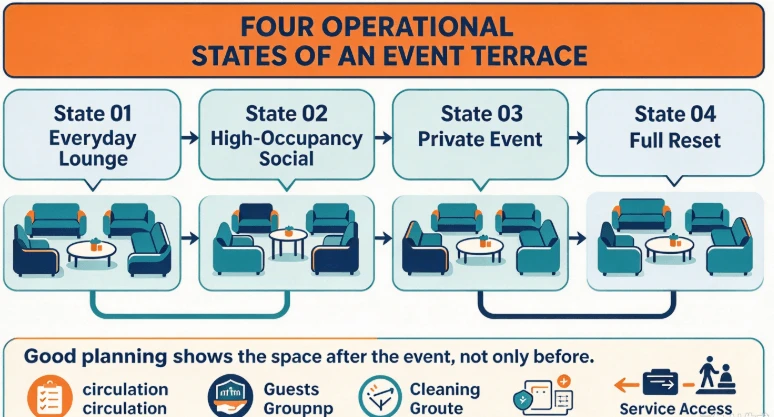
A strong specification should include at least four operational states.
State 01 - Everyday Lounge
The furniture supports comfort, visual balance and natural guest circulation.
State 02 - High-Occupancy Social
Modules move closer together, tables are redistributed and seating density increases.
State 03 - Private Event
The furniture is split into smaller zones, giving hosts control over guest groups and circulation.
State 04 - Full Reset
Furniture returns to a standard hospitality arrangement without blocking doors, cleaning routes or service areas.
That fourth state deserves more attention.
Many furniture plans show how a venue looks before an event.
Good operations planning also shows how it looks after one.
5.Event Flexibility Is Also a Floor-Plan Problem
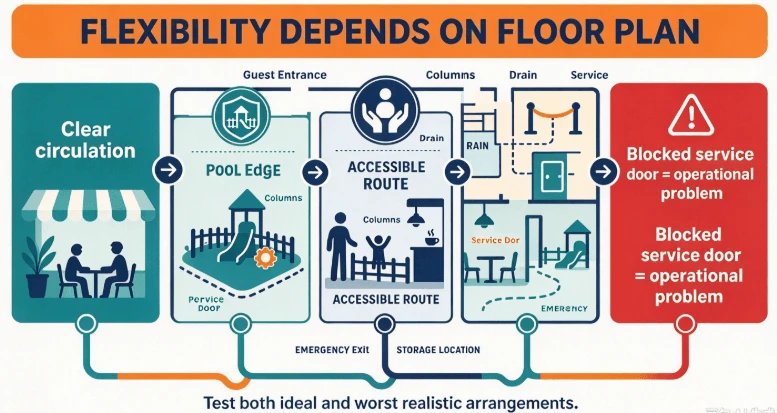
A sofa cannot create flexibility by itself.
The building has to allow the furniture to move.
Before approving a configuration, mark:
guest entrances
pool edges
architectural columns
planter zones
drains
service doors
accessible routes
emergency exits
food-service paths
storage locations
A modular sectional that blocks a service door has not solved a space problem.
It has created one.
A useful design review should therefore test both the "ideal arrangement" and the "worst realistic arrangement."
That includes the evening when the terrace is full, the catering team needs access, several tables have been added and cushions need to be moved because weather has changed.
6.Commercial Outdoor Furniture for Hotels: Design for Reset Speed
Hotels and resorts experience something residential terraces usually do not:
constant operational turnover.
A hospitality property may move furniture for an event, clean the terrace, reopen the area, change table positions and repeat the process many times.
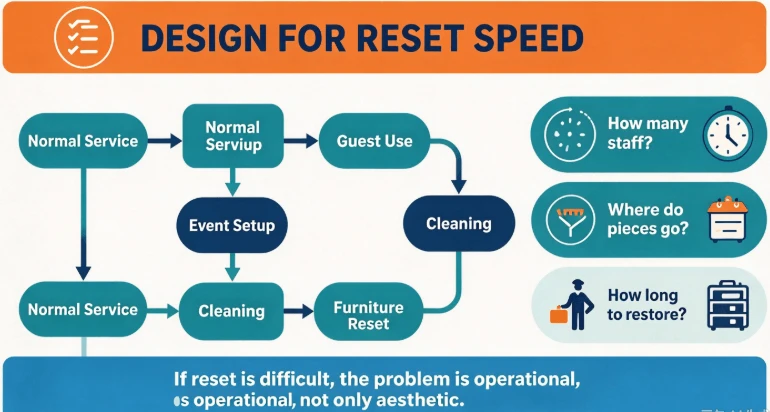
The value of modular seating therefore depends partly on how quickly a property can return to normal service.
Three questions are particularly revealing:
How many people are needed to move the system?
Where do the pieces go during an event?
How long does it take to restore the standard layout?
These questions should be answered before the purchase order, not after installation.
Visual operating loop
NORMAL SERVICE ↓ EVENT SETUP ↓ GUEST USE ↓ CLEANING ↓ FURNITURE RESET ↓ NORMAL SERVICE
If the system becomes difficult at the fifth step, the problem is not aesthetic.
It is operational.
7.The Difference Between "Moveable" and "Commercially Useful"
A lightweight sofa may be easy to move.
That does not automatically make it suitable for a busy resort.
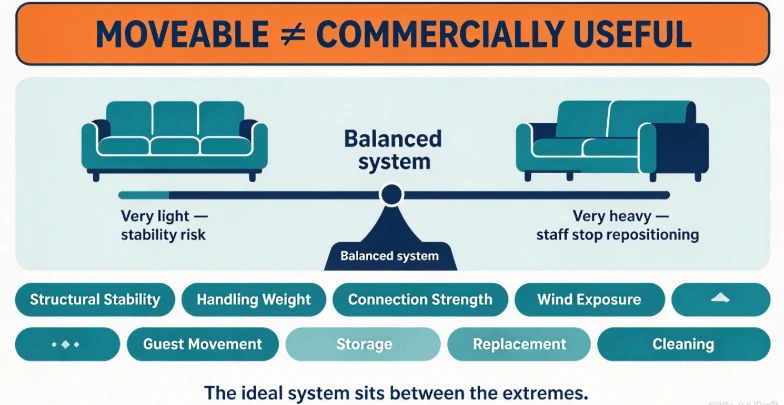
The supplier has to balance:
structural stability
handling weight
connection strength
wind exposure
guest movement
storage
replacement
cleaning
In windy rooftop or waterfront locations, an extremely light modular unit may introduce a different operational risk.
Conversely, an oversized heavy unit may be durable but so difficult to reposition that staff simply stop using its modular features.
The ideal system sits somewhere between those extremes.
8.Luxury Resort Outdoor Furniture: Materials Should Follow the Environment
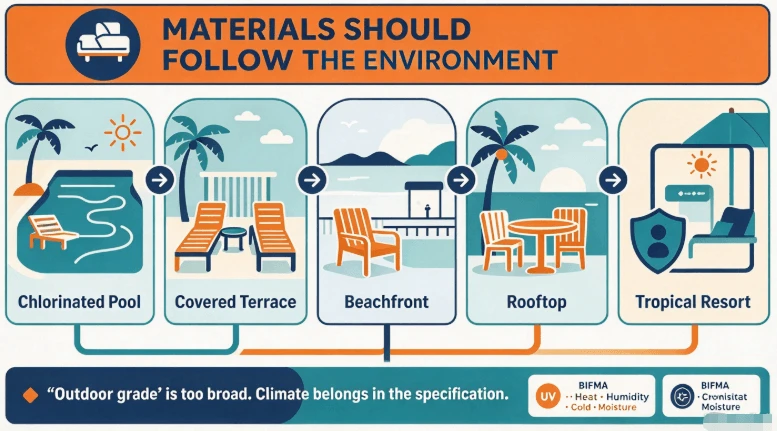
The phrase "outdoor grade" is too broad to be useful on its own.
A sofa placed beside a chlorinated pool does not experience exactly the same environment as one under a covered terrace.
A beachfront property adds salt exposure.
A rooftop adds wind and intense solar exposure.
A tropical resort adds persistent humidity and rain.
BIFMA's outdoor-furniture guidance specifically recognizes environmental pressures including UV exposure, heat, humidity, cold and moisture when evaluating exterior furnishings. Its guidance also highlights the difficulty of combining durability, safety and accelerated-weathering considerations into a single universal material-neutral standard.
That is why climate should appear in the furniture specification.
Not just in the architect's notes.
9.🌦️ Five Environmental Stresses to Map Before Ordering
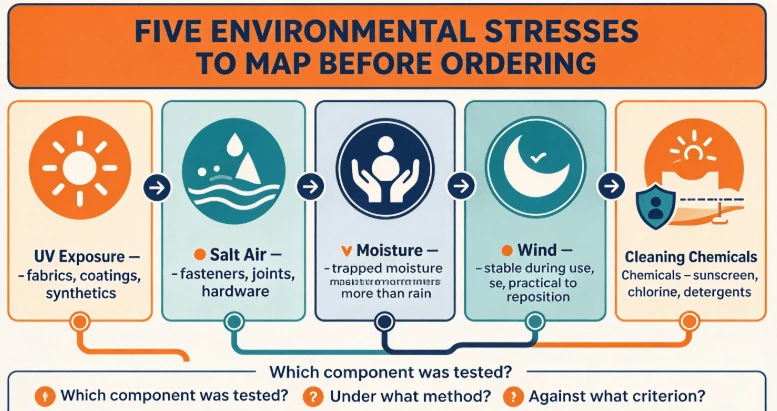
☀️ UV Exposure
Long periods of direct sun can influence fabrics, coatings, synthetic components and plastics.
Do not ask simply:
"Is it UV resistant?"
Ask what component was tested, under what method and against what performance criterion.
🌊 Salt Air
Coastal environments introduce chloride exposure.
The vulnerable points are often hidden: fasteners, joints, hardware and damaged coating edges.
💧 Moisture
Rain itself is not necessarily the biggest issue.
Trapped moisture is.
Good drainage and ventilation can be as important as water-resistant fabric.
🌬️ Wind
A movable modular system must remain stable in its normal operating condition while still being practical for staff to reposition.
🧽 Cleaning Chemicals
Poolside and hospitality furniture may encounter sunscreen, chlorine, detergents, food residue, body oils and frequent wiping.
A material that performs well in sunlight can still behave poorly under repeated aggressive cleaning.
10.Material Selection: Which Systems Make Sense for Which Environment?
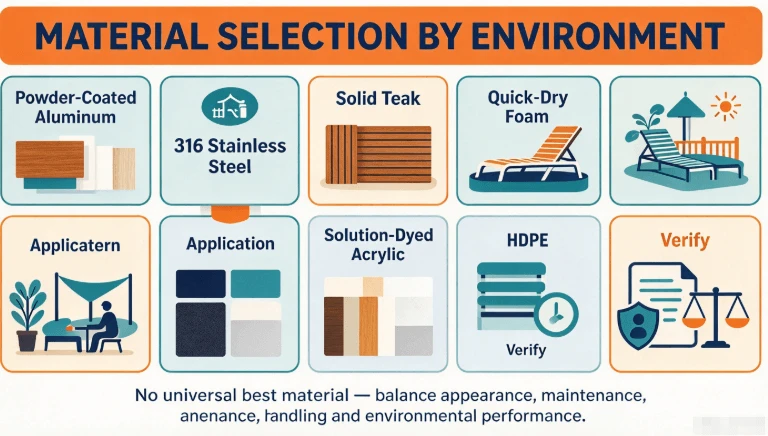
| Material / Component | Common Hospitality Application | Main Exposure Concern | What Buyers Should Verify |
|---|---|---|---|
| powder-coated aluminum | Pool decks, rooftops, terraces | Coating damage, corrosion at exposed areas | Finish system, surface preparation, coating evidence |
| 316 stainless steel | Coastal hardware and connection points | Chloride exposure | Hardware grade and component application |
| solid teak | Premium resort lounges and villas | Weathering, moisture movement, maintenance preference | Wood sourcing, finish expectations, maintenance guidance |
| quick-dry foam | Poolside and rain-exposed cushions | Moisture retention if drainage is poor | Cushion construction, airflow and drainage design |
| solution-dyed acrylic | High-use exterior upholstery | UV, staining and repeated cleaning | Fabric specification and applicable performance data |
| HDPE | Poolside and high-cleaning zones | Surface wear and thermal movement | Resin specification and cleaning requirements |
There is no universal "best" material.
The better question is:
Which material combination gives this property the right balance of appearance, maintenance, handling and environmental performance?
11.Coastal Resort Furniture Requires a Component-Level View
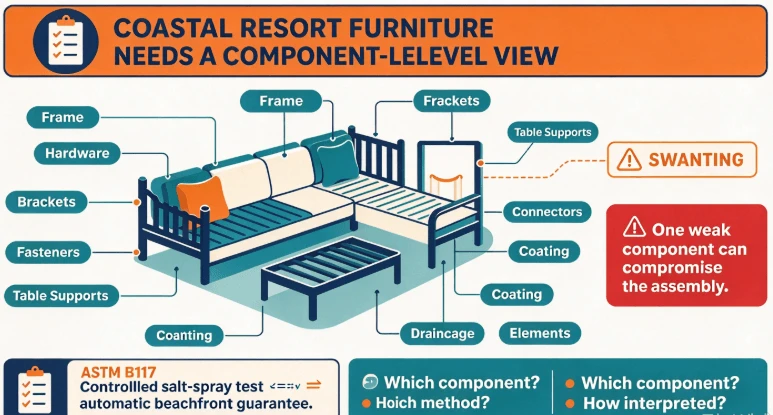
Corrosion resistance is often discussed as though it belongs to the frame alone.
In practice, a complete furniture assembly may contain several materials:
frame
hardware
brackets
fasteners
table supports
connectors
coating
drainage elements
One weak component can compromise an otherwise sensible specification.
ASTM B117 provides a controlled salt-spray environment used to generate comparative corrosion-resistance information for metals and coated metals. ASTM also notes that standalone salt-spray results do not reliably predict natural environmental performance.
That means the procurement question should not be:
"Did the sofa pass salt spray?"
It should be:
"Which component was tested, under which method, and how should the result be interpreted for our site?"
That is a much stronger commercial question.
12.UV Testing Needs the Same Discipline
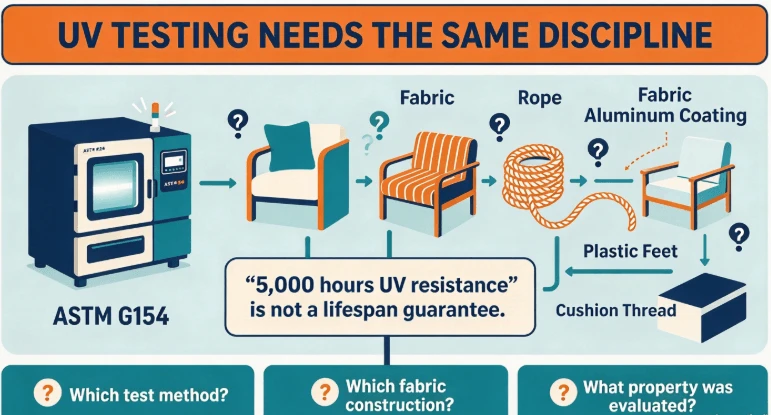
ASTM G154 provides a controlled practice for fluorescent UV exposure of nonmetallic materials. It can help evaluate changes associated with UV, moisture and heat, but it is not a one-number guarantee of outdoor lifespan.
So a fabric statement such as:
"5,000 hours UV resistance"
should trigger another question:
"According to which test method, on which fabric construction, and what property was evaluated after exposure?"
This distinction matters because a fabric test does not automatically tell you how the aluminum coating, rope, plastic feet or cushion thread will behave.
13.Cushion Engineering Is More Important Than "Waterproof"
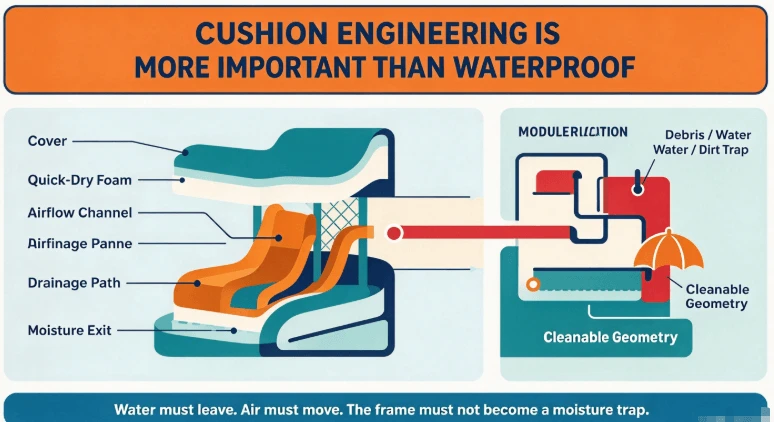
A commercial outdoor cushion is not simply a piece of foam wrapped in outdoor fabric.
Water has to leave the assembly.
Air has to move through it.
The cover needs to dry.
The underlying frame should not become a moisture trap.
This is where quick-dry foam becomes relevant in poolside applications.
The same principle applies to modular connections. The interface between two sofa units can collect debris, water and dirt if the geometry is difficult to clean.
A design that looks perfectly clean in a showroom can behave very differently after months of sand, leaves, sunscreen and food particles.
14.Resort Patio Furniture Manufacturer: Ask for Evidence, Not Marketing Language
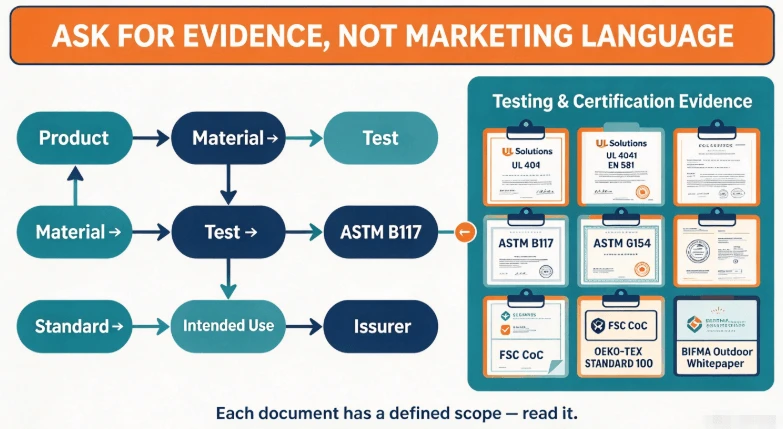
A serious supplier should be able to explain exactly what a document proves.
The procurement team should request a document package that connects:
Product → material → test → standard → intended use → issuer
That chain is much more useful than a folder containing unrelated certificates.
Testing and certification evidence
| Organization / Standard | What It Addresses | What It Does Not Automatically Prove |
|---|---|---|
| UL Solutions | Outdoor furniture testing and certification services | Does not mean every product is certified for every market |
| UL 4041 | Outline of investigation for outdoor furniture | Not a universal replacement for project-specific requirements |
| EN 581 | Outdoor furniture safety and mechanical requirements for applicable seating and tables | Does not by itself answer every weathering question |
| ASTM B117 | Controlled salt-spray exposure | Does not guarantee natural service life |
| ASTM G154 | Controlled UV exposure for applicable nonmetallic materials | Does not establish a universal outdoor lifespan |
| FSC Chain of Custody | Traceability of certified forest-based materials | Does not certify structural or weather durability |
| OEKO-TEX STANDARD 100 | Testing textiles and components for harmful substances | Does not replace UV, mechanical or weathering tests |
| BIFMA Outdoor Furniture Whitepaper | Informative guidance for evaluating exterior furniture | Not itself a consensus certification standard |
UL Solutions states that its outdoor furniture testing services cover products such as seating and references applicable outdoor-furniture standards including the EN 581 series and UL 4041.
FSC describes Chain of Custody as a system for tracking certified forest-based materials through the supply chain.
OEKO-TEX states that STANDARD 100 is a textile safety label covering testing for harmful substances.
And BIFMA explicitly describes its outdoor-furniture whitepaper as informative guidance rather than a formally approved consensus standard.
That is the standard buyers should apply to supplier documentation:
What is the document?
Who issued it?
Which product does it cover?
Which material does it cover?
What test or certification scope does it actually describe?
15.A Certificate Is Only Useful When It Matches the Product
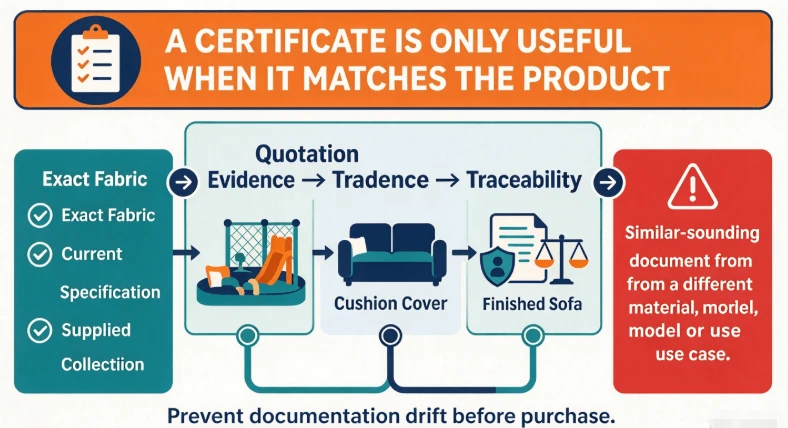
Suppose a supplier provides a textile certificate.
Good.
But does the certificate belong to:
the exact fabric?
the current specification?
the supplied collection?
the cushion cover?
the finished sofa?
The same logic applies to corrosion reports and wood sourcing documents.
A sophisticated procurement team should ask for traceability between the quotation and the evidence.
That small step prevents a surprisingly common problem:
documentation that sounds relevant but belongs to a different material, model or use case.
16.Howvin Product Documentation Should Be Used in the Buying Journey
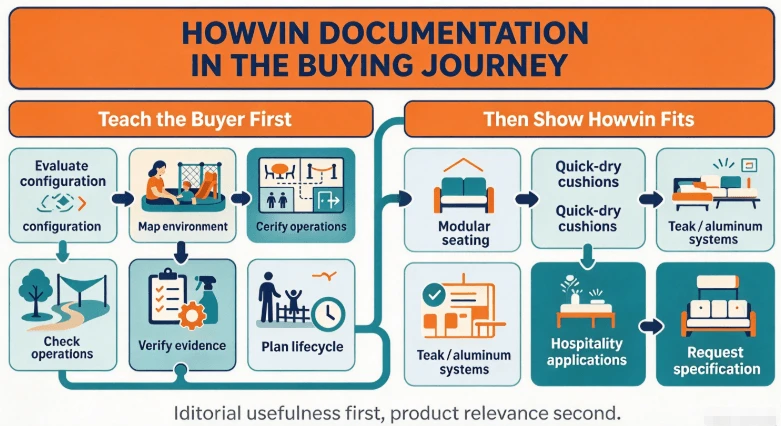
Howvin's current product catalog positions its outdoor sectional collections around hotel, resort, restaurant, beach-club and other professional environments, with modular seating and quick-dry cushion solutions among the featured applications.
Its current modular sofa product pages also describe combinations involving teak, aluminum, quick-dry cushion construction and hospitality applications.
That information is useful as a product example, but the article should not turn every technical paragraph into a brand claim.
A stronger SEO strategy is:
Teach the buyer what to evaluate first.
Then:
Show where a Howvin collection fits that evaluation.
That keeps the editorial content useful to readers who are still comparing suppliers, while creating a natural bridge to product pages for buyers who are ready to request specifications.
17.ROI for Modular Outdoor Sofas: Look Beyond Purchase Price
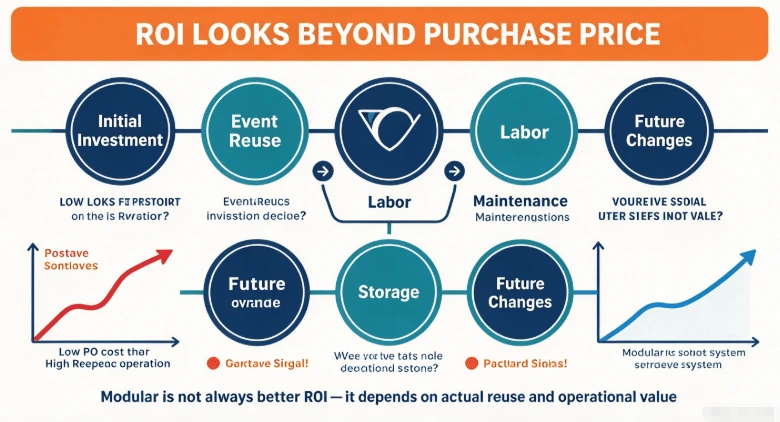
A resort furniture project can lose money even when the purchase order looked inexpensive.
Why?
Because investment value is not only about acquisition.
It also appears in:
event reuse
staff handling
storage
repair
replacement
future expansion
design changes
Imagine a terrace that changes its furniture layout every weekend.
A modular system may carry additional upfront cost but create operational value through reuse.
Now imagine another property where the layout almost never changes.
The same modular feature may produce much less practical benefit.
This is why "modular is always better ROI" is too simplistic.
Six investment lenses
| Investment Lens | Question to Ask | Positive Sign |
|---|---|---|
| Initial investment | What exactly is included? | Complete system rather than isolated pieces |
| Event reuse | Can the same inventory support several layouts? | Multiple practical configurations |
| Labor | How difficult is moving and resetting? | Manageable modules and clear storage |
| Maintenance | Can individual parts be replaced? | Component-level serviceability |
| Storage | What happens between events? | Compact, planned storage |
| Future changes | Can the property add or relocate modules? | Compatible expansion path |
There is also a less visible benefit:
risk reduction.
If a resort redesigns a terrace later, a collection that can be split and reused may preserve more of the original furniture investment than a fixed sectional with one intended layout.
That is not a guaranteed financial return.
It is a form of investment flexibility.
18.The Hidden ROI of Faster Event Reset
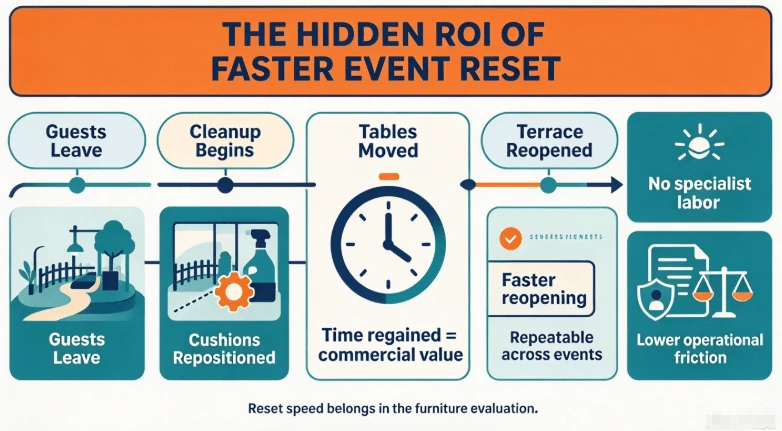
Consider a typical resort event.
Guests leave.
Food service begins cleanup.
Cushions need repositioning.
Tables move.
The terrace has to be reopened.
At that point, the value of a modular system is no longer theoretical.
If the furniture can return to its normal layout quickly and without specialist labor, the operator has gained something that does not appear in the product catalog:
time.
And time has commercial value.
That is why reset speed should be included in the furniture evaluation.
19.What a Strong RFQ Should Include
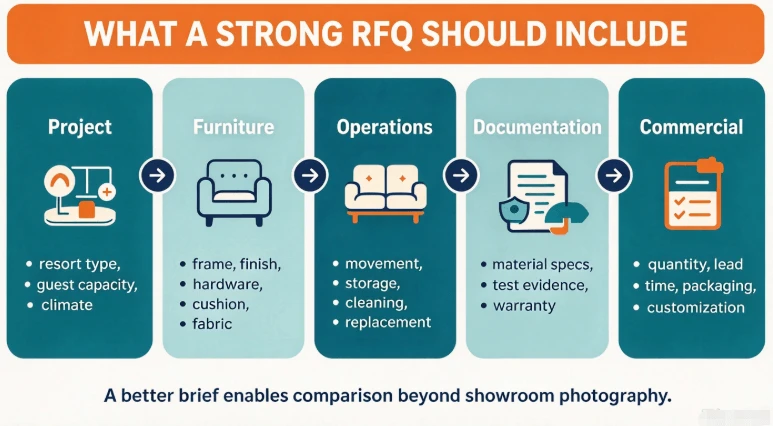
A vague RFQ might say:
"Please quote outdoor sofas for a resort."
A useful RFQ is more specific.
Project
resort type
number of outdoor zones
guest capacity
event frequency
climate
coastal or inland exposure
Furniture
preferred module family
frame material
finish
hardware
cushion construction
fabric category
table compatibility
connection method
Operations
expected movement
storage location
cleaning method
service routes
replacement requirements
Documentation
material specifications
testing evidence
certification documents where applicable
warranty
maintenance instructions
spare-part availability
Commercial
wholesale quantity
sample requirement
packaging
lead time
project coordination
customization capability
The better the brief, the easier it becomes to compare suppliers on something more meaningful than showroom photography.
20.A Practical Buyer Test
Before placing an order, run five questions through the actual project.
🧩 Configuration
Can the system produce the layouts the event team will genuinely use?
🌦️ Environment
Does the material package match the site's sun, rain, humidity, wind or salt exposure?
🛠️ Operations
Can staff move, clean and store the furniture without creating a separate workflow headache?
🧾 Evidence
Can the supplier connect its claims to identifiable product documentation?
💰 Lifecycle
Will the furniture remain useful if the terrace layout changes?
If a supplier answers all five clearly, you have moved beyond product shopping.
You are specifying an operating system for an outdoor space.
21.Common Procurement Mistakes
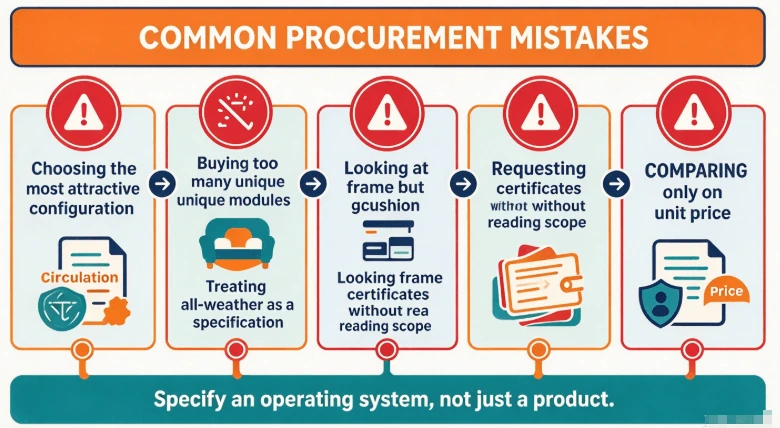
Choosing the most attractive configuration
A beautiful U-shaped sofa can consume valuable circulation space.
Buying too many unique modules
Excess variety sounds flexible but can make replacement and storage harder.
Treating "all-weather" as a technical specification
It is not. Ask which materials and components were evaluated.
Looking at the frame and ignoring the cushion
Poolside performance depends heavily on the complete cushion system.
Requesting certificates without reading their scope
A certificate is only useful when the buyer understands what it actually covers.
Comparing suppliers only on unit price
A cheaper sofa may become more expensive to operate if it is harder to move, clean, repair or replace.
Six Questions a Commercial Buyer Should Ask the Supplier
Can the center and corner modules be combined in multiple arrangements?
Can individual cushions and frame components be replaced?
Which materials are specified for the project environment?
What testing evidence is available for the quoted material package?
How are modules connected during normal guest use?
What happens when the resort wants to expand the system later?
A supplier that answers these questions specifically is telling you far more than a supplier who repeatedly says "premium quality."
FAQ
1. What modular outdoor sofa configuration is most flexible for resort event spaces?
A system based on repeatable center modules, corner units and ottomans usually provides strong practical flexibility. It can support linear, L-shaped, U-shaped, island and separated group arrangements while keeping the furniture family visually consistent.
2. Are modular outdoor sofas suitable for high-traffic hotels and resorts?
They can be, provided the entire specification is appropriate for the operating environment. Frame construction, hardware, upholstery, cushion drainage, connection design, cleaning procedures and replacement access matter as much as the word "modular."
3. What materials should coastal resorts consider for outdoor sofas?
Coastal projects often require closer attention to the frame finish, hardware and connection points because salt exposure can accelerate corrosion-related problems. The material choice should be based on the actual site environment rather than a generic "weatherproof" label.
4. Why is quick-dry foam important for poolside furniture?
It helps water move through and out of the cushion system more effectively than conventional cushion construction. The complete design still matters, because drainage, fabric, foam, support mesh and airflow all influence how quickly a cushion can dry.
5. What certifications should I ask an outdoor furniture supplier for?
Ask for documents that match the product, market and claim. Depending on the project, this may include applicable outdoor furniture testing, mechanical safety documentation, corrosion or weathering evidence, textile safety documentation and wood-sourcing traceability.
6. Does modular outdoor furniture always provide better ROI?
No. Its investment value depends on how often the property actually changes layouts, how difficult furniture movement is, how easily components can be repaired, and whether the same inventory remains useful as the property evolves.