Quick Summary
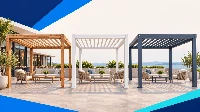
Choose wood when genuine timber justifies its finish-care needs, consider vinyl when a consistent PVC exterior meets the design, and shortlist aluminum when a coated metal frame fits the roof and operating brief. None is automatically maintenance-free or suitable for every exposure. The decisive comparison is between complete systems with equivalent roof functions, dimensions and site requirements.
First, identify what the material actually describes
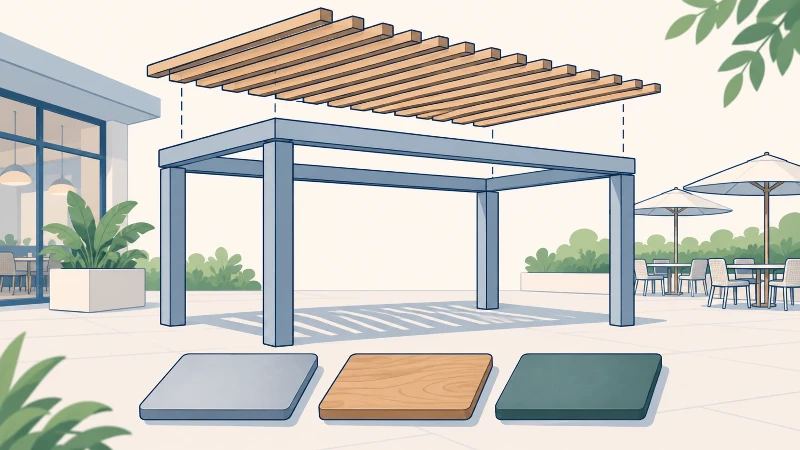
A useful pergola material comparison separates three things: the supporting structure, its visible surface and the roof above it. They influence different decisions. Posts, beams and connections support the assembly; the surface determines much of its appearance and care; the roof configuration determines how it manages sunlight and rain.
Here, vinyl means rigid PVC profiles, rather than a flexible fabric canopy. For a vinyl proposal, obtain a section drawing showing which elements carry loads and whether any internal reinforcement is part of the design. Do not assume that the material visible from the terrace tells you what supports the roof. For wood and aluminum, the actual member specifications and connections matter just as much.
Roof features also deserve their own line in the brief. Open slats, fixed roofing, rotating blades and retractable covers are different configurations. Their availability and performance belong to the selected system. A material name alone establishes neither rain protection nor wind or snow capacity; those decisions require the exact assembly and site conditions to be reviewed before an order is approved.
Wood, vinyl and aluminum at a glance
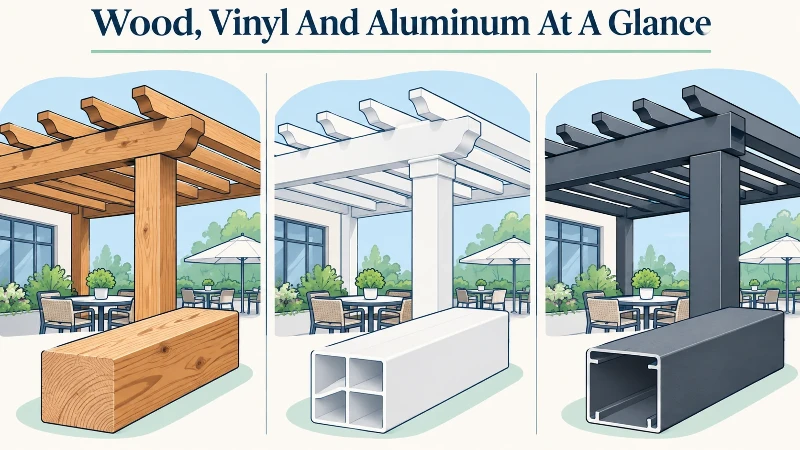
This qualitative comparison helps form a shortlist. It is not a tested ranking of strength, lifespan or installed cost.
| Decision factor | Wood | Vinyl / rigid PVC | Aluminum |
|---|---|---|---|
| Appearance to approve | Real grain, natural variation and the chosen finish | Profile shape, colour and surface finish | Coating colour, texture, gloss and visible joints |
| Main care decision | Whether to retain a particular finished appearance or accept approved weathering | How the selected surface is cleaned and what happens if its appearance changes | How the finish, connections and any roof equipment are maintained |
| Exposure issue | Moisture movement and the chosen exterior finish | Weathering response of the actual PVC formulation and surface layer | Wet salt contamination, coating details and metal compatibility |
| Construction detail to identify | Species, grade, treatment and member connections | Load-bearing elements, profile construction and any reinforcement | Alloy/profile specification, joints, fasteners and finish system |
| Good reason to shortlist | Genuine timber is central to the design and its care is practical | A consistent PVC exterior is acceptable and the complete system meets the brief | A coated metal frame and the selected roof package fit the project's use |
Where the maintenance trade-offs become real

Wood: agree what the timber should look like over time
Wood has a clear design advantage when the brief requires real grain and natural variation. The important follow-up is whether the operator wants to preserve a particular colour and finish, or will accept the appearance changes allowed by the selected specification.
Its moisture behaviour needs consideration too. The USDA Wood Handbook's chapter on moisture relations explains that wood can swell or shrink as moisture changes below fibre saturation, potentially causing checking or distortion. Species and grain direction affect that response. For a pergola, this makes the actual timber specification more informative than a broad "wood" label.
Finish selection creates another trade-off. USDA's chapter on finishing wood treats appearance, weather protection and cleanability as related considerations. A finish chosen to retain a particular appearance brings its own care requirements. Where renewal is permitted by the specified finish system, the operator must also allow access, preparation and time away from guest use. There is no defensible single recoating interval for every wood pergola.
Wood is therefore worth considering when its material character has real design value and the property can accommodate the specified care. If retaining the opening-day appearance is essential but maintenance access is difficult, resolve that conflict before approving the timber option.
Vinyl: assess the PVC surface and the structure separately
Vinyl can suit a design that calls for a consistent exterior surface rather than visible natural grain. Its appeal should be assessed through an approved profile and finish sample, together with the complete assembly behind that surface.
"Low maintenance" still needs a defined meaning. NIST research into vinyl siding and U-PVC formulations found that formulation, surface layers and exposure conditions influenced weathering behaviour. This was siding and specimen research, not a pergola test or a prediction of pergola service life. It provides a reason to examine the selected PVC system instead of treating all vinyl products as interchangeable.
For an operator, separate routine cleaning from restoration. A surface that is straightforward to wash may still need a product-specific remedy for a scratch, colour change or damaged component. Establish whether repainting is permitted and whether an affected part can be replaced individually. Neither remedy should be assumed from the word "vinyl."
This option belongs on the shortlist when the chosen appearance works for the property and the supplier can document both the construction and the care route. If the proposal leaves the load-bearing elements unidentified, the material comparison is incomplete.
Aluminum: evaluate the finished assembly, including moving parts
Aluminum is worth considering when the project wants a coated metal frame and a roof package that matches its operating needs. It avoids specifying a timber finish, but care shifts to the metal finish, joints and any mechanisms included in the system.
For a powder-coated aluminum pergola, identify the actual coating system. AMPP's description of powder coating includes pretreatment, application and curing. "Powder coated" describes a process; it does not establish the outdoor performance of a particular finished assembly.
Exposure remains relevant. The Canadian Conservation Institute explains that wet salt contamination can cause pitting on aluminum. Its guidance for outdoor objects also describes galvanic corrosion where different metals are electrically connected in salt-bearing water. These are material mechanisms, not pergola qualifications. For a coastal or otherwise demanding location, use them to focus review on the proposed finish, fasteners, joint details and care instructions.
A moving roof adds another layer of maintenance. Blade mechanisms, drainage components, motors and controls need the care and access specified for that model. When comparing aluminum with wood or vinyl, separate those equipment tasks from frame-material care. Otherwise, a more complex roof can make the material comparison misleading.
Let the roof and furniture plan define the useful space
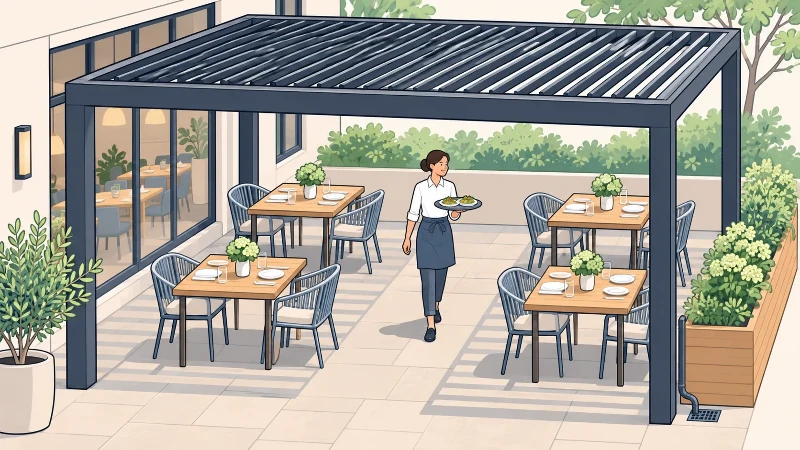
For a pergola for a restaurant patio, identify when shade is needed, which tables it should reach and how the dining area will operate around the posts. Overall footprint alone does not show the space available for chair movement, staff service and cleaning.
An aluminum louvered pergola may be relevant when adjustable sunlight is part of the brief, provided the selected model offers the required function. An open lattice may answer a different design task. Compare each roof against the intended operating conditions rather than assuming that one frame material determines all available functions.
Coordinate outdoor dining furniture with the post layout before fixing the configuration. In a lounge area, include sofa access and the route for moving cushions or cleaning equipment. If rain management is required, show the proposed water outlets and check their relationship to seating and walking routes. A closed-roof photograph does not establish that furniture beneath it will remain dry in the site's conditions.
Compare complete quotations before comparing price
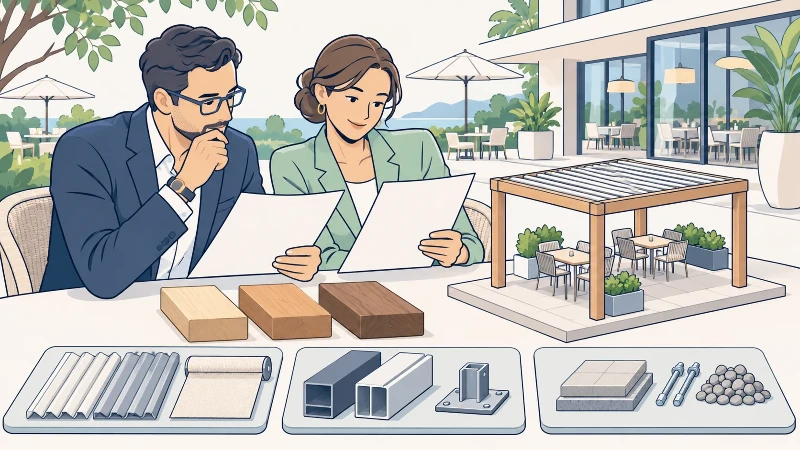
A simple timber frame, a PVC-finished assembly and a motorised metal roof package can include very different products and work. Comparing their headline prices tells you little about the material premium until their functions and scope are aligned.
Use the following table as a proposed quotation framework, with each bidder identifying differences and exclusions.
| Quote field | Hold constant or disclose | What a mismatch can conceal |
|---|---|---|
| Usable dimensions | Overall size, clear opening, height and post positions | A cheaper option that provides less useful seating space |
| Roof function | Open, fixed, adjustable or retractable; specified rain management | Extra roofing, drainage, motors or controls |
| Material and finish | Timber specification, PVC construction or aluminum profiles; selected finish | A different construction hidden beneath the same material label |
| Site and installation work | Freight, unloading, assembly, foundations, anchoring and making good | Costs left to a separate contractor |
| Optional equipment | Screens, pergola lighting, electrical work and control integration | Features shown in images but excluded from supply |
| Care and replacement | Required maintenance, service access, parts, labour and delivery exclusions | Ownership costs absent from the purchase price |
For a commercial aluminum pergola, separate the frame, roof equipment and site work in the quotation. Apply the same breakdown to the wood and vinyl alternatives. Where an option cannot provide the same roof function, keep it as a different solution rather than presenting the price difference as a pure material saving.
For longer-term value, compare documented care and replacement obligations over the same planned ownership period. This guide supplies no universal lifespan or lowest-cost ranking. A warranty period also should not be treated as the expected service life of the entire pergola.
Safety Constraints & What NOT to Do
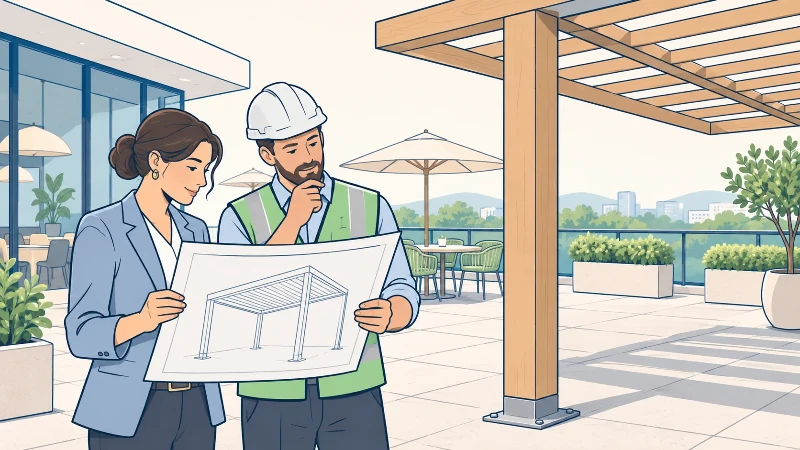
WARNING: Do not approve structural or anchoring suitability from a material label or this comparison. The exact dimensions, roof configuration, supporting substrate and site wind or snow conditions have not been verified here. Obtain the applicable assembly documents and review by the professionals responsible for the project before installation is accepted.
Do not add screens, roof coverings, heaters or hanging equipment unless the selected assembly and proposed change have been approved for that use. Powered features also need a defined electrical installation scope. This article provides no anchor sizing, load calculations or wiring instructions.
Small omissions that can complicate the order
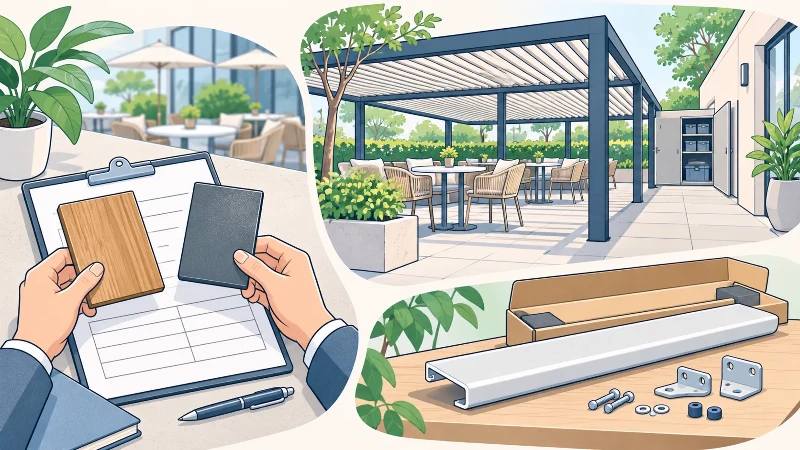
Tie the finish sample to the order. Record the product, finish and colour code, plus the acceptable timber variation or surface appearance. An attractive reference photograph is a weak basis for resolving a later finish disagreement.
Check servicing without rearranging the terrace. Show how the specified roof parts and drainage components will be reached. A maintenance plan is less practical if every visit requires moving tables and chairs out of the area.
Define the replacement package. A spare component price may exclude removal, labour, transport or finish matching. Identify those items separately so a small part does not become an unresolved scope dispute.
Learn more about the guidelines for purchasing outdoor furniture
FAQs
Can wood-look aluminum replace a specified timber pergola?
Only with approval from the person responsible for the specification. A wood-effect finish changes the material, natural variation and potential restoration route. Review the actual sample and revised construction, then record the accepted substitution in the order rather than treating visual similarity as equivalence.
Can a residential pergola kit be used for a restaurant?
Its retail description does not establish suitability for the proposed commercial installation. Confirm the manufacturer's intended use, commercial warranty scope and configuration documents, alongside the applicable project requirements. Acceptance depends on that evidence and the project approval process, rather than the material alone.
Does the frame warranty cover the finish, motors and controls?
Read the written coverage for each component. Frame, finish, roof mechanism, motor, controls and installation may have different terms, conditions or providers. Identify who handles a claim and which removal, labour and transport costs are included. The longest advertised period should not be assumed to cover the complete system.
What should the order include if screens or roof upgrades are planned later?
List the intended options, any provisions supplied now, their compatibility with the ordered model, and who will supply and install them. Obtain written terms for any committed price or availability; do not assume that future components or matching finishes will remain available. A reserved upgrade also remains subject to the change-approval boundary described above.