
A factory can often reproduce a corporate color on an outdoor furniture frame, but "matching the color code" and "matching the finished product" are not the same thing.
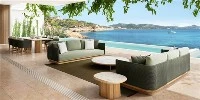
For a hospitality project, a commercial outdoor sofa may sit directly below a building facade, next to branded signage, or beside architectural metalwork. In that setting, a small difference in hue, gloss, or texture can be more noticeable than it would be on a standalone piece of furniture.
For an outdoor furniture manufacturer, the real challenge is therefore not simply finding a powder that looks similar. It is controlling the relationship between the color reference, metal substrate, powder chemistry, surface preparation, curing conditions, finish level, and the environment in which the furniture will operate.
For buyers working on contract restaurant outdoor seating, the issue becomes even more practical. A frame that looks correct in a factory showroom may look warmer in direct sunlight, flatter under shade, or noticeably different beside another production batch.
An OEM outdoor furniture manufacturer should therefore treat corporate color matching as a controlled specification process rather than a cosmetic request.

Key takeaway
Pantone or RAL custom powder-coating colors are achievable for many outdoor furniture applications, but the purchasing specification should define the color reference, substrate, finish, sample approval method, acceptable variation, coating system, and environmental exposure-not just the color number.
What Does "Color Matching" Actually Mean for Outdoor Furniture?
There is a common misunderstanding in project procurement: if a buyer supplies a Pantone or RAL number, the factory simply looks up the number, selects a powder, and sprays it.
That is usually too simplistic.
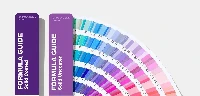
RAL is a professional color communication system widely used across architecture, design, trade, and industry, with more than 2,500 defined colors across its color ranges. Pantone likewise provides standardized color systems used by designers and manufacturers, but Pantone itself notes that color appearance and achievability can change according to the material and application.
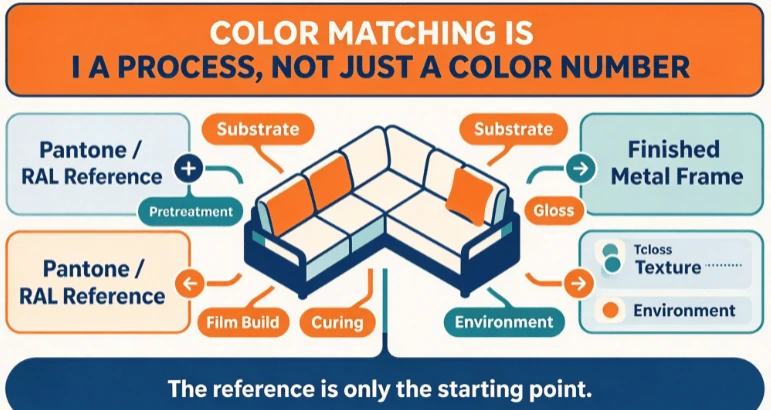
In outdoor furniture, the reference color is only the starting point.
The finished surface is affected by:
substrate + pretreatment + powder formulation + film build + gloss + texture + curing + lighting + weathering
That is why experienced buyers ask for a physical approval sample instead of approving a digital rendering.
Pantone vs RAL: Which Reference Is Easier to Use?
RAL and Pantone are not interchangeable systems.
RAL is deeply embedded in industrial and architectural color communication, while Pantone is especially important in branding, graphic design, textiles, and product color workflows. Pantone also explicitly explains that colors can behave differently across materials and that not every color is equally achievable on every substrate.
Pantone vs RAL for Powder-Coated Outdoor Furniture
| Procurement factor | Pantone reference | RAL reference |
|---|---|---|
| Common use | Brand identity, graphics, product color direction | Architecture, industrial products, coated metal |
| Direct powder lookup | Often requires formulation or conversion work | Often easier to map to existing powder libraries |
| Physical reference | Strongly recommended | Strongly recommended |
| Metal substrate effect | Important | Important |
| Gloss/texture effect | Important | Important |
| Batch approval | Required for demanding projects | Required for demanding projects |
| Suitable for branded hotel furniture | Yes, with controlled sampling | Yes, with controlled sampling |
| Exact screen-to-metal expectation | Should not be assumed | Should not be assumed |
The practical conclusion is not "Pantone is better" or "RAL is better."
It is this:
Use the color system your project design team specifies, then convert that reference into a controlled metal-finish specification.
That distinction saves considerable trouble later.
Why a Pantone Color on Paper May Not Look the Same on Aluminum
This is where many projects encounter their first surprise.
Pantone itself explains that different color systems exist partly because the appearance of a color can change according to the material on which it is produced. Some colors may also be difficult or impossible to reproduce on a particular material or process.
That matters because coated aluminum is not paper.
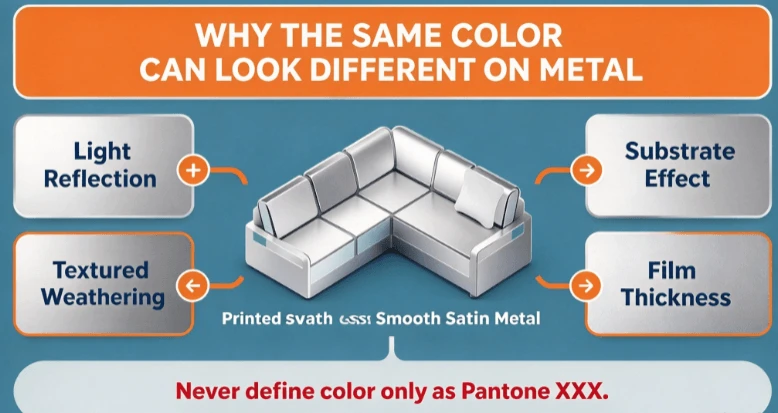
A printed swatch absorbs and reflects light differently. A powder-coated metal surface may be smooth, textured, matte, satin, or glossy. Two samples with a similar pigment balance can therefore produce noticeably different visual impressions.
ASTM D2244 provides a recognized framework for evaluating color differences using instrumentally measured color coordinates and emphasizes that acceptable color tolerances should be agreed between purchaser and seller. It also notes that factors such as gloss and texture influence how color differences are perceived commercially.
So a serious project should never define color only as:
"Pantone XXX."
It should define something closer to:
Color reference + aluminum substrate + finish + gloss level + texture + approved master sample + acceptance method.
That is a much stronger purchasing document.
How commercial outdoor sofa Color Matching Should Be Specified
An outdoor sofa is particularly sensitive because its large frame area can make small variations highly visible.
Imagine a resort project using the same dark green across:
lounge frames
dining chairs
side tables
parasol structures
architectural railings
A small difference might be acceptable on a hidden bracket. It becomes much more noticeable when two large sofa frames sit side by side.
For procurement, the useful question is therefore:
"What is the approved visual target?"
not:
"What powder code did the factory use?"
The powder code can change. The approved appearance should not change without approval.
The Factory Color-Matching Process: What Should Actually Happen?
A competent supplier should be able to describe its process clearly.
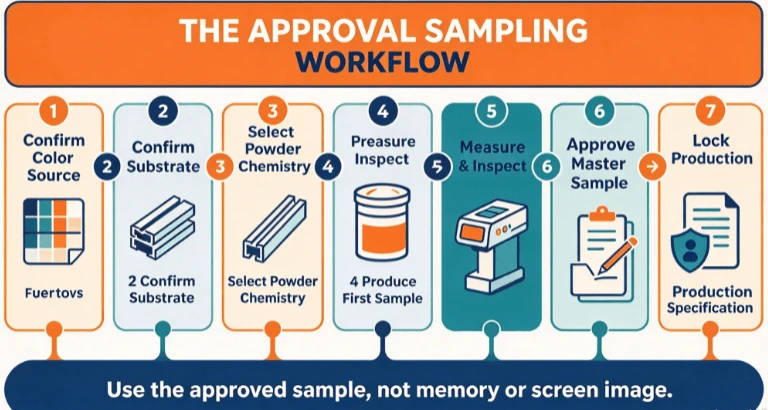
Step 1: Confirm the color source
The buyer should send one of the following:
physical Pantone reference
official RAL reference
approved architectural sample
approved metal finish sample
existing product sample
A screenshot or website image is the weakest reference because display devices do not reproduce physical finishes consistently.
Step 2: Confirm the substrate
The factory needs to know what is being coated.
Typical commercial outdoor furniture systems use aluminum alloy, because it offers a favorable combination of low weight and corrosion resistance. Howvin's outdoor furniture range includes powder-coated aluminum frames across sofa and dining applications.
But the exact alloy, surface preparation and component geometry still matter.
A flat test panel and a complex tubular frame may not produce exactly the same visual result.
Step 3: Select the powder chemistry
For exterior furniture, suppliers often use weatherable polyester powder systems because exterior-grade polyester formulations are available with enhanced resistance to UV exposure, weathering, and color or gloss loss.
The important procurement point is not to ask simply:
"Is it powder coated?"
Ask:
"What exterior coating system is being used, and what performance evidence supports it for this environment?"
Step 4: Produce the first sample
The first sample should ideally use the same:
metal substrate
pretreatment
coating system
texture
gloss
curing process
that will be used in production.
Otherwise, the approved sample may not represent the finished product.
Step 5: Measure and visually inspect
Color evaluation may combine instrumental measurement and controlled visual inspection.
ASTM D2244 addresses instrumental color-difference evaluation, while ASTM D523 covers specular gloss measurement. Gloss is especially important because a color can appear visually different when one surface reflects substantially more light than another.
Step 6: Approve a master sample
This step is often skipped and later becomes expensive.
Once the buyer approves a sample, that sample should become the master reference for the project.
Future production should be compared against the retained approved sample, not against a screen image or memory.
Step 7: Lock the production specification
The production file should record:
Color reference
Finish
Gloss
Texture
Substrate
Coating system
Approved sample ID
Inspection method
Acceptance criteria
That document becomes more valuable than a marketing statement saying "custom color available."
🎨 Color Reference
🔬 Instrumental Check
🌦 Environmental Exposure
📋 Approved Master Sample
This four-part workflow is much closer to how a professional contract project should manage finish consistency.
Why Gloss and Texture Matter as Much as Hue
A frequent mistake in furniture specifications is to approve the color while ignoring the surface.
Consider three versions of the same dark neutral:
fine texture, low gloss
smooth satin
smooth high gloss
The color family may be identical. The finished furniture will not look identical.
ASTM D523 explains that specular gloss relates to how strongly a surface reflects light, and notes that texture and other surface characteristics also influence visual appearance.
This is especially important on hospitality furniture because the same frame may be viewed:
under strong noon sunlight
under a roof
beside glass
under warm evening lighting
against greenery
beside wood or stone surfaces
The finish is therefore part of the brand color.
How contract restaurant outdoor seating Changes the Procurement Requirement
Restaurant projects create a different operating reality from residential patio furniture.
The furniture may be:
moved daily
wiped down repeatedly
exposed to food and drinks
placed in direct sunlight
used by different customers continuously
installed beside branded architecture
So the buyer is not simply purchasing a color.
The buyer is purchasing repeatable visual performance under repeated use.
This is where finish durability becomes part of the brand specification.
A color that looks excellent on day one but loses gloss or shifts visibly after repeated weather exposure creates a different commercial problem from a simple appearance complaint.
For restaurants, hotels and resorts, a sensible RFQ should separate:
color consistency
from
weather durability
from
cleaning resistance
from
mechanical durability
They are related, but they are not the same test.
How Outdoor Environment Changes Powder-Coated Furniture
Outdoor furniture operates inside an environmental system.
The same finish can experience very different stress depending on where the project is located.
UL Solutions notes that outdoor furniture is continuously exposed to sunlight, moisture, temperature changes and other environmental stresses, and that accelerated weathering can be used to evaluate the impact of UV light and moisture over controlled test cycles.
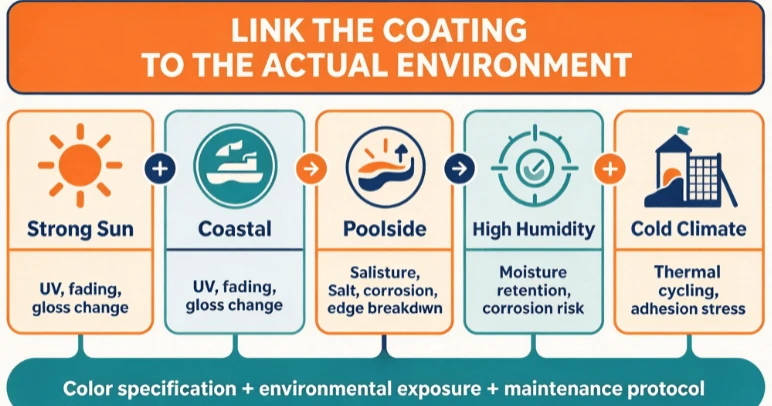
Environment vs Coating Risk
| Environment | Main stress | Typical concern | What the buyer should specify |
|---|---|---|---|
| Strong sun | UV exposure | Fading, gloss change, chalking | Exterior-grade weatherable coating |
| Coastal | Salt + humidity | Corrosion, edge breakdown | Pretreatment + corrosion testing |
| Poolside | Moisture + chemicals | Staining, finish deterioration | Chemical resistance + maintenance protocol |
| High humidity | Moisture retention | Corrosion risk | Drainage + pretreatment + substrate control |
| Cold climates | Temperature cycling | Adhesion and surface stress | Appropriate coating system + test evidence |
| Urban commercial | Pollution + cleaning | Gloss loss or staining | Cleaning compatibility + surface testing |
The critical lesson is simple:
A color specification should be linked to the environment, not written independently from it.
UV Exposure: Why "Fade Resistant" Is Too Vague
"UV resistant" is one of the most overused phrases in outdoor furniture marketing.
A buyer should ask:
What coating system?
What exterior durability class?
What weathering test?
What color retention evidence?
What gloss retention evidence?
On what substrate?
Under what exposure conditions?
Architectural coating standards such as AAMA 2603, AAMA 2604 and AAMA 2605 define different performance requirements for pigmented organic coatings applied to aluminum extrusions and panels. They are useful references for coating specification, but they are not a universal certification for every piece of outdoor furniture.
That distinction matters.
A supplier should never imply:
"AAMA compliant coating = the entire furniture product is certified."
Those are different claims.
Coastal Air: Color Is Not the Only Issue
A beachfront resort can have an excellent color match and still experience premature coating failure if corrosion protection is weak.
Salt-laden air increases the importance of:
substrate preparation
pretreatment
coating adhesion
film continuity
fastener selection
drainage
corrosion protection
Intertek identifies UV weathering, salt spray, temperature and humidity testing as relevant tools for evaluating outdoor product durability.
For buyers near oceans, pools or humid climates, this means:
do not approve the color sample independently from the corrosion specification.
The Material Behind the Finish Matters
Powder coating is a surface system, not a magic shield.
The furniture underneath it still matters.
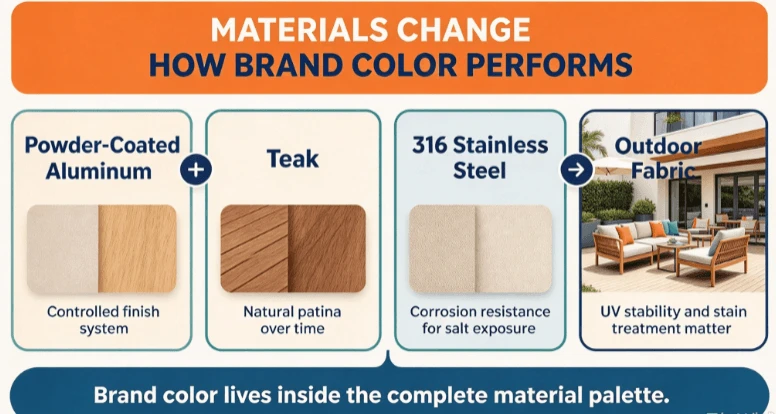
Aluminum
Aluminum alloy is widely used in commercial outdoor furniture because it is relatively lightweight and does not develop conventional red rust like untreated carbon steel. Howvin's product range includes powder-coated aluminum frames for sofas, dining sets and poolside products.
The finish, however, still depends on proper pretreatment and application.
Teak
Teak wood behaves differently.
Its appearance evolves naturally, and its surface patina changes over time. In project settings, the buyer should decide whether the design intentionally allows natural weathering or whether appearance is expected to remain closer to its original tone.
Howvin's hotel teak furniture content also describes untreated teak developing a silver-grey patina, while treated teak retains more of its original warm color.
That is relevant to branding because a project may combine:
RAL-colored metal
natural teak
outdoor fabric
architectural stone
The "brand color" therefore exists inside a material palette, not in isolation.
Stainless Steel
316 stainless steel is often considered when salt exposure and corrosion resistance are key concerns. Howvin also discusses marine-oriented hardware choices for coastal and poolside applications.
Again, the procurement principle is to specify the complete system, not one attractive surface feature.
Can a Factory Match a Corporate Brand Color Across Different Furniture Collections?
Yes, but only if the color is managed as a common manufacturing specification.
This matters when a hotel group wants:
outdoor lounge sofas
dining chairs
bar stools
side tables
sun loungers
parasol components
pergola frames
to share the same visual identity.
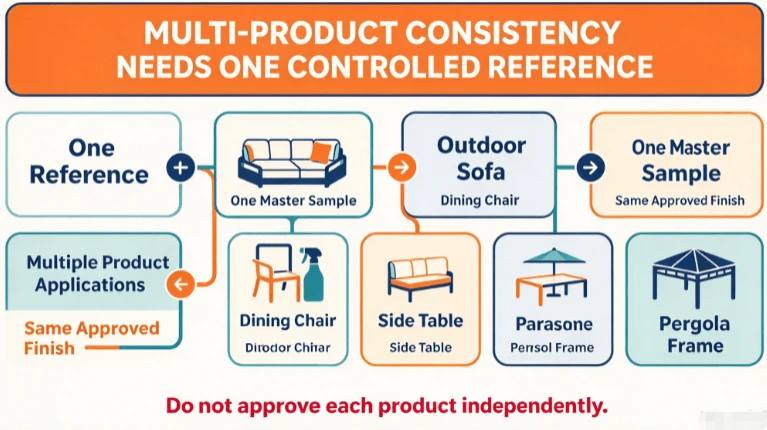
The buyer should not approve each product independently with a different sample.
Instead, use:
one reference → one master sample → multiple product applications
That creates much stronger multi-product consistency.
Howvin's product pages already show the practical basis for this kind of customization: its outdoor furniture products state that customized orders are welcome, and a commercial sofa page specifically states support for RAL matching on powder-coated metal components.
The stronger workflow, however, is to document the actual approved finish rather than relying only on the product-page promise.
What Should an OEM outdoor furniture manufacturer Provide Before Production?
A serious project buyer should be able to request a compact technical package.
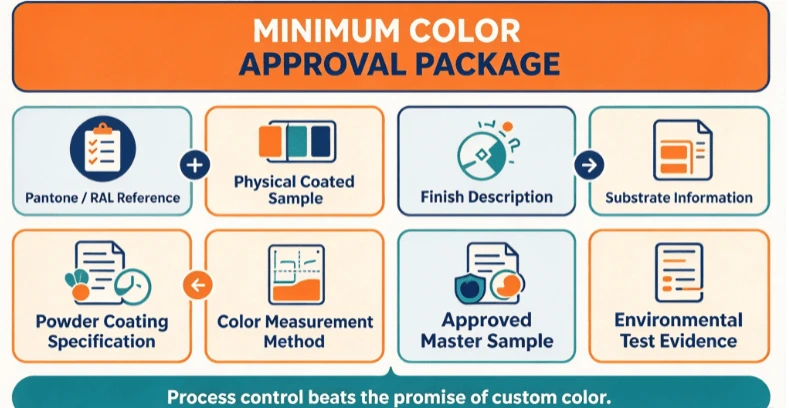
Minimum Color Approval Package
| Document / item | Why it matters | Buyer decision |
|---|---|---|
| Pantone or RAL reference | Defines the starting target | Confirm source |
| Physical coated sample | Shows real metal appearance | Approve / reject |
| Finish description | Controls gloss and texture | Confirm |
| Substrate information | Controls how the coating behaves | Confirm |
| Powder coating specification | Defines the coating system | Review |
| Color measurement method | Makes acceptance less subjective | Confirm |
| Approved master sample | Becomes the visual reference | Retain |
| Environmental test evidence | Links appearance to service conditions | Review |
| Production QC record | Confirms batch consistency | Request |
| Retained production sample | Helps future reorder control | Retain |
This is the difference between:
"We offer custom color."
and:
"We offer a repeatable color-control process."
The second statement is much more useful to a procurement manager.
Certifications and Testing: What Actually Matters?
This is an area where suppliers frequently overstate what certificates prove.
A certificate may cover:
the coating
the laboratory
the furniture
the testing method
the manufacturing system
Those are not interchangeable.
Standards and Organizations Buyers May Encounter
| Organization / standard | What it relates to | What it does not automatically prove |
|---|---|---|
| Pantone | Color communication and brand color reference | Exact outdoor-metal reproduction |
| RAL | Professional industrial color communication | Long-term coating durability |
| ASTM D2244 | Color-difference evaluation | Full furniture durability |
| ASTM D523 | Specular gloss measurement | Overall outdoor performance |
| AAMA 2603 / 2604 / 2605 | Performance requirements for organic coatings on aluminum | Universal furniture certification |
| QUALICOAT | Quality scheme for powder and liquid organic coatings on aluminum for architectural applications | Automatic certification of a furniture product |
| GSB International | Quality regulations for coating systems, including aluminum applications | Proof that every furniture product is compliant |
| UL 4041 | Outdoor furniture safety and performance evaluation | Automatic color approval |
| ISO/IEC 17025 | Competence of testing and calibration laboratories | Product certification by itself |
QUALICOAT describes its quality label as a product certification scheme for coating applications on aluminum in architectural contexts, with inspections and accredited laboratory testing. GSB similarly maintains quality regulations covering coating materials and coating operations.
UL Solutions separately offers outdoor furniture testing and certification under UL 4041, covering issues such as corrosion, stability, strength, endurance and durability.
ISO/IEC 17025, meanwhile, concerns the competence, impartiality and consistent operation of testing and calibration laboratories.
That distinction is essential in procurement.
A supplier saying:
"Our powder is certified."
does not necessarily mean:
"This exact outdoor sofa has been independently certified."
Ask what was certified, by whom, under which scope, and for which product or material.
A Note on BIFMA and Commercial Outdoor Furniture
BIFMA is relevant when commercial buyers evaluate furniture durability and performance, but procurement teams should be careful with terminology.
BIFMA publishes furniture performance standards and also provides outdoor-furniture guidance. Its outdoor furniture whitepaper is explicitly described as informative guidance rather than a formally approved consensus standard.
BIFMA also maintains standards relating to public and lounge seating and a registry for products conforming to certain furniture performance standards.
That means a buyer should distinguish between:
design guidance
test standard
third-party certification
supplier declaration
Those four evidence levels should never be treated as identical.
The ROI of Corporate Color Matching Is Bigger Than It Looks
At first glance, color customization can seem like a design expense.
For a large hospitality project, it is often better understood as an asset-control decision.
Imagine a hotel group operating multiple properties with a recognizable outdoor palette.
If the frame color changes from one supplier to another, the impact may include:
mismatched visual identity
additional sample rounds
design approval delays
replacement discussions
inconsistent guest-facing environments
difficulties when expanding the project
problems reordering matching pieces later
The value of a good color-control process is therefore partly in avoided friction.
It can reduce uncertainty in:
design approval
procurement
reordering
multi-site deployment
brand consistency
maintenance planning
replacement matching
The cheapest furniture is not automatically the lowest-cost procurement decision.
The lower lifecycle cost may come from the supplier that keeps the approved finish stable across batches and future collections.
ROI by Procurement Scenario
| Scenario | Short-term focus | Hidden cost if color control is weak | Better procurement approach |
|---|---|---|---|
| Single restaurant | Purchase price | Rework or visible mismatch | Approve a physical sample |
| Hotel opening | Lead time | Delayed design sign-off | Freeze color specification early |
| Resort rollout | Unit cost | Multi-site inconsistency | Retain master sample |
| Brand refresh | New appearance | Replacing otherwise usable furniture | Develop reusable finish specification |
| Multi-product order | Matching appearance | Different frames look unrelated | Use one controlled reference |
| Repeat purchase | Easy reordering | Supplier re-matches from memory | Retain approved reference |
The strongest ROI argument is therefore not:
"Custom colors make furniture look better."
It is:
"Controlled finishes reduce future uncertainty."
That is a much more defensible commercial argument.
Why a Master Sample Is More Valuable Than a Pantone Number
For a multi-stage project, the master sample becomes a physical bridge between:
designer
→ buyer
→ factory
→ QC team
→ future reorder
Pantone or RAL gives you a language.
The master sample gives you a manufacturing reference.
That difference becomes particularly important where the surface includes:
texture
metallic effects
low gloss
special pigments
large tubular frames
visible weld areas
multiple furniture components
A screen cannot capture all of that reliably.
What Buyers Should Put Into Their RFQ
A good RFQ for branded outdoor furniture should read more like a technical brief than a simple shopping list.
Recommended RFQ fields
Project environment
Coastal / urban / poolside / rooftop / dry high-UV / humid
Furniture category
Sofa / lounge chair / dining chair / table / sun lounger / bar furniture
Frame material
Aluminum / stainless steel / steel / mixed material
Color reference
Pantone / RAL / physical sample
Finish
Smooth / fine texture / textured / metallic
Gloss
Matte / satin / semi-gloss / gloss
Sample requirement
Required before bulk production
Approval authority
Designer / architect / buyer / brand team
Testing
Color / gloss / weathering / corrosion / mechanical
Reorder requirement
Same finish required across future batches
This is how the buyer turns a vague aesthetic request into something a factory can actually control.
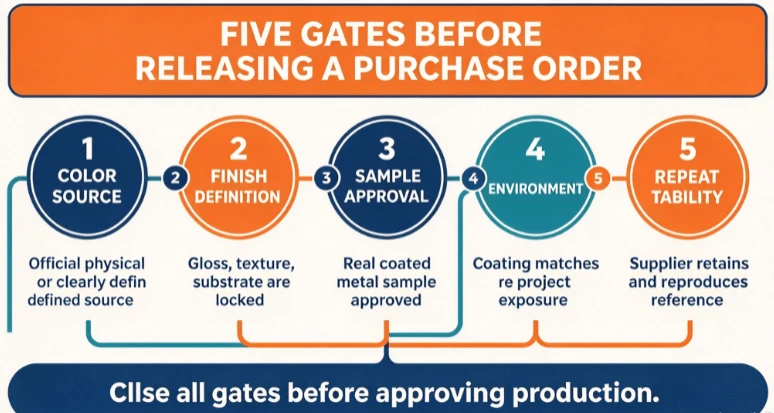
A Practical Five-Gate Procurement Check
Use these gates before releasing a purchase order.
Gate 1 - Color source
Is the reference an official physical or clearly defined color source?
Gate 2 - Finish definition
Are gloss, texture and substrate defined?
Gate 3 - Sample approval
Has a real coated metal sample been approved?
Gate 4 - Environment
Does the coating system correspond to the actual project exposure?
Gate 5 - Repeatability
Can the supplier retain the approved reference and reproduce it on future orders?
If any of these questions remains unanswered, the color specification is not fully closed.
What a Good Supplier Should Say About Pantone or RAL Matching
Be cautious when a supplier says:
"Any color is possible."
That is a marketing statement, not a technical specification.
A better answer sounds more like:
"Provide the Pantone or RAL reference. We will evaluate the target against the selected metal substrate and exterior powder system, produce a physical sample, confirm finish characteristics, obtain approval, and use the approved sample as the production reference."
That answer demonstrates process rather than promise.
Howvin's Practical Position
Howvin's current product pages show a practical combination of powder-coated aluminum outdoor furniture, contract-oriented seating, hotel and resort applications, and custom orders. Its commercial sofa documentation specifically states support for RAL matching on powder-coated metal components.
That creates a reasonable foundation for branded furniture projects.
But for a professional buyer, the important next question should be:
What is the actual sample approval and QC process for my project?
That is the question that turns customization from a product feature into a procurement control.
Frequently Asked Questions
1. Can a factory match a corporate Pantone color on powder-coated aluminum?
Usually, a factory can target a Pantone color through a suitable powder formulation and a controlled sample-development process. The physical result depends on the substrate, powder chemistry, finish, gloss, texture and lighting. Pantone itself notes that appearance and achievability can change across materials, so a physical approval sample should be treated as the practical reference.
2. Is RAL easier to match than Pantone for outdoor furniture?
RAL is generally more directly aligned with industrial and architectural color communication, which can make metal coating specification more straightforward. Pantone can also be used, particularly when the project is driven by a corporate brand system, but the reference often needs to be translated into a coating-specific target.
3. Can the same Pantone or RAL color look different on different outdoor furniture products?
Yes. The underlying metal shape, surface preparation, texture, gloss, coating system and lighting can change visual perception. That is why one approved master sample is more reliable than simply reusing the same color code for every component.
4. What testing should I ask for when the furniture will be installed outdoors?
Depending on the project, buyers may consider color-difference measurement, gloss measurement, UV/weathering evaluation, corrosion testing and relevant furniture performance testing. ASTM D2244 and ASTM D523 address color and gloss measurement, while UL Solutions identifies corrosion, weathering, stability, strength and durability as relevant outdoor furniture evaluation areas.
5. Does QUALICOAT certification mean the outdoor furniture itself is certified?
Not automatically. QUALICOAT describes its scheme as covering the quality of coated aluminum products for architectural applications. A coating quality scheme and a furniture-product certification are different layers of evidence.
6. How can I make sure my replacement furniture still matches the original color?
Keep the original approved physical sample and the complete finish specification in the project record. When reordering, the supplier should compare new production with the retained master instead of recreating the finish from a digital image or a remembered color code.