
Quick Summary
A commercial outdoor furniture warranty should be compared against the same project, covered failure and recovery process, rather than its headline duration alone. Eligibility, component definitions, exclusions and the work included in an approved remedy can change the value of the offer. Put unanswered points beside confirmed promises so a longer term does not conceal a coverage gap.
Compare the same purchase before comparing the promise

Start with a shared project description. A policy for residential seating and a policy for the specified hotel installation do not provide a fair comparison, even if their covers display the same number of years.
Give each supplier the same model schedule, specifications, destination, intended commercial use and exposure conditions. Identify the purchasing entity and the party expected to handle claims. Then ask each supplier to identify the written terms applicable to that purchase.
Fix the product, use and claimant
"Hotel furniture" can describe a private balcony, a restaurant terrace or a shared pool deck. State the actual setting rather than deciding for the supplier which use classification applies. Include relevant storage, cleaning and handling arrangements where they affect the proposed terms.
The invoice buyer, property owner, procurement agent and hotel operator may be different entities. Establish who receives the promise, who can submit a claim and whose purchase evidence is required. A contact willing to discuss a problem is not necessarily the entity responsible for the remedy.
For an order containing several models, avoid a single tick beside "commercial warranty." Record the applicable policy and any special conditions against each relevant product group.
Use the same time point
Duration is meaningful only after its starting event is clear. A term beginning at manufacture is different from one beginning at delivery, particularly when furniture is stored before opening.
Compare each offer at the same point in the project: for example, after the same period of actual operation, with any earlier storage time accounted for under the supplied terms. Do not quietly assume that all clocks start when guests arrive.
A supplier's product warranty period and its freight or labour support period may also differ. Keep those dates separate in the comparison record.
Turn broad wording into a specific covered event
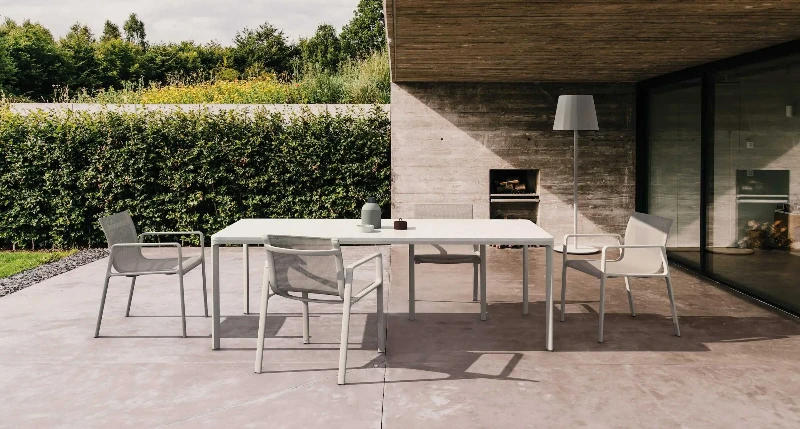
Outdoor furniture warranty coverage needs more than a component name. The comparison should connect the part, the condition being claimed, the relevant use and the stated remedy.
An outdoor sofa warranty is a useful example. Commercial outdoor sofas combine a frame with other components, potentially including a finish, upholstery, stitching, fastenings and filling. A promise about one does not establish the scope for the others.
Clarify the words that could change the decision
The following is a purchasing clarification aid, not a warranty offered by Howvin or an automatic claim-acceptance checklist.
| Wording in an offer | Why it is incomplete for comparison | Clarification to record |
|---|---|---|
| "Frame warranty" | Structural members, coating, connectors and moving parts may have different terms | Named components, covered failures and relevant exclusions |
| "Fabric covered" | Colour change, tearing, stains and seam failure are different conditions | Covered event; fabric-only or finished-cover remedy |
| "Cushions included" | Cover, sewing, zip and filling are separate items | Scope for each relevant component and any normal-change exclusion |
| "Corrosion resistant" | A performance description does not by itself identify a warranty remedy | Whether a written corrosion promise exists; then its conditions, environment and remedy |
| "Lifetime warranty" | The duration's definition and conditions remain unresolved | Meaning of lifetime, eligible owner, permitted use and available remedy |
Read coverage and exclusions together
Commercial furniture warranty exclusions need to be read alongside the positive promise. A clause addressing normal weathering does not, without further analysis, answer whether a separately described coating failure is covered. Equally, a broad statement about durability does not cancel a specific exclusion.
Distinguish an observed symptom from its cause. A split seam, stain, coating change or loose connection can be described accurately without declaring it a manufacturing defect. If a decision depends on cause, establish the assessment process and evidence needed rather than asking the operator to guess.
Where a general exclusion appears to contradict product-specific coverage, mark the point for written clarification. Do not silently select whichever paragraph makes the offer look stronger.
Put one accepted claim through both offers

An effective comparison asks what each supplier would actually provide for the same problem.
The example below is hypothetical. It contains no real quotations, supplier identities or Howvin promises. Assume the same eligible hotel purchaser, declared commercial setting and recognised structural manufacturing defect, within both applicable warranty periods.
For Offer B, also assume that the product documentation permits repair with a specified compatible replacement component and method, and that the supplier has confirmed that remedy. This is not a suggestion that any damaged frame can be repaired by fitting a generic part.
Compare the deliverable, not just "claim approved"
| Question for the same accepted claim | Hypothetical Offer A | Hypothetical Offer B |
|---|---|---|
| What is promised? | Supplier chooses repair or replacement of the affected frame | Supply of the specified compatible component for the permitted repair |
| Is a complete new furniture item promised? | No blanket promise; the stated remedy concerns the frame | No; the stated remedy concerns the component |
| What if the original reference is discontinued? | A similar frame replacement is permitted | Future supply or an alternative remedy is not addressed |
| What coverage applies after the remedy? | The original unexpired period is expressly stated | The supplied wording does not state it |
| What decision remains unresolved? | Which remedy will be selected and whether it meets the project's requirements | The fulfilment arrangements and treatment of unavailable parts |
Neither offer can be ranked from this table alone. A component remedy may be workable where the permitted work can be completed locally. A frame replacement may involve different transport, handling and reinstatement. The next comparison concerns what accompanies the promised item or work.
If an offer uses a proportional refund or credit, obtain the actual basis for it. Do not assume a straight-line reduction, a fixed annual percentage or cash reimbursement when those terms have not been stated.
Keep "unanswered" separate from "excluded"
Use clear review labels: expressly included, included subject to stated conditions, expressly excluded, or unanswered in the documents reviewed. Attach the document reference and conditions to each entry.
These are procurement-review labels, not legal findings. Silence does not automatically establish inclusion, exclusion or zero cost. An unanswered point needs clarification before it can support the purchasing decision.
Follow the remedy all the way back into service

"Replacement part supplied free" does not explain how that part reaches the hotel or how the furniture becomes usable again.
For commercial sun loungers, a sun lounger warranty may need separate treatment of the frame, sling, wheels and adjustment mechanism. Once the relevant remedy is identified, follow the actual work required around it rather than treating the part price as the complete outcome.
Assign the work and costs explicitly
If a reported condition may affect safety, keep the affected item out of use pending appropriate assessment. Collect only observations and photographs that can be obtained safely without intrusive work. Sampling, dismantling, loading or transporting a suspect item requires the applicable procedure and responsibility arrangements; a request for claim evidence is not permission to improvise.
Use the following worksheet for each offer. It lists questions to resolve, not costs assumed to be recoverable.
| Recovery stage | Responsibility or cost to confirm | Condition that can change the outcome |
|---|---|---|
| Assessment | Inspection, samples or any required testing | Who approves the work, and how are costs treated if the claim is disputed? |
| Return of the affected item | Removal, packing, collection and outward transport | Is return required, and is prior return authorisation needed? |
| Delivery of the remedy | Freight, insurance and destination charges | Does the commitment reach the actual project country and named delivery point? |
| Local reinstatement | Labour, access, fitting and reinstallation | Is a local contractor permitted, and what expenditure needs approval? |
| Return to service | Appropriate checks after repair or replacement | Who has responsibility for confirming suitability for use? |
| Interruption to operations | Temporary seating, loss of use or other interruption costs | Is any recovery expressly agreed, rather than merely assumed? |
Location matters. A domestic freight allowance is not automatically a promise to pay for international delivery. Clarify return and replacement journeys separately, along with who arranges and funds any applicable destination charges. A warranty promise does not make those charges disappear.
The same applies to labour. Establish which work is included, any stated cap or approval condition, and whether support ends before the component warranty does. A hotel should not discover after claim approval that no one has accepted responsibility for fitting the remedy.
Compare support with the hotel's operating needs
A product remedy and a service commitment answer different questions. If the project needs a response deadline, local attendance or temporary furniture, discuss those requirements explicitly. Do not infer them from the number of years on the warranty.
Likewise, spare-parts availability and warranty eligibility are separate purchasing considerations. A covered component may still raise supply questions, while a worn part outside the agreed coverage may be available to purchase. Neither position should be assumed without confirmation.
For the wider financial comparison, consider maintenance and replacement costs as well. Warranty scope is only part of ownership cost; it does not predict failure frequency, furniture lifespan or the hotel's future maintenance workload.
Check the evidence behind the claim process

A useful claim procedure identifies the recipient, notice requirements, purchase and product references, evidence requested, assessment route and approval steps. Ask how the claim's status and the selected remedy will be communicated.
Keep cause, eligibility and cost approval as distinct questions. Accepting that a component is defective does not necessarily resolve every cost surrounding its replacement. Conversely, a request for further evidence is not itself a final rejection.
An inspection report answers a different question
SGS describes furniture inspections that report findings on matters such as assembly, finish and packaging, with final random inspection examining selected finished products. Its furniture inspection service description explains that inspection scope.
An inspection report can inform a product-conformity discussion. It does not replace the supplier's later remedy terms or identify who pays for every recovery stage. That distinction is a purchasing-document comparison, not a claim that SGS has approved Howvin products or guaranteed their service life.
The written warranty is not the whole legal picture
Check the transaction's applicable contractual and statutory rights separately. For example, the Australian ACCC distinguishes additional warranty promises from consumer guarantees and explains that some business purchases qualify for those guarantees under stated conditions and exceptions. See its consumer rights and guarantees guidance.
That Australian example does not establish eligibility for every hotel purchase or a global commercial-furniture rule. Do not assume a supplier's exclusion is necessarily enforceable, or that warranty expiry ends every possible right. Obtain appropriate advice for the actual contract and market where that question affects the decision.
Safety Constraints & What NOT to Do
WARNING: Do not use warranty coverage as approval to keep a potentially unsafe item in service. The relevant product condition needs assessment independently of whether a supplier has accepted the claim.
Do not treat a free part or an approved claim as a repair method. Confirm the specified component, applicable instructions, competent person and checks required after work before proceeding.
Do not load, dismantle or modify suspect furniture simply to produce evidence. Use a suitable assessment procedure. Where parts must be retained or returned, agree safe handling and evidence requirements without delaying necessary safety action.
Buying checks that keep the comparison reliable
Keep the accepted version. Retain the policy supplied for the order, the approved specification and any agreed project-specific variation. Do not rely solely on a webpage that may change later.
Make exceptions traceable. A useful written clarification identifies the model, relevant clause, agreed departure and responsible entity. Ask how it will be incorporated into the purchase documents; an unresolved contradiction should not become a "covered" tick.
Decide what is essential before scoring offers. Separate non-negotiable project requirements from negotiable preferences. Compare the confirmed scope and remaining responsibilities, then assess price and other purchasing factors. A single unexplained warranty score can conceal a condition that makes an offer unsuitable for the project.
For a Howvin enquiry, provide the furniture schedule, destination, intended use and the component coverage and recovery responsibilities you want confirmed. The aim is a comparable written offer for the selected products, not an assumed industry-standard promise.
FAQ
Does changing the specified fabric leave the warranty unchanged?
Do not assume so. Ask for the revised split between the textile, fabrication and finished cushion, including any customer-supplied-material conditions. Confirm whether the change affects only that component or other identified coverage, and retain the response against the revised specification.
Can a new hotel operator claim under the original warranty?
Check who holds the promise and whether transfer is permitted. A management change, ownership transfer and change of invoicing entity are not necessarily the same event. Obtain confirmation for the actual arrangement rather than treating continued use at the same address as proof of eligibility.
Should phased deliveries share one warranty start date?
Only if that is the agreed arrangement. Record the stated starting event and supporting documents for each phase. If delayed opening or storage matters, resolve the treatment before award; do not assume that the final opening date resets coverage for earlier deliveries.
Does an approved replacement have to match the whole seating group?
Read the remedy and matching provisions. Establish how discontinued models, fabrics and finishes will be handled, including whether the commitment concerns the affected item or a wider group. Similar replacement, exact visual matching and complete-set replacement are different outcomes and should not be treated as interchangeable promises.