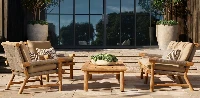

Resort procurement managers, project engineers, and hospitality landscape architects frequently ask: how does outdoor teak furniture perform under heavy salt spray and high-humidity coastal resort climates? Oceanfront hospitality properties represent the most aggressive testing ground for exterior commercial FF&E (Furniture, Fixtures, and Equipment). Airborne sodium chloride, continuous relative humidity exceeding 80%, blistering ultraviolet rays, and rapid thermal cycles break down standard commercial furniture within two to three seasons.
Understanding wood anatomy, resin saturation, and joint engineering reveals why tropical hardwoods remain unmatched for beachfront properties. Selecting Grade-A teak wood provides natural biological protection against extreme marine exposure.

The Micro-Mechanisms of Coastal Degradation: Salt Spray, UV, and Moisture
🌊 Coastal environments launch a two-pronged attack on exterior timber: chemical oxidation and mechanical stress. Airborne salt deposits land on furniture surfaces, drawing ambient moisture out of the air via hygroscopic action. This keeps the wood surface perpetually damp, creating ideal conditions for fungal growth and structural degradation in standard timber species.
Wood Anatomy: Why Tectoquinone Resists Marine Attack
The secret to durability lies inside the cellular structure of mature heartwood. Teak contains high concentrations of natural rubber, silica content, and organic extracts known as tectoquinone. These natural biocide compounds make the timber naturally toxic to rot fungi, termitic infestation, and marine borers.
Unlike porous softwoods that absorb seawater, teak features an unusually dense, interlocking grain structure. The natural oils act as an internal hydrophobic barrier. Salt water cannot easily penetrate the internal cell walls, preventing internal salt crystallization-the primary cause of fiber shattering and surface degradation in inferior woods.
Thermal Expansion and Equilibrium Moisture Content
High humidity forces wood to absorb atmospheric vapor until it reaches equilibrium moisture content (EMC). In tropical coastal regions, EMC levels routinely hover between 15% and 18%.
When furniture undergoes proper factory kiln-drying down to 8%–12% moisture content before production, the cellular structure stabilizes. This prevents dramatic swelling during wet monsoon periods and mitigates shrinkage during dry, hot weather.

Commercial Performance Analysis: Teak vs. Alternative Materials
📊 Selecting outdoor furniture for high-traffic beach resorts requires balancing aesthetic longevity against ongoing maintenance overhead. Below is an engineering evaluation of common frame materials subjected to accelerated coastal exposure.
Material Physical & Chemical Performance in Marine Environments
| Frame Material | Resistance to Salt Spray | Moisture Absorption Rate | Maintenance Cycle | Projected Commercial Lifespan | Primary Failure Mode |
| Grade-A Teak Wood | Exceptional | Minimal (< 8% surface) | Annual cleaning | 25+ Years | Surface weathering (Cosmetic only) |
| 316 Stainless Steel | High | 0% | Bi-monthly wash | 15–20 Years | Tea-staining & Pitting Corrosion |
| Powder-Coated Aluminum | Moderate to High | 0% | Quarterly inspection | 5–8 Years | Blistering under coating / Oxidation |
| Synthetic PE Wicker | Moderate | 0% | Monthly deep clean | 3–5 Years | UV embrittlement & Frame snapping |
| Pressure-Treated Softwood | Low | High (> 20%) | Bi-annual sealing | 2–4 Years | Rot, Warping & Delamination |

Tropical Hardwood Timber Properties for Oceanfront Sourcing
| Wood Species | Janka Hardness Rating | Silica Content (%) | Natural Oil Saturation | Volumetric Shrinkage | Marine Borer Resistance |
| Mature Teak (Tectona grandis) | 1,070 lbf | 0.50% – 1.40% | High | 5.3% (Extremely Stable) | Highest |
| Ipe (Handroanthus spp.) | 3,680 lbf | 0.10% – 0.30% | Moderate | 12.4% (Prone to Checking) | High |
| Shorea / Red Balau | 1,300 lbf | 0.10% | Low | 11.5% | Low to Moderate |
| White Oak | 1,360 lbf | 0.05% | Very Low | 12.6% | Low in Marine Environments |
Custom B2B Manufacturing Solutions for Coastal Hospitality Projects
🛠️ Standard off-the-shelf residential furniture fails quickly in commercial hospitality settings. Oceanfront resorts require custom dimensions, reinforced mortise-and-tenon joinery, and specialized hardware capable of handling heavy daily guest turnarounds.
Partnering with a Commercial Lounge Sofa Manufacturer
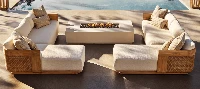
Selecting a qualified custom size commercial outdoor teak lounge sofa manufacturer gives resort developers precise architectural control over patio layouts. Commercial lounge frames require deeper seating profiles, heavy-duty internal bracing, and marine-grade reticulated quick-dry foam cushions that allow saltwater spray to drain immediately.
Designing Custom Dining Sets for Restaurant Patios
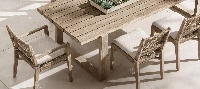
High-density oceanfront dining space demands tables and seating that handle spills, salt air, and constant repositioning. Specifying custom teak outdoor dining sets for restaurant patios allows operators to integrate parasol grommets, flush-fitting table extensions, and stackable frame designs engineered for effortless night storage.

Specifying Technical Configurations for High-Traffic Oceanfront Settings
📑 Layout flexibility determines operational efficiency across beach clubs, pool decks, and open-air lounge bars.
Modular Seating Versatility: The 3 Piece Set
For private guest balconies and VIP cabanas, a 3 piece teak outdoor sofa set delivers optimal spatial utility. Utilizing modular left-arm, right-arm, and ottoman configurations allows housekeeping staff to reconfigure seating setups based on group sizes while maintaining a cohesive architectural aesthetic.
Dining Area Resilience: Selecting Patio Tables and Chairs
Open-air seaside dining venues require furniture that remains stable during high coastal winds. A heavy, well-balanced teak patio table and chairs setup provides the structural mass needed to resist ocean gusts without requiring unsightly floor anchors or sandbags.
🛠️ Engineering Rule for Coastal Hardware: Never accept zinc-plated or 304-grade steel fasteners for oceanfront installations. Specify 316 marine-grade stainless steel hardware exclusively to prevent structural failure caused by galvanic corrosion.
International Certification Standards and Lab Testing Validation
📜 Procurement officers must request independent laboratory test documentation rather than relying on promotional marketing claims.
ISO 9227 Salt Spray Testing: Simulates years of coastal exposure. High-quality teak assemblies utilizing 316 stainless steel joints undergo 1,000+ hours of continuous salt fog exposure without structural joint degradation or fastener corrosion.
ASTM B117 Standard: Validates coating adhesion and metal component corrosion resistance under continuous salt mist environments.
EN 581 European Standard: Guarantees that commercial outdoor furniture meets rigorous mechanical safety, structural stability, and weight capacity requirements for contract hospitality environments.
FSC Certification: Ensures timber originates from responsibly managed forests adhering to strict environmental, social, and economic standards.
SVLK Timber Legality Verification: Guarantees legal compliance and full supply-chain traceability from Indonesian government-certified plantations to the final export port.

Maintenance Protocols & Lifecycle Cost Analysis for Resort Purchasing Managers
🌿 Left untreated in coastal environments, teak naturally oxidizes under UV light to form a distinguished silver-grey patina. This protective surface layer does not compromise the structural integrity of the timber.
10-Year Total Cost of Ownership (TCO) Comparison (Per 100 Outdoor Seats)
| Cost Component | Grade-A Teak (Patina Finish) | Powder-Coated Metal | Synthetic Wicker |
| Initial Procurement Cost | High | Moderate | Low to Moderate |
| Annual Maintenance Expense | Low (Basic wash down) | Moderate (Touch-up paint) | High (Wicker repair / replacement) |
| Replacement Cycle (Years) | 25+ Years | 5–7 Years | 3–5 Years |
| 10-Year Total Cost Index | 100 (Lowest TCO) | 165 | 210 (Highest TCO) |
FAQ:
1. How long does Grade-A teak furniture last in direct oceanfront resort environments without rotting?
Grade-A teak heartwood lasts 25 to 50+ years in direct oceanfront environments. Its high natural oil and silica content prevents moisture absorption, wood rot, and internal fungal decay even when exposed to perpetual salt spray and high relative humidity.
2. Does airborne salt spray erode natural teak wood fibers over time?
No. Unlike softwoods, high-density teak resists salt degradation. Salt deposits sit on the surface without penetrating the closed cellular structure. Regular rinsing with fresh water removes surface salt buildup and maintains the pristine appearance of the wood.
3. Should commercial resort teak furniture be oiled, varnished, or left untreated in high-humidity zones?
For commercial hospitality settings, leaving teak untreated to develop its natural silver-grey protective patina is recommended. Film-forming varnishes and lacquers trap moisture underneath the surface in tropical climates, causing peeling, blistering, and increased maintenance costs.
4. What hardware grade is mandatory for teak furniture installed on oceanfront restaurant patios?
Only 316 marine-grade stainless steel hardware should be specified for oceanfront environments. Standard 304 stainless steel or zinc-plated steel hardware oxidizes and bleeds rust stains into the surrounding wood when exposed to continuous coastal air.
5. How does kiln-drying prevent warping when humidity fluctuates between day and night?
Kiln-drying reduces the core moisture content of raw timber to 8%–12%. This stabilizes the cellular structure, bringing the wood close to the region's equilibrium moisture content and preventing severe swelling, twisting, or joint separation during coastal weather shifts.
6. What is the difference between Grade-A teak and lower grades for oceanfront hospitality projects?
Grade-A teak is harvested exclusively from the center heartwood of mature trees. It contains dense oil deposits, tight grain lines, and zero sapwood. Grade-B and Grade-C teak contain porous sapwood that absorbs salt moisture, leading to rapid cracking, mold growth, and premature joint failure.
7. How can hotel procurement managers verify timber sustainability and legal compliance?
Procurement managers should require valid FSC certification or SVLK timber legality verification documents from the manufacturer. These certificates prove that the timber was legally harvested from sustainably managed plantations.
8. What custom lead times and manufacturing options should resort developers expect from Howvin?
Custom B2B commercial orders typically require 35 to 50 days for production, including kiln-drying, precision CNC woodworking, custom frame sizing, and marine-grade upholstery integration. Detailed shop drawings and prototype approvals are finalized before mass production.