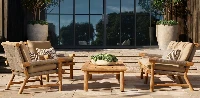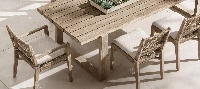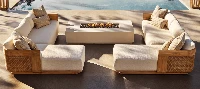

Hospitality procurement directors, landscape architects, and FF&E specialists frequently evaluate a core structural question: how to specify teak outdoor sofa sets for commercial hospitality projects? Outdoor furniture in high-occupancy luxury resorts, boutique hotels, and rooftop lounges faces grueling operational stresses. Unlike residential settings, commercial lounge frames endure constant guest rotation, exposure to chlorinated pool water, heavy UV radiation, and rigorous daily cleaning by housekeeping staff.
Failure to establish rigorous technical specifications during the tender phase leads to loose frame joints, waterlogged cushions, premature timber splitting, and costly warranty disputes. Specifying a high-performance hotel teak sofa set requires a deep understanding of tropical hardwood physics, structural joinery engineering, foam cellular structures, and international contract compliance standards.
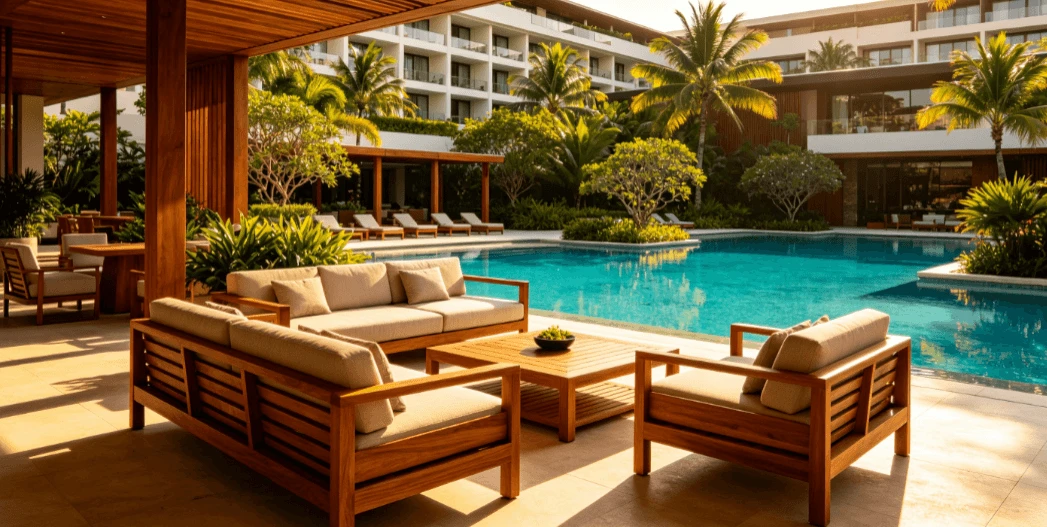
Timber Sourcing and Hardwood Physical Properties
🏨 Specifying timber for commercial hospitality begins at the forest level. Teak timber varies dramatically depending on tree maturity, plantation soil chemistry, and heartwood extraction methods. Commercial tender documents must strictly exclude sapwood, which lacks protective resins and decays rapidly under exterior exposure.
Grade-A Heartwood vs. Sapwood Structural Integrity
Grade-A teak wood is harvested exclusively from the central heartwood of mature trees (typically 30 to 50 years old). This wood features a close, straight grain with high concentrations of natural rubber, silica content, and organic biocide compounds known as tectoquinone. These natural extracts make the timber resistant to rot fungi, termitic damage, and water penetration.
Lower grades contain sapwood-the living outer layer of the tree. Sapwood is light in color, highly porous, and structurally weak. When specified in oceanfront settings, sapwood absorbs salt spray, encouraging rapid mold growth and cell wall collapse.
Moisture Control: Kiln-Drying and Equilibrium Moisture Content
Raw timber naturally contains high moisture levels. If crafted into furniture without controlled seasoning, the wood twists, checks, and cracks as ambient humidity fluctuates.
Commercial specification sheets must mandate computer-controlled kiln-drying down to a core moisture content of 8% to 12%. This process stabilizes the wood fiber, bringing it close to the equilibrium moisture content of most tropical and Mediterranean coastal resort zones.
Grade-A Teak vs. Grade-B/C Teak Specification Matrix
| Physical & Technical Parameter | Grade-A Heartwood (Contract Standard) | Grade-B / Grade-C Sapwood (Residential Grade) |
| Origin & Tree Age | Center heartwood (30–50+ years mature) | Outer growth rings (< 15 years juvenile) |
| Natural Oil Saturation | High (> 1.2% organic extracts) | Low to negligible |
| Grain Consistency | Straight, tight annual growth rings | Irregular, wide grain with knots and white streaks |
| Janka Hardness Rating | ~ 1,070 lbf | < 650 lbf |
| Rot & Insect Resistance | Exceptional (Immune to rot fungi) | Poor (Requires chemical preservatives) |
| Expected Resort Lifespan | 20–25+ Years under heavy use | 2–4 Years before structural failure |
Joinery Engineering and Hardware Selection for Contract Heavy-Use
🛠️ Frame failure in commercial outdoor seating almost always occurs at the connection points rather than within the timber itself. Guests dropping onto sofa arms or dragging modular frames across stone patios exerts heavy torsional stress on structural joints.
Precision Mortise and Tenon Construction
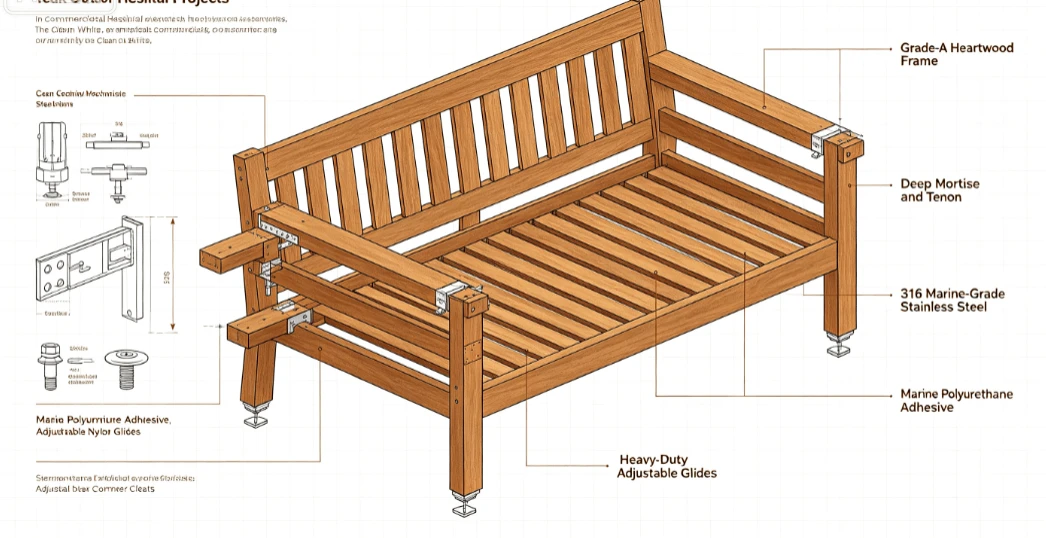
Commercial specifications must prohibit simple butt joints, pocket screws, or superficial metal brackets. All structural frame intersections require deep mortise and tenon joinery machined via CNC equipment to tolerances within 0.1 millimeter.
Tenons must extend at least two-thirds into the receiving mortise block. Joints should be permanently locked using high-durability marine polyurethane adhesive that resists hydrolysis in high-humidity environments.
Marine-Grade Hardware Requirements
Exposed screws, brackets, and internal alignment pins must withstand continuous salt fog without corroding or staining the wood.
Tender documents must specify commercial outdoor teak furniture with 316 stainless steel hardware. Standard 304 stainless steel, often used in residential furniture, suffers from pitting corrosion and tea-staining when exposed to coastal air. 316-grade steel contains 2% to 3% molybdenum, providing superior protection against chloride corrosion.
Contract Joinery & Fastener Performance Matrix
| Joinery / Hardware Element | Commercial Contract Specification | Substandard Alternative (Avoid) |
| Primary Structural Frame | Deep interlocking mortise and tenon | Pocket holes, wood screws, or dowels |
| Joint Adhesive | Two-part marine polyurethane / epoxy | Standard PVA exterior wood glue |
| Metal Fasteners | 316 marine-grade stainless steel | 304 Stainless or zinc-plated steel |
| Stress Corner Blocks | Screwed and glued teak corner cleats | Plastic brackets or soft plywood cleats |
| Leg Glides / Feet | Heavy-duty adjustable nylon / PTFE glides | Bare wood legs resting directly on concrete |
Material Comparison: Teak vs. Aluminum for Coastal Resort Lounges
📊 Resort developers often debate frame materials when outfitting oceanfront pool decks, VIP cabanas, and beach clubs. Understanding the trade-offs between a teak garden sofa set and metal alternatives is essential for long-term project planning.
Evaluating an Outdoor Teak Sofa vs Aluminum Outdoor Sofa for Coastal Saltwater Environments
While powder-coated metal offers a sleek profile, coastal marine conditions present distinct engineering challenges. The comparison below outlines key performance differences for oceanfront properties.
Outdoor Teak Sofa vs. Aluminum Outdoor Sofa for Coastal Saltwater Properties
| Performance Factor | Grade-A Teak Sofa Frame | Powder-Coated Aluminum Sofa Frame |
| Salt Spray Corrosion | Impervious to salt air; no oxidation | Prone to blister oxidation if coating scratches |
| Solar Heat Retention | Low thermal conductivity; stays cool to touch | High thermal absorption; metal frame gets hot |
| Structural Mass & Stability | Heavy, solid frame resists high coastal winds | Lightweight; prone to tipping in strong wind gusts |
| Surface Finish Maintenance | Natural weathering to silver patina or seasonal oil | Requires touch-up paint if chipped or scratched |
| Aesthetic Warmth | Natural organic texture; matches resort greenery | Modern, industrial look; cooler visual feel |
| Structural Repairability | Can be sanded, re-bonded, and refinished on-site | Scratched or dented metal frames are hard to repair |

Cushion Core Engineering, High-Performance Fabrics, and Drainage
🌊 A commercial sofa frame is only as reliable as its cushion system. Waterlogged, moldy cushions create operational challenges for hotel housekeeping teams and result in negative guest reviews.
Open-Cell Foam Technology
Residential cushions use closed-cell polyurethane foam wrapped in Dacron. When rained on, these cushions act like sponges, trapping water inside for days.
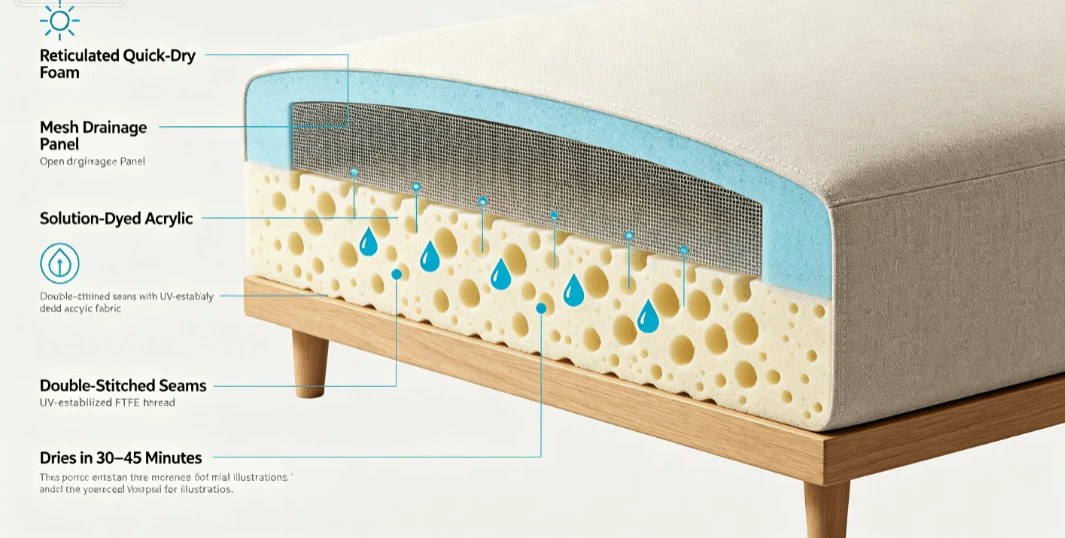
Commercial specifications must require reticulated quick-dry foam. This foam features a porous, open-cell structure that allows water and air to flow through freely. When combined with a bottom mesh drainage panel on the cushion cover, a saturated cushion can dry completely within 30 to 45 minutes of sun exposure.
High-Performance Marine Upholstery Fabrics
Cushion covers must resist UV degradation, chlorine fading, body oils, and sunscreen lotion.
Solution-Dyed Fabrics: Specify solution-dyed acrylic or solution-dyed olefin (such as Sunbrella or Agora). In solution dyeing, color pigments are added directly to the liquid polymer before the fibers are extruded. This ensures the color extends through the entire fiber, resisting fading under intense sunlight.
Seam Construction: Require double-stitched seams using UV-stabilized PTFE thread (such as Tenara). Standard polyester thread degrades under UV light within two seasons, causing seams to burst.
Expanding the Design Language: Bar and Lounge Co-ordination
📐 Modern luxury resorts require design consistency across different functional zones. Guests moving from an open-air lounge to a poolside bar expect a cohesive design language, material palette, and level of comfort.
Integrating Teak Outdoor Bar Furniture with Lounge Seating
Specifying teak outdoor bar furniture alongside low-slung lounge sets maintains visual harmony across outdoor food and beverage venues. Bar stools and high-top communal tables require the same Grade-A teak wood, mortise-and-tenon construction, and 316 stainless steel footrest protectors as deep-seating sofa frames.
Matching the timber grade, oil finish, and cushion upholstery across both lounge areas and bar zones simplifies maintenance for resort engineering teams and reinforces the project's architectural identity.
International Certification Standards and Lab Testing Protocols
📜 To ensure compliance, procurement teams should require independent laboratory test certificates alongside factory quotations.
Primary Contract Certifications
EN 581-1 & EN 581-2 Commercial Safety: European standards certifying that outdoor seating meets rigorous requirements for structural strength, stability, edge safety, and heavy weight capacities in public spaces.
FSC Certification: Guarantees that teak is harvested from responsibly managed forests adhering to strict environmental and social standards.
SVLK Timber Legality Verification: Indonesian government certification ensuring full legal traceability from timber source to final export.
ISO 9227 / ASTM B117 Salt Fog Testing: Validates that metal components and hardware endure 1,000+ hours of continuous salt spray without corrosion.
ISO 9001 Quality Management: Ensures the manufacturing facility follows consistent quality control standards during mass production.

Lifecycle Cost Analysis and Maintenance Protocols for Hotel Operators
🌿 Over a 10-year operational lifecycle, Grade-A teak delivers a favorable total cost of ownership compared to alternative materials.
Weathering Dynamics: Patina vs. Color Retention
When exposed to sunlight and rain, teak naturally oxidizes, developing a distinguished silver-grey patina. This patina development is purely cosmetic and does not affect the structural integrity of the timber.
During the weathering process, minor surface cracks-known as micro-checking-may appear along the wood grain. This is a natural reaction to temperature and humidity shifts as the outer fibers adjust. Micro-checking does not weaken the frame's internal structure.
10-Year Commercial Outdoor Furniture Total Cost of Ownership (100-Seat Resort Lounge)
| Cost Breakdown Element | Grade-A Teak Sofa System | Powder-Coated Metal Sofa | Synthetic Resin Wicker Sofa |
| Initial Capital Expenditure | Higher initial investment | Moderate initial investment | Low to moderate initial investment |
| Annual Maintenance Expense | Low (Basic washdown & clean) | Moderate (Touch-up paint / rust treatment) | High (Wicker strand repair) |
| Expected Replacement Cycle | 15–20+ Years | 5–7 Years | 3–5 Years |
| 10-Year Financial Index | 100 (Lowest Overall TCO) | 155 (Moderate TCO) | 190 (Highest Overall TCO) |
For resorts preferring to maintain teak's warm golden-brown tone, apply a breathable, non-film-forming teak protector once or twice a year. Avoid thick lacquers or varnishes, which trap internal moisture and peel in tropical environments.
FAQ:
1. How to specify teak outdoor sofa sets for commercial hospitality projects to ensure maximum frame longevity?
Specify 100% Grade-A teak wood heartwood, core kiln-dried to 8%–12% moisture content. Require deep mortise and tenon joinery pinned with 316 marine-grade stainless steel hardware. Ensure cushions utilize reticulated quick-dry foam wrapped in solution-dyed acrylic fabric with bottom mesh drainage panels.
2. What timber moisture content is mandatory for hotel outdoor sofa production?
Core moisture content must be strictly controlled between 8% and 12% via computer-monitored kiln-drying. This prevents checking, warping, and joint movement when furniture is installed in fluctuating tropical or Mediterranean coastal climates.
3. Why specify commercial outdoor teak furniture with 316 stainless steel hardware instead of 304 grade?
316 stainless steel contains molybdenum, which resists pitting corrosion and tea-staining caused by airborne salt spray. Standard 304 stainless steel oxidizes in marine environments, creating unsightly rust streaks on the light-colored teak wood.
4. How does an outdoor teak sofa vs aluminum outdoor sofa for coastal saltwater properties perform under direct tropical sunlight?
Teak wood has low thermal conductivity, staying comfortable to touch even in high ambient heat. Aluminum absorbs thermal energy quickly, making unshaded metal frames uncomfortably hot for hotel guests. Teak also offers greater mass, resisting displacement during sudden coastal wind gusts.
5. What structural safety standards must commercial hotel outdoor seating meet?
Commercial outdoor seating should comply with EN 581-1 (general safety) and EN 581-2 (contract mechanical strength and stability). Procurement documents should also require FSC Certification or SVLK Timber Legality Verification for environmental and legal compliance.
6. How should cushion cores be specified for a commercial teak garden sofa set placed near pool decks?
Specify open-cell reticulated quick-dry foam with a density of 30 to 35 kg/m³. Ensure the cushion cover uses solution-dyed acrylic fabric stitched with UV-resistant PTFE thread and features a PVC mesh bottom panel for rapid water drainage.
7. Can teak outdoor bar furniture be specified to match deep-seating lounge collections?
Yes. Commercial manufacturers can produce matching teak outdoor bar furniture using identical Grade-A timber, finishes, joinery methods, and fabric collections. Adding 316 stainless steel kickplates to bar stool footrests prevents wood wear from footwear.
8. How should hotel engineering teams maintain a hotel teak sofa set in high-turnover beach resorts?
Perform quarterly washdowns using fresh water, mild soap, and a soft-bristle brush to remove salt spray and organic debris. Allow the wood to weather naturally to a silver patina, or apply a breathable, water-based teak protector annually. Avoid film-forming polyurethane lacquers.