
☕ Commercial Outdoor Assessment for Hospitality Operators: For busy café owners, boutique hotel operators, and rooftop venue managers, storing outdoor furniture indoors every night or during sudden rainstorms incurs immense labor overhead. High-grade teak bistro tables can indeed remain outdoors permanently through continuous rain, intense sunlight, and freezing humidity. Thanks to dense organic oils, high silica content, and precise kiln-drying, quality teak naturally seals itself against rot, warpage, and structural degradation without requiring synthetic coatings or nightly storage.

1. The Year-Round Commercial Exposure Test for Café Patio Furniture
Operating a successful outdoor café or hotel terrace relies on maximizing seating capacity and eliminating operational friction. When sudden rain squalls hit or afternoon sun bakes sidewalk seating, staff should focus on guest service-not racing to haul heavy tables inside.
This brings up a crucial procurement question for hospitality owners: can teak bistro tables be permanently left outdoors in rain and sun without suffering structural failure, mold growth, or surface delamination?
Unlike synthetic rattan that becomes brittle under UV light, or powder-coated metals that rust when chipped, high-grade teak wood is evolutionarily engineered to thrive under punishing environmental exposure.
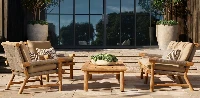
In modern outdoor venue design, compact dining arrangements often sit directly adjacent to low-slung lounge zones. Incorporating a matching teak outdoor side table next to primary bistro seating creates a cohesive visual flow while offering guests convenient surfaces for coffee cups, mobile devices, or cocktail glasses.
2. Timber Physics: How Natural Oils and Cellular Density Resist Weathering
To understand why teak withstands continuous outdoor exposure while domestic hardwoods like oak or pine rot within seasons, we must analyze its interior wood chemistry.
Grade-A teak (Tectona grandis) harvested from mature tropical plantations possesses an extraordinarily dense heartwood cellular matrix packed with natural rubber resins and tectoquinone-a naturally occurring organic compound that acts as a built-in preservative.
🌧️ The Water Protection Barrier
Hydrophobic Oil Barrier: The natural oil content inside teak fibers repels liquid water on contact, preventing water from saturating the timber's interior core.
Silica Content: Teak absorbs high levels of natural silica from mineral-rich soil during growth. This silica crystalizes inside the wood grain, creating a natural shield against wood-boring insects, termites, and fungal decay.
Fungal Resistance: Because water cannot penetrate deep into the dense heartwood, mold spores cannot establish roots within the timber.
☀️ The Sun and UV Transformation
When exposed to direct sunlight, radiant ultraviolet rays trigger a mild surface photo-oxidation reaction. Over several months of continuous outdoor exposure, the rich golden-brown timber transitions naturally into a distinguished, silvery-grey patina layer.
This patina layer is purely aesthetic. It acts as a protective shield for the interior wood fibers, locking in internal oils without reducing structural strength or table load capacity.
📊 Outdoor Material Performance Under 24/7 Rain & Sun Exposure
| Material Type | Water Penetration Risk | UV Degradation Resistance | Mold & Rot Immunity | Annual Maintenance Need | Expected Commercial Life |
| Grade-A Teak Wood | 🟢 Extremely Low (Self-Sealing) | 🟢 High (Forms Silver Patina) | 🟢 Natural Immunity | Low (Optional Washing) | 20+ Years |
| Powder-Coated Steel | 🔴 High (Rusts if Chipped) | 🟡 Moderate (Fades/Chalks) | 🟢 Immune to Rot | High (Anti-Rust Touch-ups) | 3–5 Years |
| High-Pressure Laminate (HPL) | 🟡 Moderate (Edge Seep Risk) | 🟡 Moderate (Surface Cracking) | 🟢 Synthetic Material | Medium (Edge Inspection) | 4–6 Years |
| Softwood (Pine/Fungicide Treated) | 🔴 Extreme (Warps & Absorbs) | 🔴 Low (Splits & Checks) | 🔴 Requires Chemical Coating | High (Annual Staining) | 1–3 Years |
3. Kiln-Drying Standards & Moisture Expansion Control
While raw teak possesses superior natural oils, improper seasoning during manufacturing causes table tops to split or warp when subjected to alternating rain and intense sun.
When timber is freshly harvested, its internal moisture content can exceed 50%. If crafted into furniture without controlled drying, sunlight rapidly evaporates surface moisture while the interior remains saturated. This differential stress causes severe surface checking, warping, and joint rupture.
To guarantee all-weather stability, reputable commercial suppliers enforce a strict kiln dried teak outdoor furniture moisture content standard of 8% to 12%.
By slowly evaporating internal water in computer-monitored kilns over 30 days, the wood achieves dimensional equilibrium. When exposed to torrential rainstorms, the timber expands uniformly; when baked under direct sun, it contracts without splitting the frame or joint assemblies.
Furthermore, premium commercial tables utilize quarter-sawn timber cuts. Quarter-sawn boards feature vertical grain growth rings, reducing tangential expansion by up to 50% compared to flat-sawn commercial lumber.

4. Hardware, Slatted Tabletop Joinery, and Drainage Design
A solid slab of wood left outdoors will accumulate standing water, leading to localized swelling. Therefore, the architectural design of a commercial bistro table must facilitate rapid water drainage.
📐 Engineering Features of All-Weather Bistro Tables
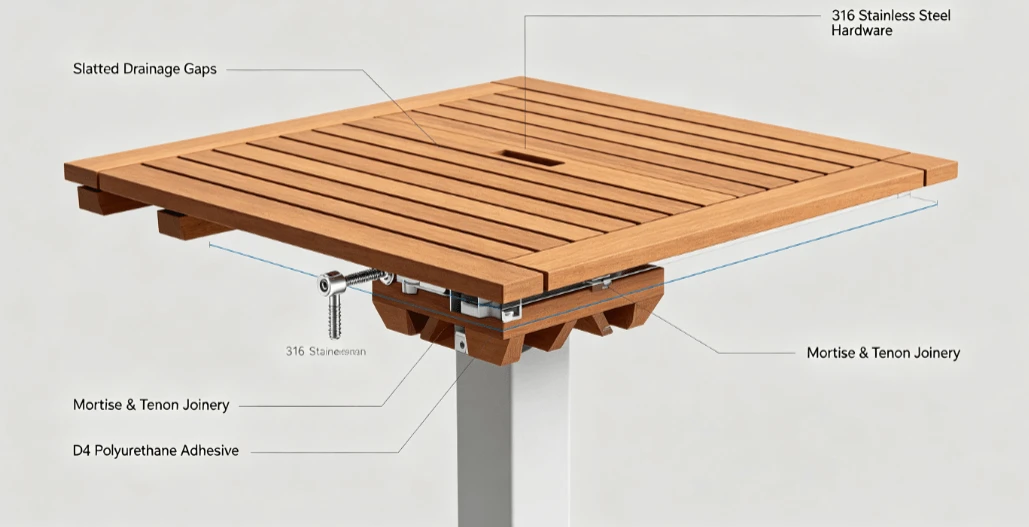
Precision Slatted Planks: Round bistro tops should feature slatted plank configurations separated by engineered 3mm to 5mm drainage gaps. Rainwater flows directly through the surface rather than pooling in the center.
Beveled Edge Profiles: Underside edges feature subtle drip grooves that break water surface tension, forcing droplets to shed off the frame before reaching structural leg joints.
316 Marine-Grade Hardware: All internal assembly screws, threaded inserts, and center post connectors must utilize 316 stainless steel or solid brass. Lower-grade steel hardware corrodes when exposed to rain, causing rust stains that bleed through wood grain.
Deep Mortise and Tenon Joinery: Structural under-carriages and pedestal legs must be joined using traditional mortise and tenon joinery sealed with waterproof D4 polyurethane adhesive.
🛠️ Hardware & Frame Durability Matrix
| Component Section | Ideal Commercial Spec | Lower-Grade Alternative | Operational Risk of Low Spec |
| Fastener Material | 316 Stainless Steel / Brass | Zinc-Plated Carbon Steel | Rust bleeding & structural joint failure |
| Structural Glue | D4 Polyurethane Adhesive | D2/D3 PVA Wood Glue | Glue line dissolves under heavy rainfall |
| Leg Base Pads | High-Density Nylon Glide Feet | Direct Wood-to-Ground | Capillary water absorption into leg ends |
| Tabletop Slats | Individual Radius-Cut Planks | Single Solid Sheet Plywood | Cupping, warping, and water pooling |

5. Complementary Outdoor Hospitality Layouts: From Bistro Dining to Lounge Balconies
Hospitality venues rarely rely on bistro tables alone. To maximize venue revenue per square foot, property managers blend compact dining areas with flexible outdoor lounge zones.
For instance, pairing small café dining sets with a solid teak outdoor sofa allows venues to seamlessly shift from daytime coffee service to evening cocktail lounging.
When designing narrow footprint spaces-such as urban coffee shop terraces or boutique hotel room verandas-specifying an outdoor teak loveseat sofa for small cafe and hotel balcony space provides comfortable upholstered lounge seating without obstructing pedestrian traffic or server walkways.
Because teak handles rain and sun uniformly across all product categories, mixing bistro tables, side tables, and lounge sofas maintains a harmonious aesthetic across the entire commercial footprint.
6. International Standards, Certifications, and Quality Audits
Commercial procurement managers must verify that outdoor furniture shipments satisfy international safety, environmental, and structural durability standards before installation.
🛡️ Essential Industry Certifications
EN 581-1 / EN 581-3: European safety, mechanical strength, and stability testing standards specifically regulating commercial outdoor tables and seating.
FSC Certification: Forest Stewardship Council certification guaranteeing that all teak timber originates from responsibly managed, environmentally sustainable forests.
SVLK Certification: Indonesian Legal Wood Assurance System certifying legal timber origin and full supply chain transparency.
ISO 9001: International quality management system certification ensuring consistent factory tolerances and joinery precision.
BIFMA X5.5: American National Standard for Desk and Table Products, evaluating impact resistance and vertical load capacities.

7. Operational ROI and Maintenance Protocols for 24/7 Outdoor Furniture
From a financial perspective, leaving teak bistro tables outdoors permanently delivers immediate labor savings and an exceptional Return on Investment (ROI).
The Financial Case for Permanent Outdoor Placement
Consider a commercial patio with 20 bistro tables. Paying staff 30 minutes daily to haul furniture into indoor storage consumes roughly 180 hours of paid labor annually per venue. By deploying permanent Grade-A teak tables, that labor expense drops to zero.
Minimal Maintenance Protocol
Maintaining 24/7 outdoor teak requires no complicated varnishing or sanding:
Seasonal Washing: Clean tables twice a year using warm water, mild dish soap, and a soft bristle brush to clear environmental dust, pollen, or ocean salt.
Spill Management: Wine, coffee, or olive oil spills should be wiped promptly with a damp cloth. Natural teak oils prevent immediate liquid absorption into the grain.
Patina Choice: To maintain the natural honey-gold wood tone, apply a breathable teak protector once a year. Alternatively, allow the wood to age naturally into a classic silver-grey patina shield requiring zero ongoing finish re-application.
FAQ:
Q1: Can teak bistro tables remain outdoors during winter freezing rain and snow?
Yes. Grade-A teak handles freezing winter conditions, snow, and rain without structural damage. Because properly kiln-dried teak absorbs virtually no surface liquid, internal water freezing and expansion do not occur within the wood grain. However, ensuring table feet feature nylon glides keeps the bottom grain elevated off wet or freezing patio stones.
Q2: Will rain wash away the natural protective oils inside a teak bistro table?
No. Teak oils are insoluble organic resins tightly bound within the timber's cellular walls. Rain exposure washes away only superficial surface oils, which causes the outer wood layer to oxidize into a silvery-grey patina. The interior wood core retains its natural protective oils indefinitely, preserving structural integrity over decades of weather exposure.
Q3: What is the difference between Grade-A teak and Grade-C teak for all-weather outdoor use?
Grade-A teak is cut exclusively from the mature heartwood of the tree, packed with dense oils, silica, and tight grain. Grade-C teak is soft sapwood cut from the outer edges of young trees. Grade-C wood lacks protective oils, absorbs water quickly, warps under sun exposure, and will rot if left outdoors permanently without heavy synthetic chemical treatments.
Q4: How do I prevent oil or food stains from ruining an unsealed outdoor teak bistro table?
Grade-A teak's dense oil profile prevents liquids from penetrating deep into the grain immediately. Promptly wiping food or beverage spills with a damp cloth and mild soap removes surface residue. For stubborn oil spots, mild scrubbing with soapy water along the natural wood grain direction removes the mark without damaging the underlying timber.