
🛠️ Commercial Procurement Summary: Hospitality dining chairs suffer continuous dynamic load cycles, lateral shear stress, and atmospheric moisture shifts. Standard residential dowels or pocket screws fail within months under commercial turnover. Achieving a 10+ year lifespan requires heavy-duty joint construction for restaurant teak chairs centered around deep, hand-fitted mortise and tenon joinery reinforced with interlocking teak dowel pins and structural D4 polyurethane adhesive.

1. The Engineering Reality of Commercial Dining Chair Stress
When specifying seating for busy resort patios, rooftop bars, and fine dining establishments, structural integrity directly protects revenue. Unlike residential furniture that experiences sporadic use, restaurant seating endures aggressive, continuous stress.
When a guest leans back on two chair legs or slides a seat across an uneven stone patio, the frame encounters severe rotational force known in structural engineering as racking stress.
Without superior joint construction for restaurant teak chairs, the microscopic bonds holding the seat apron to the rear leg fracture. Once internal movement begins, moisture penetrates the cavity, degrading the structural adhesive and leading to frame wobble or catastrophic joint shear.
In high-end commercial spaces featuring luxury teak patio furniture, structural failure is unacceptable. A single wobbly chair compromises patron perception and creates serious safety liabilities for venue operators.
2. Comparing Joint Construction Methodologies for High-Traffic Seating
Not all joinery techniques are created equal. Commercial furniture manufacturers utilize various assembly methods, but their structural load capacity under cyclic fatigue varies dramatically.
To understand which joint construction for restaurant teak chairs provides maximum longevity, procurement managers must compare the mechanical attributes of common woodworking joints.
🪵 Joinery Method Performance Comparison
| Joinery Method | Primary Mechanical Interlock | Resistance to Racking Stress | Moisture Cycle Stability | Commercial Lifespan Rating |
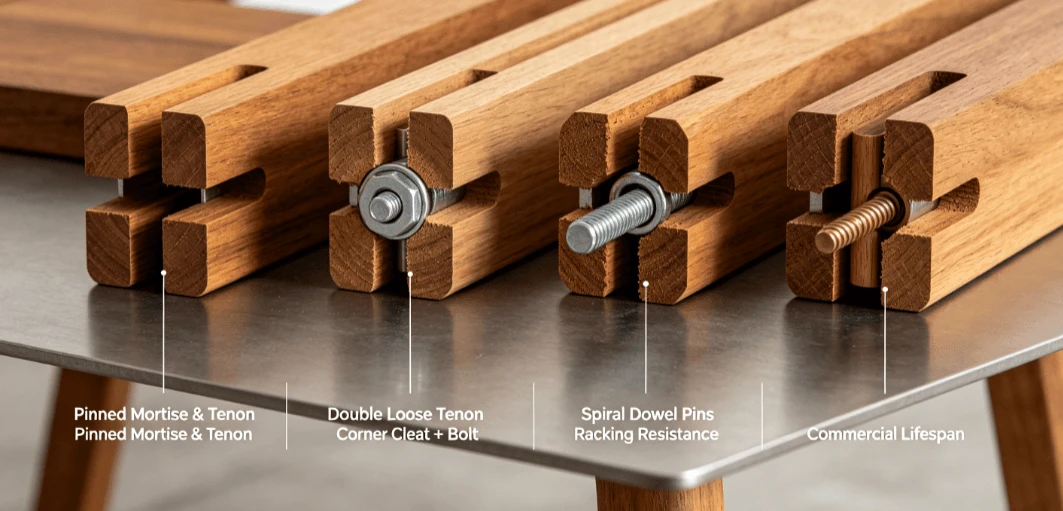
| Pinned Mortise & Tenon | Wood-to-Wood Shoulder + Teak Dowel Lock | 🌟🌟🌟🌟🌟 (Maximum) | 🌟🌟🌟🌟🌟 (Immune to Moisture Pop) | 15+ Years |
| Double Loose Tenon (Domino) | Floating Solid Teak Insertion Keys | 🌟🌟🌟🌟 (High) | 🌟🌟🌟🌟 (Excellent) | 10–12 Years |
| Internal Corner Cleat + Bolt | Metal Threaded Insert & Bracket | 🌟🌟🌟 (Moderate) | 🌟🌟 (Requires Tightening) | 3–5 Years |
| Spiral Wooden Dowel Pins | Friction Fit Multi-Dowel Alignment | 🌟🌟 (Low) | 🌟 (Prone to Shear Creep) | 1–2 Years |
| Pocket Hole Screws | Diagonal Metal Screws into End-Grain | 🌟 (Extremely Poor) | 🌟 (Fails under Wet Exposure) | Unsuitable for Commercial Use |
Why Dowels and Pocket Screws Fail in Hospitality
Spiral dowels rely almost entirely on adhesive surface area. Because wood expands and contracts along its radial and tangential axes, seasonal outdoor humidity changes break the thin glue line around smooth dowels.
Pocket screws drive steel fasteners into end-grain timber. End-grain possesses weak screw-holding power. Under repeated lateral loads from heavy diners, the metal threads strip the wood fibers internally, causing unrepairable looseness.
3. The Gold Standard: Deep Pinned Mortise and Tenon Joinery
The undisputed champion for heavy-duty commercial seating is the blind pinned mortise and tenon joint. This ancient woodworking technique relies on precise wood-to-wood contact reinforced by modern timber science.
Key Components of a Heavy-Duty Commercial Joint
Tenon Length & Thickness Ratio: The tenon length must measure at least 30mm to 40mm, with a thickness equal to one-third of the total rail stock. This maximizes the longitudinal grain bonding surface (cheek-to-cheek contact).
Precision Shoulder Bearing: The tenon shoulders must sit flush against the mortise face. When a guest leans back, the shoulder transfers the compressive load directly into the solid wood leg rather than stressing the glue line.
Interlocking Teak Dowel Pin: A solid teak dowel pin is driven vertically or horizontally through the assembled mortise and tenon. This creates a mechanical lock. Even if an adhesive were to fail completely, the wood pin prevents the tenon from physically withdrawing from the mortise cavity.
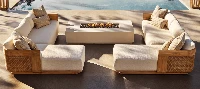
When specifying outdoor dining layouts, space optimization is crucial. Venues often balance spacious dining zones with space-saving lounge setups, such as integrating a teak outdoor sofa for small spaces alongside high-density dining chairs. Across all seating types, consistent joinery engineering ensures uniform durability across the entire property.
4. Timber Science: Teak Oils, Grain Orientation, and Adhesives
Selecting the proper joint geometry is only half the battle. Grade-A teak (Tectona grandis) possesses unique natural characteristics that dictate specialized manufacturing protocols.
Managing Natural Teak Oils
Teak wood contains high concentrations of natural rubber and tectoquinone, an organic resin that renders the timber immune to rot, termites, and water penetration. However, these natural oils can form a barrier against standard PVA wood glues.
To achieve an unbreakable bond in joint construction for restaurant teak chairs:
Joint mating surfaces must be degreased with a rapid-evaporating solvent immediately prior to assembly.
Manufacturers must utilize D4 polyurethane adhesive or marine-grade epoxy resin. These adhesives cure via chemical cross-linking rather than simple water evaporation, bonding permanently with oil-rich wood fibers.
Grain Orientation and Moisture Content
The structural timber must undergo precise kiln-drying to achieve an equilibrium moisture content of 8% to 12%.
Furthermore, joint components require quarter-sawn timber grain orientation. Quarter-sawn wood exhibits minimal expansion across its width, preventing the tenon from swelling excessively during tropical storms or shrinking during arid summer heat.
For large commercial buyers, such as contract teak outdoor furniture suppliers for golf country clubs, verifying kiln-drying logs and grain selection protocols prevents catastrophic joint split issues across multi-hundred chair deployments.

5. Structural Testing Standards and Industry Certifications
Commercial hospitality furniture must pass rigorous mechanical testing to verify that joinery can endure years of public abuse.
📐 Key Performance & Quality Certifications
When evaluating commercial teak chair specifications, request official test reports from accredited laboratories confirming compliance with global standards:
BIFMA X5.1: The American National Standard for Office & Commercial General Purpose Seating. Tests include backrest strength, drop impacts, and 100,000+ cycle leg racking forces.
EN 581-1 / EN 581-2: European safety, strength, and durability standards specifically governing outdoor commercial seating and tables.
ISO 9001: Quality management system certification ensuring factory joinery tolerances remain consistent across thousands of units.
FSC Certification: Ensures all teak timber is legally harvested from responsibly managed, sustainable plantations.
SVLK Certification: Indonesian Legal Wood Assurance System verifying chain-of-custody compliance from forest to final export.
🛡️ Laboratory Load Test Standards
| Test Type | Applied Force / Motion | Cycles / Duration | Structural Pass Threshold |
| Backrest Cyclic Strength | 334 N (75 lbf) Lateral Push | 120,000 Cycles | Zero joint separation or audible cracking |
| Front Leg Proof Load | 1,000 N (225 lbf) Static Push | 1 Minute Hold | Permanent deflection less than 1.5mm |
| Seat Impact Drop Test | 102 kg (225 lbs) Freefall | 10 Consecutive Drops | Zero tenon fracture or corner separation |
| Horizontal Corner Rack | 300 N Torsional Twist | 50,000 Cycles | Zero adhesive bond rupture |

6. Weather Protection and Seasonal Care Protocols
While high-grade mortise and tenon joints resist physical load fatigue, protecting the complete outdoor ensemble during extreme seasonal weather preserves frame aesthetics and cushion soft-goods.
When managing expansive resort properties, staff must follow structured seasonal maintenance routines. Understanding how to protect outdoor teak sofa cushions during heavy winter rain is just as critical as protecting chair frames. Storing cushions in ventilated deck boxes, applying hydrophobic fabric treatments, and deploying custom-fitted breathable covers prevents water pooling around wooden frame joints during cold non-operational months.
⚖️ Lifecycle Cost Analysis: Joinery Type Impact
Investing in superior joint construction for restaurant teak chairs significantly lowers the Total Cost of Ownership (TCO) over a ten-year operational horizon.
| Cost Element | Pinned Mortise & Tenon Chairs | Pocket Screw / Dowel Chairs | Metal Frame / Welded Chairs |
| Initial Capital Expenditure | Higher Initial Investment | Low Initial Investment | Moderate Initial Investment |
| Annual Joint Maintenance | Zero ($0) | High (Screw Retightening) | Low (Paint Touch-ups) |
| Average Service Life | 12 to 15+ Years | 1 to 2 Years | 3 to 5 Years |
| 10-Year Replacement Frequency | 0 Replacements | 4 to 5 Full Replacements | 2 Full Replacements |
| 10-Year Total TCO Index | 💰 (Lowest Long-Term Cost) | 💰💰💰💰 (Extremely Expensive) | 💰💰💰 (Moderate-High) |

7. Procurement Inspection Checklist for Commercial Buyers
Before releasing final payment or accepting overseas container shipments of restaurant seating, commercial procurement teams should execute this 5-point quality check:
Shoulder Tightness: Inspect all seat rail joints. There should be zero visible light gap between the tenon shoulder and the leg face.
Dowel Lock Verification: Confirm that dowels are crafted from solid teak (not cheap softwood dowels) and are locked flush with the outer frame.
Diagonal Rack Test: Grab the top backrest rail and apply firm lateral pressure while holding the front seat rail stationary. A properly engineered chair should exhibit zero flex.
Moisture Content Audit: Use a pin-type wood moisture meter to verify that the internal timber moisture reads between 8% and 12%.
Documentation Audit: Request certified laboratory test sheets demonstrating compliance with BIFMA or EN 581 standards.
FAQ:
Q1: Why is pinned mortise and tenon superior to metal corner brackets for restaurant teak chairs?
Metal corner brackets rely on screws driven into wood. Because wood and metal expand at drastically different rates under temperature and humidity changes, metal screws loosen over time and strip the internal wood grain. A pinned mortise and tenon joint uses wood-to-wood joinery with identical expansion rates, locked mechanically by a teak dowel that never loosens or rusts.
Q2: Can knocked-down (KD) flat-pack teak chairs offer the same joinery strength as factory-assembled chairs?
No. Knocked-down chairs rely on end-user assembly using bolts, barrel nuts, or metal cam locks. These mechanical fasteners cannot replicate the structural rigidity or permanent surface-area bonding of factory-glued, hydraulically clamped mortise and tenon joints with cured D4 polyurethane adhesive. For high-traffic commercial dining, factory-assembled fully welded or mortised seating is mandatory.
Q3: What glue formulation is best for outdoor teak chair joints exposed to humidity and rain?
The gold standard for commercial outdoor teak joinery is D4 polyurethane adhesive or two-part marine-grade epoxy resin. Standard D1, D2, or D3 PVA wood glues break down when exposed to moisture and heat. D4 polyurethane cures chemically, forming a waterproof, slightly flexible bond that withstands outdoor weather shifts and natural teak oil interference.
Q4: How does kiln-drying affect the long-term tightness of teak chair joints?
If teak timber is not properly kiln-dried to an 8% to 12% equilibrium moisture content, the wood will lose internal moisture after assembly in dry or air-conditioned restaurant environments. As the tenon shrinks inside the mortise, the adhesive bond shears apart, causing catastrophic joint wobble. Proper kiln-drying ensures the tenon dimensions remain stable permanently.