
💡 Commercial Patio Layout Direct Insight
For urban cafes with restricted square footage, stackable armless teak chairs, slender-frame folding bistro chairs, and integrated perimeter teak benches yield the highest seating density without violating local fire codes or staff service clearance rules. Selecting Grade-A teakwood constructed with mortise-and-tenon joinery ensures commercial-grade structural integrity, reducing physical footprint by up to 28% compared to standard residential armchairs while boosting daily table turnover.

Outdoor hospitality operator faces a constant economic equation: revenue per square meter is directly tied to usable seating capacity, yet guest comfort and servers' movement cannot be compromised. When designing narrow sidewalk seating or compact urban terraces, choosing which outdoor teak dining chair styles offer the best space efficiency for small cafe patios becomes a high-stakes capital decision.
Teak wood remains the gold standard material for commercial hospitality due to its natural oleoresin content, which protects timber from moisture, UV deterioration, and fungal decay. However, unoptimized furniture silhouettes can quickly consume valuable patio real estate. Commercial operators often start by calculating basic dining layouts using a teak patio chairs set of 4 around compact 70cm square bistro tables, but expanding that capacity requires understanding how specific structural chair profiles utilize spatial volume.
☕ 1. Stackable Armless Teak Chairs: The High-Density Workhorse
When floor space is severely constrained, armrests add between 8 to 15 centimeters of horizontal width per chair without contributing to functional seating width. For high-density dining environments, stackable armless designs provide the single highest return on floor area.
Key Commercial Advantages:
Slim Lateral Footprint: With average widths ranging between 42cm and 48cm, armless units allow four guests to sit comfortably around a compact 70x70cm table without shoulder collision.
Vertical Storage Efficiency: Stacking mechanisms engineered into commercial teak frames permit vertical nesting 4 to 6 chairs high during closing hours or inclement weather.
Under-Table Clearance: Without arms blocking the table apron, these chairs tuck fully beneath tabletop edges, opening up circulation aisles during off-peak hours.
To withstand the constant friction of daily stacking, commercial-grade stackable chairs rely on 316 marine-grade stainless steel structural reinforcement caps embedded into high-stress frame joints.
🪑 2. Slender-Frame Folding Teak Chairs: Rapid Space Reconfiguration
For cafes operating under municipal sidewalk permits requiring daily furniture removal, folding teak chairs offer exceptional spatial versatility.
Modern folding teak dining chairs feature streamlined back slats and reduced frame depths (typically under 52cm operational depth). Unlike bulky residential options, commercial folding chairs utilize heavy-duty brass or stainless hardware that allows frames to collapse into a slim 9cm vertical profile.
This adaptability allows cafe managers to add extra covers instantly during peak breakfast hours or clear space rapidly for private group events. Stowing 20 folded chairs requires less than 1 square meter of indoor back-of-house storage space.

📐 3. Integrated Perimeter Teak Bench Seating: Eliminating Dead Space
Static perimeter walls, railings, and alcoves represent underutilized outdoor real estate. Installing custom or modular teak bench seating against patio boundaries yields up to 30% more seating capacity compared to individual freestanding chairs.
Spatial Efficiency Breakdown:
Zero Rear Clearance Requirement: Individual chairs require 45cm to 60cm of rear pull-out space for guest entry and exit. Benches eliminate rear pull-out clearance entirely.
Flexible Group Squeezing: A 180cm straight teak bench comfortably seats three adults, but can accommodate four children or dynamic party sizes during rush hours.
Hidden Storage Solutions: Commercial teak benches can be custom-engineered with hinged seats, converting base structures into weatherproof storage lockers for cushions and outdoor heaters.
🍹 4. High-Top Teak Tables and Bar Stools: Exploiting Vertical Dimensions
When horizontal floor space cannot be expanded, commercial venues look upward. Transitioning a portion of a small patio to high-top dining creates visual depth while drastically compressing the furniture footprint.
Integrating modern commercial teak outdoor bar height tables and stools along outdoor railings, glass facades, or narrow perimeter corridors transforms zero-revenue transition zones into profitable seating spots. Bar stools feature compact bases (often under 40x40cm) and slide entirely under high-top counters when vacant, keeping pedestrian traffic lanes wide and unobstructed.
📊 Commercial Patio Furniture Style Comparison Matrix
Evaluating chair styles requires balancing operational flexibility, space optimization, and seating capacity.
| Chair Style | Average Width (cm) | Min. Aisle Clearance Needed (cm) | Stacking / Folding Capability | Seating Density Rating (1-10) | Ideal Patio Zone Placement |
| Stackable Armless Teak Chair | 44 - 48 cm | 60 cm | Vertical Stack (4-6 Units) | 9.5 / 10 | Main central floor & small tables |
| Folding Teak Bistro Chair | 40 - 45 cm | 55 cm | Collapsible Flat (9cm depth) | 9.0 / 10 | Flexible sidewalk zones |
| Teak Bar Stool (Backless) | 38 - 42 cm | 45 cm | Tuck-Under Counter | 8.5 / 10 | Railings, bars, perimeter walls |
| Teak Dining Armchair | 58 - 65 cm | 85 cm | Rigid / Non-Stackable | 4.5 / 10 | Large VIP corner tables only |
| Linear Teak Bench | 120 - 180 cm | 0 cm (Rear) | Fixed / Modular | 9.8 / 10 | Flat back walls & perimeter edges |

🏢 Multi-Zone Commercial Patio Design Strategies
Modern hospitality projects rarely rely on a single seating style. Designing an expansive rooftop venue or multi-tiered resort cafe requires zoning different spaces based on guest dwell time and exposure to weather elements.
High-Wind Terraces & Rooftop Applications
For rooftop dining environments exposed to high atmospheric wind pressures, lightweight plastic or aluminum chairs present safety hazards. Here, operators specify a heavy duty outdoor teak sofa for high wind rooftop terraces weighted with dense kiln-dried teak subframes. Combining heavy base seating along outer glass windbreaks with space-efficient stackable dining sets in sheltered center sections ensures both safety compliance and maximum seating capacity.
Hybrid Hospitality Lounging
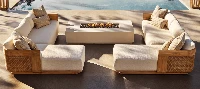
To cater to guests seeking drinks before dinner, integrating a luxury teak outdoor sofa within low-density lounge alcoves allows venues to charge premium minimum spends for soft-seating reservations while maintaining high cover turnover across main dining tables.
🛠️ Material Engineering, Joinery & International Certifications
Commercial outdoor furniture undergoes significantly more mechanical stress than residential items. Ensuring long-term return on investment requires specifying commercial-grade structural standards.
Key Technical Specs to Inspect:
Grade-A Teak Timber: Harvested strictly from mature heartwood rich in natural oils, resisting checking, warping, and splintering under thermal shocks.
Precision Mortise-and-Tenon Joinery: Interlocking wood joints secured with teak dowels maintain frame rigidity through thousands of commercial seating cycles.
Textylene & Olefin Slings: Incorporating quick-dry all-weather synthetic wicker or high-tensile mesh backrests reduces frame mass while eliminating bulky foam cushions that require indoor night storage.
Prior to procurement, commercial purchasing managers should request certified test documentation verifying compliance with global structural and environmental benchmarks:
FSC (Forest Stewardship Council): Ensures all timber is sourced from responsibly managed, renewable plantations.
EN 581 Standard: European mechanical safety and stability testing specifically for commercial contract outdoor furniture.
BIFMA X5.5 certification: North American commercial desk/table and seating structural durability compliance.
SGS durability testing: Independent laboratory verification of load capacity, salt-spray resistance, and UV stability.
ISO 9001 quality management: Ensures strict manufacturing tolerances across large-volume production runs.
📏 Patio Clearance & Circulation Guidelines
Space-efficient chairs only function well when deployed within a properly calculated floorplan. Failing to account for egress aisles creates bottlenecks for waitstaff and uncomfortable experiences for diners.
| Dimension Parameter | Minimum Recommended Distance | Commercial Rationale |
| Chair Back to Table Edge | 45 cm | Allows guest entry and exit without pushing into aisles |
| Main Server Passageway | 90 - 120 cm | Permits two trays or servers to pass simultaneously |
| Secondary Service Passageway | 75 - 90 cm | Minimum width for single staff passage |
| Table-to-Table Center Spacing | 180 cm | Measures from table center to table center (70cm tables) |
| Fire Egress Route | 120 cm (Local Code Dependent) | Unobstructed exit lane required by municipal fire safety |

🧼 Commercial Maintenance Protocol for High-Traffic Teak
Maintaining spatial efficiency also means keeping furniture looking pristine. High-turnover cafe settings expose teak to coffee spills, grease, and cleaning chemicals.
Daily Surface Wipe-Down: Clean surfaces with mild pH-neutral soap and warm water. Avoid harsh bleach or pressure washers, which strip natural wood oils and raise wood grain.
Annual Deep Scrub: Apply specialized teak cleaner using a soft-bristle scrub brush along the direction of the wood grain to remove accumulated dirt, soot, and food oils.
Sealer vs. Teak Oil Application: For commercial applications, avoid traditional teak oils which can attract mold and leave sticky residue. Instead, apply an eco-friendly water-based teak sealer once a year to preserve the warm golden-brown luster, or allow the wood to naturally oxidize into a classic silver-grey patina.
Hardware Tightening: Schedule bi-annual inspections of all stainless steel bolts and folding hinges using a standard hex key to ensure long-term frame stability under constant commercial use.
❓ FAQ:
Q1: How many chairs can comfortably fit around a 70cm x 70cm cafe table without crowding the patio?
A: Using stackable armless teak chairs with widths under 48cm, you can fit 4 covers around a 70x70cm square table (one per side). If using standard dining armchairs with widths exceeding 58cm, you are restricted to 2 covers per table to maintain proper elbow room and prevent armrests from colliding beneath the table apron.
Q2: Why is Grade-A teak preferred over metal or plastic furniture for small coastal cafe patios?
A: Grade-A teak contains dense natural oils and rubber resins that make it completely impervious to salt air corrosion, cracking, and water rot. Unlike metal furniture, teak does not absorb excessive solar heat, ensuring seats remain cool and comfortable for guests during peak afternoon sun exposure. Furthermore, solid timber frames provide stable ballast without rusting or scratching delicate outdoor tiles.
Q3: What is the average lifespan of commercial teak dining chairs in high-traffic hospitality settings?
A: High-grade commercial teak chairs built with mortise-and-tenon joinery routinely last 10 to 15+ years under heavy daily commercial use. In contrast, residential-grade wood or aluminum options often experience frame joint failure within 2 to 3 seasons. Purchasing certified commercial-grade teak dramatically reduces long-term replacement capital expenditure.
Q4: How do stackable teak chairs perform regarding off-season storage and theft prevention?
A: Stackable commercial teak chairs allow staff to nest 4 to 6 units vertically, reducing overnight and off-season storage footprints by up to 75%. During off-hours, stacked sets can be secured easily through frame legs using a single high-tensile coated security cable attached to anchor points, preventing outdoor vandalism and theft.