
OPERATOR COMPLIANCE & SPECIFICATION NOTICE 🛡️
Specifying textile-based seating for heavy commercial dining requires balancing aesthetic comfort with structural safety and strict cleaning turnaround times. Always demand verifiable independent testing certificates covering load durability and corrosion resistance before issuing large hospitality purchase orders.
The Commercial Outdoor Furniture Dilemma: Aesthetic Appeal vs. High-Volume Friction 🍽️
Hospitality managers often face a tough tradeoff between comfortable residential aesthetics and industrial durability. Modern venue designs are moving away from cold metal frames, opting for soft, woven textures to elevate guest dwell time.
Deploying commercial outdoor furniture in high-density dining environments introduces severe operational wear. A busy terrace can turn over hundreds of guests daily, exposing chairs to continuous friction, sun exposure, greasy food spills, and harsh sanitation routines.
Evaluating whether rope-woven and strap outdoor chairs possess the stamina for heavy dining setups requires examining fiber science, frame engineering, and long-term asset degradation.
Material Science: Comparing Rope Weaves in Commercial Outdoor Furniture 🔬
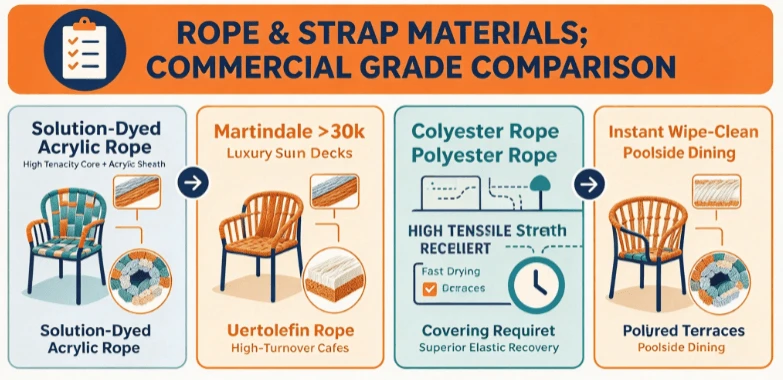
The longevity of woven seating relies on synthetic polymer chemistry and dual-core yarn engineering. Contract-grade furniture replaces natural fibers with extruded synthetic polymers built for weather immunity.
To maintain structural shape under heavy weight, premium rope uses a high-tenacity inner core wrapped in a solution-dyed acrylic outer sheath. This layered design provides superior tensile strength while offering remarkable resistance against surface abrasion and color fading.
Another widely specified synthetic option is polyolefin rope, which inherently repels moisture, dries rapidly, and resists chemical breakdown from acidic food spills at a cost-effective price point.
Budget-focused furniture lines may utilize polyester rope, which offers high initial tensile strength but requires additional UV coatings to prevent long-term degradation in high-sun environments.
For modern strap seating, manufacturers utilize polypropylene strap webbing or thermoplastic polyurethane bands to deliver flexible body support with rapid surface cleanability.
Comprehensive Outdoor Rope & Strap Material Comparison Matrix 📊
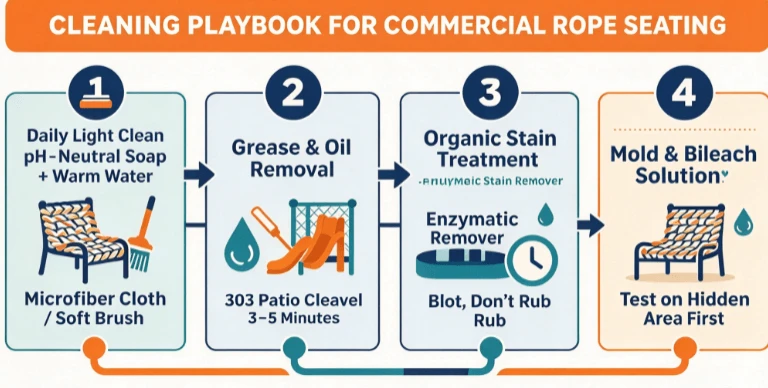
| Material Type | Core Tensile Strength | UV Resistance & Color Retention | Hydrophobic & Drying Speed | Abrasion Resistance | Ideal Commercial Application |
| Solution-Dyed Acrylic Rope | High (Polyester Core) | Premium (2,000+ Hours) | Fast (30–45 Mins) | Superior (Martindale >30k) | High-end luxury resorts & sun decks |
| Polyolefin Rope | High (Pre-tensioned) | Very High (1,500+ Hours) | Ultra-Fast (15–30 Mins) | Excellent | High-turnover dining patios & cafes |
| Polyester Rope | Very High | Moderate (Needs UV Coating) | Moderate (Dries in 45 Mins) | Good | Covered terraces & shaded lounges |
| Polypropylene Strap | Superior Elastic Recovery | High (1,800+ Hours) | Near Instant (< 15 Mins) | Excellent | Heavy-duty bistro & poolside dining |
| Thermoplastic Polyurethane | Unbreakable Banding | High | Instant Wipe-Clean | Maximum Tear Strength | High-spill fast-casual dining venues |
The Ultimate Cleaning Playbook for Restaurant Patio Seating Wholesale Buyers 🧼
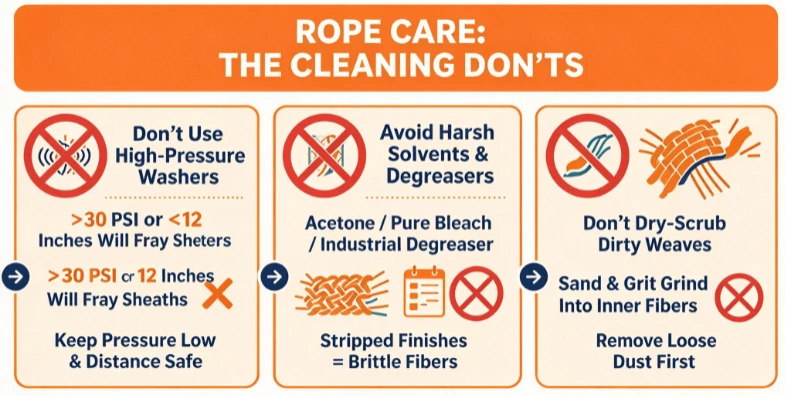
Maintaining pristine outdoor seating in a busy dining establishment requires a standardized cleaning protocol using approved chemical solutions.
For routine daily cleaning, staff should mix 1 tablespoon of mild pH-neutral dish soap into 1 gallon of warm water (under 100°F). Softly scrub the weave using a microfiber towel or a soft-bristle nylon brush to lift dust and food crumbs.
When tackling stubborn grease, salad oil, or mustard, apply specialized sprays such as 303 Patio Furniture Cleaner directly onto the weave. Allow the formula to dwell for 3 to 5 minutes so surfactants can loosen organic fats before gently scrubbing along the direction of the weave.
For organic food stains or fruit juice residue on light-colored synthetic ropes, apply an enzymatic stain remover to digest organic matter without damaging fiber integrity.
If mold or mildew develops due to prolonged dampness, prepare a diluted chlorine bleach solution containing 1/4 cup of bleach and 1 tablespoon of soap per gallon of water. Test this mixture on a hidden underside section before applying it to solution-dyed synthetic fabrics.
Emergency Stain Treatment & Chemical Guide Matrix 🧪
| Stain Type | Recommended Cleaner / Agent | Brush & Tool Spec | Dwell Time | Critical Precautions |
| Red Wine & Berry Juice | Enzymatic stain remover or mild soap | Soft horsehair or nylon brush | 3 to 5 Minutes | Blot with cloth first; do not rub dry spill into fibers |
| Salad Oil, Butter & Grease | 303 Patio Cleaner or dish soap | Microfiber cloth / soft brush | 5 Minutes | Use lukewarm water to dissolve fats; rinse thoroughly |
| Coffee & Dark Cola | Mild pH-neutral dish soap | Soft nylon brush | 2 to 3 Minutes | Flush out weave intersections with low-pressure water |
| Mold & Mildew Spots | Diluted chlorine bleach solution | Soft bristle brush | 5 Minutes | Use ONLY on solution-dyed acrylic/olefin; never on polyester |

Essential Washing Precautions (The "Don'ts" of Rope Care) ⚠️
Never use high-pressure power washers: Water pressure exceeding 30 PSI or nozzle distance closer than 12 inches will fray outer rope sheaths and destroy water-repellent coatings.
Avoid harsh solvents & degreasers: Acetone, pure bleach, and industrial floor degreasers strip protective finishes, turn polymers brittle, and yellow aluminum frames.
Do not dry-scrub dirty weaves: Friction from dry brushing pushes sand and micro-grit into inner fibers, accelerating physical abrasion and cause pilling.
Optimizing Spatial Layout with an Outdoor Dining Table Chair Set 📐
The spatial arrangement of outdoor furniture directly influences server workflow, safety compliance, and dining comfort.
Arranging a complete outdoor dining table chair set requires maintaining proper clearance between seating rows. Leaving adequate room behind chair backs prevents server bottlenecks and creates a relaxed dining environment.
When selecting a standalone dining chair outdoor unit, choosing a lightweight, stackable frame allows venue staff to clear patio spaces rapidly for evening events or seasonal storage.
Selecting High-Performance Dining Chair Outdoor Models with Verified Lab Certificates 🛡️
When sourcing from restaurant patio seating wholesale manufacturers, buyers must request third-party lab documentation to confirm safety and endurance.
Frames must be built from a heavy-gauge powder-coated aluminum frame that resists structural bending and surface chipping under daily customer use.
All frame assembly hardware must utilize stainless steel hardware to prevent unsightly rust stains from bleeding onto patio pavers.
Synthetic rope and strap fabrics require a factory-applied hydrophobic coating to shed water and an oleophobic finish to prevent oil absorption.
Materials should be certified for high colorfastness to light, ensuring the fabric maintains rich color vibrancy despite thousands of hours of sun exposure.
Technical Certifications & Laboratory Testing Benchmarks 📋
| Certification Standard | Testing Agency / Standard Scope | Commercial Acceptance Threshold | Hospitality Operator Benefit |
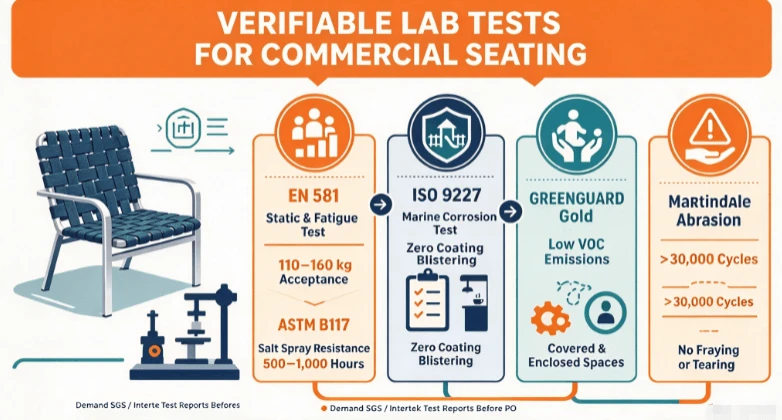
| EN 581 | European Structural Safety | Pass 110 kg–160 kg static & fatigue test | Prevents frame failure under heavy commercial loads |
| ASTM B117 | Accelerated Salt Spray Resistance | 500 to 1,000 continuous hours | Guarantees rust-free performance in coastal air |
| ISO 9227 | Marine Corrosion Testing | Zero coating blistering or flaking | Protects frame finishes in seaside restaurant setups |
| GREENGUARD Gold | Volatile Chemical Emission Test | Strict low-emission indoor air threshold | Safe for enclosed dining spaces and covered patios |
Independent testing organizations like SGS and Intertek perform rigorous drop and impact tests on contract seating to verify structural integrity under extreme usage.
Fabrics are also subjected to the Martindale abrasion test, where commercial-grade ropes must endure over 30,000 friction cycles without fraying or tearing.
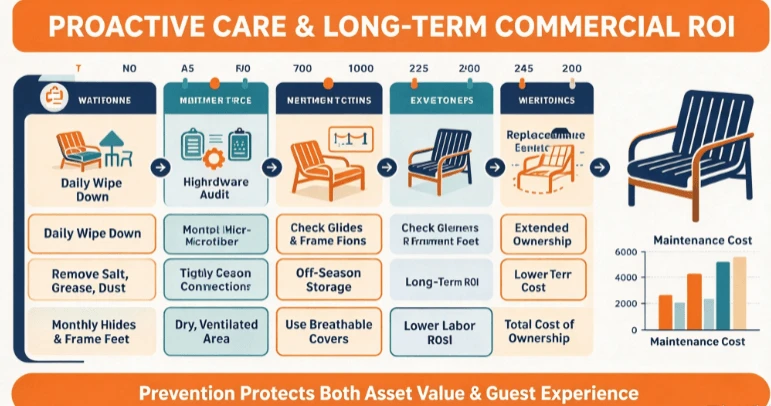
Proactive Preventive Care and Long-Term Commercial ROI 💰
Establishing a routine preservation strategy protects capital investments and reduces lifecycle replacement costs.
Daily, Monthly & Seasonal Care Checklist:
Daily Wipe Down: At the end of evening service, wipe down frames and straps with a damp microfiber cloth to remove salt, grease, and dust.
Monthly Hardware Audit: Inspect frame feet glides and tighten frame hardware connections to prevent leg wobble and premature frame wear.
Off-Season Storage: During winter, store seating in a dry, ventilated area. If storing outside, use breathable fabric covers rather than airtight plastic tarps, which trap condensation and foster mold.
Investing in high-grade synthetic seating delivers long-term financial returns by cutting maintenance labor and extending product replacement cycles.
Industry Frequently Asked Questions ❓
Q1: What exact cleaning solution ratio should staff use for daily dining spills?
Staff should mix 1 tablespoon of mild pH-neutral dish soap into 1 gallon of lukewarm water. For oily food residue, spraying 303 Patio Furniture Cleaner directly on the weave and letting it sit for 3 minutes before scrubbing effectively dissolves fats without damaging fibers.
Q2: Can high-pressure power washers be used to clean dirty rope chairs quickly?
No. Power washers generating high pressure destroy synthetic rope sheaths, fray fibers, and strip protective frame coatings. Cleaning should always be done using low-pressure garden hoses (< 30 PSI) paired with soft-bristle nylon brushes.
Q3: How do solution-dyed acrylic ropes compare to polyolefin ropes in commercial dining setups?
Solution-dyed acrylic offers superior colorfastness and a soft, cotton-like feel, making it ideal for luxury resort dining. Polyolefin rope provides faster drying times, superior oil repulsion, and high abrasion resistance at a more budget-friendly price point for busy bistros.
Q4: Is bleach safe to use on all woven rope and strap outdoor furniture?
Bleach is only safe on solution-dyed acrylic and solution-dyed polyolefin fibers. Never use bleach on polyester rope, non-solution-dyed yarns, or dark straps, as bleach breaks down polyester molecular bonds and causes severe discoloration.
Q5: How do hydrophobic and oleophobic treatments improve patio table turnover after rain?
Hydrophobic coatings cause water droplets to bead up and roll off the surface rather than soaking into the core foam or yarn interior. Staff can wipe down the seating in minutes, allowing restaurants to seat waiting guests quickly after rain showers pass.
Q6: What structural safety certificates should procurement managers request before ordering?
Procurement managers should require test reports verifying EN 581 compliance for structural safety, ASTM B117 or ISO 9227 for salt spray corrosion resistance, and Martindale abrasion results exceeding 30,000 rubs from accredited labs like SGS or Intertek.