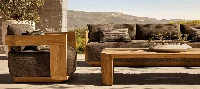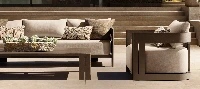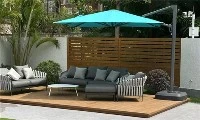

High-humidity tropical environments present severe technical degradation risks to exterior wooden installations. Continuous exposure to saturated atmospheric air, intense solar radiation, and sudden torrential downpours induces extreme hygrothermal stress on outdoor joinery. Commercial buyers and resort developers must implement precise material engineering protocols to prevent teak wood from silvering, splitting, or warping over long operational lifespans.
Selecting structural pieces manufactured with high-grade, dense timber serves as a primary defense against rapid weathering in seaside developments. Investing in commercial teak furniture engineered specifically for harsh outdoor environments protects capital investments across beachfront resorts, rooftop lounges, and hospitality venues.
Understanding the biochemical and structural mechanisms behind timber decay allows property operations teams to implement targeted maintenance schedules.

🌡️ Environmental Degradation Mechanics on Commercial Teak Furniture
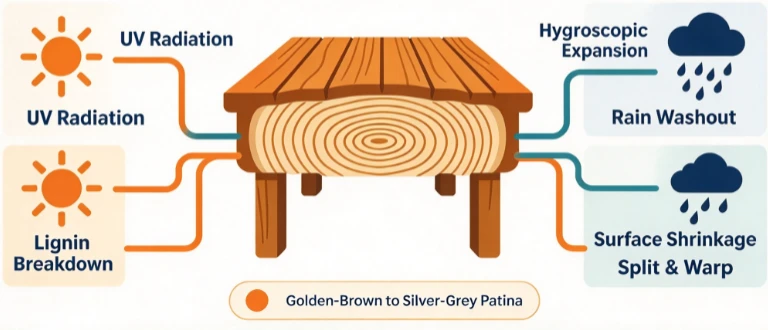
Cellular breakdown in exterior timber is primarily driven by photo-oxidation and localized moisture gradients. Solar ultraviolet radiation breaks down lignin, the complex organic polymer that binds cellulose fibers together within the wood matrix. As surface lignin degrades, rainstorms wash away soluble byproducts, leaving unbonded cellulose fibers exposed at the surface. These exposed fibers scatter ambient light, causing the wood to gradually transition from its natural golden-brown hue to a silver-grey patina.
Sourcing long-lasting inventory from an experienced teak furniture manufacturer ensures that timber undergoes specialized conditioning prior to frame fabrication.
Atmospheric humidity fluctuations induce continuous volumetric changes within timber structures. Saturated tropical air causes hygroscopic moisture expansion, forcing cellular cavities to swell as water molecules fill the capillary network. When intense sunlight follows heavy rain, rapid surface evaporation causes outer wood layers to shrink while the dense interior core remains saturated. This severe moisture differential generates internal tension along the wood grain, eventually evolving into structural splits and dimensional warping across table surfaces.
🌳 Timber Grading Matrix for Resort Outdoor Furniture Supplier Specifications
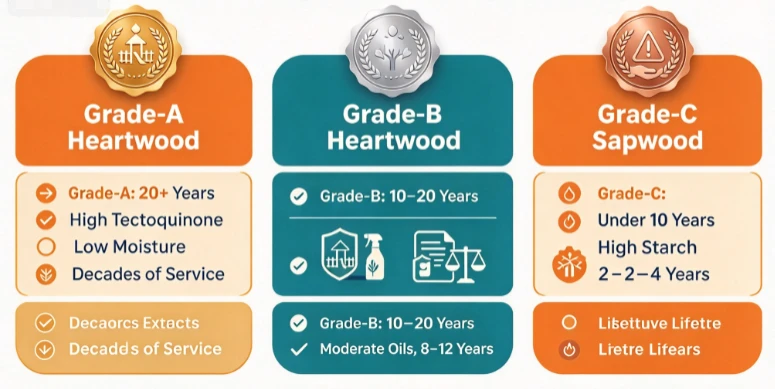
Selecting high-grade timber represents the most critical decision in mitigating environmental weathering. Authentic Grade-A heartwood harvested from mature trees aged twenty years or older exhibits tight, uniform growth rings and exceptional structural density. The inner core of mature timber contains concentrated deposits of natural extractives, including tectoquinone, a naturally occurring compound that acts as a potent biological defense against fungal rot and wood-boring insects.
Procuring collections through a reliable resort outdoor furniture supplier guarantees that raw materials meet strict international forestry compliance standards.
In contrast, immature sapwood taken from the outer rings of younger trees lacks dense extractive concentrations and contains higher starch levels that attract destructive organisms. Sapwood exhibits loose grain structures with elevated moisture absorption rates, making lower timber grades highly susceptible to severe distortion when installed in tropical microclimates.
Physical and Chemical Property Matrix Across Teak Quality Grades
| Quality Classification | Source Tree Age | Chemical Extractive Profile | Moisture Absorption Susceptibility | Structural Lifespan in Tropical Climates |
| 🥇 Grade-A Heartwood |
20+ Years
|
High tectoquinone & organic oils
|
Low (Tightly packed vascular cell walls) |
Decades of continuous outdoor service
|
| 🥈 Grade-B Heartwood | 10–20 Years | Moderate oil concentration | Moderate (Requires periodic protective sealers) | 8–12 Years before severe surface checks |
| 🥉 Grade-C Sapwood | Under 10 Years | Low oil & high starch content | High (Rapid swelling and shrinkage) |
2–4 Years (Prone to rot and warping)
|
⚙️ Kiln Drying Protocols in Commercial Restaurant Outdoor Furniture
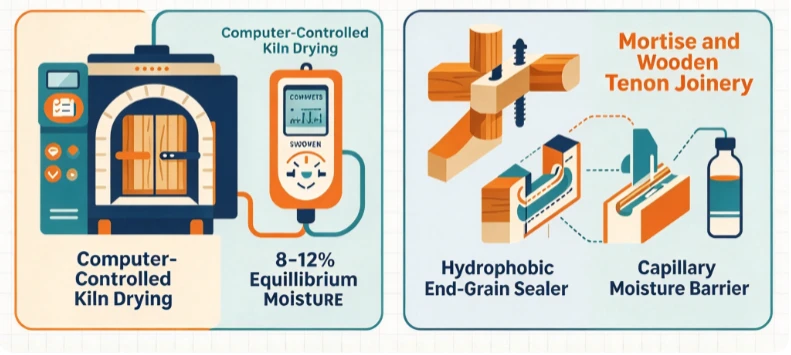
Preventing structural deformation in humid environments requires precise thermal and moisture conditioning during manufacturing. Raw timber must undergo computer-controlled kiln-drying cycles to reduce internal moisture down to an optimal equilibrium moisture content between 8% and 12%. This conditioning process stabilizes cellular fluid levels before timber enters machining operations, minimizing dimensional movement post-installation.
Outfitting high-volume dining spaces with durable commercial restaurant outdoor furniture prevents premature structural instability while maintaining visual elegance under constant humidity cycles.
Structural framing in commercial outdoor collections relies on deep mortise and tenon joinery secured with interlocking wooden dowels. This mechanical interlocking system distributes mechanical loads evenly across frame members while accommodating minor natural swelling without cracking surrounding timber. Applying a hydrophobic end-grain sealer to all cut end-grains creates a barrier against capillary moisture draw, preventing water from penetrating deep into joint cavities during tropical downpours.
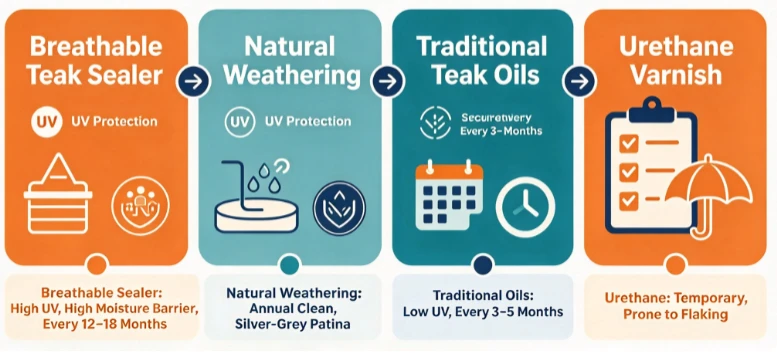
To maintain original wood coloration, maintenance teams should apply specialized breathable sealers formulated with titanium dioxide UV inhibitors. These compounds reflect solar radiation while maintaining open micro-pores, allowing residual vapor to escape without causing surface film blistering. Periodic maintenance should include washing surfaces with mild soapy water and a soft-bristle brush, followed by light spot touch-ups using a fine sanded finish technique to smooth out raised fibers.
Surface Finish Treatment Performance Comparison
| Treatment Category | UV Oxidation Resistance | Moisture Penetration Barrier | Maintenance Labor Frequency | Visual Aging Effect |
| 🛡️ Breathable Teak Sealer | High (Reflects solar UV rays) | High (Hydrophobic barrier) | Every 12–18 Months |
Preserves original golden-brown hue
|
| 🌿 Natural Weathering Routine |
None (Allows natural silvering)
|
Moderate (Relies on natural oils)
|
Annual surface cleaning only
|
Develops uniform silver-grey patina
|
| 🛢️ Traditional Teak Oils | Low (Breaks down under sunlight) | Moderate | Every 3–5 Months | Creates dark amber tones |
| 🧪 Urethane Varnish Coatings | Temporary (Prone to flaking) | High (Until film cracks) | High (Requires total sanding upon failure) | High gloss (Prone to peeling under heat) |
📊 Financial ROI, Lifecycle Labor, and Maintenance Analysis
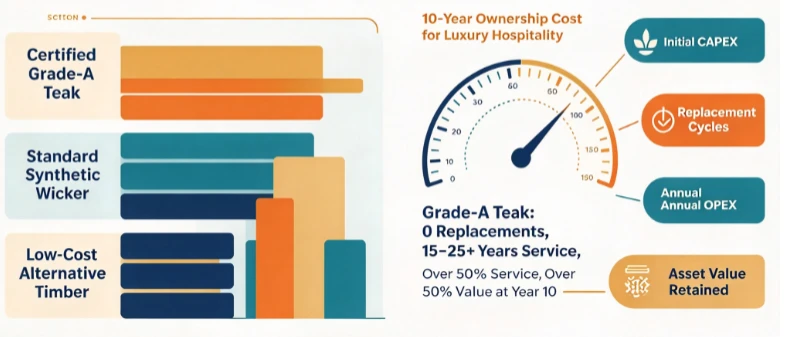
Commercial procurement decisions require balancing upfront Capital Expenditure (CAPEX) against recurring Operational Expenditure (OPEX). While Grade-A heartwood furniture carries a higher initial CAPEX, its inherent resistance to rot and moisture deformation eliminates frequent replacement costs, delivering a favorable long-term Return on Investment.
Low-cost timber alternatives or synthetic wicker seating often suffer from accelerated UV degradation and frame cracking, leading to elevated labor costs and early disposal. Investing in high-grade timber structures lowers net operational expenses over a ten-year hospitality asset lifecycle.
10-Year Ownership Cost Analysis for Luxury Hospitality Assets
| Financial & Operational Metric | Certified Grade-A Teak Furniture | Standard Commercial Synthetic Wicker | Low-Cost Alternative Timber |
| 💰 Initial Purchase CAPEX | Premium baseline investment | 30% lower initial outlay | 50% lower initial outlay |
| ⏱️ Expected Service Lifespan |
15–25+ Years
|
4–6 Years (UV degradation) |
2–4 Years (Splitting/rot)
|
| 🔄 10-Year Replacement Count | 0 Replacements | 1–2 Full replacement cycles | 2–3 Full replacement cycles |
| 🛠️ Annual Operating OPEX |
Minimal (Routine washing)
|
Low (Surface cleaning) | High (Frequent repairs/re-oiling) |
| 📈 Net Operational Cost Trend | Lowest long-term operational cost | Moderate cumulative cost | Highest long-term operational cost |
| 🏷️ Asset Value Retained at Year 10 | Over 50% functional asset value | 0% (Scrapped upon brittle failure) | 0% (Scrapped upon rot/splitting) |
🛡️ International Standards, Testing, and Compliance Frameworks
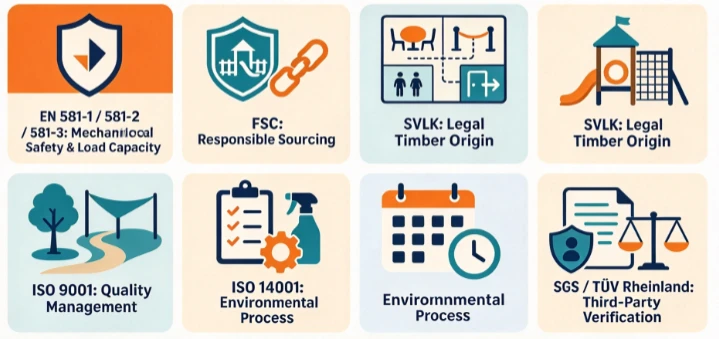
Structural safety compliance for public commercial outdoor seating is validated under rigorous mechanical testing criteria specified by European standards. General safety requirements are governed by EN 581-1 guidelines, while static load capacities and dynamic mechanical strength reaching 110 kg are verified under EN 581-2 testing protocols. Outdoor dining tables are evaluated for structural stability and weight distribution under EN 581-3 requirements.
Sustainable forestry management and responsible timber sourcing are independently verified through FSC certification. Legal timber origin and supply chain transparency are enforced through national SVLK chain-of-custody compliance systems.
Manufacturing facilities adhering to ISO 9001 quality management systems and ISO 14001 environmental management frameworks deliver consistent engineering tolerances. Independent laboratory audits conducted by third-party testing organizations such as SGS and TÜV Rheinland provide objective verification of product durability and safety compliance.
Global Certification & Compliance Framework
| Certification / Testing Standard | Accredited Testing Agency | Scope of Technical Evaluation | Commercial Venue Relevance |
| 📜 EN 581-1 / EN 581-2 / EN 581-3 |
European Committee for Standardization / Independent Labs
|
Mechanical safety, static load capacity (110kg), seating and table stability
|
Mandatory safety benchmark for public commercial contract furniture
|
| 🌲 FSC Certification |
Forest Stewardship Council
|
Chain-of-custody tracking for responsibly managed timber plantations
|
Required for eco-compliant commercial procurement
|
| 🇮🇩 SVLK Certification |
Indonesian Legal Wood Compliance
|
National timber legality verification and export authorization
|
Guarantees legally sourced Grade-A timber origin
|
| 🏭 ISO 9001 / ISO 14001 | International Organization for Standardization | Quality control systems and environmental manufacturing processes | Ensures uniform engineering tolerances across large orders |
| 🔬 SGS / TÜV Rheinland Audits |
Independent Third-Party Inspection Bodies
|
Material composition verification, salt spray testing, structural fatigue |
Objective validation of commercial durability claims
|
❓ Frequently Asked Questions
Does silvering reduce the structural integrity of outdoor furniture?
Silvering is a superficial surface reaction caused by UV photo-oxidation of top-layer organic polymers. It affects only the outermost surface fibers and does not reduce the internal density, load-bearing capacity, or structural strength of mature timber.
How do SVLK and FSC certifications protect commercial buyers?
These certifications verify that timber is legally harvested from responsibly managed forests. They ensure supply chain traceability, compliance with international trade laws, and protection against inferior timber grades that warp under severe weather exposure.
Why is equilibrium moisture content critical during manufacturing?
Conditioning timber to an equilibrium moisture content between 8% and 12% via kiln-drying stabilizes internal moisture levels before processing. This prevents major volumetric expansion or shrinkage when furniture is deployed in hot, humid tropical climates.
What mechanical tests are required under EN 581 standards for contract furniture?
Testing involves static load evaluations, impact resistance, structural fatigue checks, and seating stability tests. Compliance ensures furniture withstands continuous public use up to designated weight thresholds without structural failure.
How does an end-grain sealer prevent localized timber splitting?
End-grain surfaces contain open vascular tubes that draw moisture rapidly through capillary action. Applying a specialized sealer creates an impermeable barrier across exposed cut ends, blocking water absorption during heavy rain and preventing severe differential drying stress.
Why does Grade-A teak deliver higher ROI than synthetic alternatives in coastal resorts?
Grade-A heartwood contains dense natural oils and protective compounds that resist moisture decay and insect damage for decades. Synthetic materials often become brittle and crack under continuous UV radiation, requiring full replacement every few years and resulting in higher cumulative operational costs over time.