
You have seen it happen. A server carries a 400°F sauté pan off the pass, sets it on a patio table without a trivet, and walks away. Ten minutes later the surface has a mark that will not wipe off. That single moment is the whole reason this guide exists.
This is written for cafe owners, hotel procurement leads, architects, and operations managers who are specifying tops for weather resistant outdoor furniture that has to survive service, not just look good in a catalog shot. A residential patio set gets replaced when it fades. A commercial tabletop gets replaced when it fails mid-service. Those are two different purchases.
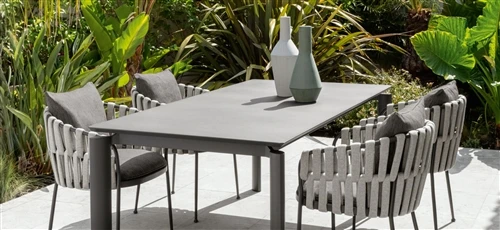
People search this problem in scattered language. Patio table material. Heat resistant outdoor tables. What table surface won't scratch? Cafe tables that take hot plates. Those phrases describe a feeling. They do not describe a failure mode. The failure modes are concrete: a hot pan on a cold slab, a chair dragged out forty times a shift, a summer of UV, salt air at the coast, a chip that becomes a tripping hazard.
That is why commercial outdoor furniture is a different spec from a backyard set. Nobody at home calls a repairman on a Saturday night because the patio table warped. Every operation manager does.
Read this scope box before you compare surfaces
This guide covers the surface you eat on-the slab or skin-not the frame. A powder-coated aluminum base will not rescue a top that warps under a hot cup.
"Heat resistant" is not one test. It can mean direct pan contact, radiant oven heat, or a surface left in 95°F sun. Those are different claims, and a supplier who uses one word for all three is selling, not specifying.
A residential weather test does not make a top food-contact safe. For food service, ask whether the material holds a recognized food-contact claim.
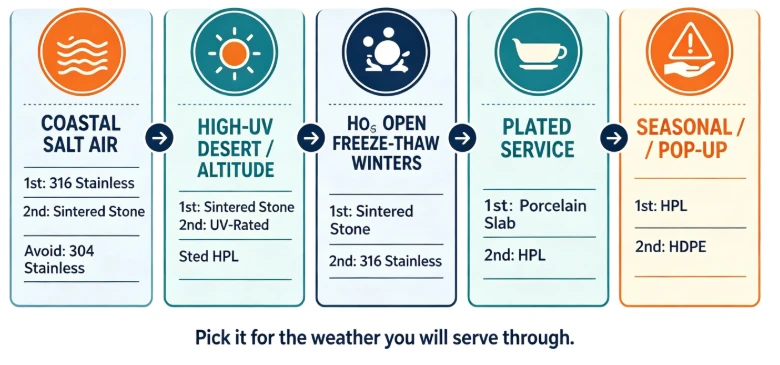
Every climate is a different exam. Coastal salt, desert UV, freeze-thaw winters, and humid lanais reward and punish the same material differently. Do not pick a top for the weather you like. Pick it for the weather you will serve through.
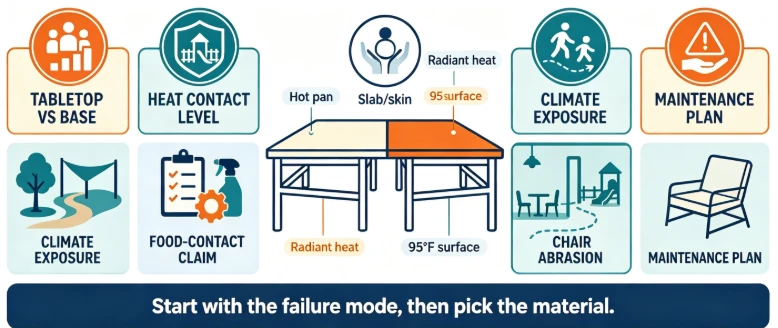
Start with the failure mode, not the material
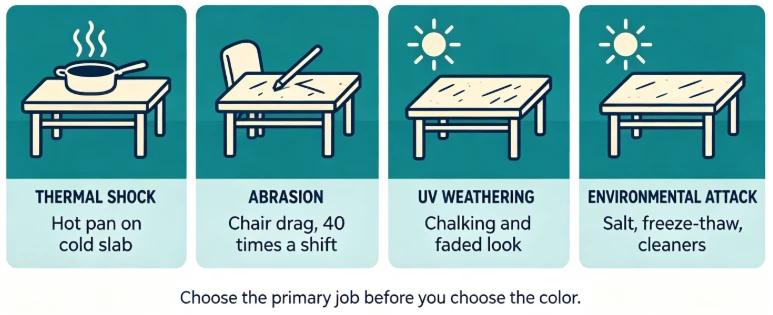
A top has one of four jobs in a patio. It either survives a hot plate without marking, resists the scrape of a chair pulled out all day, holds its look after three summers, or takes a food-service cleaning chemical. Pick the primary job before you pick a color.
The surface matrix
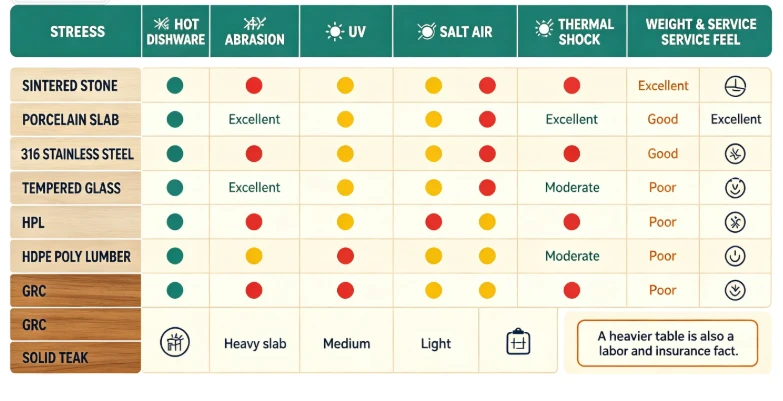
This is the comparison framework, not a verdict. One venue's worst top is another's budget pick. The icons mark stress direction: 🔥 direct heat, ⚙️ abrasion, ☀️ UV, 🌊 salt air, ❄️ thermal cycling.
|
Surface |
🔥 Hot dishware |
⚙️ Scratch / chair abrasion |
☀️ UV weathering |
🌊 Salt air |
❄️ Thermal shock |
Weight & service feel |
|
Sintered stone |
Excellent-direct pan |
Excellent (Mohs 7+) |
Excellent |
Excellent |
Excellent |
Heavy, slab |
|
Porcelain slab |
Good-use a trivet |
Good to moderate |
Excellent |
Excellent |
Good |
Heavy, slab |
|
316 stainless steel |
Excellent-direct pan |
Moderate-brushes out |
Excellent |
Excellent (marine-grade) |
Excellent |
Medium |
|
Tempered glass |
Moderate-can fail |
Excellent (hard) |
Good |
Good |
Moderate |
Light |
|
High-pressure laminate |
Poor-edge heat only |
Moderate |
Good to moderate |
Good |
Poor at the edge |
Light |
|
Glass-fiber reinforced concrete |
Moderate |
Moderate-pits over time |
Good |
Good |
Poor in freeze-thaw |
Very heavy |
|
HDPE poly lumber |
Poor-can warp/melt |
Good |
Good (chalks over years) |
Good |
Poor |
Light |
|
Solid teak |
Poor-marks |
Moderate |
Excellent |
Excellent |
Poor |
Medium, needs oil |
Read the last column carefully. A slab that weighs 80 pounds is also a table a busboy cannot move alone at closing. That is a labor and insurance fact, not a materials opinion.
Sintered stone: the commercial cafe default
Sintered stone is fired at temperatures high enough that it behaves like geology, not a manufactured panel. A pan set directly on it will not mark. A knife dragged across it will not gouge it. A bleach spray will not dull it. This is the material that answers the title question most directly.
The cost is weight and seam integrity. A large slab needs a steel under-frame, and a poorly supported panel flexes and cracks along the seam-not across the field. For cafe outdoor tables and chairs commercial grade, this is the top that stops being a recurring complaint ticket.
It is also unforgiving the other way. A dropped wine glass shatters on it. A chair slammed into an edge chips a corner that cannot be sanded out. It has to be swapped. That is a maintenance plan, not a defect.
💡 Pro tip: Ask the supplier for the seam width and under-frame gauge. Most sintered-stone failures are support failures, not material failures.
Porcelain slab: the plated-service step-down
Porcelain slab looks similar and sits in the same price neighborhood, but it is a thinner body. It takes heat well, it holds up to UV beautifully, and it is lighter to install.
Its weak spot is the edge. A sharp knock starts a crack that travels across the field, and direct pan contact is riskier than it is on sintered stone. A trivet matters.
For a hotel that serves plated dishes and coffee rather than pans, porcelain is a rational step down in cost without stepping down in weather resistance. For an open-flame table or a pizza patio, it is the wrong compromise.
316 stainless for hotel outdoor bar furniture sets
This is where hotel outdoor bar furniture sets often end up, and the reason is simple. Marine-grade construction shrugs off salt spray, takes a hot shaker tin directly, and a scuff brushes out with a non-woven pad instead of becoming a permanent scar.
The material behind that rating is 316 stainless steel. It is not perfect. It conducts heat-an iced glass sweats on it, and a sun-left tabletop runs warm on a July afternoon. It fingerprints. Your cleaner will polish it every night. Budget that labor. A 304 saves money inland but is the wrong call within a mile of the ocean; the difference between 304 and 316 is not a label, it is a few seasons of rust at the weld.
Tempered glass: the rooftop gamble
Tempered glass tops look clean, never show a hot ring, and weigh almost nothing. They are the right call for a rooftop lounge serving plated desserts and cocktails.
⚠️ The honest warning: thermal shock. A panel sitting in 95°F sun, hit by a stream of chilled soda from an ice bucket, can fail. Rarely. But once in a service season is once too often. Edge chips are the precursor. Inspect edges weekly, and keep replacement panels in the storeroom for the first summer.
Budget skins: HPL, HDPE, and concrete
High-pressure laminate is the workhorse of the seasonal patio. Light, wipes clean, costs a fraction of a slab. It will not survive a direct pan-heat delaminates the edge first, long before the field shows trouble-and UV cycles dull it in a few seasons. Treat it as a replaceable skin.
HDPE poly lumber routes the same logic toward poolside. It never rots, never needs oil, will not splinter. But a hot cup left unattended leaves a permanent ring, and in strong sun the top can bow. It is a consumable.
Glass-fiber reinforced concrete reads as luxury. It is porous at the surface, it pits under repeated abrasion, and in climates that freeze and thaw, water absorbed into the skin eventually pops a flake. Seal it yearly or do not specify it north of the frost line.
What the weather actually does
A surface does not fail in a single dramatic moment. It fails because an environment attacks it along a slow axis, and the hot pan is just the final straw.
UV: the slow fade
Sunlight breaks down the polymer in any resin-bound surface. The result is chalking-that dusty, faded film you wipe off a plastic chair in year two. It accelerates at altitude and in humidity, and it shows up on the north and south sides of the same table at different rates.
Freeze-thaw: the silent pop
Water gets into a porous edge at night, freezes, expands, and by spring the surface is flaking. That is the unsealed concrete and GRC failure. It is invisible until it is not.
Salt air: the weld enemy
Salt air attacks welds and fasteners, not the top itself. A 304 frame at the beach will bleed rust at the joint while the surface still looks fine. This is why the frame spec and the top spec are one conversation.
Thermal shock: what the question actually means
It is not just the pan. It is a cold slab hit by a hot dish. It is a sun-heated panel hit by a bucket of ice water. It is a winter morning where the surface froze overnight and a server pours hot coffee next to it. Materials with a uniform microstructure absorb this. Layered or porous materials do not.
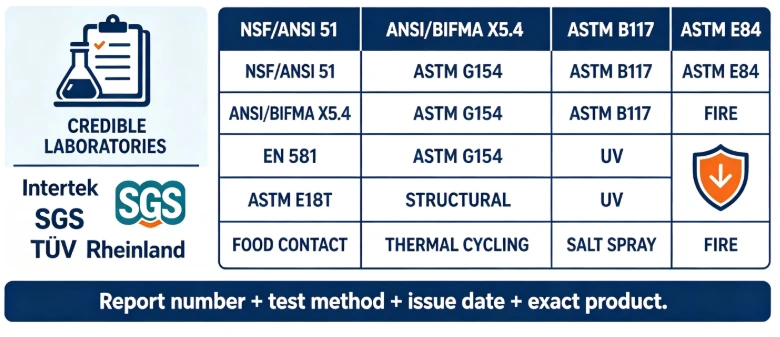
🔑 Evidence request: Ask the supplier for the actual weathering report, not a marketing line. The credible independent labs to look for on the report header are:
The relevant test methods cover UV cycling, salt spray, and thermal shock. A deck that says "weather resistant" without a report number is a wish.
The climate-to-material selector
Use this the way a chef uses a prep list-not as a menu, but as a starting point your own operations can override.
|
Your site stress |
First choice |
Second choice |
Do not specify |
|
🌊 Coastal salt air (within 1 mile) |
316 stainless |
Sintered stone |
304 stainless, plain aluminum |
|
☀️ High-UV desert or altitude |
Sintered stone |
UV-rated HPL |
Untreated HDPE long-term |
|
❄️ Freeze-thaw winters |
Sintered stone |
316 stainless |
GRC, unglazed concrete |
|
🔥 Open kitchen, pizza, hot pans |
Sintered stone |
316 stainless |
Tempered glass, HPL |
|
🍽️ Plated service, no direct heat |
Porcelain slab |
HPL |
Solid teak (too much maintenance) |
|
💰 Seasonal or pop-up |
HPL |
HDPE |
Sintered stone (over-built) |
The investor view
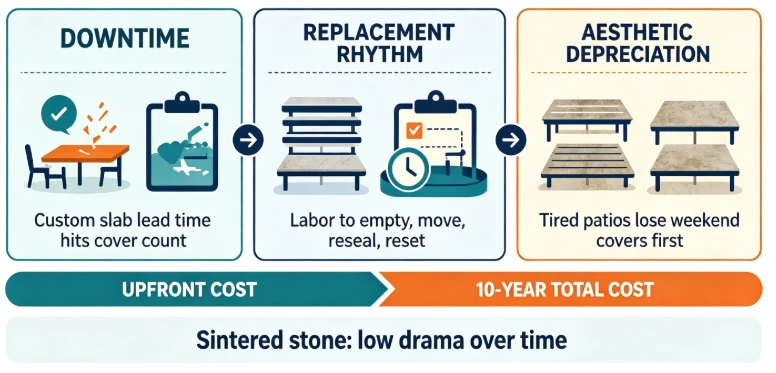
Here is the conversation most RFQs skip. A tabletop is not a décor line item. It is a small piece of revenue infrastructure, and its true cost shows up in three places that never appear on the purchase order.
Downtime is the hidden line
A chipped top at a full-service patio is not a fifteen-minute repair. It is a table out of service for the lead time of a custom slab, while the cover count drops. The lead time is the number that hurts.
The replacement rhythm
A cheap laminate top that lasts a few seasons is not really cheaper than a premium slab. It is a recurring expense, and every recurrence carries the labor to empty, move, reseal, and re-set the table. The reset cost is the part nobody puts in the spreadsheet.
Aesthetic depreciation
A top that chalks, yellows, or rust-pits in year two makes the whole patio read as tired. Tired patios lose the weekend cover before they lose the weekday one. This is the hardest number to quantify, which is exactly why it gets ignored.
|
Surface |
Upfront cost |
Service life feel |
Failure downtime |
Repair path |
Best owner profile |
|
Sintered stone |
High |
Long, low drama |
Low |
Swap slab only |
Full-service, year-round patio |
|
316 stainless |
High |
Long, nightly polish |
Low |
Brush out scuffs |
Coastal bars, beach hotels |
|
Porcelain slab |
Medium-high |
Good look, edge risk |
Medium |
Replace slab |
Plated-service hotel terraces |
|
Tempered glass |
Medium |
Clean, light |
Medium (shatter) |
Replace panel |
Rooftop lounges, light use |
|
HPL |
Low-medium |
Replaceable skin |
Medium |
Replace sheet |
Seasonal cafe, pop-up |
|
HDPE |
Low |
Poolside casual |
Medium |
Replace segment |
Pool, beach club, resort |
|
GRC |
Medium-high |
Luxury read |
High (seal schedule) |
Reseal, not refinish |
Warm-climate, covered terraces |
The question is not "which is the best top." It is "which top stops costing me money in three years." For a cafe open twelve months a year, the premium slab usually wins quietly. For a summer-only operation, the budget skin wins loudly.
Certifications and evidence to ask for
A supplier who cannot name a test is not a supplier. They are a reseller with a catalog. The documents that matter for food-service patios are narrow.
NSF/ANSI 51 is the food-contact materials standard. If servers set food directly on the top and you clean it with restaurant chemicals, this is the claim to ask for. It is the line between a patio top and a prep surface.
ANSI/BIFMA X5.4 covers outdoor patio furniture strength and durability. It is a structural test, not a beauty one.
EN 581 is the European outdoor seating and tables safety standard. Worth requesting even on a U.S. project, because European lab methods are often more explicit about thermal cycling.
ASTM G154 covers UV accelerated weathering; ASTM B117 covers salt spray. Ask for the cycle count and the before-and-after photos, not just a pass mark.
For fire marshal questions, ASTM E84 is the surface burning reference. For soft goods on the same patio, CAL TB117 and NFPA 701 are the usual expectations.
Ask for the report identifier, the lab, the issue date, and the exact product it covers. A "certified" stamp that cannot be traced to a serial number is not evidence.
The RFQ brief
A useful brief is specific enough to check and modest enough not to invent compliance. Send the supplier:
venue type, primary climate, and coastal distance if any;
service model-pans direct to the table, plated service, or poolside casual;
expected open months and peak cover count;
the cleaning chemistry you actually use (bleach, quat, vinegar, steam);
the standard claims you require and the lab reports to prove them;
who owns the slab if it chips in year three, and what the replacement lead time is;
the seam and under-frame detail.
If a quote answers every question except the last two, you do not have a price. You have a catalog.
FAQ:
Which outdoor tabletop can take a hot pan directly?
Sintered stone and 316 stainless steel. Porcelain needs a trivet. HPL, HDPE, and solid wood should not take direct pan contact at all.
Is porcelain or sintered stone better for commercial outdoor use?
For hot pans and heavy abrasion, sintered stone. For plated-service patios that want a lighter panel at a lower cost, porcelain is reasonable. Watch the edge, not the field.
Why does a stainless steel table top scuff so quickly in a cafe?
It does not really scratch-it scuffs. Chair feet, cutlery, and bus bins leave marks that brush out with a non-woven pad. 316 resists coastal corrosion far better than 304, which will rust at the welds near salt air.
Can tempered glass tops survive outdoor temperature swings?
Usually, but it is the surface most likely to fail under a sudden hot-to-cold swing. Inspect edges weekly and keep spare panels on site the first season.
What certifications should I ask for on commercial patio tabletops?
Start with NSF/ANSI 51 if food contacts the surface. Add ANSI/BIFMA X5.4 for structure and EN 581 or ASTM G154/B117 reports for weathering. Ask for the report number and lab, not the word "certified."
Does a more expensive tabletop actually pay back?
It depends on how many months you are open. A year-round full-service patio usually recovers a premium slab through fewer replacements and less downtime. A seasonal pop-up will not, and a budget skin is the honest choice.
The practical conclusion
Start with the failure mode-hot pan, chair abrasion, UV, salt, freeze-thaw-and only then name a material. The most expensive mistake is not choosing the wrong color. It is specifying a top that reads as luxury in the catalog and then becomes a recurring repair ticket at brunch.
For most year-round food-service patios, sintered stone is the safest default. For coastal bars, 316 stainless. For light rooftop service, tempered glass. For seasonal venues, a budget HPL is the honest call. Run the RFQ with the weathering reports in hand, and refuse the quote that cannot show you a serial-numbered lab result. That is the difference between an Internet search phrase and a table that still looks right in year three.