

A certified resort pergola wind load capacity must reach a minimum threshold of 131 to 156 mph (209 to 251 km/h) to withstand the destructive forces of a Category 4 hurricane. When coastal hospitality properties face extreme weather, standard recreational shade structures fail instantly. Surviving these coastal zones requires more than heavy perimeter posts; it demands an engineered aluminum louvered pergola system where the internal drive mechanism, louvers, and structural fasteners act as a unified, load-bearing aerodynamic shield.
Go above a 130 mph engineering threshold, and three critical engineering metrics shift: the structural alloy requirement transitions to high-yield marine grades, the static uplift calculations triple, and the internal transmission linkage must endure immense tensile stress without shearing. If you are exploring commercial outdoor pergola ideas for beachfront resorts, understanding these mechanical tolerances is the difference between asset preservation and structural catastrophe.
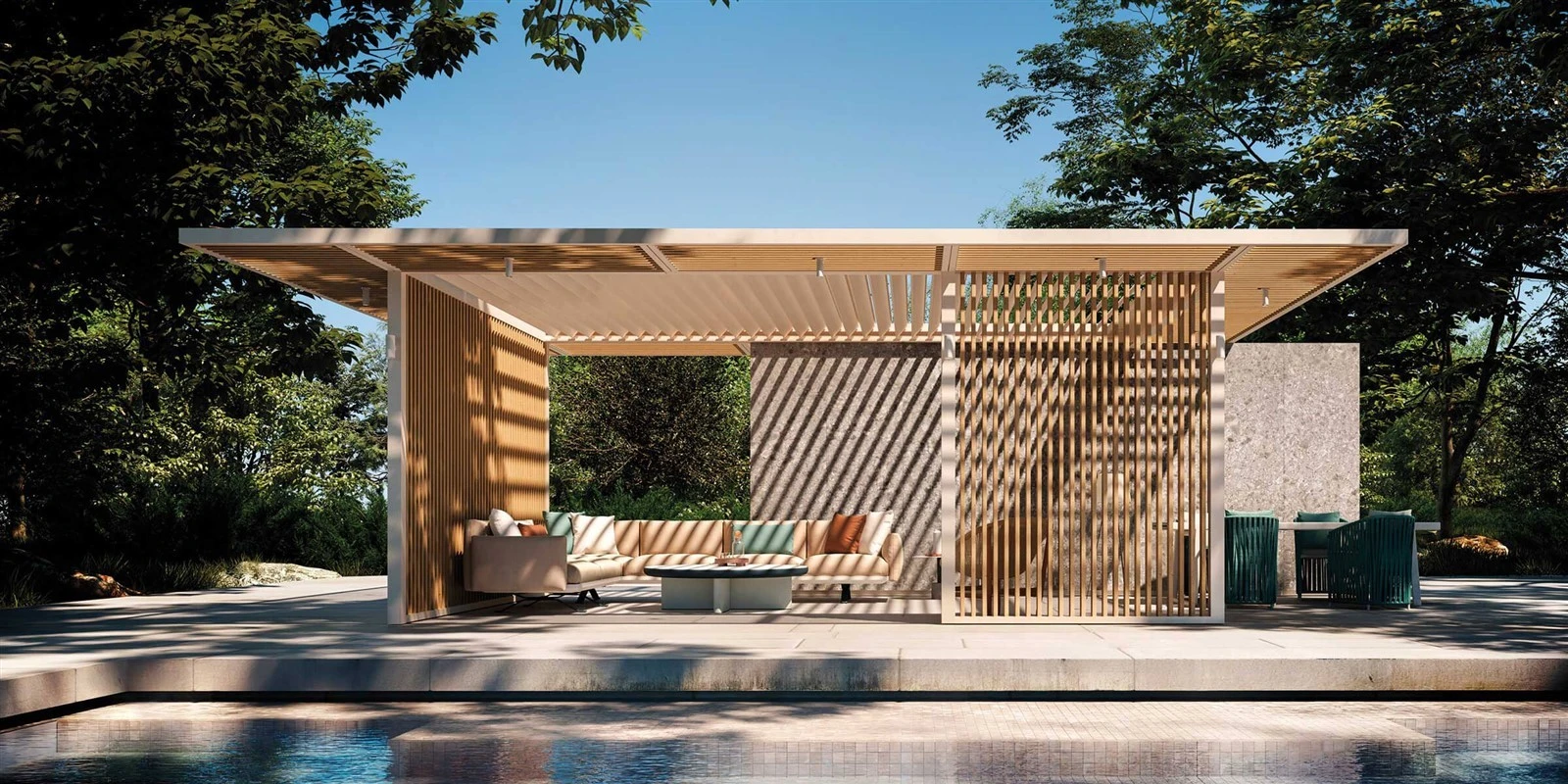
🌀 The Physics of Category 4 Wind Loads on Louvered Systems
When a hurricane hits a resort, a pergola experiences two violent aerodynamic forces: horizontal kinetic pressure and vertical negative pressure (uplift force). Many structural designers make the mistake of assuming that leaving louvers open solves the wind problem. In reality, turbulent coastal wind vectors create massive vortex shedding, causing individual louvers to flutter violently. This harmonic vibration can destroy an improperly reinforced system within minutes.
To counteract this, heavy-duty commercial systems utilize a mechanical lock-down state. When the louvers are fully closed, the structure becomes an engineered solid deck. However, this transfers the entire surface area load directly onto the internal drive linkage and the linear actuation system.
At a peak resort pergola wind load capacity of 150 mph, the structural surface experiences positive pressures exceeding 55 pounds per square foot (psf) and negative uplift pressures reaching up to 80 psf depending on roof geometry and proximity to coastal bluffs.
🛠️ Core Mechanical Intent: Internal Drive Linkage Specifications
The absolute weakest point in a standard bioclimatic structure is the internal mechanism that controls louver rotation. Under Category 4 hurricane forces, if the transmission rod or internal connecting pin deforms by even 2mm, the tight seal between louvers breaks. Once a single louver is forced open by the wind, the entire roof unzips due to pressure equalization failure.
For high-velocity hurricane zones (HVHZ), the internal drive transmission bars cannot be made of standard stamped aluminum or low-grade plastics. They require precision-machined 316 Stainless Steel or specialized Duplex Stainless Steel alloys.
📊 Internal Mechanism Material & Structural Specification Blueprint
| Engineering Factor | Standard Hospitality Grade (Up to 75 mph) | Hurricane-Resistant Resort Grade (Category 4 / 156 mph) |
| Linkage Material | Stamped 6063-T5 Aluminum / Nylon | Precision CNC 316 Stainless Steel / Carbon Fiber Reinforced Alloy |
| Minimum Tensile Strength | 185 MPa | $\ge$ 515 MPa (High-Yield Marine Specification) |
| Connecting Pin Diameter | 6 mm to 8 mm | 12 mm to 16 mm Solid Shear-Resistant Pins |
| Drive Type | Exposed Single-Track Pull Rod | Fully Enclosed Dual-Channel Synchronous Drive Segment |
| Corrosion Protection | Basic Anodizing | Qualicoat Class 2 Powder Coating + Passivated Marine Treatment |
| Actuator Holding Torque | 1,500 N to 3,000 N | 8,000 N to 12,000 N Static Locking Force |

🏗️ Structural Tonnage and Alloy Allocation
Beyond the internal linkages, the frame must maintain absolute rigidity. Deflection is the enemy of wind resistance. If a 6-meter span beam bends under load, it alters the tolerances of the internal drive rod, causing mechanical jamming or catastrophic buckling.
Top-tier engineering utilizes 6005-T6 Aluminum for main structural rafters and columns, providing a significantly higher Yield Strength compared to standard architectural 6063-T6 aluminum. As a trusted OEM hotel outdoor furniture partner, structures must be designed knowing that the concrete foundations and anchoring footings must handle up to 5 to 7 tons of vertical pull-out force per column.
📊 Wind Speed vs. Structural Load & Mechanical Resistance Metrics
| Hurricane Category | Wind Speed Range (mph / km/h) | Kinetic Surface Pressure (PSF) | Required Linkage Tensile Load Resistance | Minimum Base Plate Anchor Spec |
| Category 1-2 | 74–110 mph / 119–177 km/h | 18 – 35 PSF | 3,500 Newtons | 4x M12 Hilti Anchors (100mm Embedment) |
| Category 3 | 111–130 mph / 178–208 km/h | 36 – 49 PSF | 6,500 Newtons | 4x M16 High-Tensile Anchors |
| Category 4 | 131–156 mph / 209–251 km/h | 50 – 78 PSF | $\ge$ 11,000 Newtons | 6x M16 Heavy-Duty Chemical Epoxy Anchors |
| Category 5 | 157+ mph / 252+ km/h | 80+ PSF | 15,000+ Newtons | Custom Engineered Embedded Steel I-Beams |
To ensure these parameters are met during large-scale hospitality developments, purchasing managers must source directly from an advanced, verified Sustainable outdoor furniture factory. Modern production facilities utilize automated heavy-duty extrusion setups capable of handling thick-walled profiles (up to 4.0mm internal structural webbing) necessary to support these extreme load distributions.

🛡️ Compliance, Certifications, and Testing Protocols
Never rely on theoretical calculations when selecting coastal outdoor structures. Commercial project specifications require real-world destructive testing verification from accredited global validation bodies.
Miami-Dade County NOA (Notice of Acceptance): The gold standard for high-velocity hurricane zone compliance. A structure carrying this certification has passed rigorous missile-impact testing and cyclic wind pressure loading protocols.
ASTM E330: This testing standard monitors structural performance of exterior windows, curtain walls, and louvers under uniform static air pressure differences via a dedicated test chamber.
TÜV Rheinland / SGS Validation: Certifies that both the electrical motor systems (IP67 waterproof rating for linear actuators) and mechanical load limits comply with international safety directives.
Qualicoat Class 2: Essential for coastal installations. This certificate ensures that the exterior finish can survive aggressive salt spray environments without bubbling or blistering, which would otherwise compromise the underlying metal substrate over time.
❌ Engineering Pitfalls in Coastal Resort Deployments
Neglecting Thread Galling in Stainless Fasteners: When assembling high-tensile stainless steel drive rods, failure to use anti-seize lubricants can lead to thread locking. Under wind vibration, these fasteners can experience micro-fractures and brittle snapping.
Improper Drainage Path Integration: High winds drive water horizontally. If the internal internal gutter channels inside the aluminum rafters restrict airflow, the pressure differentials can force water upward into the motor housing, shorting out the static lock system.
Single-Point Linear Actuation: Utilizing a single motor to drive a wide-span louver configuration introduces asymmetrical torsional stress on the internal linkage bar. Dual-motor synchronized drive systems are mandatory for maintaining balanced holding torque across spans wider than 4.5 meters.
❓ Industry FAQ
Q1: Can a bioclimatic pergola truly remain fully closed during a Category 4 hurricane?
Yes, provided it is engineered with a verified resort pergola wind load capacity rating exceeding 130 mph. When fully closed, the interlocking louvers create a rigid diaphragm that transfers lateral loads to the columns. However, the internal transmission rods must feature a minimum tensile strength of 515 MPa to prevent the wind from prying the louvers open.
Q2: What is the difference between 6063-T6 and 6005-T6 aluminum in high-wind engineering?
6063-T6 aluminum is standard for architectural trim but lacks the ultimate strength required for extreme forces. 6005-T6 Aluminum offers roughly a 50% higher yield strength, meaning it can withstand significantly higher bending moments before undergoing permanent structural deformation.
Q3: Why is mechanical locking torque more important than operational motor power?
During a hurricane, the motor is powered down. The wind resistance depends entirely on the static holding brake of the actuator and the shear strength of the internal linkages. A system requires a minimum of 10,000 N of static locking force to keep the louvers immobilized against 70 PSF uplift pressures.
Q4: How do coastal salt conditions affect wind load capacity over a 5-year period?
Salt air accelerates galvanic corrosion between stainless steel mechanisms and aluminum frames. If unchecked, corrosion eats away at connecting pins, reducing their effective cross-sectional diameter. Utilizing Qualicoat Class 2 coatings and isolation washers is critical to preventing structural degradation from weakening the wind rating over time.
Q5: What anchoring mechanism is required for concrete resort decks in hurricane zones?
Standard expansion anchors are insufficient due to concrete micro-cracking risks during cyclic loading. High-velocity zones require heavy-duty chemical epoxy anchors (such as Hilti HIT-RE system) embedded at a minimum depth of 120mm to 150mm into reinforced structural concrete foundations.
Q6: Do open louvers reduce the wind load requirement on the foundations?
While open louvers reduce horizontal drag, they create highly unpredictable aerodynamic lift (similar to an aircraft wing). The localized vortex forces acting on individual louvers can cause the internal linkages to shear faster than they would in a completely closed, locked-down state. Therefore, engineering for extreme wind zones always prioritizes the closed-lock configuration.