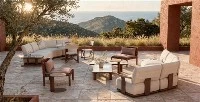

Choosing outdoor furniture is often presented as a style decision. In reality, the more expensive mistake is usually not choosing the wrong color or silhouette. It is specifying a product for the wrong level of use.
Residential vs. Commercial Outdoor Furniture becomes an important distinction when the same chair, sofa, or dining table is expected to survive very different operating conditions. A private patio may be used for several hours each week by a familiar group of people. A hotel terrace can face continual guest turnover, frequent cleaning, repeated repositioning, and direct exposure to weather.
The difference becomes especially obvious with teak outdoor sofa commercial projects. Teak can look equally appropriate in a private villa and a high-end resort, but the specification behind the furniture should not necessarily be identical. Timber selection, cushion construction, joint detailing, maintenance expectations, and replacement planning all become part of the commercial discussion.
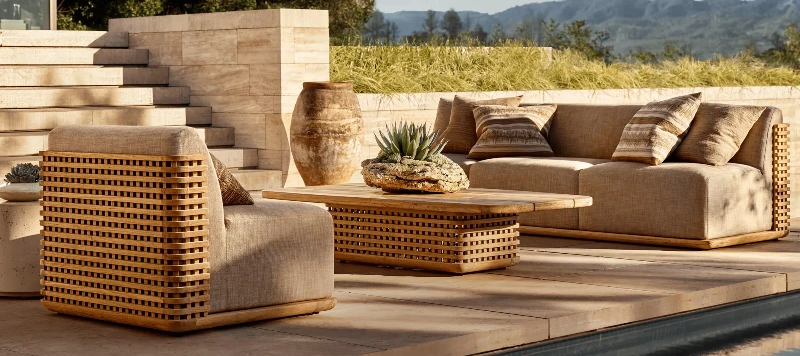
The same principle applies when comparing a resort outdoor lounge sofa with an attractive residential sectional. Hospitality furniture has to perform as part of an operating environment. Guests do not treat a sofa as carefully as an owner might, and housekeeping teams cannot maintain every cushion and frame with the same attention as a private homeowner.
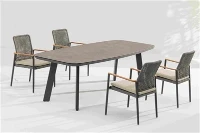
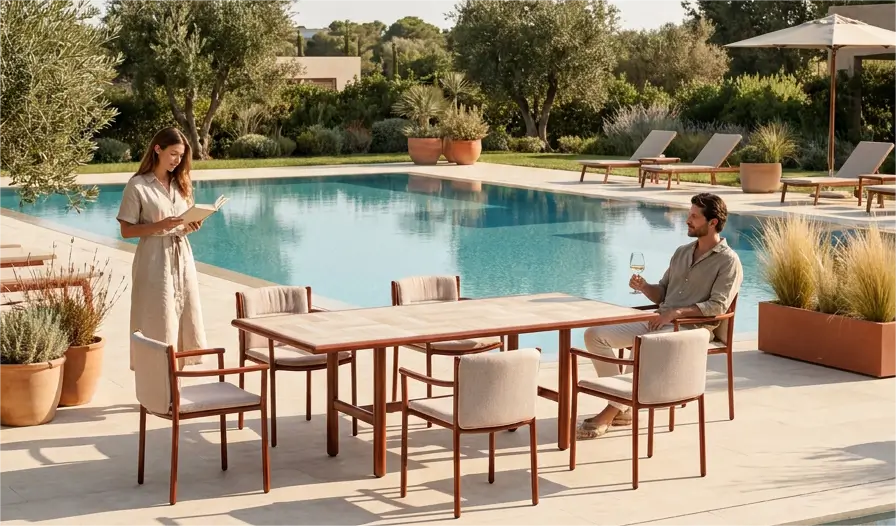
An outdoor dining table chair set also changes character when it moves from a family terrace to a restaurant or resort. The questions become less about whether six chairs look good together and more about stacking, handling, cleanability, stability, finish consistency, replacement parts, and how the furniture behaves after repeated movement.
For a project buyer, an outdoor furniture manufacturer should therefore explain more than material names. The useful information includes construction details, finish systems, relevant test documentation, dimensions, customization limits, packaging, maintenance instructions, and what happens when a component eventually needs replacement.
A capable outdoor furniture trade supplier can add another layer of value by coordinating several collections, fabrics, finishes, tables, chairs, loungers, and replacement components across one project. That can simplify procurement, but it should never replace technical due diligence.
1.Quick Answer: How Are Residential and Commercial Outdoor Furniture Different?
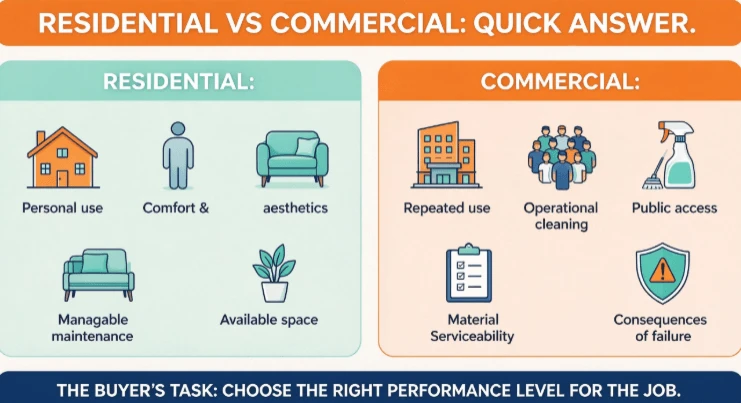
Residential furniture is generally specified around personal use, comfort, aesthetics, available space, and manageable maintenance.
Commercial furniture is specified around repeated use, operational cleaning, public access, material performance, serviceability, environmental exposure, and the consequences of failure.
That does not mean every commercial product is automatically better.
A poorly engineered contract chair can perform worse than a carefully built residential chair. The word "commercial" is not a performance test. What matters is whether the actual construction matches the demands of the site.
For a quiet private balcony, a lightweight and visually delicate product may be entirely appropriate. For a pool deck, hotel terrace, restaurant courtyard, or rooftop venue, the specification needs to account for a much more demanding combination of traffic and environment.
The buyer's real task is not to choose the label.
It is to choose the right level of performance for the job.
2.What Does "Commercial" Really Mean in Outdoor Furniture?
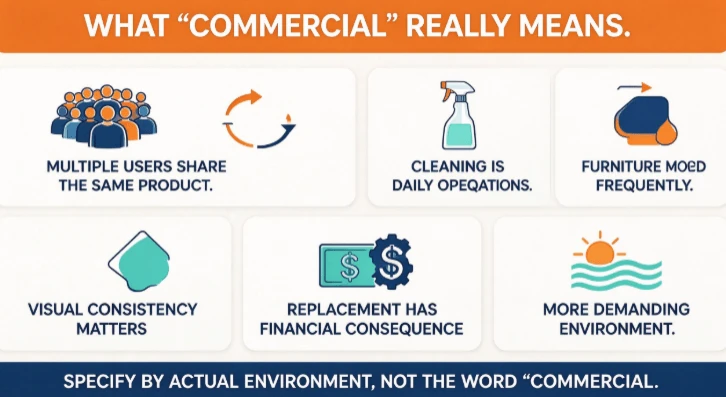
The term "commercial" is often used too loosely.
In practical purchasing language, it usually means the furniture is intended for environments where:
multiple users share the same product;
furniture may be moved frequently;
cleaning is part of daily operations;
visual consistency matters;
replacement has a financial or operational consequence;
the product may be exposed to more demanding environmental conditions.
Consider a hotel with several outdoor zones.
A pool deck may require easy-clean surfaces and faster cushion drying.
A rooftop lounge may place greater emphasis on stability and wind exposure.
A shaded restaurant terrace may care more about stacking, handling, and finish durability.
A coastal resort may be more concerned with corrosion and salt deposition.
Calling all four locations "commercial" does not tell the factory enough.
The specification should be built around the actual environment.
3.Residential vs. Commercial Use: The First Buyer Comparison
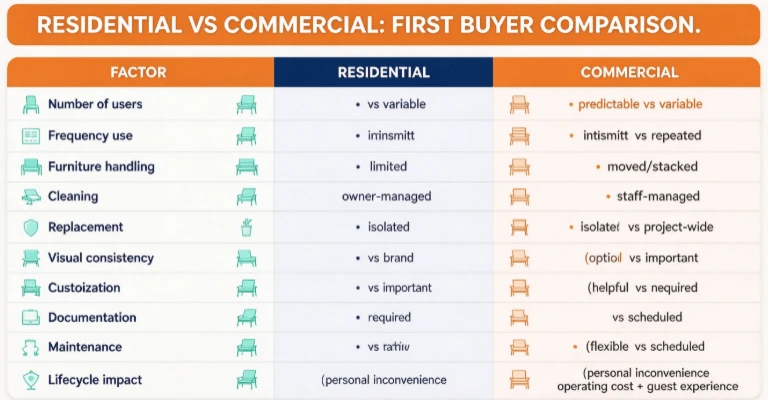
| Factor | Residential Setting | Commercial Setting |
|---|---|---|
| Number of users | Relatively predictable | Variable |
| Frequency of use | Often intermittent | Often repeated throughout operating hours |
| Furniture handling | Usually limited | May be moved, stacked, or rearranged regularly |
| Cleaning | Owner-managed | Operational or staff-managed |
| Replacement | Usually isolated | May affect an entire project |
| Visual consistency | Personal preference | Often part of brand presentation |
| Customization | Optional | Frequently important |
| Documentation | Helpful | Often required for approval and specification |
| Maintenance planning | Flexible | Usually scheduled |
| Lifecycle consequences | Mostly personal inconvenience | Can affect operating cost and guest experience |
The table explains why price alone is not enough for commercial procurement.
A lower quotation may simply reflect a simpler frame, lighter hardware, fewer customization options, less documentation, or a different fabric specification.
4.When Is Residential Outdoor Furniture the Better Choice?
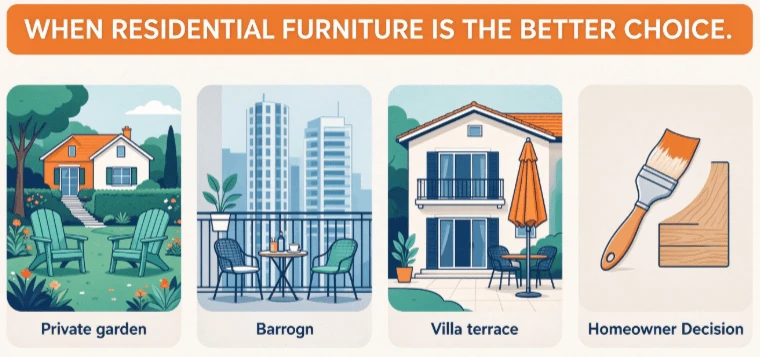
Residential furniture makes sense when the environment is controlled and the owner accepts the maintenance responsibility.
A private garden may have predictable users.
A balcony may have limited seating capacity.
A villa terrace may have furniture stored during poor weather.
A homeowner can decide that a particular wood finish or textile is worth maintaining because the visual result matters personally.
That flexibility is valuable.
It also means a residential specification can sometimes deliver a better result than a commercial specification because it is tailored more closely to how the space is actually used.
The mistake is assuming that "residential" means "cheap" or "weak."
A high-end villa can require premium materials, carefully finished metalwork, outdoor-grade fabrics, and custom dimensions.
The difference is not prestige.
It is the operating brief.
5.Residential Applications That May Still Need High Performance
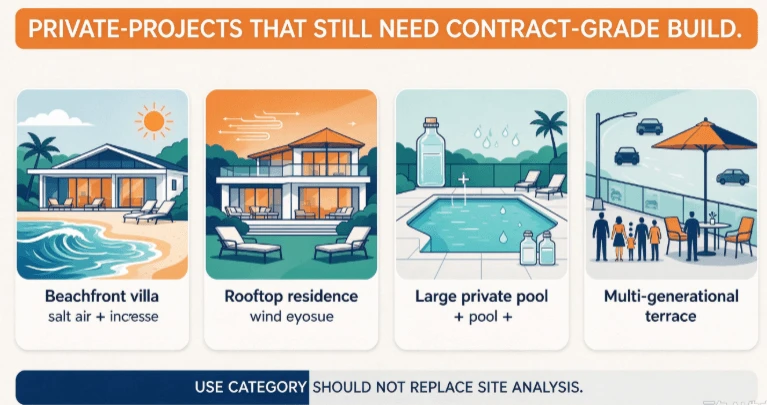
Some private projects are surprisingly demanding.
A beachfront villa can expose furniture to salt-laden air and intense sunlight.
A rooftop residence may be affected by wind.
A large private pool can create continual moisture and chemical exposure.
A multi-generational terrace can experience more traffic than a small commercial lobby.
This is where buyers often discover that a "residential" project can still justify contract-oriented construction.
In other words, the use category should not replace site analysis.
6.When Should You Move to a Commercial Specification?
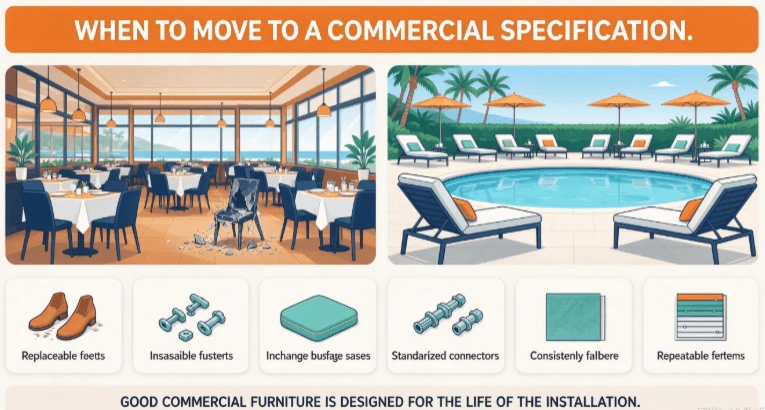
Commercial specification becomes more compelling when failure has consequences beyond inconvenience.
Imagine a restaurant that opens every morning with a specific seating layout. Six damaged chairs are not simply six replacement products. Staff must identify the problem, source replacements, maintain a consistent appearance, and work around the temporary shortage.
Or consider a resort where lounge sofas sit beside the pool. A cushion cover that cannot be replaced easily can affect not only maintenance but also the appearance of the guest area.
The larger the project, the more valuable serviceability becomes.
This includes:
Replaceable feet
Accessible fasteners
Interchangeable cushion covers
Standardized connectors
Consistent fabric references
Repeatable finish specifications
Good commercial furniture is designed not only for first installation but also for the life of the installation.
7.How an outdoor furniture manufacturer Should Explain the Specification
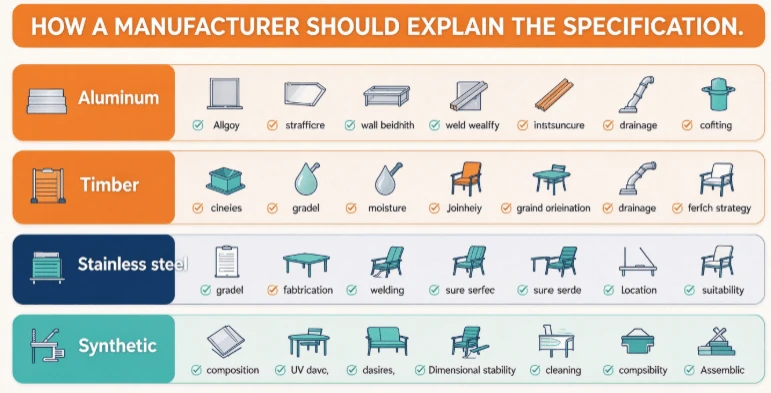
A competent factory should be able to explain the furniture from the inside out.
Start with the frame.
For aluminum, look at alloy choice, profile geometry, wall thickness, weld quality, joint reinforcement, drainage, and coating.
For timber, look at species, grade, moisture condition, joinery, grain orientation, drainage, and finish strategy.
For stainless steel, ask about grade, fabrication quality, welding, surface finishing, and suitability for the location.
For synthetic materials, examine material composition, UV behavior, dimensional stability, cleaning compatibility, and how components are assembled.
The important question is not:
"What material is it?"
It is:
"Why was this material and construction selected for this use?"
That second question reveals much more about a supplier's technical thinking.
8.Material Selection Is an Environmental Decision
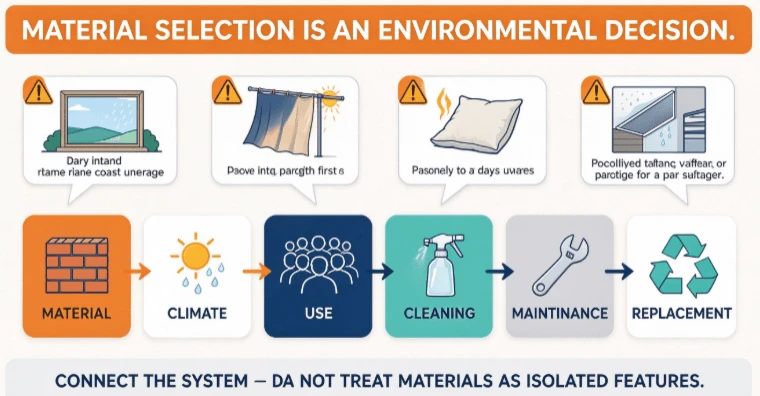
Outdoor furniture does not operate in a vacuum.
Its surrounding climate becomes part of the material system.
A frame may be perfectly suitable for a dry inland patio but require more careful specification in a coastal environment.
A fabric may look excellent in a shaded courtyard but fade more quickly in direct sun.
A cushion can be structurally sound while drying too slowly after rain.
A coating can perform well under laboratory testing but require a different maintenance strategy in real-world conditions.
This is why a good specification connects:
Material → Climate → Use → Cleaning → Maintenance → Replacement
rather than treating materials as isolated product features.
9.Teak, Aluminum, Stainless Steel and HDPE: Which Works Where?
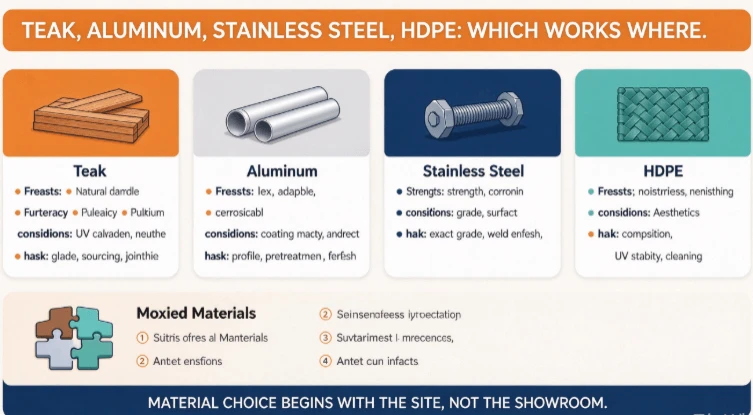
| Material | Key Strengths | Environmental Considerations | Best Questions to Ask |
|---|---|---|---|
| Teak | Natural outdoor character, good durability, premium appearance | UV changes surface color; moisture management still matters | Timber grade? Sourcing? Joint and drainage details? |
| Aluminum | Lightweight, adaptable, corrosion-resistant relative to ordinary steel | Coating quality and hardware remain important | Profile specification? Pretreatment? Finish system? |
| Stainless Steel | Strength and strong corrosion resistance potential | Grade and surface condition matter, especially near salt air | Exact grade? Weld finish? Hardware compatibility? |
| HDPE | Moisture resistance and relatively simple maintenance | Aesthetic character differs from natural materials | Composition? UV stability? Cleaning method? |
| Mixed Materials | Can balance appearance, weight and function | Material interfaces require attention | How are different materials joined and maintained? |
No single material wins every project.
A high-end resort may deliberately combine teak and powder-coated aluminum.
A pool deck may prioritize fast-drying synthetic materials.
A rooftop restaurant may prefer lighter aluminum furniture for operational handling while still considering wind-related stability.
Material choice should therefore begin with the site, not the showroom.
Climate Factor 1: UV Exposure
Sunlight is one of the quietest forms of outdoor wear because the damage accumulates without any dramatic event.
UV exposure can influence coatings, pigments, synthetic fibers, plastics, timber surfaces, and some adhesives or finishes.
The important issue for buyers is not merely "UV resistant."
Ask what that statement actually means.
Was the material evaluated separately?
Was the coating tested?
Was the complete assembly exposed?
What test method was used?
What changed after the exposure?
ASTM D4587 describes accelerated weathering of coatings and related products using fluorescent UV and condensation equipment. The method is useful for comparing tested configurations, but its results should not be interpreted as a universal prediction of field lifespan.
Buyer Tip
If a supplier provides a weathering report, check the test specimen, test method, exposure cycle, and reported change.
Do not accept "UV tested" as enough information by itself.
Climate Factor 2: Humidity and Rain
Moisture often creates more practical problems through poor drainage than through exposure itself.
A frame that allows water to escape is easier to maintain than one that traps it.
A cushion cover that dries quickly can be more useful than one that simply claims to be water resistant.
A tabletop with well-managed joints can remain easier to clean than one where debris continually collects.
This is why commercial outdoor furniture should be evaluated for:
drainage openings
water-trapping points
seam design
cushion recovery
removable covers
frame interiors
floor-contact details
A short rain shower should not automatically be a major event.
Furniture becomes difficult when ordinary weather repeatedly creates conditions that the design does not manage well.
Climate Factor 3: Salt Air and Coastal Exposure
Coastal projects demand a different level of attention because salt and moisture can work together.
Potential trouble spots include:
exposed fasteners
weld areas
poorly finished edges
dissimilar-metal connections
hidden brackets
underside surfaces
joints where salt deposits accumulate
A buyer should therefore evaluate the entire assembly rather than only the main frame material.
A stainless steel fastener attached to a coated aluminum frame does not magically make the complete product corrosion-proof.
Likewise, a powder-coated frame does not eliminate the need to inspect hardware and joints.
Coastal furniture needs a coordinated material strategy.
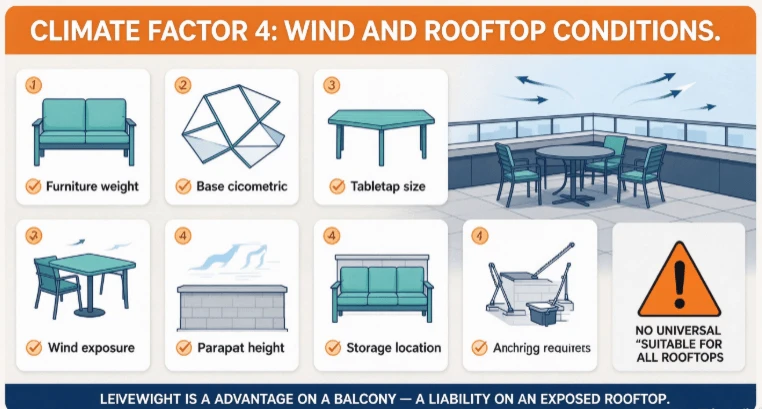
Climate Factor 4: Wind and Rooftop Conditions
Wind changes the meaning of "lightweight."
In a residential setting, moving a chair occasionally may be an advantage.
On an exposed rooftop, that same lightweight chair may require much more attention to base geometry, storage strategy, or site-specific anchoring.
The buyer should assess:
Furniture weight
Base geometry
Tabletop size
Wind exposure
Parapet height
Storage location
Anchoring requirements
There is no responsible universal statement such as "this table is suitable for all rooftops."
The correct decision depends on the site.
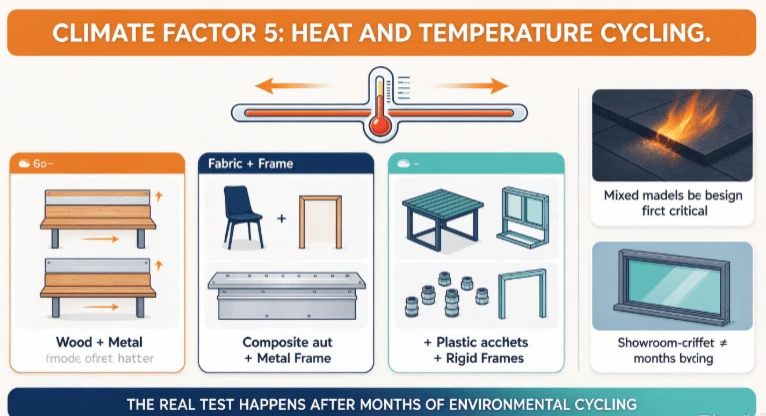
Climate Factor 5: Heat and Temperature Cycling
Outdoor furniture experiences repeated heating and cooling.
Metal expands differently from timber.
Synthetic materials respond differently again.
Dark surfaces can become substantially hotter under direct sun than shaded surfaces.
Those differences become especially relevant at interfaces between:
wood and metal
fabric and frame
composite tops and metal bases
plastic fittings and rigid frames
A product may function perfectly in a showroom while the real test occurs after months of environmental cycling.
The more mixed materials a product contains, the more important the interface design becomes.
10.Where a teak outdoor sofa commercial Specification Makes Sense

Commercial teak seating is often selected for a reason that goes beyond durability.
It communicates a particular visual language.
Warm, natural, premium, architectural.
That makes teak especially attractive for:
luxury resorts
premium hotels
villa developments
destination restaurants
private clubs
landscaped courtyards
But commercial teak should still be specified carefully.
The buyer needs to understand:
Timber source
Timber grade
Moisture condition
Joinery
Drainage
Cushion construction
Fabric specification
Expected surface appearance
Maintenance requirements
One resort may want the wood to weather naturally toward a silver-gray appearance.
Another may want to maintain a more consistent honey-brown finish.
These are different maintenance commitments even when the same timber species is used.
For certified wood projects, FSC Chain of Custody can provide traceability for certified forest-based materials through the relevant supply chain. It should not, however, be presented as evidence of structural strength or outdoor durability.
11.Where a resort outdoor lounge sofa Needs More Than Good Looks

A hospitality sofa often has to solve several problems simultaneously.
It needs to be comfortable enough for long stays.
It must look presentable under frequent use.
Its cushions need to handle moisture intelligently.
Its covers may need cleaning or replacement.
Its modules should fit the space without creating awkward movement.
And the structure needs to survive repeated handling.
This is where sectional design becomes commercially useful.
A single large sofa can be visually impressive.
A modular configuration can be operationally smarter.
A resort may want one configuration during normal service and another during an event.
A restaurant may reconfigure a terrace between lunch and evening service.
A hotel may need replacement modules without replacing the entire seating environment.
The design objective is not simply "more modules."
It is controlled flexibility.
Commercial Sofa Specification: What to Inspect
| Component | Residential Focus | Commercial Focus |
|---|---|---|
| Frame | Comfort and appearance | Repeated-use structural stability |
| Cushion | Feel and softness | Recovery, drainage, cleaning |
| Fabric | Color and texture | Cleaning compatibility and repeat-use performance |
| Feet | Floor protection | Stability and replaceability |
| Connectors | Optional | Important for repeated movement |
| Covers | Personal maintenance | Easy removal and replacement |
| Modules | Design preference | Layout flexibility and serviceability |
A sophisticated procurement team will usually ask to review a sample before approving the full production.
That sample should not only be judged by appearance.
Sit on it.
Move it.
Inspect the underside.
Open the cushion cover if possible.
Look at the seams.
Check the feet.
Look at where water could collect.
Ask what happens when one component is damaged.
Those small observations often tell you more than a catalog description.
12.How an outdoor dining table chair set Changes Under Commercial Use

The dining area is where residential and commercial furniture often look almost identical.
The difference appears after repeated handling.
A restaurant chair may be moved several times during a single service cycle.
A resort dining area may be reset for breakfast, lunch, dinner, and private events.
A hotel may store or rearrange furniture depending on occupancy.
That means handling efficiency becomes a design consideration.
Stackability can matter.
But stacking should not create excessive scratching, frame deformation, finish damage, or instability.
Likewise, a dining table should be assessed not only for tabletop appearance but for:
base stability
edge construction
connection points
cleaning access
level adjustment
movement behavior
replacement compatibility
A dining set is a system.
The chair and table should work together ergonomically and operationally.
13.Residential vs. Commercial Outdoor Furniture: A Lifecycle Perspective
Many buyers compare furniture by acquisition price because that figure is easy to see.
Lifecycle cost is less visible.
Consider what happens after installation.
A product may require:
routine cleaning
replacement cushions
fabric renewal
hardware replacement
refinishing
seasonal movement
repairs after heavy use
replacement of isolated components
Every one of those activities has a labor consequence.
That is why the most economically efficient commercial furniture is not always the furniture with the lowest purchase price.
Nor is the most expensive furniture automatically the best investment.
The useful question is:
Which product creates the least operational friction for the level of performance the site actually requires?
14.The Hidden Cost of Cheap Furniture
Cheap furniture can become expensive through small repeated failures.
A loose leg creates maintenance work.
A non-replaceable foot forces unnecessary replacement.
A difficult-to-clean cushion increases staff time.
A discontinued fabric complicates future refurbishment.
A mismatched replacement chair damages visual consistency.
An inconsistent finish across production batches creates a quality-control dispute.
None of these problems appears on the original quotation.
That is why serious project procurement should include serviceability as part of the value discussion.
15.The Hidden Cost of Over-Specifying

The opposite problem also exists.
A buyer can spend heavily on materials or engineering features that provide little benefit in the actual environment.
For example:
A shaded hotel courtyard does not necessarily need the same environmental strategy as an exposed seaside deck.
A private balcony may not need the same replacement system as a 300-room resort.
A low-traffic amenity terrace may not require the same furniture handling strategy as a busy restaurant.
The goal is not to maximize specification.
It is to match specification to risk.
That is how a higher-quality procurement process protects ROI.
16.How to Think About ROI Without Reducing It to a Formula

A commercial furniture investment becomes easier to understand when the buyer asks five practical questions.
What can fail?
Frame, finish, fabric, hardware, cushion, tabletop, connectors.
How often might it fail?
Usage frequency and environmental exposure influence the answer.
How difficult is the repair?
Can one part be replaced?
What happens to the operation?
Does maintenance remove seating from service?
Does the appearance remain acceptable?
Because functional furniture can still become commercially undesirable if it looks worn, mismatched, or poorly maintained.
That is why lifecycle value is more useful than an isolated purchase price.
17.Three Different ROI Decisions

Case A: Private Villa
The owner prioritizes aesthetics and comfort.
A premium teak sofa may be worthwhile because appearance and enjoyment are the main benefits.
Case B: Restaurant Terrace
The operator prioritizes handling, cleanability, stackability, and quick replacement.
A slightly higher initial specification may be rational if it reduces operational disruption.
Case C: Resort Pool Deck
The property may prioritize moisture management, corrosion resistance, fabric performance, modularity, and replacement availability.
Here, environmental suitability can influence the investment decision more strongly than visual styling.
Notice that none of these buyers necessarily needs "the most durable furniture available."
They need the furniture that best fits the operating model.
18.What Testing Should a Commercial Outdoor Furniture Buyer Look For?

A test document becomes useful only when it answers a real purchasing question.
Start with the exact product.
Does the report identify:
the tested model?
the tested construction?
the material?
the finish?
the relevant method?
the test conditions?
the result?
the sample identity?
A generic report can be interesting without being decisive.
The closer the document is to the exact supplied construction, the more useful it becomes.
EN 581: A Relevant Outdoor Furniture Reference
EN 581 addresses outdoor seating and tables for camping, domestic, and contract use.
Its mechanical parts address issues including strength, stability, reliability, and relevant safety requirements for outdoor seating and tables. Current versions distinguish the seating and table requirements.
However, buyers should note an important boundary: the standard does not automatically answer every question about ageing, weathering, upholstery durability, or a particular coastal environment. For example, the table standard explicitly excludes resistance to ageing and degradation from its scope.
That makes EN 581 useful evidence-but not a universal performance guarantee.
ANSI/BIFMA: What Buyers Should Understand
ANSI/BIFMA is widely recognized in commercial furniture performance and safety.
BIFMA also maintains a conformity registry intended to help buyers and specifiers identify products that conform to applicable BIFMA standards. BIFMA notes that the registry concerns standards conformance and does not itself review materials specifications or engineering drawings.
That distinction is valuable.
A buyer should not ask only:
"Is this BIFMA?"
Instead ask:
Which BIFMA standard applies to this product?
What exact model was tested?
Is the supplied configuration the same one represented by the evidence?
That produces a much more useful procurement conversation.
ASTM Weathering Evidence
ASTM D4587 covers accelerated fluorescent UV-condensation exposure for coatings and related products.
It can help assess changes related to light, heat, and moisture under defined laboratory conditions.
But a test method is not a crystal ball.
Actual outdoor performance is influenced by local sunlight, humidity, pollution, salt, cleaning chemicals, temperature, installation details, and maintenance.
Use the report to compare and understand behavior.
Do not turn it into an unsupported promise of field lifespan.
FSC for Timber Projects
When a project requires responsibly sourced certified timber, FSC Chain of Custody is particularly relevant.
The certification system addresses the sourcing, processing, labeling, and sale of forest-based materials as certified products through the supply chain.
This can be important for developers, hospitality groups, architects, and projects with sustainability requirements.
But FSC does not certify that a chair is structurally stronger.
That distinction should remain clear.
ISO 9001: Useful, but Often Misunderstood
ISO 9001 is a quality management system standard.
It focuses on how an organization establishes, implements, maintains, and continually improves its quality management processes.
It is therefore evidence about the management system, not proof that every outdoor product is automatically durable.
A thoughtful buyer should treat ISO 9001 as one part of supplier evaluation rather than a substitute for product testing.
19.What About SGS, Intertek and TÜV Rheinland?

Third-party organizations such as SGS, Intertek, and TÜV Rheinland may provide testing, inspection, auditing, or certification services depending on the product, market, and requested scope.
For buyers, the critical word is scope.
A supplier may show a beautiful certificate containing a respected testing organization's name, but the buyer still needs to confirm:
what was tested;
what standard was used;
which product was tested;
whether the production model matches the tested sample;
whether the document is valid for the purchasing market.
TÜV Rheinland, for example, identifies outdoor furniture within its furniture testing and certification services.
The organization's name matters less than whether the evidence actually addresses your product.
20.Certification vs. Test Report vs. Factory Declaration

| Evidence Type | What It Can Tell You | What It Cannot Automatically Tell You |
|---|---|---|
| Product test report | How a defined sample performed under a defined method | Every future production batch |
| Certification | Conformity within a stated certification scope | Every possible environmental condition |
| Factory declaration | What the supplier declares about the product | Independent verification |
| Material certificate | Identity or characteristics of a material | Complete product durability |
| Quality management certificate | Management-system framework | Performance of an individual product |
| Timber chain-of-custody evidence | Certified material traceability | Furniture structural strength |
This is why a small, relevant evidence package is often better than a large folder of unrelated certificates.
21.What Should You Send a Supplier Before Asking for a Quote?

The quality of the supplier quotation depends heavily on the quality of the brief.
For a meaningful commercial proposal, provide:
Project type
Site location
Indoor / outdoor exposure
Approximate furniture quantities
Required dimensions
Preferred materials
Color or finish reference
Fabric preferences
Environmental concerns
Storage requirements
Expected usage
Required documents
Delivery destination
The more concrete the brief, the less room there is for a supplier to fill technical gaps with assumptions.
This is particularly important for hospitality projects with different outdoor zones.
22.What Should You Ask Before Approving the Final Production Sample?

Do not judge a commercial sample only by looking at it.
Ask to inspect:
The frame
Check geometry, welds, visible defects, and connection points.
The finish
Check consistency, edges, underside areas, and touch points.
The cushion
Open or inspect the construction where practical.
The fabric
Check color, texture, seam quality, and care instructions.
The hardware
Confirm the material and accessibility for replacement.
The dimensions
Compare the approved sample with the technical drawing.
The packaging
A good product can still become a bad delivery if packaging is inadequate for long-distance shipping.
A sample approval should therefore be treated as a technical checkpoint, not only a styling approval.
23.How an outdoor furniture trade supplier Can Add Value

The trade-supply role becomes particularly useful on larger projects.
Instead of sourcing:
tables from one factory
chairs from another
loungers from a third
cushions from a fourth
replacement parts from somewhere else
the buyer can sometimes consolidate procurement around a supplier capable of coordinating several categories.
The benefit is not simply fewer emails.
It can also mean better control of:
Color
Finish
Dimensions
Packaging
Production timing
Replacement parts
Shipping coordination
Project communication
That said, consolidation should not eliminate supplier comparison.
A sourcing partner is valuable precisely because it makes comparison easier, not because it removes the need for it.
24.A Project Buyer's Supplier Comparison Framework

When comparing two or three factories, keep the evaluation consistent.
| Evaluation Area | Supplier A | Supplier B | Supplier C |
|---|---|---|---|
| Frame specification | Review | Review | Review |
| Material documentation | Review | Review | Review |
| Finish information | Review | Review | Review |
| Test evidence | Review | Review | Review |
| Customization capability | Review | Review | Review |
| Sample quality | Review | Review | Review |
| Replacement parts | Review | Review | Review |
| Packaging | Review | Review | Review |
| Production communication | Review | Review | Review |
| After-sales support | Review | Review | Review |
This is more reliable than comparing three quotation totals side by side.
25.The Buyer's Material Selection Checklist

Before finalizing a specification, ask:
☀️ Sun
Will the furniture receive direct sunlight for long periods?
🌧️ Water
Where will rainwater go?
🌊 Salt
Is the project exposed to marine air?
🌬️ Wind
Can furniture move or tip in the actual site?
🧽 Cleaning
What cleaning products will staff use?
🪑 Traffic
How often will the furniture be moved?
🔧 Repair
Can common components be replaced?
🎨 Appearance
How much visual change can the project tolerate?
Those questions often produce a better product selection than simply asking for the "best material."
26.Visual Buyer Guide: Which Specification Fits Your Project?

🏡 Private Home
Prioritize comfort, aesthetics, climate suitability, and manageable maintenance.
🏨 Hotel / Resort
Prioritize repeat-use durability, coordinated appearance, cleaning, and serviceability.
🍽️ Restaurant
Prioritize movement, stackability, cleanability, stability, and fast replacement.
🌊 Coastal Property
Prioritize corrosion strategy, hardware, moisture management, and maintenance.
🏙️ Rooftop Venue
Prioritize site-specific wind considerations, furniture weight, stability, and storage.
🏡 Luxury Villa Development
Balance premium appearance with the long-term requirements of repeated owner or guest use.
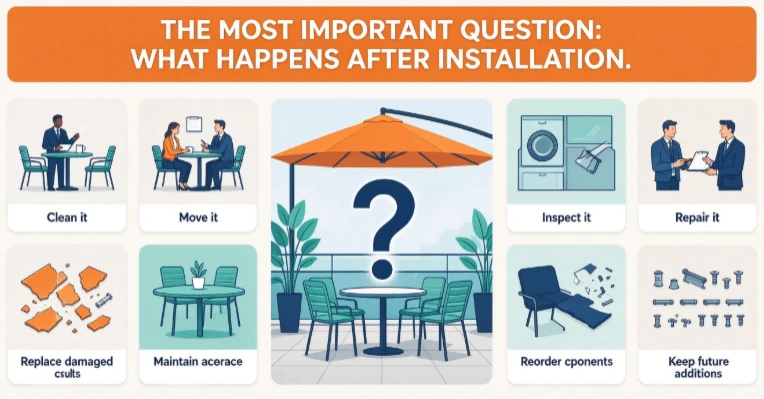
27.The Most Important Question: What Happens After Installation?
This is where experienced buyers think differently.
The furniture order is only the beginning.
After installation, someone has to:
clean it
move it
inspect it
repair it
replace damaged pieces
maintain its appearance
reorder components
keep future additions visually consistent
That is why a supplier that provides only a product catalog may not be enough for a major project.
The better supplier relationship continues through the product lifecycle.
28.Six Signals That a Commercial Furniture Specification Is Weak

🚩 The supplier says only "commercial grade" without explaining why.
🚩 The material name is given without a grade or technical specification.
🚩 The certificate is shown without identifying the tested model.
🚩 The finish is described as UV resistant with no supporting details.
🚩 Replacement components are not discussed.
🚩 The quotation contains no clear assumptions about climate, fabric, finish, or usage.
Any one of these does not automatically mean the product is unsuitable.
Several together should trigger a deeper review.
29.Six Signals That a Supplier Is Thinking Like a Project Partner

✅ They ask about the site before recommending a material.
✅ They distinguish residential and contract use rather than treating them as labels.
✅ They explain why one material may work better than another.
✅ They identify what is tested and what is not.
✅ They can discuss replacement components.
✅ They are comfortable putting assumptions into writing.
That last point is often underestimated.
Clear written assumptions reduce disputes later.
30.How to Choose Between Residential and Commercial Outdoor Furniture
Do not ask:
"Which category is better?"
Ask:
"Which specification matches the consequences of use?"
Choose a residential-oriented product when use is controlled, maintenance is manageable, and the environment does not justify additional commercial requirements.
Choose a commercial-oriented product when user turnover, maintenance frequency, operational handling, weather exposure, or replacement consequences justify a higher level of specification.
Choose a hybrid specification when different areas of the same project have different requirements.
That last approach is often underused.
There is no reason a private villa's shaded terrace and its exposed pool deck must have identical furniture specifications.
Likewise, a resort's quiet garden does not necessarily need the same specification as its main pool terrace.
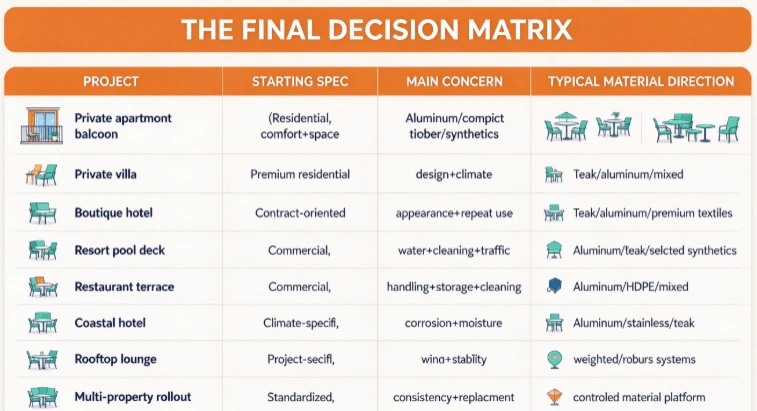
The Final Decision Matrix
| Project | Starting Specification | Main Concern | Typical Material Direction |
|---|---|---|---|
| Private apartment balcony | Residential | Comfort + space | Aluminum, compact timber, synthetic materials |
| Private villa | Premium residential | Design + climate | Teak, aluminum, mixed materials |
| Boutique hotel | Contract-oriented | Appearance + repeat use | Teak, aluminum, premium textiles |
| Resort pool deck | Commercial | Water + cleaning + traffic | Aluminum, teak, selected synthetics |
| Restaurant terrace | Commercial | Handling + storage + cleaning | Aluminum, HDPE, mixed materials |
| Coastal hotel | Climate-specific commercial | Corrosion + moisture | Suitable aluminum, stainless steel, teak |
| Rooftop lounge | Project-specific commercial | Wind + stability | Site-selected weighted or robust systems |
| Multi-property rollout | Standardized commercial | Consistency + replacement | Controlled material and finish platform |
31.What Should Your Final Purchase Specification Include?

Before signing off the order, make sure the document clearly identifies:
Product model
Dimensions
Frame material
Material grade where applicable
Surface treatment
Fabric specification
Cushion construction
Hardware
Color / finish reference
Applicable testing
Applicable standards
Packaging
Assembly requirements
Replacement components
Maintenance instructions
Approved drawings
Approved sample
Project-specific assumptions
If these items are vague, the product may still be good.
The procurement process simply has not defined it well enough.
32.A Better Way to Think About Outdoor Furniture ROI

ROI is not only about whether the furniture survives.
It is about whether the furniture continues to support the operation.
A successful outdoor furniture investment should ideally remain:
Functional
Presentable
Maintainable
Repairable
Replaceable
Consistent
That is the real connection between technical specification and commercial value.
A cheaper chair that needs repeated replacement may be a poor investment.
A premium chair that delivers performance the site never needs may also be poor value.
The strongest decision usually sits between those extremes.
33.Final Answer: Which One Do You Need?

Choose residential-oriented outdoor furniture when:
The users are predictable.
The furniture is not moved constantly.
Maintenance can be handled personally.
Environmental exposure is manageable.
The cost of occasional replacement is acceptable.
Choose commercial-oriented furniture when:
The space receives frequent traffic.
Furniture is cleaned and rearranged repeatedly.
The property depends on consistent presentation.
Environmental exposure is demanding.
Downtime or replacement creates operational cost.
The project requires documentation and coordinated procurement.
Choose a hybrid approach when:
Different zones face different levels of risk.
That is common in villas, resorts, hotels, restaurants, and mixed-use developments.
The smartest buyer does not upgrade everything.
The smartest buyer upgrades the areas where the additional specification actually solves a problem.
FAQs:
1. Is commercial outdoor furniture always better than residential outdoor furniture?
No. Commercial furniture is designed around a different operating environment, but the "commercial" label by itself does not prove higher quality. Compare the actual construction, materials, finish, testing, maintenance requirements, and intended use.
2. What is the best material for commercial outdoor furniture?
There is no universal answer. Teak can suit premium hospitality settings, aluminum can offer useful weight and corrosion-resistance characteristics, stainless steel can be valuable in demanding applications, and HDPE may be practical where moisture and maintenance are major concerns. Climate and usage should drive the decision.
3. Can residential outdoor furniture be used in a hotel or resort?
Sometimes. The real question is whether the product can tolerate the actual traffic, cleaning, environmental exposure, handling, and service requirements. Some residential-style products can perform well in controlled hospitality areas, while others may need a more contract-oriented specification.
4. What certifications should a buyer ask an outdoor furniture supplier for?
Request documents relevant to the actual product and destination market. Depending on the project, that may include applicable EN 581 evidence, relevant ANSI/BIFMA conformity or testing information, ASTM weathering test reports, FSC Chain of Custody documentation for certified wood, or reports from recognized independent testing organizations.
5. How can I tell whether a higher-priced outdoor furniture product is worth the extra investment?
Look beyond purchase price. Review maintenance effort, replacement availability, serviceability, visual consistency, environmental suitability, and operational disruption. A higher specification is worthwhile when it addresses a real project risk rather than simply adding expensive materials.
6. What should I ask an outdoor furniture factory before placing a project order?
Ask for exact material information, construction drawings, finish details, applicable test evidence, sample approval procedures, production quality controls, replacement-part availability, packaging information, and written clarification of project assumptions. A reliable factory should be comfortable discussing both strengths and limitations.
Conclusion
Outdoor furniture becomes a very different product when it moves from a private terrace into a commercial operating environment.
A homeowner may ask whether a sofa is comfortable and attractive.
A hotel buyer must also ask whether it can be cleaned quickly, moved repeatedly, repaired efficiently, reordered consistently, and kept presentable under real operating conditions.
That is the practical distinction between residential and commercial specification.
The material matters.
The frame matters.
The finish matters.
The climate matters.
The supplier matters.
But none of these should be evaluated in isolation.
The better procurement decision connects them.
For a quiet private patio, a residential specification may be exactly right.
For a resort pool deck, a contract-oriented solution may be more appropriate.
For a premium villa, a hybrid specification can often deliver the best balance between aesthetics, climate performance, and budget.
The most valuable question is therefore not:
"Which product is more expensive?"
It is:
"Which specification will perform properly in this environment, with this level of use, under this maintenance routine, for the way this project actually operates?"
That is the question that turns outdoor furniture from a decorative purchase into a long-term project investment.