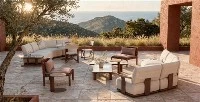

Buying outdoor furniture for a hotel, resort, restaurant, rooftop venue, club, or high-end residential development looks straightforward until the furniture starts operating.
A catalog can show you a beautiful sofa.
A project has to deal with the rain that lands on it, the guest who drags it across the floor, the housekeeping employee who cleans it, the salt that settles on the hardware, the afternoon sun that hits the cushions, and the replacement order that may happen much later.
That is the difference between selecting an attractive product and specifying a working outdoor furniture system.
A commercial outdoor sofa may be aesthetically similar to a residential model, yet the decisions underneath the upholstery can be very different. Frame geometry, connection details, cushion construction, hardware, cleanability, and replacement planning all become more important when the product belongs to a revenue-generating environment.
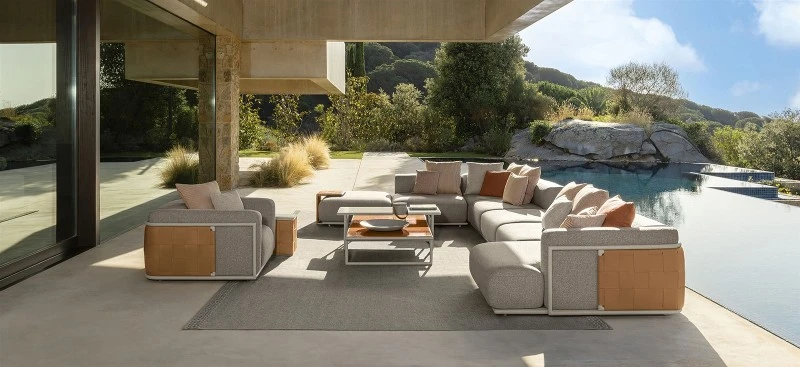
A premium hospitality project may also specify a Grade A teak furniture supplier because the natural timber itself contributes to the visual character of the property. But the buyer still needs to understand what the supplier means by "Grade A," how the timber is sourced, how the joints are constructed, and what appearance change is acceptable after exposure.
In a complete outdoor environment, furniture rarely works alone. A motorized louvered pergola can alter shade, rain management, circulation, and maintenance requirements, which means the furniture specification should be considered together with the space around it rather than selected in isolation.
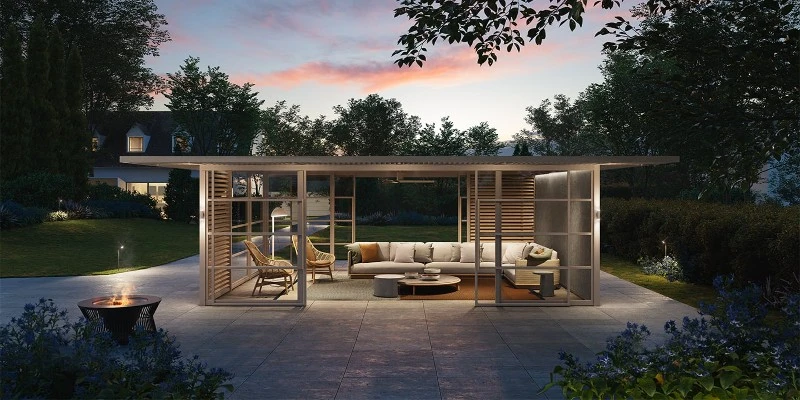
For an OEM/ODM outdoor furniture manufacturer, the challenge becomes even broader. The supplier may be expected to reproduce approved finishes, custom dimensions, fabrics, structural details, packaging, and replacement components across multiple production runs.
That is why hospitality outdoor furniture should be selected through a decision process, not a product-name search.
Quick Answer: What Should Hospitality Buyers Look At First?
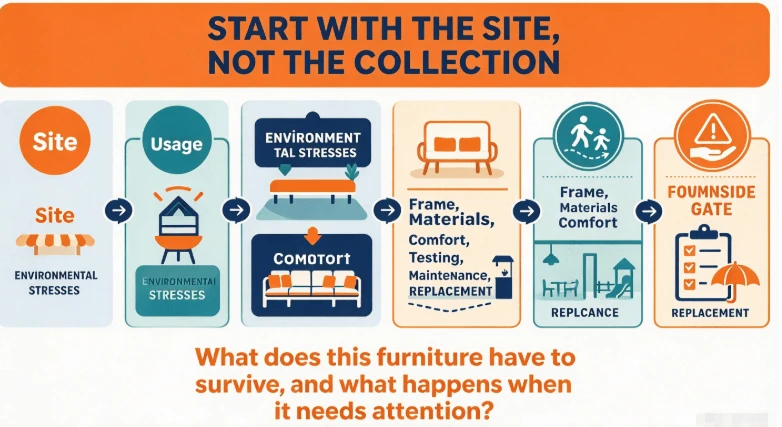
Start with the site.
Then define the usage.
Then identify the environmental stresses.
After that, evaluate the frame, materials, comfort system, testing, maintenance and replacement strategy.
The mistake is to start with the question:
"Which collection looks best?"
The stronger question is:
"What does this furniture have to survive, and what happens when it eventually needs attention?"
That single change in thinking eliminates many poor purchasing decisions.
The 7 Critical Factors at a Glance
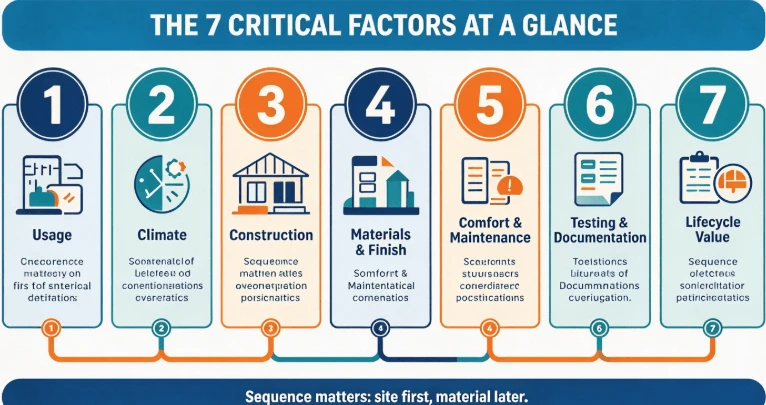
| Factor | Core Question | Why It Matters |
|---|---|---|
| 1. Usage | Who will use it, and how often? | Determines the level of structural and operational demand |
| 2. Climate | What will sun, water, salt and wind do? | Determines environmental exposure |
| 3. Construction | How is the product actually built? | Determines structural behavior and serviceability |
| 4. Materials & Finish | Are the selected materials right for the site? | Determines appearance, maintenance and environmental response |
| 5. Comfort & Maintenance | Can guests use it comfortably and staff maintain it efficiently? | Connects design to daily operation |
| 6. Testing & Documentation | What evidence supports the claims? | Reduces specification uncertainty |
| 7. Lifecycle Value | What happens after installation? | Determines practical long-term ROI |
The sequence matters.
You should not choose the material before understanding the environment.
You should not compare testing documents before identifying the intended use.
And you should not compare supplier prices before confirming that the quotations describe comparable specifications.
Factor 1: Define the Actual Hospitality Use Case
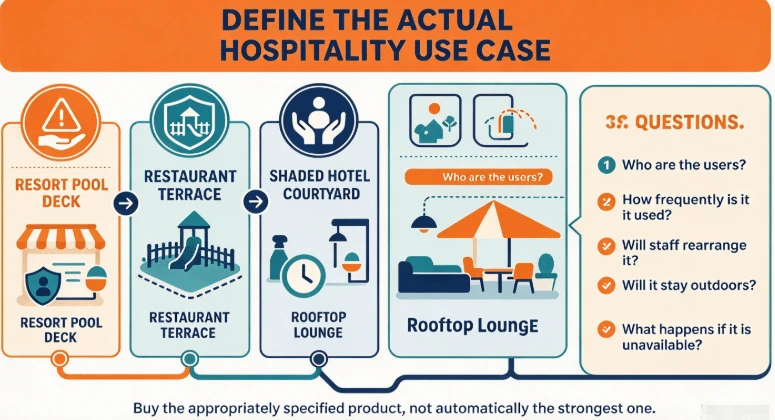
A resort pool deck is not the same operating environment as a private villa.
A restaurant terrace is not the same as a shaded hotel courtyard.
A rooftop lounge is not the same as a ground-level garden.
Yet these spaces are often placed under the same broad label:
Outdoor furniture.
That label is too broad to make a good procurement decision.
Ask These Questions Before Selecting Products
Who are the users?
Guests, homeowners, restaurant customers, staff, members, tenants and event visitors all interact with furniture differently.
How frequently is it used?
A chair used occasionally has a different operating profile from one moved throughout every service period.
Will staff rearrange it?
If furniture is constantly moved, weight, grips, feet, stacking behavior and connection design suddenly matter more.
Will it stay outdoors?
Permanent exposure creates different requirements from furniture that is routinely stored.
What happens if it is unavailable?
A damaged chair in a private garden is inconvenient.
A row of missing restaurant chairs can affect seating capacity.
Usage Intensity Changes the Specification
| Usage Pattern | Typical Situation | What to Prioritize |
|---|---|---|
| Light | Private terrace | Comfort, appearance, climate fit |
| Moderate | Villa development | Appearance + durability + consistency |
| Regular | Boutique hotel | Structure + finish + maintenance |
| Heavy | Restaurant / resort | Handling + cleanability + serviceability |
| Highly variable | Events / hospitality venues | Modularity + storage + repeat configuration |
The most experienced buyer does not automatically buy the strongest product.
They buy the product that is appropriately specified for the expected use.
That distinction protects budget as well as performance.
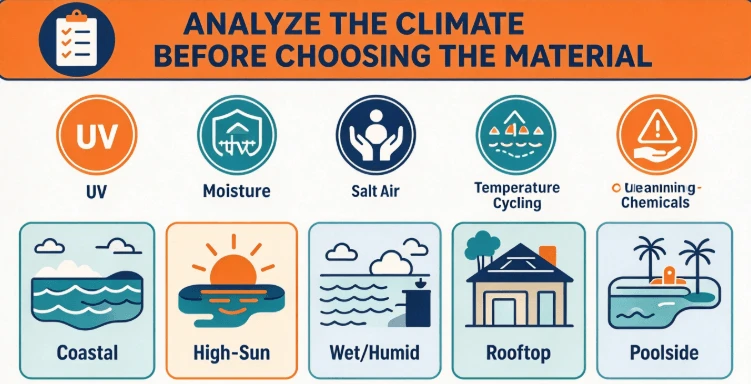
Factor 2: Analyze the Climate Before Choosing the Material
Outdoor furniture has no "neutral" environment.
Every site applies different stress.
☀️ UV exposure can influence finishes, fabrics, coatings and polymers.
🌧️ Moisture can collect where the design does not drain effectively.
🌊 Salt air can accelerate corrosion on vulnerable metals and connections.
🌬️ Wind can move lightweight products or complicate rooftop use.
🌡️ Temperature cycling can stress interfaces between different materials.
🧽 Cleaning chemicals create another type of exposure that is easy to forget during specification.
BIFMA's outdoor-furniture work recognizes that exterior products can face direct UV, heat, humidity, cold and moisture, and its outdoor guidance examines the interaction between environmental exposure and furniture performance.
That leads to a simple rule:
Climate should be identified before the material is approved.
What Different Environments Do to Furniture
Coastal Projects
The buyer should pay special attention to hardware, connection points, surface contamination, drainage, cleaning frequency and material compatibility.
The frame material matters, but the complete assembly matters more.
High-Sun Locations
Direct exposure can accelerate visual change in finishes and textiles.
The question is not only whether the material is "UV resistant."
The buyer should ask what exactly was tested and under which method.
Wet or Humid Locations
Water should have somewhere to go.
A product with poor drainage can create maintenance problems even when the base material itself is suitable for outdoor use.
Rooftop Locations
Weight and movement become site-specific concerns.
A lightweight chair may be convenient for staff but may behave differently in an exposed rooftop environment than it would in a sheltered courtyard.
Poolside Areas
The furniture may encounter water, chlorine-related contamination, sunscreen, food, drinks and frequent cleaning.
The maintenance routine can therefore be as important as the weather.
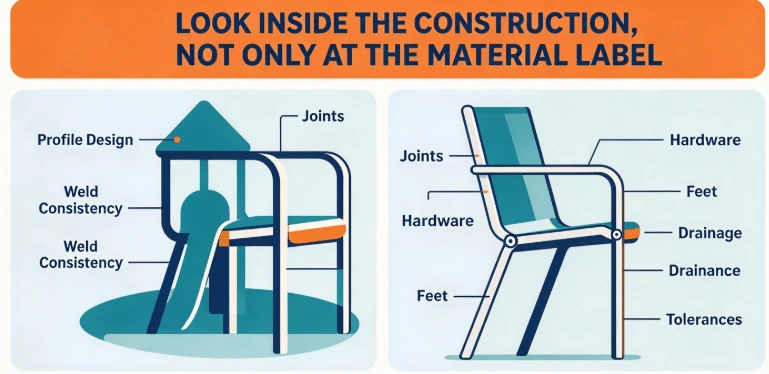
Factor 3: Look Inside the Construction, Not Only at the Material Label
Suppose two chairs are both made from aluminum.
That does not mean they have comparable performance.
One may use carefully selected profiles, properly reinforced joints and appropriate fasteners.
Another may use a lighter construction with less reinforcement.
The material name is identical.
The engineering is not.
What Should a Buyer Inspect?
Frame Geometry
Look at how the profile carries load rather than simply how thick the visible tubing appears.
Welds
Check consistency, transitions and visible finishing.
Joints
Look for how the frame handles repeated movement.
Hardware
Identify materials and whether components can be serviced.
Feet
Inspect floor-contact components for stability and replacement access.
Drainage
Look for points where water could remain trapped.
Tolerances
Custom furniture is especially sensitive to dimensional consistency because multiple pieces must fit together visually and physically.
This is where project drawings become useful.
A drawing can reveal information that a lifestyle image never will.
Factor 4: Choose Materials for the Site, Not for the Sales Pitch
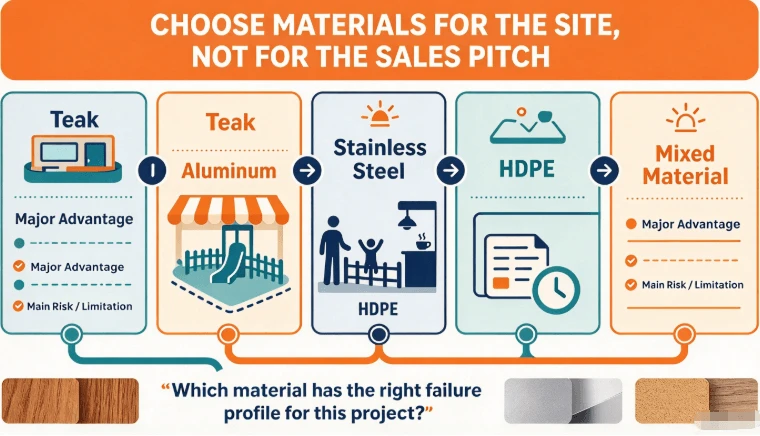
There is no universally "best" outdoor material.
That statement is worth keeping.
The right material depends on:
climate
traffic
aesthetics
maintenance
handling
budget
replacement
sustainability requirements
Teak
Teak is valued for its natural appearance and suitability for premium outdoor environments.
It can work particularly well in luxury hospitality, villas, resorts and design-led projects.
But teak still requires a maintenance conversation.
Will the buyer accept natural color change?
Will the surface be cleaned regularly?
Will the project maintain a finished appearance?
How will replacement pieces match the original installation?
Those questions are part of material selection.
Aluminum
Aluminum offers useful flexibility when low weight, design adaptability and corrosion resistance are priorities.
That makes it popular for commercial dining furniture, lounge seating and many hospitality applications.
But aluminum should not be treated as one homogeneous specification.
Profile design, wall thickness, welds, pretreatment, coating and hardware all influence the result.
Stainless Steel
Stainless steel is often considered when strength and corrosion resistance are important.
The buyer should still ask about grade, fabrication, finishing, welding and interaction with other materials.
A stainless component does not make the entire product immune to every coastal or maintenance problem.
HDPE and Synthetic Materials
HDPE and other engineered synthetics can make sense in wet, high-use environments where easy maintenance is important.
They may be especially practical around pools and public spaces.
But the visual language differs from natural timber or premium metal.
That is not a technical weakness.
It is a design choice.
Material Comparison for Hospitality Buyers
| Material | Major Advantage | Main Risk / Limitation | Typical Application |
|---|---|---|---|
| Teak | Natural character + premium appearance | Appearance changes and maintenance expectations | Luxury resort, villa, hotel |
| Aluminum | Lightweight + design flexibility | Finish and hardware still need careful specification | Hotel, restaurant, rooftop |
| Stainless Steel | Strength + corrosion resistance potential | Grade and fabrication matter | Premium or demanding sites |
| HDPE | Moisture resistance + practical maintenance | Different aesthetic character | Poolside, public-use areas |
| Mixed Materials | Allows different materials to solve different problems | Interfaces need careful detailing | Design-led hospitality |
The right question is not:
"Which material is most durable?"
It is:
"Which material has the right failure profile for this project?"
That is a much more useful procurement question.
Factor 5: Evaluate Finish and Fabric as Real Performance Components
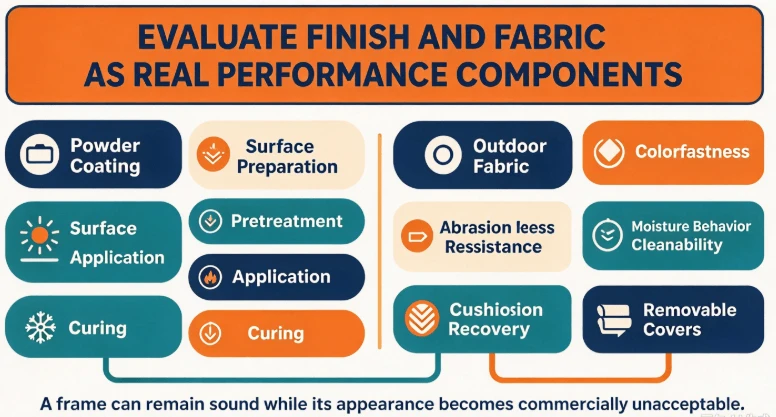
Frames receive most of the technical attention.
In real hospitality operations, fabric and finish can create just as much maintenance work.
A frame can remain structurally sound while its appearance becomes commercially unacceptable.
That is why buyers should review:
Powder coating
Outdoor textiles
Colorfastness
Abrasion resistance
Moisture behavior
Cleanability
Cushion recovery
Removable covers
Drainage
Surface repairability
Why Powder Coating Needs More Than a Color Sample
A color card tells you almost nothing about long-term outdoor behavior.
For powder coating, the buyer should ask about the full finishing process, including surface preparation, pretreatment, application and curing.
The coating may be visually excellent while the more important question is how the complete system was prepared.
This is particularly relevant in coastal or high-humidity environments.
Why Fabric Can Change Commercial ROI
Imagine a hotel replacing otherwise usable sofas because the original covers can no longer be matched.
That is not a structural failure.
It is a lifecycle problem.
For project buyers, useful questions include:
Can covers be replaced?
Can the same fabric reference be reordered?
Are the seams designed for repeated cleaning?
Does the cushion dry efficiently?
Is the filling appropriate for outdoor use?
Does the supplier document the fabric specification?
In other words:
Comfort is part of product performance.
The Commercial Outdoor Sofa Test
A good sofa sample should not be approved only because it is comfortable.
Try it.
Move it.
Separate the modules.
Inspect the underside.
Look at the feet.
Open the cushions where practical.
Check the seams.
Ask how one damaged component would be replaced.
That process reveals practical details that a product photograph cannot communicate.
A modular sofa is particularly valuable when the property needs periodic layout changes or isolated replacements.
But modularity itself is not automatically a benefit.
Poorly designed connections can make a modular system frustrating to move.
The buyer wants useful modularity, not simply more pieces.
Factor 6: Review Testing, Certification and Documentation as Evidence
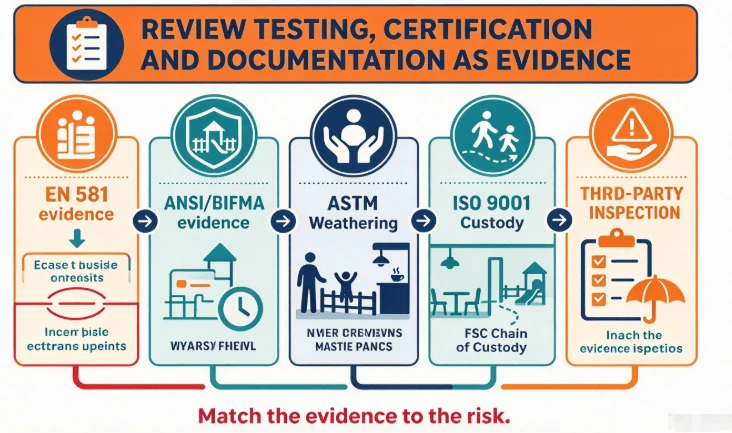
This is where experienced buyers separate marketing claims from measurable information.
A supplier says:
"Commercial quality."
Ask:
"According to what requirement?"
A supplier says:
"UV resistant."
Ask:
"Which material? Which test? Which exposure method?"
A supplier says:
"Certified."
Ask:
"For what exact model and scope?"
That is the right mindset.
EN 581
The EN 581 family covers relevant outdoor seating and tables for camping, domestic and contract use, including general and mechanical safety requirements. However, the applicable parts have defined scopes and do not automatically cover every form of ageing, weather degradation, upholstery performance or electrical safety.
That makes EN 581 useful evidence when applicable.
It should not be described as a universal outdoor-durability certificate.
ANSI/BIFMA
ANSI/BIFMA standards are widely used within commercial furniture performance and safety.
BIFMA's outdoor-furniture guidance also reflects the industry's focus on combining safety and performance evaluation with environmental exposure considerations.
For procurement, the important question remains:
Which standard applies to this exact product?
Not:
"Does the factory have BIFMA?"
ASTM Weathering
ASTM D4587 describes artificial accelerated weathering exposure using fluorescent UV lamps and condensation equipment for coatings and related products.
The test can provide useful comparative information.
It does not give a universal promise that a coating will remain unchanged outdoors for a particular length of time.
Actual field behavior depends on climate, orientation, maintenance, salt, pollution, temperature, cleaning and construction details.
FSC Chain of Custody
FSC Chain of Custody addresses the sourcing, processing, labeling and sale of certified forest-based materials through the supply chain. FSC explains that certified material is identified, separated and traceable through the relevant chain-of-custody system.
For a timber project, this can be valuable.
But FSC is not a structural furniture test.
The buyer should keep environmental sourcing claims and engineering claims separate.
ISO 9001
ISO 9001 is a quality management system standard.
It helps organizations establish, implement, maintain and improve controlled quality processes.
That can be valuable when evaluating factory process maturity.
It does not, by itself, prove that one specific chair has passed a particular outdoor strength or weathering test.
TÜV Rheinland, Intertek and SGS
Testing organizations such as TÜV Rheinland and Intertek may provide testing, inspection or certification services depending on the product and market.
TÜV Rheinland specifically describes outdoor furniture testing across areas such as design-related safety, stability, strength, durability and applicable standards, while also requesting information about destination country and intended use before testing.
This is an important lesson for buyers:
The testing scope should follow the product and destination, not the other way around.
Certification Matrix: What Does Each Document Actually Tell You?
| Evidence | Useful For | Do Not Overinterpret It As |
|---|---|---|
| EN 581 evidence | Outdoor seating/table safety and mechanical requirements | Universal weathering proof |
| ANSI/BIFMA evidence | Applicable commercial furniture performance requirements | Automatic suitability for every outdoor environment |
| ASTM weathering report | Defined accelerated weathering behavior | Guaranteed field lifespan |
| FSC Chain of Custody | Certified timber traceability | Structural quality certificate |
| ISO 9001 | Quality management system | Product durability certificate |
| Third-party inspection | Production/sample condition | Long-term field performance |
| Material certificate | Material identity/specification | Complete product qualification |
This is a much stronger way to use certificates:
Match the evidence to the risk.
Factor 7: Evaluate Lifecycle Value Before Looking at the Final Price
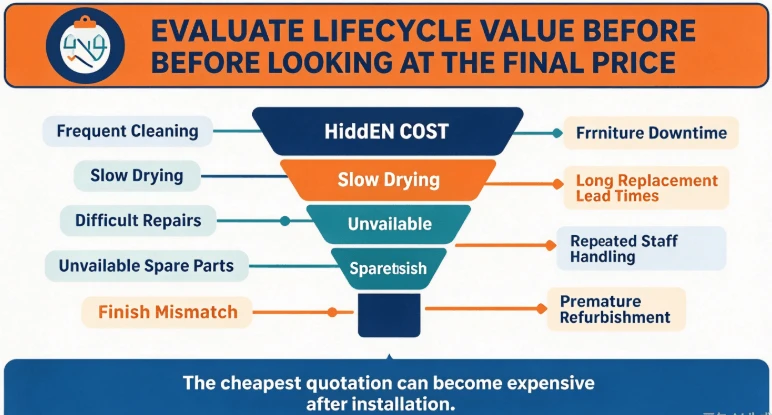
The cheapest quotation can become expensive after installation.
The expensive quotation can also be poor value if it specifies capabilities the site never uses.
That is why commercial furniture ROI should be treated as an operational question.
Where Furniture Creates Hidden Costs
A product can create cost through:
Frequent cleaning
Slow drying
Difficult repairs
Unavailable spare parts
Inconsistent replacement pieces
Finish mismatch
Long replacement lead times
Furniture downtime
Repeated staff handling
Premature refurbishment
These costs are rarely visible in the headline unit price.
The Five Questions Behind Commercial Furniture ROI
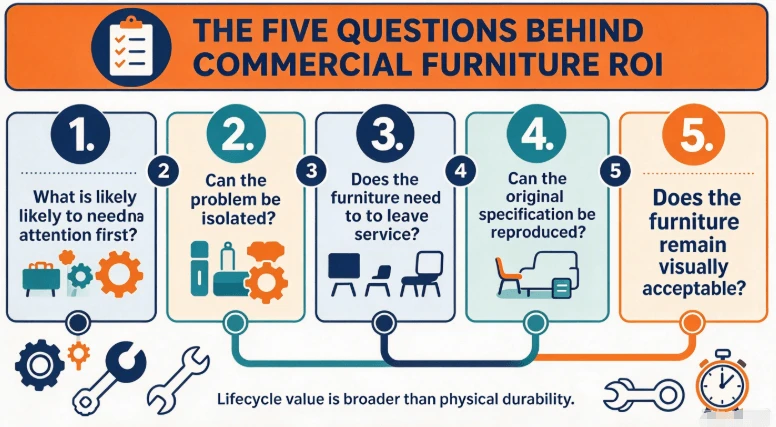
1. What is likely to need attention first?
Frame?
Finish?
Fabric?
Hardware?
Cushion?
2. Can the problem be isolated?
Can one component be replaced?
3. Does the furniture need to leave service?
One damaged module should not necessarily remove an entire seating area.
4. Can the original specification be reproduced?
This is especially important for multi-phase developments.
5. Does the furniture remain visually acceptable?
A product can remain functional while losing commercial value because it no longer looks consistent with the property.
That is why lifecycle value is broader than physical durability.
A Real-World ROI Comparison
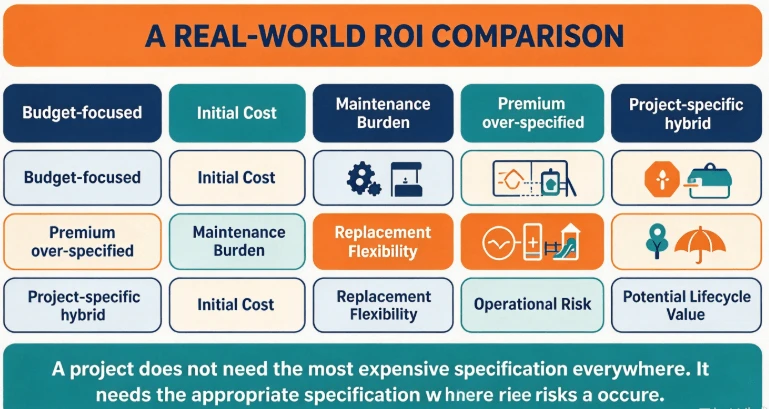
| Purchase Approach | Initial Cost | Maintenance Burden | Replacement Flexibility | Operational Risk | Potential Lifecycle Value |
|---|---|---|---|---|---|
| Budget-focused | Lower | Can be higher | Often limited | Higher if parts are difficult to source | Site-dependent |
| Balanced specification | Moderate | More predictable | Usually better | Moderate to low | Often strong |
| Premium over-specified | Higher | Potentially manageable | Usually good | Low in some areas | Not always justified |
| Project-specific hybrid | Varies | Matched to each zone | Can be strong | Controlled by zone | Often strongest when well planned |
The important word here is:
Appropriate.
A project does not need the most expensive specification everywhere.
It needs the appropriate specification where the risks actually occur.
How an OEM/ODM Outdoor Furniture Manufacturer Should Be Evaluated
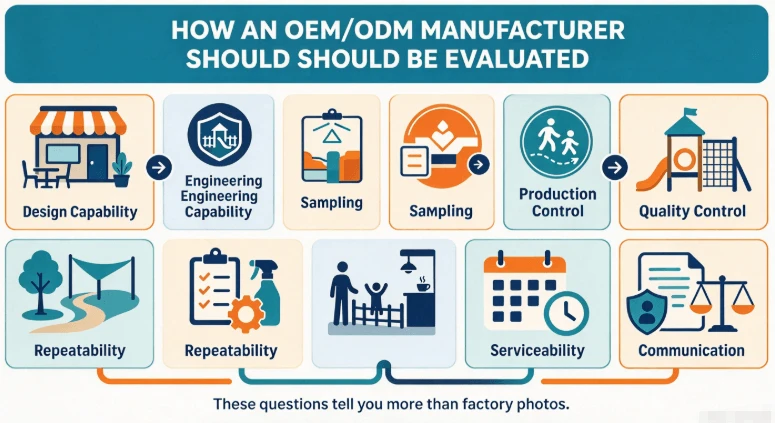
An OEM/ODM relationship is not only about manufacturing the sample.
The real test is repeatability.
Can the approved finish be reproduced?
Can a custom dimension be maintained across production?
Can the same frame detail be repeated in another order?
Can the supplier identify the approved fabric code?
Can future replacement pieces match the original?
Can packaging be standardized?
Can the factory communicate specification changes clearly?
These issues become increasingly important when one property expands into multiple locations.
OEM/ODM Supplier Evaluation
Design Capability
Can the supplier interpret drawings, sketches, reference products or project concepts?
Engineering Capability
Can design changes be evaluated instead of simply copied?
Sampling
Is there a controlled sample approval process?
Production Control
Does the factory use the approved specification as the production reference?
Quality Control
Are incoming materials, process stages and finished products checked?
Repeatability
Can the second production run match the first?
Serviceability
Can replacement components be supplied later?
These questions tell you more than factory photos.
What Makes Hospitality Outdoor Furniture Suitable for Different Zones?
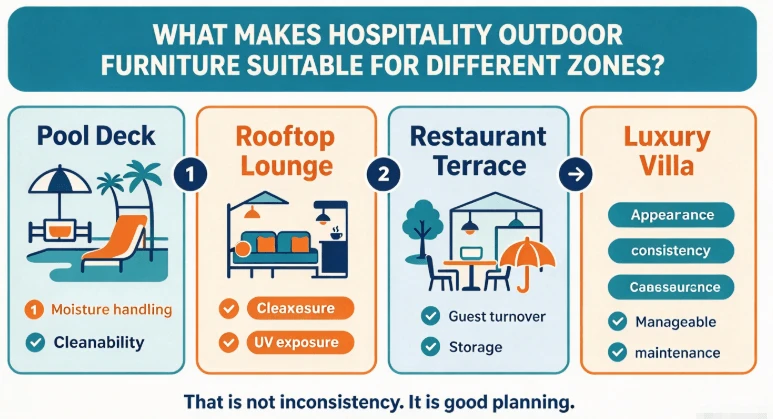
One property can contain several completely different outdoor environments.
That means the same material or furniture type does not necessarily need to be used everywhere.
Pool Deck
Prioritize:
🌊 Moisture handling
🧽 Cleanability
☀️ Sun exposure
🪑 Guest turnover
Rooftop Lounge
Prioritize:
🌬️ Site-specific wind conditions
☀️ UV exposure
🧰 Storage
🛋️ Flexible seating
Restaurant Terrace
Prioritize:
🪑 Frequent movement
🧹 Fast cleaning
📦 Storage efficiency
🎨 Appearance consistency
Luxury Villa
Prioritize:
🏡 Comfort
🌳 Natural materials
🎨 Design character
🛠️ Manageable maintenance
The best project may deliberately use different furniture specifications in each zone.
That is not inconsistency.
It is good planning.
How a Motorized Louvered Pergola Changes Furniture Planning
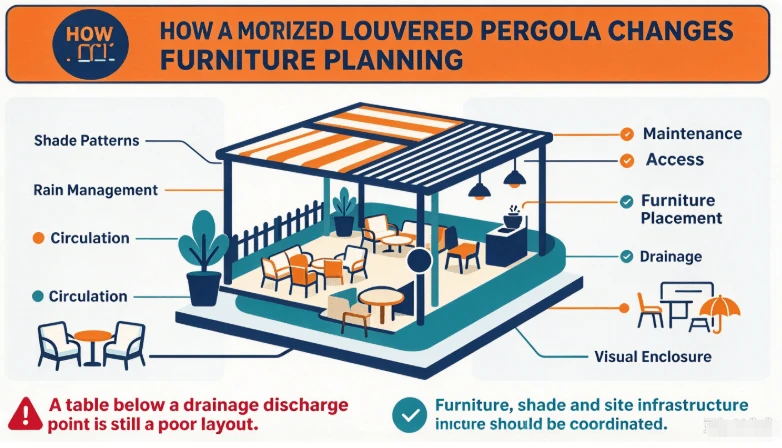
A shade structure can improve outdoor comfort, but it should not be treated as a complete solution to environmental exposure.
A pergola changes:
shade patterns
rain management
circulation
maintenance access
furniture placement
drainage
visual enclosure
The relationship matters.
A table placed directly below a drainage discharge point is still a poor furniture layout, regardless of how sophisticated the pergola is.
A sofa placed where maintenance staff cannot access the structure can create an operational problem.
A shade system may also introduce electrical or control requirements that are separate from the furniture specification.
For electrically operated outdoor systems, destination-market requirements should be assessed separately; for example, Intertek's ETL Mark is tied to its NRTL certification work in North America, while other markets can use different conformity frameworks.
Furniture, shade and site infrastructure should therefore be coordinated.
What Should Buyers Request From Suppliers Before Approval?
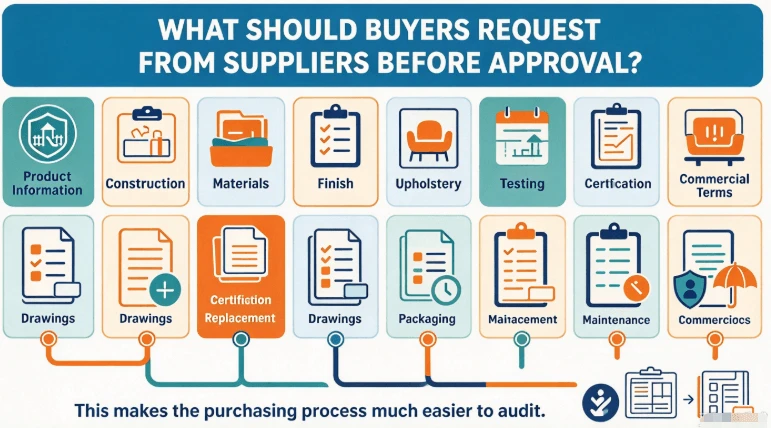
Do not simply ask:
"Send your catalog."
For a serious hospitality project, ask for a more useful technical package.
Product Information
Model name and dimensions.
Construction
Frame and joint information.
Materials
Specific material descriptions and applicable grades.
Finish
Finish system and approved color/reference.
Upholstery
Fabric and cushion construction.
Testing
Applicable test reports.
Certification
Relevant certificates and their scope.
Drawings
Product and project drawings where needed.
Packaging
Protection method for transport.
Replacement
List of serviceable components.
Maintenance
Care and cleaning instructions.
This makes the purchasing process much easier to audit.
A Better RFQ Structure for Hospitality Buyers
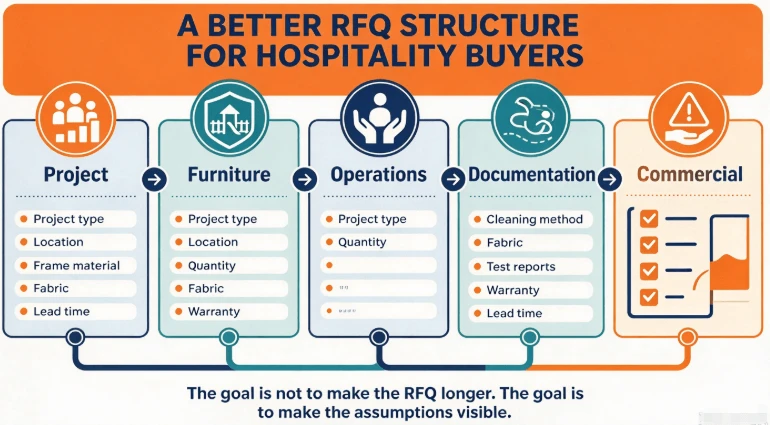
A supplier cannot provide an accurate quotation if the project brief is vague.
Include:
Project type
Project location
Furniture quantities
Outdoor exposure
Preferred material
Required dimensions
Finish
Fabric
Expected traffic
Customization
Testing requirements
Packaging
Delivery destination
Replacement expectations
The goal is not to make the RFQ longer.
The goal is to make the assumptions visible.
Sample Approval: Do Not Approve From Photographs Alone
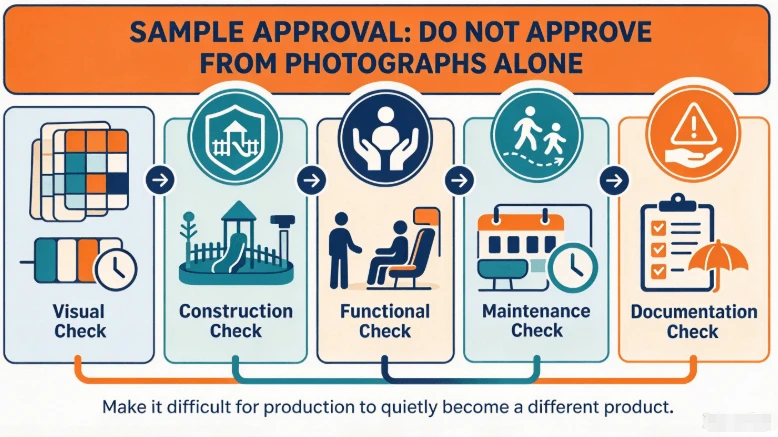
Photography is useful for design approval.
It is not enough for technical approval.
A serious sample review should include:
Visual Check
Color, proportions and overall appearance.
Construction Check
Joints, welds, connections and alignment.
Functional Check
Sit, move, stack or reconfigure where relevant.
Maintenance Check
Open covers, inspect access and consider cleaning.
Material Check
Confirm the material matches the approved specification.
Documentation Check
Verify the sample corresponds to the report or drawing being referenced.
The approval process should make it difficult for the production item to quietly become a different product.
The Supplier Comparison Matrix
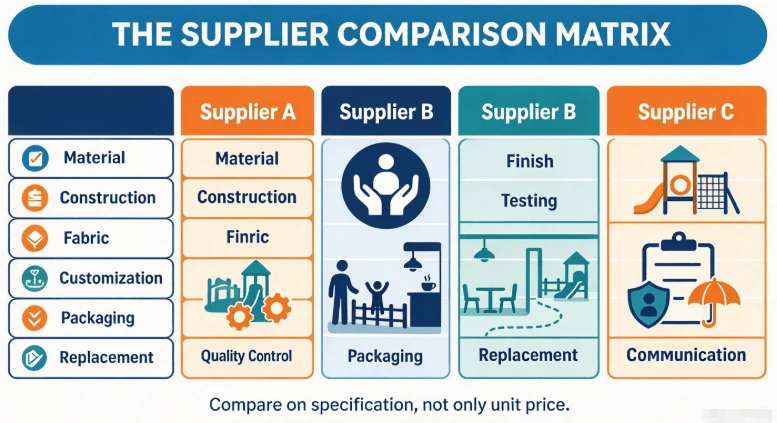
| Evaluation Area | What to Compare |
|---|---|
| Material | Exact material and relevant grade |
| Construction | Frame, joints, hardware |
| Finish | Surface preparation and coating system |
| Fabric | Performance and replacement |
| Testing | Exact model + test scope |
| Customization | Dimensions, color, fabric, structure |
| Quality control | Sample and production inspection |
| Packaging | Freight protection |
| Replacement | Availability of components |
| Communication | Clarity of technical information |
| Repeat orders | Ability to reproduce approved specification |
This is a more meaningful comparison than:
Supplier A = cheap
Supplier B = medium
Supplier C = expensive
A Visual "Red Flag" Checklist
🚩 "Commercial grade" is used without a specification.
🚩 The supplier cannot identify the exact material.
🚩 A certificate is shown without a model or scope.
🚩 "UV resistant" is claimed without test information.
🚩 Replacement parts are never discussed.
🚩 Finish samples are approved, but no production-control method is explained.
🚩 Different quotations are based on different fabric or frame specifications.
🚩 The supplier refuses to state assumptions in writing.
One red flag does not necessarily disqualify a supplier.
Several together should trigger deeper due diligence.
A Visual "Good Sign" Checklist
✅ The supplier asks about climate before recommending materials.
✅ Product specifications are written clearly.
✅ Testing is tied to specific models.
✅ Limitations are explained instead of hidden.
✅ Drawings are available when required.
✅ Replacement components are discussed before installation.
✅ Sample approval is treated as a controlled technical step.
✅ The supplier can explain how the approved specification will be repeated.
These are stronger signs of project competence than polished marketing language.
What Does "Commercial-Grade" Mean in Practice?
It means the furniture has been selected or designed around a commercial operating requirement.
That may include:
Frequent use
Public access
Operational cleaning
Repeated movement
Environmental exposure
Serviceability
Documentation
Consistent replacement
But commercial-grade does not mean:
automatically indestructible;
automatically suitable for coastal conditions;
automatically tested for every climate;
automatically superior to every residential product.
The phrase only becomes useful when the specification underneath it is clear.
Can Residential Furniture Ever Work in Hospitality?
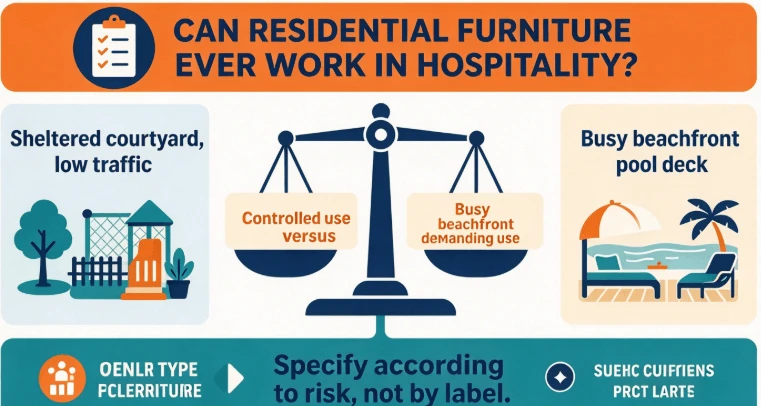
Yes.
A sheltered hotel courtyard with relatively low traffic may not require the same construction as a busy beachfront pool deck.
Likewise, a premium residential collection can sometimes outperform a poorly specified commercial product.
The distinction is therefore not:
Residential = bad
Commercial = good
The better distinction is:
Controlled use versus demanding use.
The buyer should specify according to risk.
Should Every Area in a Resort Use the Same Furniture?
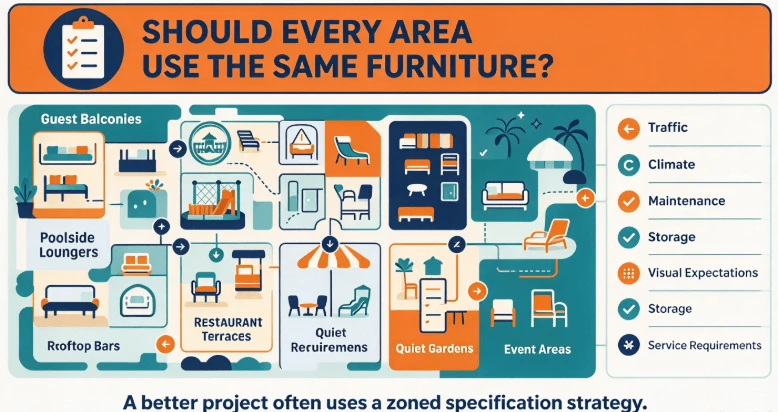
No.
This is one of the most useful conclusions in commercial procurement.
A resort may have:
guest balconies
poolside loungers
restaurant terraces
rooftop bars
quiet gardens
event areas
Each area has a different combination of:
traffic
climate
maintenance
storage
visual expectations
service requirements
Using one specification everywhere can actually reduce efficiency.
A better project often uses a zoned specification strategy.
The Final Seven-Factor Decision Framework
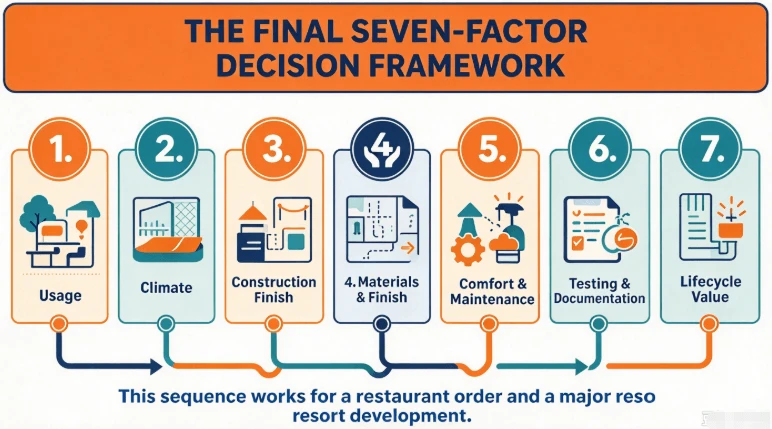
1. Usage
Determine how many users, how frequently, and how much movement the furniture will experience.
2. Climate
Map sun, rain, humidity, salt, wind and temperature exposure.
3. Construction
Inspect frame geometry, joints, welds, hardware and drainage.
4. Materials & Finish
Choose timber, metal, synthetic materials, coatings and textiles according to the site.
5. Comfort & Maintenance
Make sure guests are comfortable and staff can realistically clean and maintain the furniture.
6. Testing & Documentation
Match each technical claim to appropriate evidence.
7. Lifecycle Value
Evaluate replacement, serviceability, consistency and operational disruption-not just initial price.
This sequence can be used for a restaurant order just as effectively as for a major resort development.
The Final Procurement Checklist
Before final approval, ask:
☐ Is the intended use clearly defined?
☐ Has the environment been reviewed?
☐ Is the material appropriate for the site?
☐ Has the frame construction been checked?
☐ Have hardware and drainage been considered?
☐ Is the finish documented?
☐ Are fabric and cushion requirements clear?
☐ Are applicable tests identified?
☐ Do certification documents match the actual product?
☐ Are replacement components available?
☐ Can the approved specification be reproduced?
☐ Are quotations based on the same scope?
☐ Has the sample been physically reviewed?
☐ Are maintenance instructions available?
☐ Has lifecycle value been considered?
If several answers are still "no," the product may not yet be fully specified.
FAQs:
1. What should I look for when choosing commercial-grade outdoor furniture?
Start with usage and environment rather than price. Review traffic intensity, climate exposure, frame construction, materials, finish, fabric, testing, maintenance, replacement parts and the supplier's ability to reproduce the approved specification.
2. Which outdoor furniture material is best for hotels and resorts?
There is no single best option. Teak, aluminum, stainless steel, HDPE and mixed-material systems can all be suitable depending on climate, aesthetics, cleaning, handling and lifecycle requirements. The best material is the one whose characteristics fit the site's actual demands.
3. How important are third-party testing and certification?
They can be important, particularly when a project has formal procurement requirements. However, the buyer should verify the exact product, standard, test method and scope. A respected testing organization does not make an unrelated certificate automatically relevant to every performance question.
4. Does "commercial grade" guarantee outdoor durability?
No. "Commercial grade" is not a universal guarantee. A product still needs to be evaluated for its intended use, materials, construction, finish, climate, maintenance regime and applicable testing. The label should never replace a technical specification.
5. Is paying more for premium outdoor furniture worth it?
Sometimes, but not automatically. A higher specification can make sense when it improves serviceability, reduces maintenance effort, improves replacement flexibility, preserves visual consistency or addresses harsh environmental conditions. Paying more only makes sense when the extra specification solves a real project problem.
6. What should I ask an OEM/ODM outdoor furniture supplier before placing an order?
Ask for technical drawings, exact material information, finish specifications, fabric details, applicable test documentation, sample-approval procedures, quality-control processes, packaging details, replacement-part availability and clear production assumptions. The supplier should be able to explain both capability and limitations.
Conclusion
Choosing commercial-grade outdoor furniture is not really a question of finding the strongest product.
It is a question of fit.
Fit with the climate.
Fit with the traffic.
Fit with the maintenance routine.
Fit with the design intent.
Fit with the testing requirements.
Fit with the budget.
And, perhaps most importantly, fit with what happens after installation.
A luxury hotel may justify premium timber and highly coordinated finishes because appearance is part of the guest experience.
A restaurant may place greater value on handling, cleaning and storage.
A coastal resort may need to focus heavily on corrosion management and moisture behavior.
A rooftop venue may need a completely different approach to furniture stability and environmental exposure.
That is why the phrase commercial-grade outdoor furniture should never end the purchasing discussion.
It should begin it.
The strongest hospitality buyers do not ask a supplier to prove that a product is "good."
They ask the supplier to show:
what it is made from,
how it is built,
what it has been tested for,
where it is intended to be used,
how it should be maintained,
what happens when something fails,
and why the specification is appropriate for the project.
That is what turns outdoor furniture from a visual purchase into a professional hospitality asset.
Planning Outdoor Project?
Contact Our Engineering Team for Custom 3D Layouts & Project Quotations.