
High-velocity atmospheric turbulence presents a constant threat to commercial outdoor infrastructure. When ambient wind speeds cross 40 mph (64.3 km/h)-reaching Beaufort Scale 8 (Fresh Gale)-standard residential shade structures suffer immediate mechanical fatigue, structural warping, or dangerous base detachment. For resort operators, commercial procurement managers, and landscape architects, choosing a Patio Umbrella For Windy Areas is not a cosmetic decision; it is a structural engineering requirement designed to prevent severe liability risk and asset turnover. Engineering a high-wind shade solution requires aligning metallurgy, flexural rib mechanics, high-density fabric weaves, and dynamic anchorage.

Structural Metallurgy for Hotel Outdoor Patio Furniture in High-Wind Environments
The central pole serves as the primary structural spine of any market or cantilever shade assembly. Standard commercial market umbrellas intended for high-wind exposure rely on extruded aluminum alloy shafts to deliver exceptional strength without adding excessive weight. However, substantial metallurgical differences exist between structural alloy grades.
Commercial engineering specifies 6061-T6 aluminum alloy for primary load-bearing masts and structural hub housings. The T6 heat treatment artificially ages the alloy, pushing its ultimate tensile strength to 290 MPa and yield strength to 240 MPa. This high elastic limit enables the shaft to resist permanent bending under heavy wind shear. By contrast, 6063-T5 aluminum offers a smoother surface finish suited for intricate architectural profiles, but its lower yield strength (145 MPa) makes it better suited for secondary frame members or sheltered patio applications.

⚙️ METALLURGICAL SPECIFICATION Shaft geometry directly dictates bending resistance. High-wind commercial center poles require an outer diameter between 1.5 inches (38.1 mm) and 2.0 inches (50.8 mm), combined with a reinforced wall thickness of 0.08 inches (2.0 mm) to 0.125 inches (3.18 mm). Thin-walled poles (under 1.5 mm) quickly fracture at high-stress points, particularly around the table collar or base sleeve connection. Integrating heavy-duty hotel outdoor patio furniture equipped with wind-engineered aluminum shafts protects commercial properties from storm damage.
Primary Shaft Metallurgy: 6061-T6 aluminum alloy extruded pole, 38.1mm to 50.8mm outer diameter, minimum 2.0mm to 3.18mm wall thickness.
Secondary Architectural Trim: 6063-T5 aluminum components featuring high-definition powder coat adhesion.
Surface Coating Grade: Architectural powder coating certified to AAMA 2605 or QUALICOAT Class 2 specifications.
Assembly Hardware: Grade 316 stainless steel bolts, pivot pins, and securing screws to prevent galvanic corrosion.
| Structural Element | Material Grade / Alloy Spec | Standard Dimensions / Wall Thickness | Mechanical Tensile / Yield | Corrosion Endurance Rating |
|---|---|---|---|---|
| Central Support Mast | 6061-T6 aluminum alloy | 38.1mm – 50.8mm OD x 2.0mm – 3.18mm Wall | Tensile: 290 MPa / Yield: 240 MPa | 5,000h Salt Spray (AAMA 2605) |
| Architectural Trim / Hubs | 6063-T5 aluminum | Custom extruded profile shapes | Tensile: 185 MPa / Yield: 145 MPa | QUALICOAT Class 2 Seaside Grade |
| Flexible Frame Ribs | Pultruded Solid Fiberglass | 12.0mm – 12.7mm solid round rods | Flexural Strength: >600 MPa | Impervious to moisture and rust |
| Joint Fasteners & Pins | 316 Stainless Steel | M6 / M8 marine fasteners | Tensile: 580 MPa / Yield: 290 MPa | High resistance to marine salt air |
Surface protection is vital for maintaining long-term metal strength. Marine environments subject metal components to continuous salt spray, triggering rapid pitting corrosion if unprotected. Specifying powder coatings compliant with AAMA 2605 or QUALICOAT Class 2 ensures the frame uses high-durability fluoropolymer resins. These coatings withstand 5,000 hours of continuous salt spray testing and preserve color integrity against harsh UV degradation.
Aerodynamic Canopy Design and Flexural Rib Mechanics for Custom Made Outdoor Patio Furniture
In severe wind storms, rigid frame components made of wood or hollow aluminum often snap at pivot points. Modern engineering replaces rigid resistance with dynamic flexibility. Pultruded fiberglass ribs have become the industry standard for high-wind commercial umbrellas. Solid fiberglass ribs measuring 12.0 mm to 12.7 mm in diameter exhibit exceptional flexural memory. When hit by a 40+ mph wind gust, solid fiberglass rods bend and absorb kinetic energy, shedding air load before springing back to their original position without cracking or permanent deformation.
Facilities seeking tailored architectural branding often specify custom made outdoor patio furniture to harmonize structural stability with high-end exterior aesthetics. Furthermore, canopy aerodynamics play a crucial role in reducing uplift force. A single-layer canopy without venting acts like a sail, catching air currents and generating tremendous upward lift that can overturn heavy bases. Incorporating a dual wind vent or double-canopy system allows high-velocity wind currents to pass freely through the primary cap. This releases air pressure underneath the fabric while maintaining full shade coverage.
Fabric weight and thread density dictate tear resistance under cyclic wind stress. Inexpensive polyester fabrics rapidly degrade under UV exposure and tear around rib pocket seams during strong wind gusts. Commercial specifications require 100% solution-dyed acrylic fabrics with a weight threshold between 300 gsm and 320 gsm (9.0 to 9.5 oz/yd²).
Solution-Dyeing Process: Color pigments are added directly to the liquid polymer matrix before fibers are extruded. This ensures full-depth color saturation that resists UV bleaching.
Mass Pigmentation Benefits: Prevents fabric thinning, maintains water repellency, and preserves structural integrity.
Reinforced Stress Points: Canopy pockets feature four-layer fabric reinforcements and heavy-duty stitching to prevent fiberglass ribs from punching through under heavy wind load.

| Canopy Fabric Type | Material Weight / Density | Dyeing Method | Water Column Resistance | UV Colorfastness Standard | Mechanical Wind Shear Performance |
|---|---|---|---|---|---|
| Marine Commercial Acrylic | 300 gsm – 320 gsm | 100% Solution-Dyed Acrylic | >350 mm hydrostatic head | ISO 4892-2 Class 7-8 (4,000h) | High tear strength; resists pocket blowing |
| High-Tenacity Olefin | 230 gsm – 260 gsm | Solution-Dyed Olefin Filament | >250 mm hydrostatic head | ASTM G154 Grade 4-5 (1,200h) | Moderate; susceptible to pocket stretching |
| Surface-Dyed Polyester | 160 gsm – 180 gsm | Dip-Dyed Surface Coating | <150 mm hydrostatic head | Fades rapidly in direct sun | Poor; tears easily along stress seams |
Solution-dyed fabrics undergo rigorous laboratory testing to verify performance. Standards like ASTM G154 (accelerated weathering) and ISO 4892-2 (Xenon-arc exposure) confirm that 320 gsm solution-dyed acrylic maintains its tensile strength and color even after 4,000 hours of continuous sun and moisture exposure.
Anchoring Dynamics and Physics of a Cantilever Patio Umbrella With Base
Center-pole umbrellas distribute downward gravity loads directly along their vertical axis, making them stable when paired with a properly weighted base sleeve. However, modern hospitality layouts often require open, unobstructed floor space, driving demand for offset cantilever designs. An offset Cantilever Patio Umbrella With Base suspends its canopy from a side mast, introducing rotational torque and fulcrum leverage that multiply wind forces.
To operate safely in 40+ mph wind conditions, a cantilever system requires reinforced structural engineering. The offset mast must use heavy rectangular or oval 6061-T6 aluminum extrusions reinforced with internal support gussets. Adjustable tilt mechanisms should be avoided in high-wind zones, as internal tilt gears create mechanical weak points under strong side winds. Heavy-duty internal steel cables combined with a smooth hand-crank winch provide reliable opening and closing without compromising mast strength.
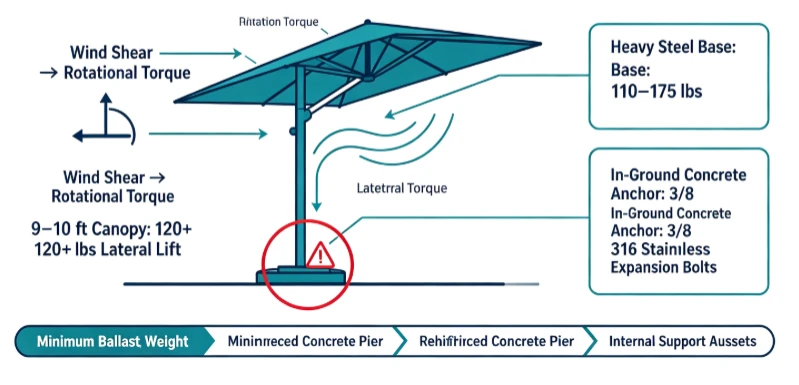
🛡️ ANCHORAGE SAFETY BENCHMARK Offset masts convert lateral wind shear into intense rotational torque at the ground mounting plate. Base weight calculations must account for total canopy surface area. A 9-foot canopy exposed to 40 mph winds generates over 120 lbs of lateral lift force. Using a light 40 lb base in this scenario creates an immediate safety hazard. Commercial pool decks and dining areas should install heavy 110 lb to 175 lb bases or anchor the mounting flange directly into reinforced concrete using 316-grade stainless steel expansion bolts.
| Umbrella Design & Size | Wind Resistance Speed | Mounting Method | Minimum Ballast Weight | Structural Ground Anchor Requirement |
|---|---|---|---|---|
| 7.5 ft – 9.0 ft Center Pole | Up to 40 mph (64 km/h) | Standalone Deck Mounting | 110 lbs – 125 lbs (50kg – 56.7kg) | Heavy steel plate with 18" tall steel sleeve |
| 9.0 ft – 11.0 ft Center Pole | Up to 45 mph (72 km/h) | Installed Through Commercial Table | 75 lbs – 100 lbs (34kg – 45.3kg) | Dual locking knobs on base stem assembly |
| 10.0 ft – 13.0 ft Cantilever | Up to 40+ mph (64+ km/h) | Direct In-Ground Concrete Anchor | In-ground concrete pier | 3/8" Grade 316 stainless expansion bolts |
| 10.0 ft – 13.0 ft Cantilever | Up to 35 mph (56 km/h) | Heavy Steel Frame Base Plate | 160 lbs – 250+ lbs (72.5kg – 113kg) | Steel frame weighted with concrete pavers |
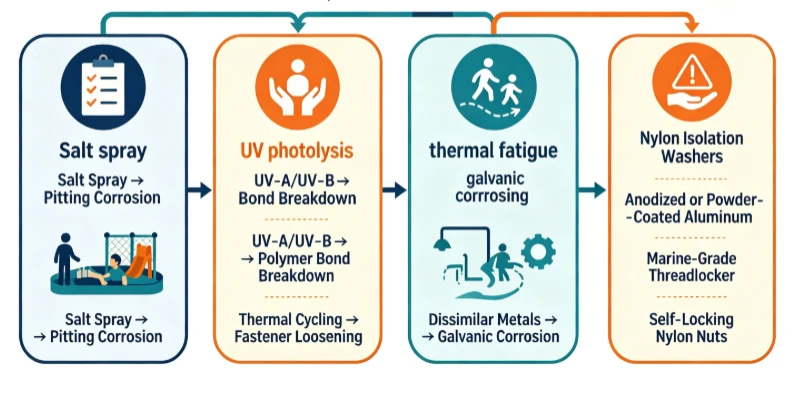
Environmental Degradation: Salt Spray, Photolysis, and Thermal Fatigue
Commercial outdoor furniture used at coastal resorts or poolside decks operates in extremely demanding environments. Atmospheric salt spray accelerates galvanic corrosion where different metals touch, such as stainless steel rivets installed in aluminum frame joints. Coastal installations require insulating nylon washers at all metal touchpoints, along with anodized or powder-coated aluminum surfaces certified to QUALICOAT Class 2 or AAMA 2605.
Solar UV-A and UV-B radiation triggers polymer photolysis, breaking down synthetic chemical bonds in low-grade fabrics. Standard fabrics lose structural strength within a single season of intense sun exposure, making them prone to tearing during sudden wind gusts. Marine-grade solution-dyed acrylic avoids this degradation by embedding UV-stabilized pigments directly into the liquid polymer matrix.
Thermal fatigue occurs during rapid daily temperature shifts, causing aluminum shafts and solid fiberglass components to expand and contract at different rates. Over time, this differential movement can back out standard threaded screws. Commercial-grade manufacturing prevents fastener loosening by utilizing self-locking nylon nuts, marine-grade threadlockers, and structural assembly adhesives tested in accredited laboratories.
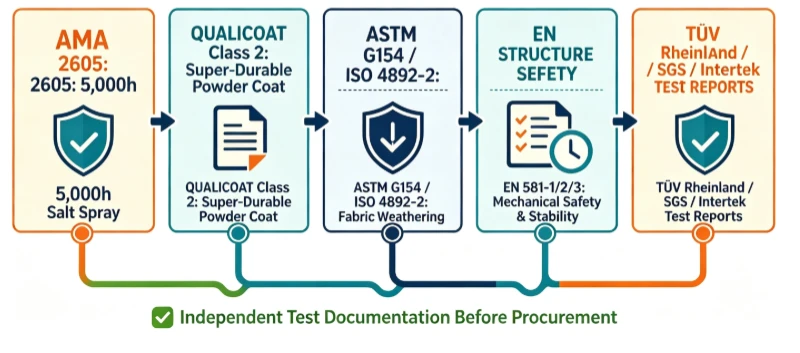
To ensure equipment meets safety and durability requirements, procurement managers should verify key third-party certifications:
EN 581 (Parts 1–3): European mechanical safety, stability, and load-capacity standards for commercial outdoor furniture.
AAMA 2605: Highest architectural coating standard for aluminum extrusions, requiring 5,000 hours of continuous salt spray testing.
QUALICOAT Class 2: European quality benchmark for super-durable powder coatings, requiring 3-year outdoor weathering resistance.
ASTM G154 / ISO 4892-2: Accelerated laboratory weathering standards for testing material colorfastness and fabric strength.
Certified test documentation issued by independent testing bodies like TUV Rheinland, SGS, Intertek, and the CPSC.
Commercial Investment Analysis: Total Cost of Ownership and ROI
From a procurement perspective, buying commercial shade equipment requires balancing initial capital expenditure (CapEx) against long-term operational expenses (OpEx). Choosing low-cost, residential-grade umbrellas reduces initial purchasing costs, but these lighter units often fail within 3 to 6 months in demanding commercial environments, driving up total equipment costs over time.
📊 COMMERCIAL ROI EVALUATION Consider a 200-seat outdoor venue deploying 20 umbrellas over a 5-year operating period. Purchasing residential-grade units at $150 each with an average lifespan of 6 months requires 10 full replacement cycles over 5 years. This results in $30,000 in direct hardware costs, plus labor overhead and service disruption during downtime.
Investing in commercial-grade wind-rated umbrellas-built with 6061-T6 aluminum alloy shafts, 12.7mm fiberglass ribs, 320 gsm solution-dyed acrylic canopies, and AAMA 2605 protective powder coatings-costs roughly $600 per unit ($12,000 total initial investment). Because these commercial units are engineered to handle 40+ mph wind gusts and harsh weather, they remain in service across the entire 5-year lifecycle. This approach saves $18,000 in replacement costs while eliminating safety risks and guest injury liabilities.

| Cost & Performance Factors | Residential / Light Commercial Umbrellas | Engineered High-Wind Commercial Umbrellas | Long-Term Operational Impact |
|---|---|---|---|
| Initial Procurement Cost | Low Baseline ($150 / unit) | Moderate ($600 / unit) | Higher initial CapEx offset by extended lifecycle |
| Average Service Lifespan | 3 to 6 Months in high wind | 5+ Years Continuous Commercial Use | Eliminates constant repurchasing cycles |
| Structural Failure Rate | High; poles bend and ribs snap | Minimal; fiberglass flexes and recovers | Protects guest safety and prevents venue liability |
| Maintenance Overhead | High; frequent rib and fabric repairs | Zero; routine tap water washing | Reduces property labor costs |
| 5-Year Total Investment | $30,000+ (Multiple replacements) | $12,000 (Single capital investment) | Yields significant overall operating savings |
FAQ:
1. What frame specifications are required for a patio umbrella for windy areas to survive 40+ mph wind gusts?
Key structural requirements include a central pole made of 6061-T6 aluminum alloy with a minimum wall thickness of 2.0 mm (0.08 inches), solid 12.0 mm to 12.7 mm fiberglass ribs that bend without snapping, dual canopy wind vents, and Grade 316 stainless steel assembly hardware.
2. Why are fiberglass ribs preferred over aluminum or wood in windy environments?
Solid fiberglass ribs offer superior flexural elasticity. Unlike hollow aluminum ribs, which can warp under severe loads, or wooden ribs, which rot and break, solid fiberglass bows under heavy wind gusts to shed wind pressure, then springs back to its original shape.
3. What fabric weight and dyeing process are necessary for commercial shade canopies?
Commercial venues require 100% solution-dyed acrylic fabrics with a weight density of 300 gsm to 320 gsm (9.0 to 9.5 oz/yd²). Solution-dyeing locks UV-stable pigments inside the fiber before extrusion, offering far greater tear strength and fade resistance than light surface-dyed fabrics.
4. How do offset cantilever umbrellas perform in strong winds compared to center-pole models?
Center-pole umbrellas transfer downward loads directly through their vertical axis, providing strong natural balance. A cantilever patio umbrella with base introduces rotational torque at its offset connection, requiring reinforced mast extrusions, fixed hub joints, dual canopy vents, and heavy ballast bases (160+ lbs) or direct concrete anchor bolts to operate safely.
5. Which powder coating certifications should coastal resorts look for?
Coastal facilities should specify aluminum finishes certified to AAMA 2605 or QUALICOAT Class 2. These high-performance fluoropolymer coatings undergo 5,000 hours of continuous salt-spray testing to ensure long-term resistance to metal corrosion and surface degradation.
6. What structural testing certifications confirm outdoor umbrella safety?
Look for products compliant with EN 581 (Parts 1–3) for structural stability, ASTM G154 or ISO 4892-2 for accelerated UV weathering, and official test documentation from independent accredited laboratories such as TUV Rheinland, SGS, Intertek, or CPSC compliance records.
Summary of Key Procurement Takeaways
Deploying shade infrastructure in exposed hospitality settings demands strict adherence to engineering specs. Specifying a Patio Umbrella For Windy Areas engineered with 6061-T6 aluminum masts, 12.7mm solid fiberglass ribs, 320 gsm solution-dyed acrylic fabric, and AAMA 2605 powder coatings protects capital investments, ensures guest safety, and maintains pristine exterior aesthetics across commercial properties.