
An architectural shade asset represents a significant capital expenditure that faces immediate environmental degradation. For structural engineers, landscape designers, and procurement managers, specifying a premium aluminum pergola system is only the first step. The true challenge lies in long-term structural maintenance. When these structural systems are deployed in high-traffic commercial environments, standard household cleaning methods are completely inadequate.
If you do not know exactly how to maintain an aluminum pergola, environmental exposure to ultraviolet rays, salt air, and acid rain will eventually degrade its structural finish and cause mechanical drive system failures.
Architectural shade installations do not degrade uniformly. Degradation occurs at specific environmental thresholds-where structural movement, moisture retention, and electrochemical oxidation intersect. Preserving these large-scale shade assets requires a systematic approach to structural care, material science, and mechanical tuning. As a premier aluminum outdoor furniture supplier, we know that structural durability depends heavily on regular, technical maintenance protocols.
🛡️ Section 1: The Mechanical and Structural Maintenance Subsystems
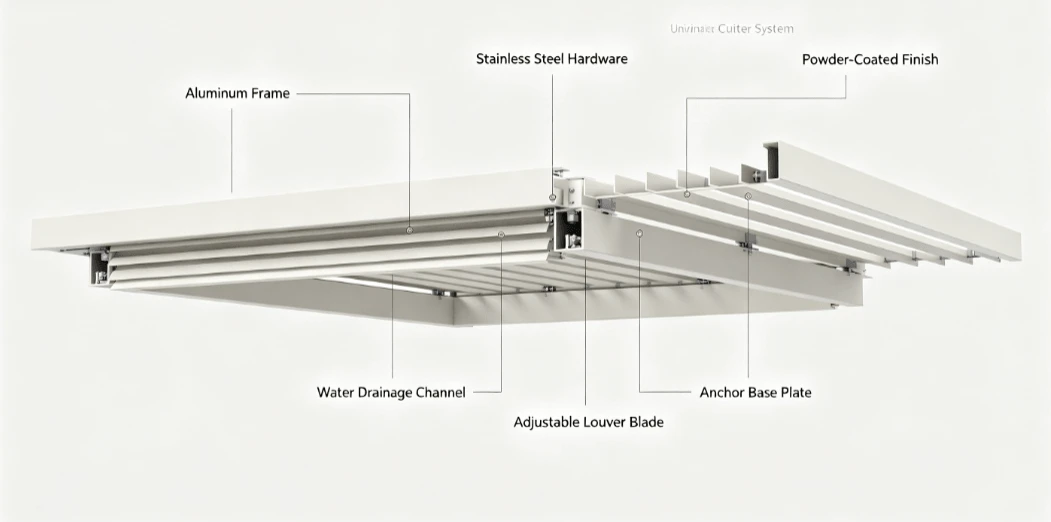
Modern exterior shade structures are highly complex mechanical systems. A motorized louvered roof system features multiple moving parts, internal drainage networks, and electrical drive mechanisms that require regular, structured inspections.
1. Motorized Louver Pivot Joints and Bearings
The drive mechanism of a modern shade structure converts rotational force into linear movement to adjust the roof blades. If internal friction increases due to dust accumulation, the electric motor can experience premature thermal overload.
Lubrication Protocol: Apply a specialized PTFE dry-film lubricant to all nylon pivot bearings and stainless steel drive rods every six months. Do not use standard wet petroleum lubricants, which attract abrasive airborne dust and accelerate gear wear.
Alignment Verification: Cycle the motorized roof system completely open and closed. Listen closely for asynchronous clicking sounds, which indicate that a tracking arm is misaligned or a mechanical fastener has shifted out of tolerance.
2. Internal Gutters and Downspout Drainage
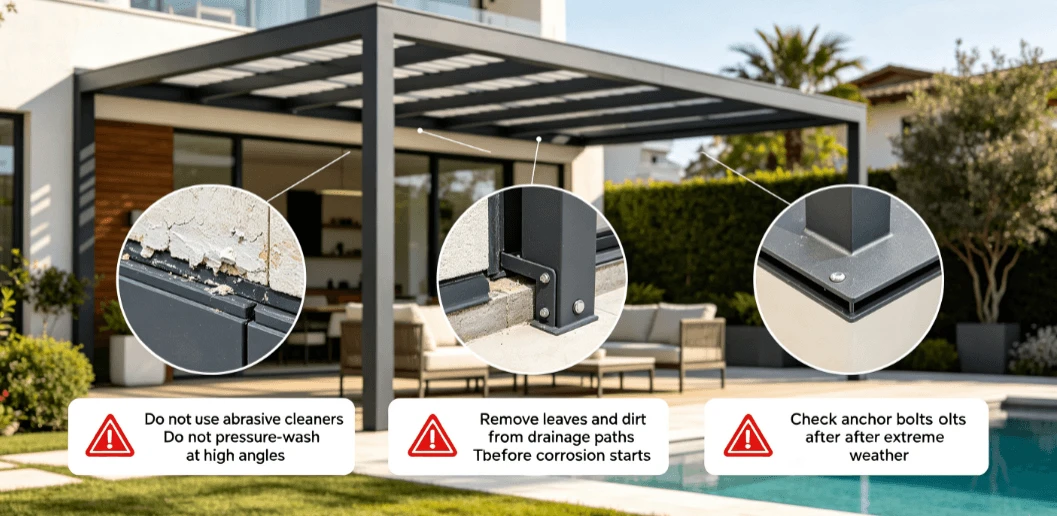
Premium structural systems feature hidden internal gutters designed to divert heavy rain down through the support posts. If leaves or organic debris block these channels, standing water can quickly pool inside the structural beams.
Debris Extraction: Clear out the primary internal collector channels before the autumn leaf drop and right after the spring pollen season. Use a flexible brush or low-pressure water flush to ensure downspout openings remain clear.
Sealant Inspection: Check the internal polyurethane joint sealants along the gutter intersections annually. Thermal expansion and contraction can create micro-tears in these seals, leading to water leaks inside the electrical wiring channels.
📋 Section 2: Coating Preservation and Chemical Interaction Limits
The long-term durability of an outdoor structure depends heavily on the condition of its surface coating. High-performance aluminum structures rely on advanced powder-coated finishes to isolate the bare metal substrate from atmospheric moisture and oxygen.
Detergent and Solvent Chemical Compatibility Matrix
| Chemical Compound Group | Qualicoat Class 2 Powder | Anodized Aluminum | EPDM Rubber Seals | Grade 316 Fasteners |
| Mild pH-Neutral Soap (pH 6–8) | 🟢 Fully Compatible | 🟢 Fully Compatible | 🟢 Fully Compatible | 🟢 Fully Compatible |
| Phosphoric Acid Cleaners | ❌ Strips Topcoat | 🟡 Heavy Pitting Risk | ❌ Causes Cracking | 🟢 Surface Brightener |
| Sodium Hypochlorite (Bleach) | 🟡 Coating Fading | ❌ Heavy Corrosion | 🟡 Accelerates Aging | 🟡 Surface Staining |
| Aromatic Hydrocarbons (Xylene) | ❌ Dissolves Resins | 🟡 Strips Seal Layers | ❌ Melts Rubber | 🟢 Chemically Inert |
| Deionized Water Rinse | 🟢 Recommended | 🟢 Recommended | 🟢 Recommended | 🟢 Recommended |
Legend: 🟢 Recommended/Safe | 🟡 Restrictive/Use Caution | ❌ Prohibited/Destructive
Allowing airborne grime, salt particles, and sulfur dioxide to sit on an unmaintained structure creates an aggressive electrochemical film. Over time, this buildup causes surface chalking and bubbling. The table below details how quickly these coatings degrade under different environmental conditions without proper care.
Coating Degradation Timelines by Environmental Zone
| Environmental Exposure Zone | Primary Coating Threat | Surface Finish Lifespan | Required Wash Cycle | Recommended Protective Coating |
| Marine / Coastal (< 1 Mile) | Sodium Chloride Pitting | 3–5 Years | Quarterly | Fluoropolymer Marine Wax |
| Industrial / Urban | Sulfur Dioxide & Acid Rain | 6–8 Years | Every 6 Months | Silicone Dioxide Ceramic Coating |
| Arid / Desert High-UV | Photo-Oxidation Polymer Break | 5–7 Years | Every 6 Months | UV-Blocking Polymer Sealer |
| Standard Suburb Landscape | Organic Pollen & Bird Droppings | 12–15 Years | Annually | Mild Detergent Wash Only |
☀️ Section 3: Managing High-Traffic Commercial Properties
Shade structures installed in commercial spaces, such as a luxury hotel pergola or a high-exposure pool pergola, face heavy daily use. They require extra maintenance steps to ensure guest safety and prevent premature structural wear.
When managing outdoor furniture for commercial projects, maintenance crews should stick to a strict inspection schedule. Pay close attention to structural connections, anchor bolts, and electrical grounding arrays to keep the installation safe and operational.
Structural Joint and Anchor Inspection Specifications
| Structural Connection Point | Fastener Hardware Type | Engineering Failure Mode | Daily Stress Catalyst | Required Correction Action |
| Baseplate Anchor Bolts | Concrete Wedge Anchors | Galvanic Corrosion | Structural Wind Shear | Annual Torque Check to 45 Nm |
| Louver Drive Linkage | Stainless Shoulder Bolts | Thread Backout | Motorized Cycle Torque | Re-apply Medium Threadlocker |
| Beam-to-Post Intersections | Internal Corner Brackets | Structural Sagging | High Snow Accumulation | Check Bracket Alignment Tightness |
Property managers can significantly reduce unexpected down-time by setting up structured maintenance routines. This proactive approach ensures large exterior shade systems remain safe, attractive, and fully functional for years to come.
🧪 Section 4: Industry Testing Standards and Quality Certifications
When engineering high-end architectural products, structural claims must be backed by rigorous laboratory testing. A premium outdoor system should meet or exceed these global engineering standards:
Qualicoat Class 2 (Super Durable) Certification: Verifies the powder-coated finish uses premium architectural grade resins, providing excellent gloss retention and chalking resistance under intense solar radiation.
Qualanod Anodizing Standard: Validates that all anodized mechanical components feature a thick, dense protective oxide layer to prevent corrosion in high-humidity zones.
ISO 9227 Salt Spray Testing: Subjects structural frames to thousands of hours of continuous, highly corrosive salt fog to prove long-term durability in tough coastal settings.
TÜV Rheinland Structural Certification: Confirms the complete assembled pergola structure passes rigorous wind load safety tests and mechanical stability evaluations.
CE Mechanical Safety Compliance: Ensures the electrical motorized drive systems, control boxes, and automated wind sensors meet all relevant safety and operational directives.
❓ FAQ
Q1: Can a high-pressure power washer be used safely to clean an aluminum frame?
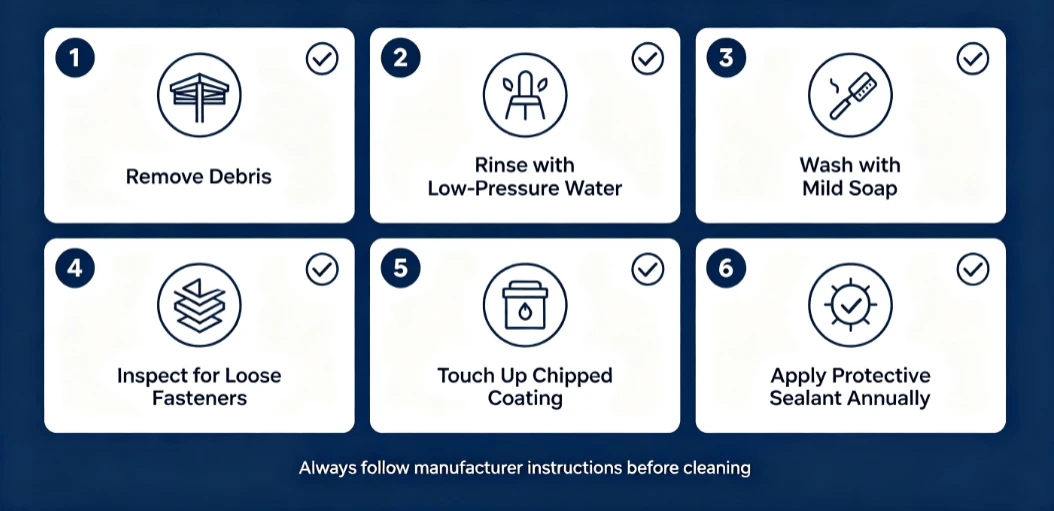
No. High-pressure washing should never be used on powder-coated aluminum joints or motorized sections. Water pressure over 1500 PSI can force moisture past the internal rubber gaskets, damaging electrical wiring and washing out factory grease from the drive bearings. Stick to a low-pressure garden hose combined with a soft nylon car-wash brush.
Q2: How do you identify and treat galvanic corrosion on an outdoor structure?
Galvanic corrosion shows up as a white, powdery blister forming where stainless steel fasteners directly touch the aluminum frame. This happens when moisture creates an electrical bridge between two different metals. To fix it, remove the fastener, clean away the corrosion, and reinstall it using a non-conductive nylon isolation washer or an anti-seize barrier paste.
Q3: What steps should be taken to prepare a louvered roof structure for freezing winter conditions?
Before freezing temperatures arrive, open the motorized roof blades to a 45-degree angle. This position prevents heavy snow from piling up on the roof and stops ice from freezing the louvers together. If the blades freeze shut, running the electric motor can strip the drive gears or burn out the motor windings.
Q4: Why is a dry-film PTFE spray preferred over standard multi-purpose lubricants?
Multi-purpose lubricants like WD-40 leave a wet, oily residue that traps airborne dust, sand, and pollen. This mixture forms an abrasive paste that grinds down moving parts. Dry-film PTFE lubricants spray on wet but dry quickly into a slick, clean layer that repels dirt while reducing friction.
Q5: How often do the automated wind and rain override sensors require calibration?
Automated sensors should be checked and calibrated every six months. Dust, bird droppings, or spiderwebs on the anemometer cups or optical rain sensors can block readings. Clean the sensor faces with a damp cloth and test the automatic override system to ensure it opens or closes the roof correctly during unexpected weather.
Q6: What causes a powder-coated surface to develop a dull, chalky appearance, and can it be fixed?
Chalking happens when prolonged exposure to intense UV radiation breaks down the polymers in the powder coat resin, leaving behind loose pigment particles. If the damage is caught early, you can restore the finish by cleaning the frame with a specialized chalk-remover solution and applying a protective marine-grade UV-inhibitor wax.
Q7: How do you address minor surface scratches on an aluminum frame before they worsen?
Although aluminum doesn't rust like steel, deep scratches expose the bare metal to oxidation, which can cause the surrounding paint to lift over time. Clean the scratch thoroughly with isopropyl alcohol, apply a thin coat of zinc-rich primer, and fill the scratch using an exact-match architectural touch-up paint pen to restore the protective seal.
Q8: Are hidden internal gutter systems prone to insect blockages or debris clogs?
Yes. Wasps, spiders, and birds often try to build nests inside the quiet, protected downspout openings. Installing a fine stainless steel mesh guard over the gutter entry points blocks debris and pests while letting rainwater drain freely down through the posts.