

Not automatically. Outdoor teak does not need an added coat of oil simply because it has started turning grey. Where the manufacturer permits natural weathering, leaving the timber untreated can be a deliberate appearance choice. Furniture supplied with an oiled or other factory-applied finish needs the care programme for that particular finish.
For a hotel, the decision is also operational. Retaining a warm timber colour can involve preparation, treatment, drying time and repeat work across an entire terrace. Accepting a silver-grey appearance avoids that particular colour-maintenance commitment, but it does not remove cleaning or inspection.
Before ordering teak oil, establish what is already on the furniture and what appearance the property intends to maintain. Those two answers are more useful than a universal instruction to oil every season.
Why teak-care advice seems contradictory
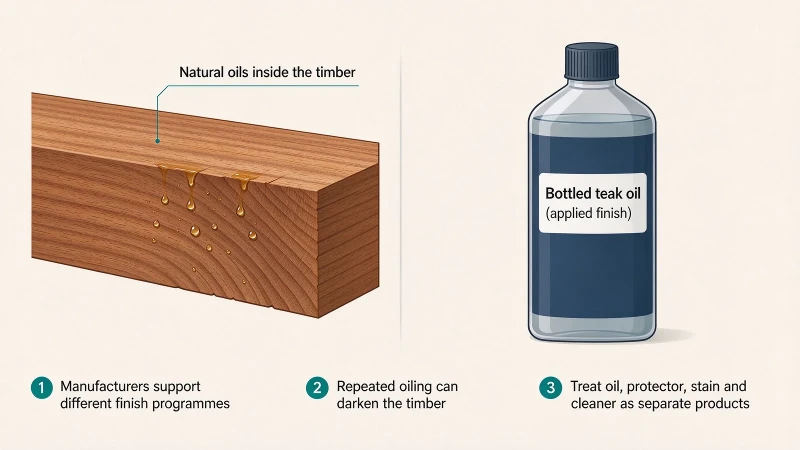
The oil inside teak and a product labelled "teak oil" are different things
Teak's naturally occurring oils are part of the timber. A bottled care product is an applied finish with its own ingredients and instructions. Its name alone does not establish that it is appropriate for every teak surface.
For a concrete example, Barlow Tyrie's 4TO product sheet identifies linseed oil in its teak-oil formulation. That tells a buyer something about that product; it is not a recipe shared by everything sold under the same name.
Treat an oil, colour protector, stain treatment and cleaner as different purchasing items. Specify the actual product and its purpose. "Use teak care products" leaves too much room for a maintenance contractor to select something the furniture supplier has never approved.
Manufacturers support different finish programmes
There is genuine disagreement in published care guidance. Westminster Teak's FAQ discourages teak oil on furniture placed outdoors, citing an increased likelihood of mould and mildew. In contrast, MasayaCo's care guide says its outdoor teak furniture is delivered oiled and describes maintaining its honey tone or allowing it to develop a silver patina.
The practical conclusion is not that either instruction can be transferred to every supplier. These brands describe their own products and care approaches. The condition of the timber, supplied treatment and chosen maintenance product all belong in the decision.
This matters when a hotel replaces furniture in phases. Two chairs that look similar in a photograph may arrive with different finishes and require different treatment. A single housekeeping instruction based only on the word teak can create an avoidable mismatch.
More oil is not necessarily better
Oiling is not a response to every appearance change. Barlow Tyrie's teak-oil description warns that repeated application makes the timber darker and discourages repeated use for that reason.
For a property trying to preserve a light, warm appearance, repeated treatment without reviewing the result can work against the design brief. Evaluate the dry, finished appearance of an approved trial rather than assuming another coat will improve it.
The same restraint applies to dark patches. Dirt, existing treatment and other surface conditions need assessment before a product is applied. Adding oil to disguise an unexplained mark can leave the underlying issue unresolved and make the appearance harder to evaluate.
Choose the appearance before choosing a treatment
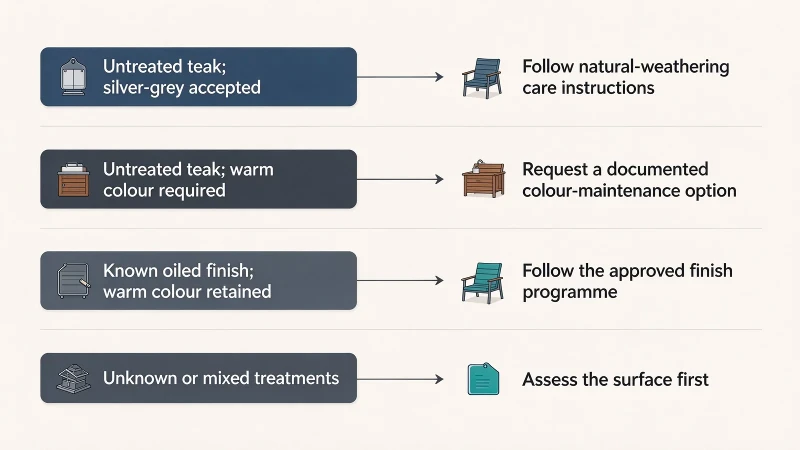
A finish decision should involve the designer, purchasing team and operator. They are agreeing on the appearance guests will see and the work required to sustain it, not just approving a delivery-day colour sample.
| Existing condition and intended look | Sensible starting decision | What needs agreement |
|---|---|---|
| Untreated teak; silver-grey appearance accepted | Follow the manufacturer's natural-weathering care instructions | Cleaning, inspections and acceptable variation |
| Untreated teak; warm colour required | Request a compatible, documented colour-maintenance option | Product, preparation, expected appearance and repeat work |
| Known oiled finish; warm colour to be retained | Follow the approved maintenance programme for that finish | Reapplication conditions, preparation and service interruption |
| Unknown or mixed previous treatments | Identify the surface and obtain a suitable assessment first | Compatibility and a trial before any site-wide treatment |
Natural silver-grey is an appearance option, not a cleaning exemption
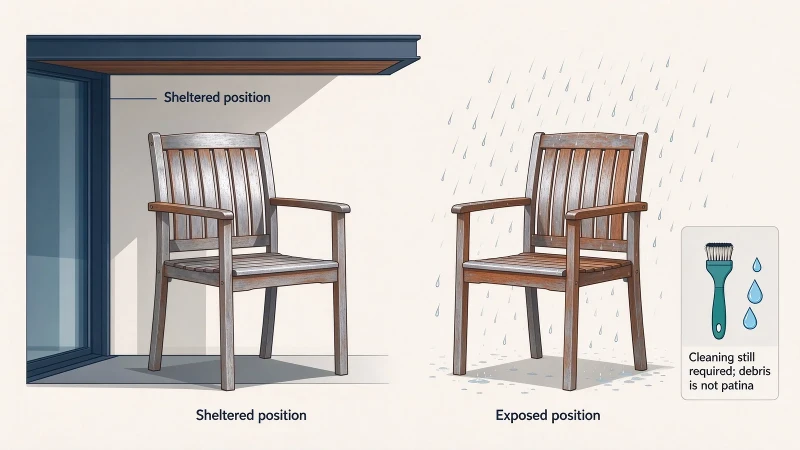
Royal Botania's teak description explains that outdoor exposure produces a silver-grey patina and that the rate varies with climate and exposure. Normal colour change should therefore not be treated as proof that the furniture needs oil.
For a hotel terrace, accepting that look also means accepting that exposed and sheltered pieces may not change colour in exactly the same way. A chair beneath an overhang and one standing in open sun and rain do not share identical conditions. An approval based on natural weathering should allow for the intended setting rather than require every piece to remain visually identical.
Cleanliness remains a separate requirement. A weathered tabletop still needs attention after food and drink spills. Organic debris and accumulated dirt should not be relabelled as desirable patina. The operating plan must distinguish the chosen colour from the condition in which furniture is ready for guests.
A warm colour needs an approved system, not an automatic oil purchase
If the design depends on a golden or brown tone, ask the supplier how that appearance is achieved on the proposed model. The answer may involve maintaining an existing oil treatment or using another compatible care system. It should identify a particular product and method rather than promise that the timber will keep its original colour indefinitely.
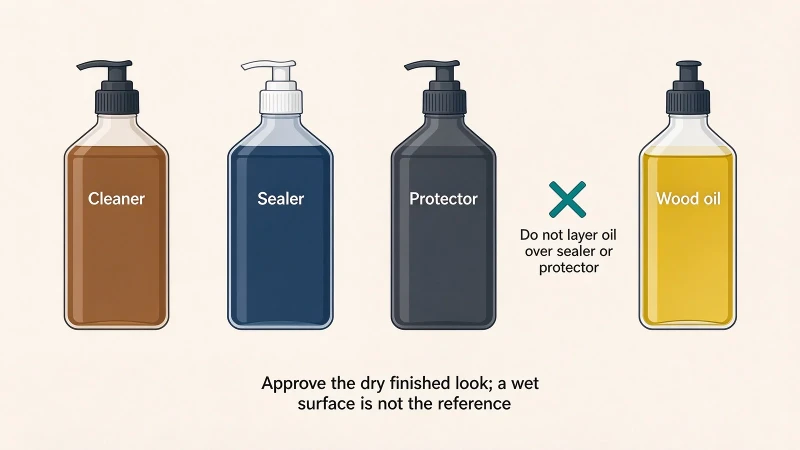
Product names are not interchangeable. Royal Botania's care instructions, available in Spanish, distinguish its teak cleaner, sealer, protector and wood oil. They also state that its wood oil should not be applied over its sealer or protector. Those are instructions for that system, but they illustrate the importance of checking compatibility instead of layering treatments by name.
A hotel buyer should approve the result on the actual supplied finish. Review colour and touch once the trial has reached the stage specified by the treatment manufacturer. A freshly wet surface is a poor reference for the appearance the property will operate with.
What an oiling plan actually commits a hotel to
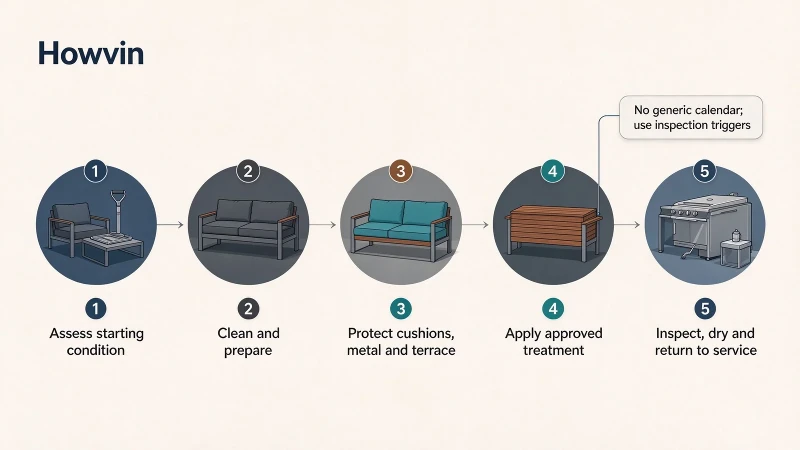
Preparation is part of the job
A quote for "oil all teak furniture" is incomplete if it does not describe the starting condition and preparation. Is the furniture new, naturally weathered, previously oiled, stained, or treated with an unidentified product? Those conditions should not be priced as though they require identical work.
Carl Hansen & Søn's teak guidance, in the section covering its former oil-treated finish, warns that applying oil to a dirty surface can lead to mould and discolouration. Its instructions distinguish cleaning from the subsequent treatment. The lesson for a commercial maintenance brief is straightforward: preparation cannot be silently omitted from the work allowance.
Use the furniture manufacturer's approved cleaning method and the treatment product's preparation requirements. A test area should establish the proposed result before the contractor works across the full furniture quantity. Where sanding or removal of an existing finish is proposed, agree the scope and suitable method first. There is no useful reason to impose the same abrasive or stripping procedure on every teak collection.
Include the surrounding materials in that planning. Cushions, woven panels, metal details and adjacent terrace surfaces need their own protection arrangements. The job is not complete merely because the exposed timber has received a coat.
Budget the repeat work and the space it needs
The labour commitment extends beyond application. Furniture may need moving, cushions removing, surfaces preparing, work areas protecting and completed pieces keeping out of service. Someone must also inspect the result and return each item to its assigned position.
Those tasks have different consequences at a resort with a maintenance workshop and a city hotel whose terrace must reopen for evening service. Before adopting a finish programme, establish whether the property has an appropriate work area and a way to keep guests away from treatment in progress.
Do not make a generic annual or quarterly oiling calendar the purchase specification. Exposure and the chosen finish matter. The same Carl Hansen & Søn guidance relates maintenance needs to the environment; that does not create a universal interval for another manufacturer's furniture.
A practical commercial arrangement is to define inspection responsibilities and the conditions that trigger the approved maintenance action. Keep the actual product instructions with the furniture records. This gives a replacement maintenance team a usable reference instead of an unexplained calendar entry saying "oil teak."
Put the finish into the purchase specification
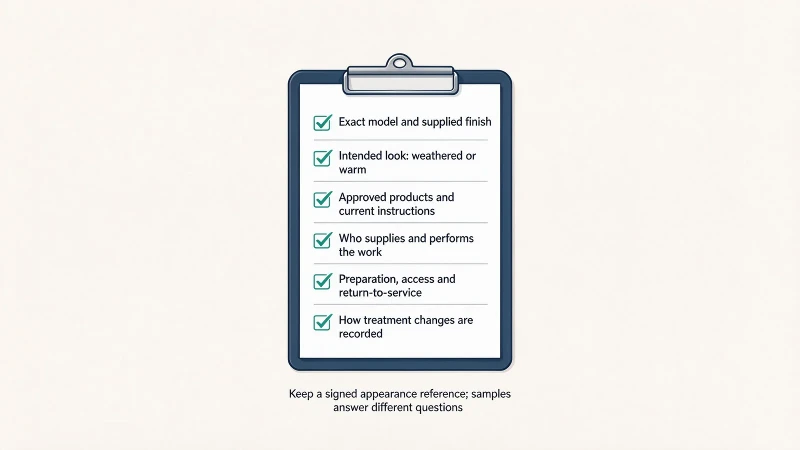
Care decisions are easier to control before the order is placed. When selecting from Howvin's outdoor teak furniture collection, request the supplied finish and model-specific care information alongside the dimensions and upholstery details. The collection's teak description does not establish that every model arrives untreated or accepts the same oil.
The purchase and handover records should identify:
The exact model and the finish supplied, including any agreed project variation.
Whether natural weathering or a maintained warm colour is intended.
The approved cleaning and treatment products, with current instructions.
Who supplies those products and performs the initial and subsequent work.
Any preparation, access restrictions and return-to-service requirements.
How a proposed treatment change will be reviewed and recorded.
Keep a signed appearance reference, but describe what it represents. A new untreated sample, an approved treated sample and an older weathered piece answer different questions. None should quietly become a promise that a whole outdoor installation will retain one exact colour.
This is also where procurement can expose an unrealistic design assumption. If the desired appearance depends on repeated work that the operator cannot accommodate, resolve that conflict before buying the furniture. Leaving the decision until the terrace has opened gives the property fewer practical options.
When the timber needs assessment instead of treatment
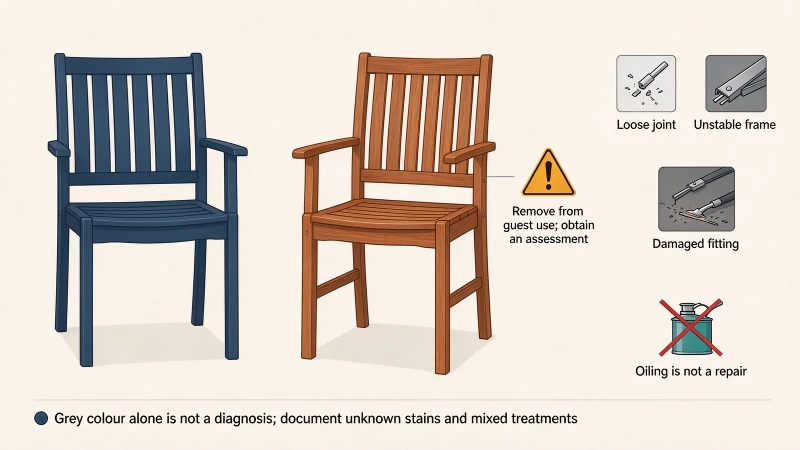
Oiling is not a repair for a loose joint, unstable chair, splintered contact surface or damaged fitting. Remove an unsafe item from guest use and obtain an appropriate assessment. A surface-care decision should not become a way to postpone a product or maintenance problem.
Equally, a photograph of grey timber is not enough to diagnose its condition. Colour, cleanliness, surface texture, connections and stability need separate consideration. Normal weathering and a defect can exist on the same piece of furniture.
For unexplained staining or a history of mixed treatments, document the condition and what has previously been applied. Give that information to the supplier or a competent refinishing specialist before approving another chemical or abrasive process. A small trial can help evaluate a proposed approach; it does not establish that a structurally damaged item is safe.
A hotel can make either a naturally weathered appearance or a maintained warm tone part of its design. What needs to be avoided is an unplanned mixture of treatments, expectations and responsibilities. Decide on the look, verify the supplied finish, and make the care programme something the operating team can actually carry out.
Procurement Boundary FAQs
Can an installation contractor oil new teak furniture before the hotel accepts it?
Only where that work is part of the agreed scope and is approved for the supplied finish. A contractor's standard finishing routine should not override the approved sample or supplier instructions. Record the product and method before work begins, and identify who will inspect the completed appearance. An unapproved treatment can complicate both acceptance and the investigation of later marks.
Can one maintenance product be used on teak, rope, metal and cushions?
Do not assume so. Obtain approval for each affected material and finish, or protect and separate the other components as instructed. Compatibility with the timber does not establish compatibility with fabric, woven elements, coatings or adhesives. A mixed-material furniture set may need several care instructions even when it is sold as one collection.
Will replacement teak chairs match furniture that has already weathered?
Not necessarily. New timber, a different supplied finish and a different exposure history can produce a visible mismatch. Include the existing furniture's condition when requesting replacements and ask what appearance options are available. Do not promise the operator an exact match or a fixed blending-in period without product-specific evidence.
Does a furniture warranty automatically include oiling or refinishing?
That should be established from the actual written terms, not assumed from the material or a warranty headline. Ask which maintenance tasks belong to the owner, whether any products are excluded, and what support or remedy is offered. If a third party proposes changing the finish, obtain the supplier's written position before proceeding. This article does not establish Howvin's model-specific warranty conditions.
How long must a hotel keep treated furniture out of service?
Use the approved product's instructions and the actual working conditions. The work specification should cover handling, reassembly, exposure to rain and contact with cushions, clothing or guests. A generic drying estimate is not an adequate handover rule. Agree who confirms completion and allow the necessary time in the operating schedule before treatment starts.
Can previously oiled teak be allowed to turn silver-grey instead?
Sometimes, under the furniture supplier's supported care approach. MasayaCo's guide, for example, describes that choice for its own oiled outdoor products. Other finishes or accumulated treatments may require a different assessment, and the transition may not be visually uniform. Identify the existing treatment before changing the programme; do not adopt a blanket stripping, sanding or re-oiling recipe for the whole site.