
Knock-down commercial outdoor furniture can have a lower wholesale unit price than a fully assembled equivalent, but there is no dependable percentage discount that applies across products. Removing factory assembly may save work. Designing and supplying the joints, fittings and protective packaging needed for a KD version can add costs back. The quoted result depends on the actual construction, specification and order.
The larger financial difference may appear after the furniture leaves the factory. Compact packing can improve transport economics, while assembly moves to the receiving warehouse or project site. A KD offer can therefore be cheaper to buy but more expensive to install-or cost slightly more at the factory and still produce a lower completed-project cost.
For a hotel developer or commercial importer, those are different purchasing outcomes. They deserve separate lines in the comparison.
First establish what the quoted unit includes
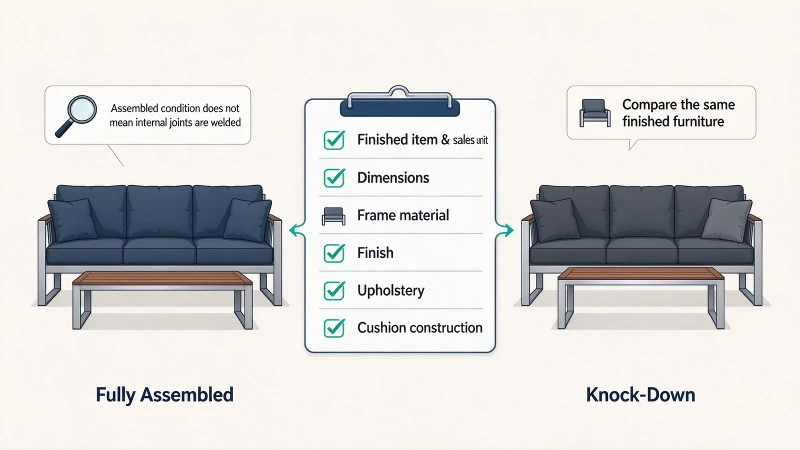
Fully assembled does not necessarily mean fully welded
"Fully assembled" describes the condition in which an item is supplied. It does not identify every joint inside it. A sofa assembled at the factory may still contain mechanical connections; a mostly welded frame might ship with removable feet.
Similarly, KD covers different amounts of work. One supplier may mean attaching four legs. Another may supply a seat base, separate arms, a backrest, connectors and cushions. Those offers transfer very different tasks to the buyer.
Manufacturers do not always use the terms identically. Loll Designs' assembly guidance, for example, distinguishes mostly flat-packed products, some partially assembled pieces and a few fully assembled products. Its description illustrates why the individual product specification matters more than the label.
Modular furniture adds another distinction. Separate, fully assembled seating modules can form a modular sofa without the modules themselves being KD. A photograph of a sectional arrangement does not reveal its shipping state.
Compare the same finished furniture
An assembled sofa and a KD sofa are comparable only if the finished items meet the same agreed brief. Match seating dimensions, frame material and sections, finish, upholstery, cushion construction, accessories and intended commercial use before judging the prices.
A lower offer may exclude back cushions, use a different fabric, omit module connectors or quote a smaller seating configuration. In that situation, the difference is partly a specification change. Calling the entire reduction a KD saving conceals what has actually been removed.
Define the sales unit as well. A price per module cannot be compared directly with a price per complete lounge set. For sofas with several cartons, the unit should include every component needed to deliver the specified finished item.
When starting from Howvin's commercial outdoor sofa collection, identify the shortlisted models and configurations first. Availability in both assembled and KD formats needs model-specific confirmation; a category containing modular sofas does not establish that every design has a flat-pack equivalent.
Why KD outdoor furniture pricing can be lower-or higher
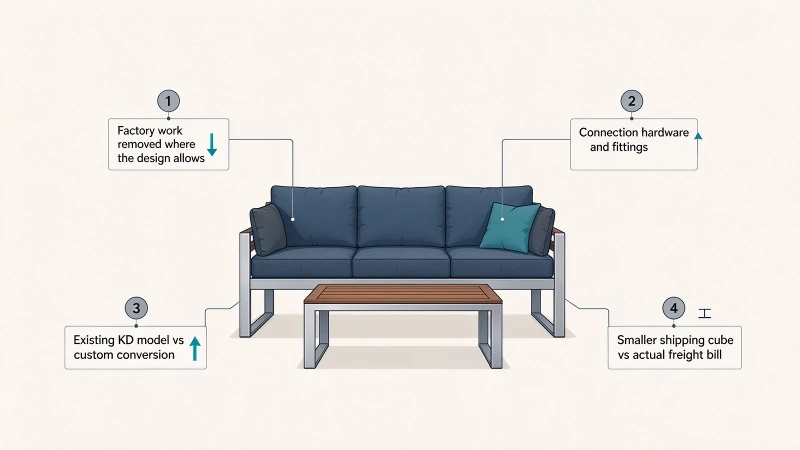
Factory work is removed only where the design allows it
If the same engineered product can be shipped before its final assembly stage, the supplier may avoid some fitting, fastening and handling. That is a plausible source of a lower unit price.
However, most of the product may remain unchanged. Cutting, forming, weaving, finishing, upholstery and cushion production do not disappear because the backrest is packed separately. The proportion of work transferred matters much more than the word KD.
Nor should reduced production cost be confused with an automatic price concession. The supplier still sets a selling price according to its commercial terms. A sensible negotiation asks for the price difference between two defined supply conditions of the same product, rather than demanding an assumed industry discount.
This comparison is particularly useful when factory assembly is genuinely optional. When the two offers use substantially different frames, they are alternative products, not simply the same sofa before and after assembly.
Connections and component control have a price
A KD design may need brackets, inserts, bolts, locating features or other purpose-designed connections. Depending on the construction, machining, alignment control, component identification and hardware packing can introduce work that an assembled alternative handles differently.
These are cost categories to investigate, not evidence that every KD product costs more to manufacture. A well-established connection system may be efficient to produce. A new, low-volume arrangement may need development before it is economical.
The joint specification also belongs in the product comparison. For an outdoor installation, the supplier should identify the connection materials, protection and maintenance requirements appropriate to the proposed design and environment. Reducing the fitting specification to achieve a lower price changes the furniture being bought.
Assembly-required construction is not confined to domestic furniture. Grosfillex's Sunset Cocktail Table, within its commercial range, explicitly requires assembly. That establishes a product format, not a price advantage or proof that any unrelated KD design is suitable for contract use.
An existing KD model and a custom conversion are different purchases
An established KD product already has a defined component arrangement and packing method. Converting an assembled design may require revised drawings, samples, assembly instructions, packaging development and appropriate performance verification.
For a short order, separate development charges can outweigh a modest unit-price reduction. On a repeat programme, the commercial result may be different. Request clarity on which charges are one-off, which recur and what a repeat order would actually cost. Future orders should remain an assumption unless they are committed.
Quantity needs the same discipline. If one price assumes a larger order, fewer finishes or a different minimum quantity, part of its advantage may come from those conditions. Compare the assembled and KD offers at the quantity the project requires, with the same finish and upholstery mix.
Buying extra stock solely to reach a lower unit-price bracket creates another cost: money and space tied up in furniture that has no immediate destination.
A smaller shipping cube has to change an actual bill
Packing volume is where KD can make a meaningful difference, but it needs its own comparison. Use external packed dimensions for the complete item, including cushions, fittings and separate cartons. A reduced frame carton is incomplete evidence if the omitted components travel elsewhere.
For full-container-load shipping, the important question is whether the revised load changes the equipment or number of containers booked. DHL's chargeable-weight guidance explicitly distinguishes FCL's per-container charge from volume-based LCL charging.
If both versions still require the same container booking, the smaller cartons do not automatically reduce the ocean-freight line. They may leave useful space for other required goods, but that value depends on a feasible mixed-load plan and an actual purchasing need. Empty capacity is not a cash saving by itself.
LCL has a different cost structure. Its weight-or-measurement basis can make reduced volume financially relevant, subject to the applicable chargeable basis, minimums and other quotation terms. Local handling charges and non-stackable cargo can also affect the result. DHL's explanation of LCL cost drivers describes those distinctions.
The useful comparison is therefore a pair of transport quotations for the actual order and packing options. A percentage reduction in CBM should not be presented as the same percentage reduction in freight-or as a reduction in the factory's wholesale price.
Put the assembly bill beside the supplier price
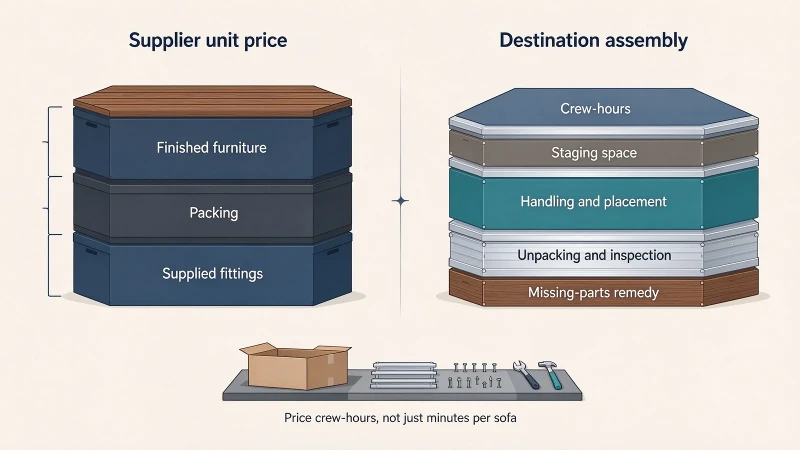
Price crew-hours, not just minutes per sofa
An assembly estimate is incomplete without the crew size and scope. A task taking two people half an hour consumes an hour of labour before allowing for other work. An installer may also charge for attendance, supervision, equipment or a minimum booking period.
Manufacturer estimates are useful starting information, not a universal productivity rate. POLYWOOD's preparation guidance gives different crew requirements across product types and explains that time estimates vary with conditions and experience. Its figures should not be transferred to another manufacturer's sofa.
For a commercial order, a trial should use the supplied instructions, fittings and intended tools. Include opening cartons, identifying components, protecting the work surface, assembly, adjustment and the agreed final check. Separately identify moving finished furniture to its assigned location and clearing packaging.
The trial also reveals whether quoted assembly time assumes a factory technician's familiarity. The receiving crew needs a sequence it can repeat without improvising or altering components.
Decide where the work will happen
A distributor with a suitable warehouse may be able to organize assembly in batches before final delivery. A working hotel may have no protected staging area and only a short period when service routes are available. The same KD sofa can present very different installation conditions in those settings.
Warehouse assembly does not remove the bulk from the final delivery. Once assembled, the furniture still needs vehicle space, protection and a clear route into the property. The first transport leg and the last transport leg may therefore benefit differently from compact packing.
At the property, loose components and completed pieces need controlled space. A delayed terrace handover can leave the assembly crew waiting or force an additional move. Include those responsibilities in the installer's scope instead of assuming the hotel's operating staff will absorb them without cost.
Assembled furniture still requires receiving, unpacking, handling, placement and inspection. Its advantage is less assembly work, not zero destination work.
Allocate fitting problems and missing parts before delivery
An assembly quotation should say who deals with incomplete hardware kits, incorrect components, poor alignment and damaged finishes. Otherwise, a fixed installation allowance may become an open-ended discussion when goods arrive.
Separate product nonconformity from installation damage. Record the condition at unpacking, identify affected items and establish how replacement parts and any return visit will be handled. Commercial responsibility needs to be agreed; it cannot be inferred from the letters KD.
Inspection costs also deserve a clear scope. A KD option may need component and trial-assembly checks; an assembled option needs checks of the finished assembly. Neither label removes the need to verify the supplied configuration.
For ongoing use, obtain the manufacturer's joint-inspection and care instructions. If the design requires periodic attention, budget that work. Replaceable components may be valuable, but only when the right parts, compatible revisions and a workable replacement process are actually available. No automatic maintenance or repair saving follows from disassembly alone.
Put both offers on the same quotation sheet
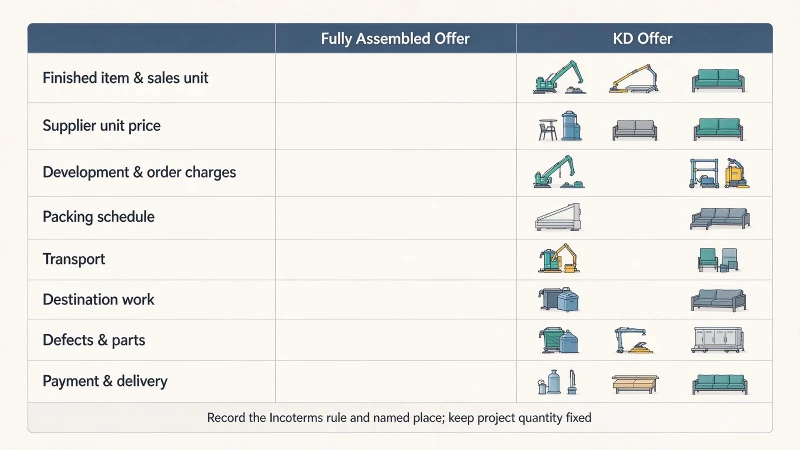
The following fields help separate the manufacturing decision from transport and installation. They are comparison requirements, not assumed inclusions in either supplier's offer.
| Quotation field | Fully assembled offer | KD offer | What must match or be explained |
|---|---|---|---|
| Finished item and sales unit | Complete item/configuration | Complete item/configuration after assembly | Model, dimensions, materials, cushions, accessories and quantity |
| Supplier unit price | Price for stated assembled condition | Price including all specified parts and fittings | Same currency, quantity, validity and commercial basis |
| Development and order charges | Identify any separate charges | Identify engineering, samples, tooling or setup charges where applicable | One-off versus recurring charges; repeat-order assumptions |
| Packing | Complete package schedule | Complete component/package schedule | Protection, dimensions, gross weight and cartons per finished item |
| Transport | Quote actual shipment | Quote actual shipment | Same route, service scope and comparable booking dates |
| Destination work | Receive, unpack, position and inspect | Receive, assemble, position and inspect | Named contractor, inclusions, crew basis, staging and waste removal |
| Defects and parts | Remedy and service responsibilities | Remedy, fitting support and replacement-kit responsibilities | Freight, labour, return visits, exclusions and response arrangements |
| Payment and delivery | Written milestones and scope | Written milestones and scope | Deposit/balance terms, storage obligations and required completion date |
Trade terms belong beside these fields. Two supplier prices on different delivery bases are not directly comparable. Record the applicable Incoterms rule and version, the named place or port, and any separately agreed services. ICC's Incoterms overview explains their role in allocating costs, risks and obligations.
Avoid double-counting services already included in a supplier or forwarder offer. Conversely, a price described as "delivered" should not silently be treated as including unloading, assembly or placement. Obtain the actual scope. Applicable duties, taxes and other destination charges also need a consistent treatment in the comparison; smaller cartons do not establish a lower tax rate.
Keep the project quantity fixed when presenting the result. A container carrying more furniture can improve a distributor's transport allocation per item, but a hotel does not save money by buying additional pieces it cannot use.
Which format fits the project?
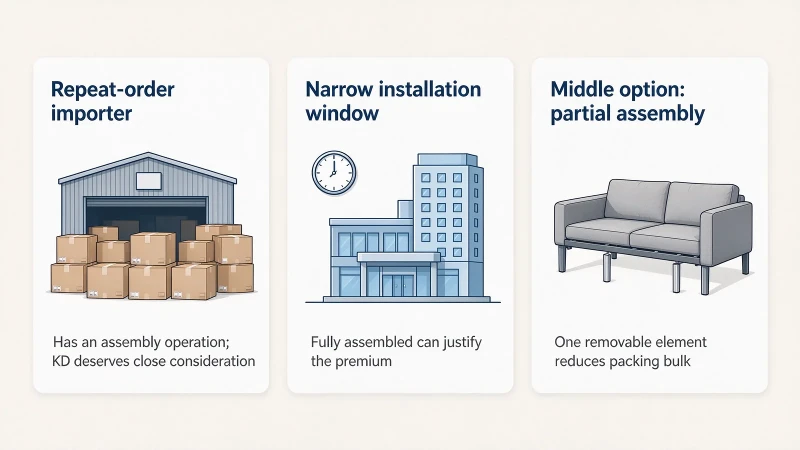
The following are conditional purchasing situations, not reported customer cases.
An importer with repeat orders and an assembly operation
KD deserves close consideration when there is an established model, a demonstrated packing improvement and a receiving operation equipped to assemble and inspect repeat batches. The importer can evaluate labour and handling from its own trials rather than from a generic estimate.
The next question is whether the packaging improvement changes shipment costs or allows other required stock into the same booking. If it does, a KD product with a similar factory price may still be attractive. The saving would arise in the wider supply arrangement, not from an assumed wholesale discount.
A hotel facing a narrow installation window
Fully assembled furniture may justify a higher supplier price where assembly labour, staging space or installation time is constrained. This is especially relevant when the assembled option already fits the planned shipment and receiving route.
Here, the additional price buys a reduction in a specific delivery task. It does not guarantee trouble-free installation: package access, placement and receiving checks remain. The buyer should compare a priced, achievable KD installation with the assembled alternative, rather than comparing an assembled quote with an uncosted promise that someone will build the furniture on site.
A project that needs a middle option
Partial assembly can be worth discussing where one removable element controls most of the packing bulk. A supplier might, where the approved design allows it, retain the main structure and detach legs or another component.
This can reduce the amount of destination assembly compared with a more extensively dismantled version. Whether it produces enough transport benefit depends on the complete package and actual load. The middle option should have its own price, packing specification and assembly scope; it should not inherit the savings claimed for a different KD arrangement.
The price difference worth negotiating
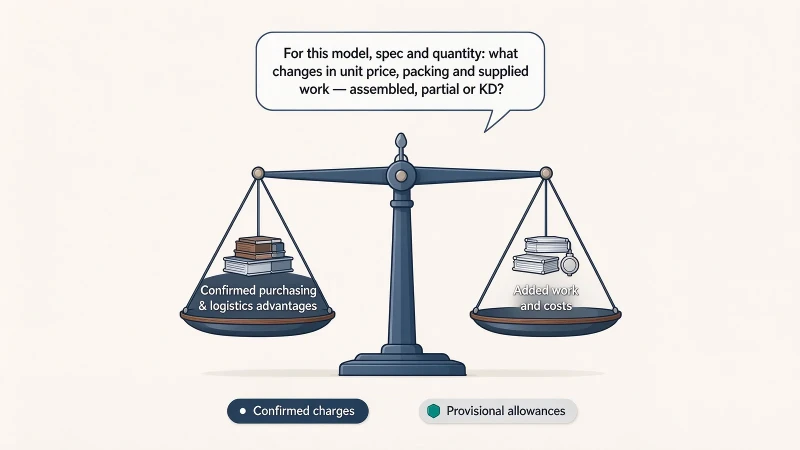
A useful request to the supplier is: "For this model, specification and quantity, what changes in the unit price, packing and supplied work if you deliver it assembled, partially assembled or KD?" Only request alternatives the design can support.
Then have the logistics provider and installer price the consequences. Keep confirmed charges separate from provisional allowances, and identify what would cause those allowances to change. If the recommendation depends on an unverified loading count or an untested assembly estimate, the comparison is not finished.
KD is the better-priced option when its confirmed purchasing and logistics advantages exceed the additional work and costs it creates. Fully assembled furniture earns its premium when the avoided work is worth more to the project. Neither needs to win every line of the quotation. What matters is the cost of the agreed furniture, in the required place, assembled and accepted for use.