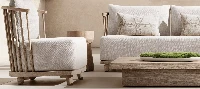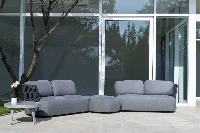

Designing public commercial spaces-like luxury rooftop lounges, high-end resorts, or busy cruise decks-presents unique, high-stakes challenges. When sourcing a commercial-grade Deep seat outdoor modular sofa or setting up a high-traffic Poolside outdoor sofa set, many procurement managers focus purely on weather protection and design appeal. That is a dangerous, costly oversight. Underneath those stylish cushions, you must ensure strict compliance with international flammability standards for outdoor sofas.

If you are working with an Outdoor furniture factory direct source or negotiating with an Outdoor furniture OEM manufacturer to build premium Hotel outdoor lounge furniture, you are legally liable for the fire safety of these assemblies. Unlike residential spaces, public hospitality venues are subject to strict regional fire codes. If a guest drops a lit match or a stray spark hits an outdoor seating area, the speed of flame spread determines whether people escape or a disaster unfolds.
1. The Fire Safety Landscape: US vs. UK Protocols 🛡️
Fire codes do not treat indoor and outdoor furniture as separate entities once they are placed in a commercial setting. If an outdoor lounge is technically part of a hotel lobby transition, a rooftop bar, or a public assembly zone, the local fire marshal will demand certified proof of compliance.
The regulatory landscape is split into distinct testing methodologies depending on where your project is located. In the United States, California's Technical Bulletins rule, while the United Kingdom relies on the British Standards (BS) system.
📊 Key Flammability Regulations and Testing Protocols
| 📜 Regulation | 🌍 Primary Jurisdiction | 🔥 Target Components | 🏷️ Compliance Classification |
| TB 117-2013 🇺🇸 | North America (Public & Residential) | Component-level smoldering resistance test (fabric & foam) | Standard commercial baseline |
| CAL 133 🛡️ | High-risk US occupancy (hospitals, public lobbies) | Full-scale composite mock-up open flame | Extreme high-risk contract rating |
| BS 5852 🇬🇧 | United Kingdom & Middle East (Commercial) | Full composite seating test (smolder & flame) | Mandatory Crib 5 standard |

2. Testing Procedures: CAL 117 vs. CAL 133 vs. BS 5852 🔬
Do not make the mistake of thinking a "fire-resistant fabric" is enough. Fire behaves dynamically. A fabric might be fire-retardant, but if the foam underneath melts and releases highly flammable gases, the entire sofa becomes a chemical accelerant.
The Composite Reality: High-risk public spaces typically require a "composite" test rather than separate component tests. This means the cushion fabric, the polyurethane foam cores, and any internal lining must be tested together as an integrated system.
To satisfy these rigorous protocols, manufacturers often insert specialized fire-barrier fabrics between the outdoor casing and the rapid-drying core. This barrier acts as an oxygen-deprivation layer, preventing the flame from reaching the highly combustible core.
📊 Material-Level Test Methods and Pass/Fail Criteria
| 🔬 Test Method | ⚡ Heat Source Type | ⏱️ Exposure Duration | ❌ Automatic Failure Criteria |
| Smolder Test (CA 117) 🚬 | Lit cigarette on mock-up seam | Cover fabric must not ignite | Char length exceeds 1.8 inches |
| Open Flame (BS 5852 Source 5) 🪵 | Wooden crib structure (Crib 5) | Burn time under 10 minutes | Mass loss exceeds limits, flame spreads |
| Large Scale Burn (CAL 133) 🔥 | High-intensity square gas burner | 10 minutes test window | Excess heat release, toxic gas limits |

3. Fabric and Foam Chemistry: Outdoor Survival Challenges 🌦️
How do we actually pass these tests? For outdoor applications, you cannot simply coat regular materials in toxic, water-soluble chemical sprays. Outdoor cushions face constant rain, chlorinated pool splashes, and heavy UV exposure. If you use standard water-soluble halogen-free fire retardants, the fire-resisting chemicals will simply wash out within three months of heavy rain.
Your supplier must use inherently flame-resistant yarns (like custom-engineered acrylic textiles or FR-polyester) and chemically modified, high-performance high-resiliency polyurethane foam.
📊 Common Fire-Retardant Treatments and Material Compatibility
| 🧪 Material Choice | 🛡️ Fire-Resisting Method | 🌦️ Weather Performance | 🏢 Recommended Application |
| Modified Acrylics 🧶 | Inherently flame-retardant polymers | ✅ Superior UV and water wash durability | Outdoor high-end commercial upholstery |
| FR-Urethane Foam 🧽 | Integrated chemical mineral additives | ✅ Retains properties despite water saturation | Poolside and rooftop lounge cushioning |
| Coated Materials 🎨 | Topical chemical spray application | ❌ Chemical wash-out under heavy rain | Covered patios only, low moisture risk |

4. B2B Procurement Verification Strategy
Before signing a purchase order for a commercial venue, ask your manufacturer to provide clean, unedited test reports from certified bodies such as the SGS Group or Intertek testing. Ensure the certificate matches the exact material specification of your purchase order. If the project is in a territory governed by the British Standards Institution, ask for the official Crib 5 pass stamp to avoid custom clearance delays.
5. FAQ 💬
Q1: Is a CA 117 certificate enough for a public hotel lobby outdoor seating area?
A: Usually, no. While CA 117 is standard for residential and basic commercial seating, high-occupancy public lobbies and exit corridors in many jurisdictions require the much stricter, full-scale CAL 133 composite mock-up open-flame test.
Q2: What exactly is a "Crib 5" test for outdoor fabrics?
A: Part of the BS 5852 standard, it involves constructing a small wooden structure (resembling a crib) on a fabric/foam mock-up, soaking it in alcohol, and lighting it to simulate a severe open-flame ignition test.
Q3: Can fire-retardant treatments wash away when outdoor cushions get rained on?
A: Topical chemical sprays will leach out when exposed to rain. For true outdoor longevity, you must specify fabrics made with inherently flame-retardant fibers and modified foam cores that contain non-leaching mineral additives.
Q4: Does quick-dry reticulated foam naturally resist fire because of its open-cell structure?
A: No. Because of the vast air channels inside reticulated foam, it actually burns faster than standard foam once ignited. It must be infused with specialized fire-retardant compounds to pass commercial standards.
Q5: How do protective fire barrier fabrics help achieve CAL 133 compliance?
A: Specialized barrier materials act as a heat-resistant envelope wrapped around the foam core. If the outer fabric burns, the barrier restricts oxygen flow to the inner foam, keeping the core from feeding the fire.
Q6: Are there non-toxic fire retardant options available for eco-conscious luxury resorts?
A: Yes. Many high-end projects specify halogen-free mineral additives (like alumina trihydrate) in the foam and rely on naturally fire-resistant materials like modified acrylics instead of harsh bromide coatings.
Q7: Do cruise ship outdoor lounges follow the same land-based flammability standards?
A: No. Marine projects must adhere to much stricter international maritime rules, specifically passing the International Maritime Organization (IMO) FTP Code requirements.
Q8: Why do local fire marshals inspect the labeling on outdoor furniture?
A: Commercial furniture must feature permanent tracking labels sewn into the cushions, clearly stating compliance with standards like TB 117-2013 or BS 5852 to prove compliance during unexpected field audits.