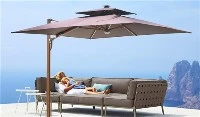

Every year, outdoor hospitality venues lose thousands of dollars because their premium patio setups degrade, crack, or fade into an eyesore under the blistering sun. If you are designing a high-exposure rooftop bar or a sunny pool deck, understanding required commercial outdoor fabric UV hours is the difference between an asset that lasts a decade and one that needs replacement in two seasons.
When sourcing a UV protected outdoor sofa for busy commercial environments, simple residential specifications won't cut it. The intense solar radiation initiates photodegradation, a chemical process where UV rays break down the polymer chains within synthetic fibers, leading to brittle threads and rapid color loss.
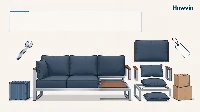
For high-traffic, luxury spaces, pairing highly rated fabrics with an aluminum outdoor sofa rust proof lightweight frame guarantees a setup that can be easily rearranged by staff while remaining incredibly structural.

Understanding UV Testing Benchmarks
To quantify solar resilience, textile labs like SGS subject fabric swatches to accelerated weathering. They utilize specialized machinery, such as the QUV accelerated weathering tester, which exposes textiles to alternating cycles of intense light and moisture.
UV Hour Ratings vs. Real-World Lifespan
| UV Testing Hours | Equivalent Sun Exposure | Typical Use Case | Expected Lifespan (No Fading) |
| ☀️ 500 Hours | Mild / Moderate | Covered residential patios | 1–2 Years |
| ☀️☀️ 1,000 Hours | Moderate / High | Standard residential & light commercial | 2–3 Years |
| ☀️☀️☀️ 1,500 Hours | Intense | Premium commercial & hotel patios | 3–5 Years |
| ☀️☀️☀️☀️ 2,000+ Hours | Extreme | High-exposure rooftops, cruises, beaches | 5+ Years |
While a residential cushion might survive with 500 hours, commercial operators must aim higher. High-exposure coastal zones require fabrics rated for 2,000+ hours.

Sourcing Comfort and Strength Together
Your fabric needs to protect more than just its own color; it acts as the primary shield for what lies beneath. If water penetrates the outer shell, you risk mold growth. Specifying Quick dry foam outdoor cushions inside your seating ensures water drains almost instantly, keeping the core structurally sound.
To create highly inviting spaces, designers frequently choose a Curved outdoor sectional to anchor a modern patio layout. These sweeping layouts encourage social interaction, but because they seat multiple guests at a time, their fabric must support a wide range of body types. Sourcing a deep seating outdoor sofa for heavy person comfort means choosing a fabric that offers superb tensile strength and tear resistance alongside its sun protection.

Primary Commercial Testing Standards
| Test Method | Certification Body / Standard | What It Measures | Minimum Commercial Target |
| 🏆 | AATCC 16.3 | Xenon-arc light colorfastness | Grade 4 minimum at 1,500 hours |
| 🏆 | ISO 105-B02 | European standard for lightfastness | Rating 7 to 8 on the Blue Wool Scale |
| 🏆 | ACT (Association for Contract Textiles) | Physical properties & lightfastness | Meets high-traffic indoor/outdoor standards |

How Material Composition Affects Sun Resistance
Not all fibers are created equal. The way color is introduced to the material dictates how it handles intense ultraviolet radiation.
Outdoor Fiber Comparison
| Fiber Type | Dyeing Process | UV Stabilization | Hydrophobic Rating |
| solution-dyed acrylic | Pigment mixed into liquid polymer before spinning | Built into the molecular structure | Excellent |
| polypropylene (Olefin) | Color extruded directly into the melt | Naturally high, boosted with chemical additives | Outstanding |
| Polyester | Piece-dyed or yarn-dyed after spinning | Relies entirely on external coatings | Moderate |
When choosing materials, solution-dyed acrylic and high-grade polypropylene excel because the color is locked deep inside the fiber core. Conversely, standard polyester only has color on the outer layer, leading to swift fading when exposed to intense solar rays.
By verifying certified laboratory test reports before making volume purchases, your hospitality business secures outdoor furniture that maintains its premium appeal, guest comfort, and long-term financial return.
FAQs:
Q1.What exactly is Xenon-arc testing for outdoor fabrics?
It is an advanced simulation method where a Xenon arc lamp reproduces the full spectrum of natural sunlight, including ultraviolet, visible light, and infrared radiation, to test the colorfastness to light of commercial textiles under accelerated conditions.
Q2.Why do residential fabrics fade so much faster than commercial fabrics?
Residential fabrics often use piece-dyed polyester which only has color on the surface of the fiber. Commercial fabrics utilize solution-dyed techniques where color pigments and UV stabilizers are mixed into the liquid polymer before it is spun into yarn.
Q3.Does a higher UV hour rating mean the fabric is also stain-resistant?
No. UV ratings measure solar degradation and fading, while stain resistance depends on the fiber's chemical structure and topical hydrophobic coatings. However, high-quality solution-dyed materials usually offer both.
Q4.Is ISO 105-B02 testing the same as AATCC 16.3?
While both evaluate light resistance, ISO 105-B02 is the European standard that uses a Blue Wool reference scale (1 to 8), whereas AATCC 16.3 is the American standard measuring color change in gray scale units after specific intervals of exposure.
Q5.How does heavy commercial sanitizing affect UV-treated fabrics?
Aggressive cleaners can strip away topical UV coatings. That is why commercial properties should buy solution-dyed fibers, which can handle heavy chemical cleaning and bleach solutions without losing their UV barrier.
Q6.Can fabric with a high UV rating still experience mold or mildew?
Yes. Mold does not feed on synthetic fibers like acrylic or polyethylene, but it grows on organic debris (like spilled food, sunscreen, or pollen) trapped in the weave if the cushions remain damp.
Q7.How does fabric elasticity hold up under continuous UV exposure?
Without proper UV formulation, sun exposure breaks down molecular bonds, causing the fabric to lose its recovery stretch. This leads to sagging, pocketing, and eventual tearing when supporting high weight capacities.
Q8.Should commercial projects always specify 2,000+ UV hours?
For unshaded, high-exposure environments like coastal resorts, cruise lines, and rooftop lounges, 2,000+ hours is highly recommended to protect your capital expenditure and prevent premature replacements.