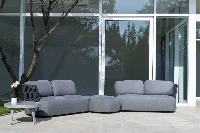

Imagine a brand-new five-star oceanfront resort preparing for its grand opening weekend.
The installation crew unboxes forty individual modules to assemble a massive 12-piece L-shaped arrangement on the primary pool deck. But as the technicians slide the third armless module against the corner unit, they hit an immediate roadblock. The seat cushions misalign by 18 millimeters vertically. A gaping, V-shaped 25-millimeter trench sits between the backrests. No matter how hard the crew pushes or shims the feet, the hidden locking clips refuse to engage.
The project manager calls the factory in a panic. The opening ceremony is forty-eight hours away, and the central lounge seating looks like an uneven, misaligned DIY disaster.
What went wrong here?
The factory failed to enforce strict dimensional tolerance standards during mass production.
When contract buyers order an Outdoor modular sectional sofa for large-scale commercial venues, precision engineering is not an aesthetic luxury-it is a structural necessity. When installing an outdoor sectional sofa across expansive hospitality terraces, even a minor 3-millimeter deviation per frame creates massive cumulative errors across long modular runs.

1. The Magic Numbers: What Millimeter Tolerances Do Commercial Factories Enforce?
In residential outdoor furniture manufacturing, factories often operate with loose tolerances of ±10 mm to ±15 mm. If a single sofa sits on a back patio, nobody notices if the left side is 8 millimeters higher than the right.
However, in commercial contract manufacturing, modular sections must be 100% interchangeable. Module A must lock into Module B, C, or D with zero visible height steps or horizontal gaps.
To achieve flawless alignment on-site, export-oriented factories enforce rigorous dimensional tolerance standards governed by international engineering guidelines:
Overall Frame Dimensions (Length & Width): Enforced within ±2.0 mm per module.
Seat Platform Height (Uncushioned Frame): Enforced within ±1.5 mm from ground level.
Cushion Compression Profile (Finished Seat Height): Enforced within ±2.5 mm under a standard 70 kg load.
Interlocking Connector Hole Pitch: Enforced within a hyper-strict ±0.8 mm to ensure universal hardware engagement.
Base Diagonal Squareness (Corner-to-Corner Parallelism): Enforced within ±1.0 mm to eliminate frame twisting.
Residential vs. Contract Grade Manufacturing Tolerances
| Evaluation Parameter | Cheap Residential Grade | Standard Commercial Grade | High-Precision Contract Grade |
| Frame Length/Width Variance | ±10.0 mm to ±15.0 mm | ±3.0 mm to ±5.0 mm | ±1.5 mm to ±2.0 mm |
| Seat Height Alignment Drift | ±8.0 mm | ±3.0 mm | ±1.5 mm |
| Angular Squareness Tolerance | ±2.0 degrees | ±0.8 degrees | ±0.2 degrees |
| Cumulative Gap over 5 Modules | Up to 45.0 mm (Visible gaps) | 15.0 mm (Minor gap) | Under 5.0 mm (Flush fit) |
| Connector Pin Hole Margin | Manual drill (Slots needed) | CNC Punch (±1.5 mm) | Laser Cut (±0.5 mm) |
| Primary Welding Method | Freehand MIG spot welding | Manual Jig TIG welding | Robotic Arm Fixture Welding |

2. How Heat and Materials Warp Modular Frames During Mass Production
Achieving sub-2-millimeter precision in outdoor furniture is uniquely challenging because outdoor materials behave unpredictably during processing.
Thermal Warping in Metal Framing
When manufacturing a heavy-duty outdoor sectional sofa frame using powder-coated aluminum, intense heat is applied during two production stages: structural TIG welding and high-temperature powder-coat curing (which bakes at over 200°C).
If an unanchored aluminum chassis enters the curing oven, differential thermal expansion causes the thin-walled tubing to twist. A frame that measured perfectly straight before coating can exit the oven with a 6-millimeter diagonal warp.
Wood Movement in Hybrid Designs
When engineering high-end outdoor teak furniture, manufacturers face the natural expansion and contraction of organic timber. Teak wood absorbs ambient moisture. In high-humidity coastal resorts, a teak base frame can swell by 1.5% to 2.0% across the grain.
If a solid teak border is rigidly bolted to an aluminum internal sub-chassis without slotted expansion joints, the wood will bow the metal frame outward, ruining section-to-section alignment.
3. The 4-Step Factory Quality Control Process for Zero-Defect Alignment
How do premier manufacturers guarantee that five hundred modular units shipped across the globe lock together with surgical precision? They replace manual craft with mechanical repeatability.
Step 1: 3D Laser Cutting & CNC Punching
Manual saw cuts introduce human error. Commercial factories feed raw extruded tubing into automated 3D fiber laser cutters. Every joint profile, mounting hole, and connector slot is cut in a single pass with positioning accuracy within ±0.1 mm.
Step 2: Pneumatic Heavy-Duty Welding Jigs
Welders never hold frame components by hand. Tubing is clamped into rigid hydraulic welding fixture jigs. These steel master frames physically lock the aluminum components in place under high pressure during welding, forcing the metal to cool in a perfect 90-degree square geometry.
Step 3: CNC Foam Profiling and Density Matching
Cushions cause more height alignment complaints than metal frames. If one module utilizes 30 kg/m³ density foam while the adjacent module uses 35 kg/m³ foam, the softer cushion will compress deeper under a guest's weight, creating an uncomfortable 15-millimeter ridge. Factories enforce strict raw foam batch inspections, cutting inner cores with automated CNC contour knives.
Step 4: Pre-Shipment Master Grid Test
Before packing, 10% of every mass production lot is pulled at random and locked onto a precision-machined steel floor grid inside the factory. Technicians inspect seam flushness using laser feeler gauges to verify compliance with strict dimensional tolerance standards before issuing export clearance.

4. Multi-Scenario Field Deployment: Real-World Applications
Precision tolerance requirements vary based on the commercial setting and layout configuration.
Scenario A: High-Density Commercial Venues ☕
Urban cafes purchasing coffee shop patio furniture sets require compact, modular flexibility. On tight outdoor dining decks, modules are rearranged daily to accommodate varying group sizes.
If tolerance gaps exceed 3 millimeters, coins, credit cards, and food debris fall between the cushion gaps, creating a severe hygiene and maintenance issue for staff.
Scenario B: Massive Resort Terrace Installations 🏨
Procurement agencies executing a large project based outdoor furniture supply contract for 500-room resorts often design continuous 15-meter serpentine sofa layouts.
In long linear runs, tolerance error multiplies exponentially-a concept known as tolerance stack-up.
By enforcing a tight ±1.5 mm tolerance limit per module, the cumulative drift across ten units stays under 15 millimeters, easily absorbed by the frame's adjustable leveling glides.

5. Critical Buyer Traps: Mistakes to Avoid During Procurement
Procurement managers can easily ruin a modular furniture installation by making key specification errors during the bidding phase.
❌ Trap 1: Relying on Flexible Plastic Connecting Clips
Cheap plastic friction clips flex under load. When three heavy guests sit on one side of an Outdoor modular sectional sofa, plastic clips stretch, allowing the modules to pull 20 millimeters apart. Always mandate heavy-duty 304 stainless steel interlocks or drop-in aluminum bayonet brackets mounted directly to the main structural chassis.
❌ Trap 2: Measuring Dimensions Without Cushion Compression Load
A bare aluminum frame might pass dimensional inspections perfectly. However, if the outer cushion cover is sewn 10 millimeters too tight, it arches the foam core like a pillow, raising the center seat height. Always mandate that seat height tolerance checks are conducted on finished, fully upholstered cushion assemblies under calibrated load weights.
❌ Trap 3: Forgetting Floor Drainage Slope Allowances
Commercial outdoor plazas are intentionally built with a 1% to 2% grade slope to shed rainwater. If your modular sofa frames are rigid with small 5-millimeter leveling feet, the sofa will follow the slope of the patio, causing long straight runs to look crooked. Always specify commercial-grade stainless steel leveling glides with a minimum ±25 mm vertical adjustment range.

Modular Interlocking System Comparison
| Mechanism Type | Material Composition | Alignment Retention | Commercial Suitability |
| Plastic Alligator Clips | Injection Molded Nylon | Low (Flexes and twists under heavy load) | Residential Use Only |
| Under-Frame Toggle Clamps | Galvanized Steel | Medium (Requires under-sofa reaching) | Low-Traffic Commercial |
| Drop-in Bayonet Brackets | 304 stainless steel interlocks | High (Zero lateral movement allowed) | High-Traffic Hospitality |
| Hidden Ratchet Connectors | Anodized Cast Aluminum | Exceptional (Micro-adjustable gap distance) | Luxury Resort Projects |
6. Testing Certifications & Quality Compliance Standards
Commercial furniture buyers should mandate third-party lab documentation verifying structural stability, dimensional accuracy, and material strength before signing off on mass production purchase orders.
Key Engineering & Quality Standards for Modular Furniture
| Standard / Certification | Testing Body / Origin | Technical Scope & Objective | Commercial Requirement |
| ISO 2768-1 | International Organization for Standardization | Defines permissive tolerance classes (Fine/Medium) for linear dimensions without individual tolerance indications | Enforce Class "m" (Medium) or Class "f" (Fine) across all frames |
| EN 581 | European Committee for Standardization | Evaluates mechanical safety, structural stability, and weight capacities for general contract outdoor seating | Mandatory compliance for all European resort & hotel tenders |
| BIFMA X5.4 | Business & Institutional Furniture Manufacturers | Tests public space lounge seating for structural impact, leg strength, and joint fatigue over 100,000 cycles | Essential for high-traffic North American commercial spaces |
| SGS certification | SGS S.A. | Independent third-party dimensional verification, frame load-bearing tests, and weld inspection audits | Full container pre-shipment audit inspection pass certificate |
| TÜV Rheinland | TÜV Rheinland Group | Comprehensive factory audit confirming automated manufacturing capability, CNC precision, and ISO standards | Verified factory production line capability stamp |
| ASTM B117 | ASTM International | Salt spray fog testing evaluating corrosion performance on metal frames, welds, and stainless steel hardware | Minimum 500-hour continuous salt spray exposure without rusting |
FAQ:
Q1: What is the maximum acceptable gap between two connected modular sofa units?
For commercial hospitality installations, the maximum acceptable gap between two locked modular units is 3.0 millimeters. Any gap wider than 5.0 millimeters is visually noticeable, allows dirt and liquids to accumulate between cushions, and indicates poor manufacturing tolerance control.
Q2: How do factories prevent aluminum frames from warping during high-temperature powder coating?
Factories prevent thermal warping by securing the welded frames inside rigid, heat-resistant steel curing fixtures before they enter the powder-coating oven. Additionally, using stress-relieved 6063-T5 grade powder-coated aluminum alloys minimizes internal metal tension during temperature spikes.
Q3: How do adjustable leveling feet compensate for frame manufacturing tolerances?
Commercial leveling feet feature threaded stainless steel stems mounted into the base of each sofa leg. They provide 15 mm to 30 mm of vertical height adjustment, allowing installation teams to compensate for minor floor variations and frame height deviations on-site.
Q4: What causes tolerance stack-up in modular sectional seating?
Tolerance stack-up occurs when minor manufacturing variances in individual modules accumulate in the same direction along a long sectional run. For example, if ten adjacent modules are each manufactured just 3 millimeters wider than specified, the completed sofa layout will end up 30 millimeters longer than designed.
Q5: How does teak wood movement affect modular sectional alignment?
Because teak wood absorbs moisture and swells across the grain, solid teak sectional bases can expand by several millimeters in humid weather. To prevent this from warping the overall frame, engineering teams use slotted bolt channels that allow the wood to expand and contract freely without distorting the metal alignment brackets.
Q6: Which ISO standard governs dimensional tolerances for outdoor furniture frames?
Dimensional tolerances for metal furniture frames are governed by ISO 2768-1. Contract furniture buyers typically mandate Class "m" (Medium) for general frame dimensions and Class "f" (Fine) for critical connector mounting points.
Q7: Why are hidden drop-in brackets better than bottom clips for coffee shop patio furniture sets?
Hidden drop-in bayonet brackets lock modules together instantly without requiring staff to bend down or flip heavy furniture over. They hold the frames rigidly at two vertical points, completely eliminating the top-edge wobble common with bottom-only spring clips.
Q8: What quality control equipment is used to test frame precision on a project based outdoor furniture supply line?
Factories utilize 3D laser coordinate measuring machines (CMM), optical laser scanners, precision feeler gauges, and heavy-duty steel master grid tables to measure linear accuracy, hole pitch, and diagonal squareness across mass production runs.
Q9: How does foam density impact long-term seat height alignment?
Low-density foam (under 25 kg/m³) breaks down quickly under heavy commercial use, causing seats to sag unevenly and creating noticeable height mismatches between heavily used middle modules and rarely used end units. Specifying high-resilience reticulated quick-dry foam with a density of 35 kg/m³ or higher ensures consistent seat height alignment across all modules for years.