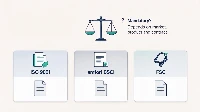

For ordinary commercial furniture sourcing, ISO 9001, amfori BSCI and FSC are not a universal set of legally mandatory factory credentials. Their importance depends on the destination market, the product and materials, the buyer's purchasing rules, and the claims made about the order.
They also represent different kinds of evidence. ISO 9001 concerns a quality management system. amfori BSCI is a social compliance audit programme. FSC certification can support claims about forest-based materials through a controlled supply chain.
A hotel developer should therefore ask a more precise question: What must this supplier demonstrate for these products, from this production site, for this project? The following framework helps separate statutory obligations, contractual requirements and useful supplier assurance.
Decide What "Mandatory" Means Before Requesting Documents

Start with the product, destination and responsible business
A resort buying teak loungers, an importer buying upholstered seating, and a contractor buying cabinets containing composite wood do not necessarily face the same requirements. Begin with the bill of materials, intended use, destination country, and the role of each business in the transaction. Identify who manufactures, imports, distributes and makes the final product claim.
Then have the responsible compliance team identify the applicable rules and required evidence. A supplier questionnaire that simply asks for three certificates can miss the documents needed for the actual goods. It can also reject a suitable vendor for lacking a credential that has no relevance to the proposed package.
Distinguish a legal obligation from your own purchasing condition
A voluntary certification can still be compulsory for a particular tender. A hotel brand, developer, lender or purchasing organisation may make it a condition of supplier approval. ISO expressly describes certification as optional, while recognising its value to customers and other stakeholders. See the official ISO 9001 overview.
Write the requirement precisely. State the required scope, acceptable evidence, verification method and timing. If alternatives are permitted, define who can approve them. Calling a requirement "internationally mandatory" without identifying its legal or contractual basis creates confusion between the buyer, agent and factory.
| Evidence | What it addresses | Is it a universal legal requirement for furniture vendors? | When a buyer may require it |
|---|---|---|---|
| ISO 9001 certification | Quality management within a defined organisational scope | No | Supplier policy, tender or contract |
| amfori BSCI audit | Working conditions and social compliance findings at an assessed operation | No; BSCI is an audit programme | Responsible sourcing policy or customer programme |
| FSC chain of custody certification | Controls supporting eligible forest-product claims | No | Specified FSC products and the relevant supply-chain role |
| Product and import compliance evidence | Requirements for particular goods, materials and markets | Mandatory where the relevant law applies | Legal market access, supply and project approval |
ISO 9001: Check the Quality System Behind the Certificate

Use certification to assess process discipline
ISO 9001 provides requirements for a quality management system. For a furniture buyer, useful follow-up questions concern drawing revisions, incoming materials, supplier controls, inspection records, nonconforming goods and corrective action. Ask the factory to show how it applies those controls to work comparable to your proposed order.
For example, request the record linking an approved finish sample to production instructions, or ask how a failed inspection led to a process correction. These are practical buyer checks. Certification does not establish that a particular chair has passed a strength test or that a coating suits a coastal terrace; those conclusions need evidence tied to the product.
Verify the holder, manufacturing scope and current status
Read the certificate and any site annex. Match the legal entity and addresses to the businesses actually producing your furniture. A certificate covering sales or distribution may not cover manufacturing. A certificate associated with a group headquarters needs further checking before you rely on it for another production site.
Verify the issuer independently and, where accredited certification is required, check that accreditation and certificate status. IAF CertSearch explains its verification function. Also confirm the applicable standard edition and any transition arrangements with the issuing body. A document's printed expiry date alone does not resolve suspension, withdrawal or scope questions. ISO itself does not issue certificates.
amfori BSCI: Request an Audit Record and Review the Findings

Replace "BSCI certified" with an accurate evidence request
Procurement forms often use "BSCI certificate" as shorthand. The terminology matters: amfori BSCI is a social compliance programme, and its audit produces findings about the assessed operation. UL Solutions describes BSCI as an audit programme rather than a certification scheme, covering issues including working hours, remuneration, health and safety, child labour and forced labour.
Request the relevant audit report, facility identity, assessment date, findings and follow-up information through an authorised sharing process. A logo on a quotation supplies none of those details. It also tells you nothing about the furniture's dimensions, structural performance or finish consistency.
Evaluate corrective action and the actual production location
An overall audit result is a starting point for review. Examine the significant findings, the proposed corrective actions, supporting evidence and any required follow-up. Decide whether the remaining issues meet your company's acceptance policy. Avoid inventing a universal rating threshold that every hotel project must use.
Confirm that the assessed facility is the one scheduled to fulfil the order, and disclose proposed subcontractors for review. TÜV NORD's BSCI explanation describes verification and reporting rather than an unconditional declaration of full compliance. Where a new assessment is required, coordinate with the customer: amfori's producer guidance explains the member-led audit request process.
FSC: Connect the Supplier's Scope to the Furniture You Buy

Decide whether the order requires an FSC claim
FSC is relevant to forest-based products and materials. A teak dining set, a wood tabletop and a paper carton raise different claim questions. Establish whether the specification requires FSC-certified furniture, particular eligible components, packaging, or another defined scope. A packaging credential cannot substantiate a claim about the furniture inside it.
FSC's chain of custody guidance explains the controls and supply-chain roles associated with producing and selling certified products. Do not automatically demand that a hotel hold chain of custody certification merely because it buys furniture for use. Equally, do not assume that a trader passing on certified-product claims needs no further scrutiny. Confirm the arrangement against the scheme's rules.
Verify both the certificate and the order documents
Search the supplier in the FSC public certificate database. Check its identity, certificate status, relevant product scope and applicable sites. Then ask which quoted items will be supplied with which FSC claims. A valid supplier certificate does not establish that every item in its catalogue is sold as FSC certified.
Carry the agreed requirement into the purchase order and verify the supporting sales documents. The FSC furniture purchasing guide explains the importance of the FSC claim and certificate code on the supplier's invoice. Keep those records with the item schedule so that the project team can distinguish certified purchases from other purchases later.
Identify the Compliance Gaps These Credentials Leave Open

Check product obligations separately from factory credentials
Consider furniture containing regulated composite wood destined for the United States. EPA's TSCA Title VI guidance distinguishes panel testing and certification from the obligations applying to finished goods. Finished furniture does not generally require its own formaldehyde testing and certification under that rule, but applicable goods must use compliant panels and meet the relevant documentation and labelling requirements.
That distinction changes the evidence request. Ask for the material and supply records appropriate to the product, rather than treating ISO 9001 or FSC as a substitute. Check exclusions and the supplier's role before deciding which documents are required.
Timber due diligence is another separate question. The European Commission's EUDR guidance discusses certification as supporting evidence. Assess current product coverage, application timing and operator obligations for the transaction; an FSC certificate alone does not settle them.
Keep commercial performance in the technical specification
None of these three credentials establishes the service life of a poolside lounger or the suitability of a cushion for prolonged wet conditions. Those are specification and verification questions. Identify the frame material, joints, hardware, coating system, fabric, foam, drainage and maintenance requirements appropriate to the site.
For a beachfront project, ask how the proposed construction addresses salt exposure and cleaning. For a restaurant terrace, examine stability, storage, cleaning access and replacement parts. Compare relevant reports and samples with the actual model and materials being ordered. Approval should account for maintenance work, replacement availability and disruption as well as initial price.
When reviewing a commercial outdoor furniture collection, use the catalogue to build the item schedule. Request the technical and compliance records for those selections before approving the package.
Turn the Evidence Into a Supplier Approval Decision

Build an evidence register around each requirement
Organise the file by requirement, responsible business, product or site, evidence and approval owner. This makes it possible to see whether a document answers the question being asked. It also helps an FF&E agent avoid forwarding a certificate folder that the owner then mistakes for a completed compliance review.
For each requirement, record the source: applicable law, brand standard, tender clause, product specification or voluntary preference. Add the verification date and the person authorised to accept gaps. The register should remain usable when the buyer, designer or project manager changes; key decisions should not depend on one employee remembering a conversation.
| Review area | Evidence to request | Verification question | Approval action |
|---|---|---|---|
| Quality management | ISO 9001 certificate, scope and site annex where applicable | Does the current certification cover the relevant organisation and activities? | Resolve identity or scope discrepancies |
| Social compliance | BSCI report, facility details and corrective-action evidence | Was the actual operation assessed, and are findings acceptable under buyer policy? | Assign remediation and follow-up |
| Forest-product claims | FSC record, applicable scope and item-specific sales claims | Can the supplier substantiate the claim for these purchases? | Confirm claims before order and check invoices |
| Legal product requirements | Relevant material records, tests, labels and import documentation | Does the evidence meet the applicable product and market rules? | Close legal gaps before release |
| Commercial suitability | Approved samples, specifications, relevant tests and service information | Does the proposed furniture meet the project's use and maintenance needs? | Approve the defined configuration |
Separate vendor approval from production and shipment release
A supplier can be suitable for the shortlist while an individual order still has unresolved conditions. Keep vendor approval, production release and shipment release as distinct decisions. Specify which documents must exist at each stage, particularly when final sales or shipping records are generated later in the process.
Hold approval when a required certificate cannot be authenticated, the production site differs without explanation, or mandatory evidence is missing. Significant audit findings need a recorded decision and appropriate action. Where the law and contract permit conditional approval, name the conditions, owner and deadline.
Require notification of changes to the factory, subcontractors, materials, certificate status or certified-product claims. Recheck affected evidence before relying on it again. Buyers evaluating Howvin's manufacturing and project scope should apply the same document checks used for any other vendor; company information alone does not establish the credentials of a particular order.
FAQ:
Are ISO 9001, BSCI and FSC legally mandatory for all international factories?
No. They are not a universal legal package for international furniture vendors. A particular law, tender or contract may impose relevant requirements, but the buyer must identify that basis. Legal obligations also depend on the product, materials, destination and business role.
Is BSCI a certification like ISO 9001?
No. amfori BSCI is a social compliance audit programme. Ask for the facility's audit record, findings and corrective-action information through an authorised process. Avoid accepting the phrase "BSCI certified" as sufficient evidence of either social compliance or product quality.
Does an ISO 9001 certificate cover every factory in a supplier group?
Do not assume that it does. Review the certified entity, activities, addresses and any site annex. Verify that the production location relevant to your order is covered by the certification arrangements on which you intend to rely.
Does an FSC-certified supplier sell only FSC-certified furniture?
No. Verify the eligible products and the claims attached to your order. The supplier's certificate and the transaction documents answer different questions. Obtain the agreed claim and supporting sales records for the furniture being purchased.
Can FSC certification replace timber due diligence required by law?
It can provide useful evidence, but it does not automatically discharge applicable legal duties. Check the destination's current rules, product coverage, responsible operator and required information. Review certification evidence within that assessment rather than treating it as automatic clearance.
Should we reject every supplier missing one of these credentials?
Reject or hold a vendor when it fails a requirement that actually applies to your project. If a credential is optional and the procurement rules allow alternatives, assess those alternatives consistently. Record the reason for the decision and who approved it.
Set Requirements You Can Verify

A strong supplier file connects the requirement to the right organisation, site, product and transaction. ISO 9001 can support confidence in quality management. BSCI can inform social compliance decisions. FSC can substantiate eligible forest-product claims when the necessary controls and records are in place.
Before requesting quotations, identify the legal obligations and project requirements. Then ask suppliers for evidence that answers each one. That approach gives hotel developers and procurement teams a clearer approval decision than collecting three logos and assuming the work is complete.