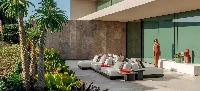

Luxury hospitality clients do not want to see wires. Nighttime guest retention relies entirely on atmospheric illumination. When specifying a commercial-grade aluminum pergola for high-traffic venues, illumination cannot be an afterthought patched together with visible conduits.
Instead, a high-end embedded lighting for pergola system shifts illumination from an afterthought to a core structural asset.
For design professionals executing modern Outdoor project interior design, maintaining a clean visual profile is paramount. The goal is simple: create an inviting nighttime ambiance that seamlessly complements premium Resort outdoor furniture zones, without allowing a single centimeter of copper wire to spoil the architectural silhouette.
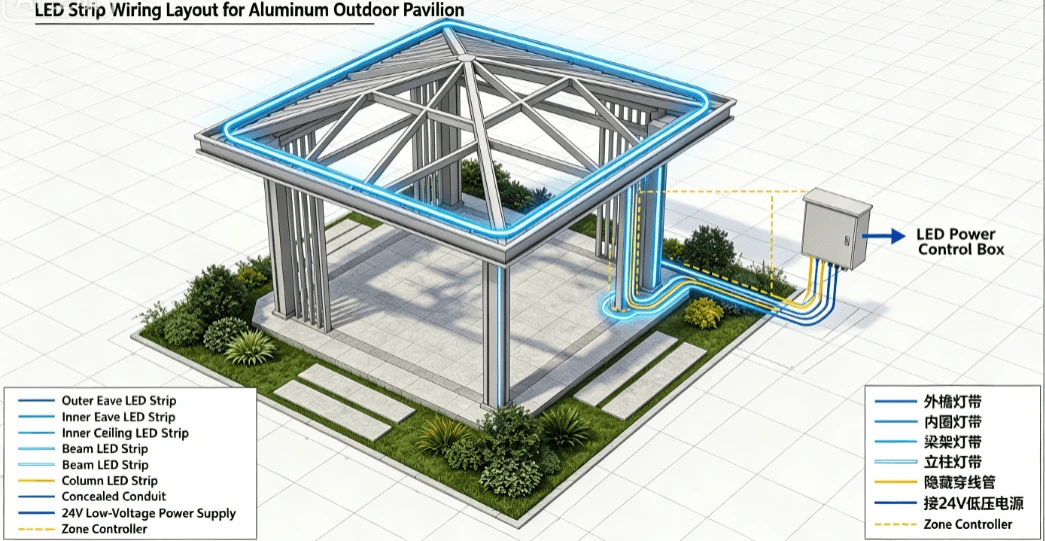
🔌 The Internal Blueprint: How Wires Vanish
Achieving a zero-exposed-wire finish requires highly specialized hollow-core extrusions. Standard outdoor structures lack internal pathways, forcing installers to rivet ugly plastic conduits along the exterior beams. Elite engineering avoids this by treating the structural framework as an electrical raceway.
The electrical feed begins at the base of the structural columns. A heavy-duty, low-voltage wire harness travels vertically through an isolated internal chamber within the extruded aluminum post.
When the wiring reaches the upper perimeter frame, it branches into dedicated internal tracks running along the main structural headers.
💡 To power LED systems embedded inside rotating louvers, the engineering must account for mechanical wear. As the louvers tilt, static wires would twist, fatigue, and eventually snap.
Advanced manufacturers solve this by running high-flexibility, marine-grade cabling through custom-engineered hollow pivot pins. This mechanism ensures that even during a full-spectrum rotation, the wiring remains completely stationary at its primary stress points, hidden from view and fully protected from weather elements.
📊 Structural Wire Management Comparison
| Engineering Attribute | Surface-Mounted Retrofit Systems | Co-Extruded Integrated Pathways |
| Visual Line Integrity | Interrupted by external conduit tracks | 100% flush, concealed architecture |
| Moisture Ingress Risk | High; exposed joints and adhesive breakdown | Zero; sealed inside structural structural beams |
| Mechanical Wear | Cords pull and stretch during operation | Cable loops protected inside pivot housings |
| Installation Labor | Multi-step drilling and clipping required | Plug-and-play internal pre-wired harnesses |
| Long-Term UV Deflection | Poor; plastic channels yellow and crack | Absolute; protected by aluminum alloy walls |
⚙️ Louver vs. Beam Integration: Choosing the Light Distribution
Not all lighting serves the same spatial purpose. Commercial layouts require a balanced layering of functional downlighting and indirect accent illumination. Integrating light directly into the aluminum pergola framework offers two primary layout methods.
Louver-Embedded Linear Strips
These systems place micro-recessed LED tracks flush into the underside of the individual louvers. When the roof is closed, they provide a uniform downward wash of light, transforming the patio into an outdoor dining room.
Because the light fixtures move with the louvers, users can angle the blades slightly to bounce light off adjacent walls, creating an elegant, indirect ambient glow.
Perimeter Beam Accent Washes
This design embeds continuous lighting tracks along the inside lip of the primary support headers. It outlines the structure's boundaries, offering a dramatic architectural frame that defines the outdoor space from a distance.
Pairing a perimeter beam wash with your Resort outdoor furniture arrangements creates a warm, bounded atmosphere that naturally draws guests into the lounge area after twilight.
📊 Technical Application Matrix for Pergola LEDs
| Placement Zone | Primary Lighting Function | Ideal Drive Current | Optical Lens Selection | Waterproof Rating |
| Louver Underside | Task & direct dining illumination | 24V DC Constant Voltage | 120-degree frosted diffuser | IP67 rating moisture barrier |
| Perimeter Beam Inner Lip | Architectural framing & ambient wash | 12V DC Low-Voltage | 45-degree asymmetric wall-wash | IP65 standard dust shield |
| Column Base Flush Plate | Pathway guidance & safety marker | 350mA Constant Current | Tempered clear borosilicate glass | IP68 submersible protection |

🌧️ Waterproofing, Metallurgy, and Compliance Protocols
Mixing high-voltage mains power with outdoor metal structures is an unacceptable safety risk for commercial real estate developers. Reliable embedded lighting for pergola architecture relies strictly on isolated low-voltage DC power systems.
Step-down transformers drop incoming power down to a safe 24V or 12V limit. This electrical architecture ensures that even in the unlikely event of a cable breach, there is zero risk of electrical shock to guests or staff touching the frame.
o maintain structural and electrical integrity in harsh environments, the lighting components must meet demanding material specifications:
Alloy Housing: Light tracks are milled from marine-grade 6061-T6 aluminum, preventing galvanic corrosion between the light housing and the main structural frame.
Encapsulation: LED arrays are fully encased in high-grade polyurethane resin rather than cheap PVC, avoiding yellowing and micro-fractures caused by continuous solar exposure.
Thermal Management: The primary aluminum profiles double as heavy-duty heat sinks. This design keeps the diode operating temperatures below 45°C, extending the lifespan of the system well beyond 50,000 hours.
Before specifying an illuminated aluminum pergola for public or commercial spaces, electrical engineers must verify international compliance certificates. The complete assembly should carry independent certifications from leading testing bodies such as Underwriters Laboratories (UL 1598 standard for luminaires), Intertek ETL, and the CE mark for European safety compliance.
Additionally, ensuring all electronic components adhere to the Restriction of Hazardous Substances (RoHS) directive guarantees that no toxic heavy metals degrade your outdoor space over time.
💬 FAQ
Q1: Can embedded lighting for pergola systems be repaired if an LED strip fails inside a louver?
Yes. Precision-engineered systems reject permanent glue-in designs. Instead, they utilize modular, snap-in extruded aluminum channels with quick-disconnect waterproof terminal clips. If an LED module requires service, maintenance crews simply pop out the specific lighting segment without dismantling the structural louvers or disturbing the main internal wiring harness.
Q2: How do you protect the hidden internal wiring from condensation buildup inside the aluminum pergola frames?
Temperature swings cause natural condensation inside hollow metal profiles. To protect the electrical system, internal wiring relies on heavy-duty cross-linked polyethylene (XLPE) jacketed cables. Additionally, structural frames feature integrated weep holes at the base of the columns, ensuring internal moisture drains away immediately rather than pooling around internal connections.
Q3: What type of automated control protocols can be integrated into hidden wiring setups?
Commercial systems are fully compatible with smart automation standard architectures. Low-voltage drivers can connect directly to DALI-2 (Digital Addressable Lighting Interface) modules or 0-10V dimming controllers. This lets resort operators sync their outdoor lighting with central property management systems, creating automated dimming schedules based on sunset times.
Q4: Does adding integrated lighting limit the snow load or wind rating of the aluminum pergola roof?
Not when engineered properly. The recessed channels for the light tracks are built into non-structural profile sections or thick, reinforced louver walls. This design preserves the structural torque resistance and load capacity, allowing the system to pass rigorous wind tests by certification firms like SGS without lowering its load limits.
Q5: Can the internal power supplies be hidden inside the columns, or do they need an external control panel?
For proper safety and performance, transformers should not be sealed inside the column cavities. They generate heat and require airflow. The ideal setup places an IP67 rated transformer enclosure in a nearby equipment room or inside a dedicated, accessible service panel at the base of the structure, keeping them hidden but serviceable.
Q6: Are embedded lighting systems compatible with motorized pergolas that feature rain sensors?
Yes. The lighting control network runs completely independent of the motor automation bus. When a rain sensor triggers the motor to close the louvers during a sudden storm, the automated control system maintains consistent power to the lighting channels, keeping the outdoor space illuminated and safe for guests seeking shelter.