



When engineering a commercial motorized pergola for high-traffic environments-such as resort rooftops, premium restaurant patios, or country club lounges-structural calculation takes precedence over aesthetics. In public domains, an overhead architectural installation faces relentless dynamic forces, including gale-force wind uplift, dead load pressure, and motorized torque stresses.
If you are sourcing from an outdoor furniture factory, specifying the exact raw material parameters is the only way to avoid catastrophic failure. This technical deep dive establishes the structural mandates for heavy-duty systems, specifically explaining why 6063-T5 aluminum alloy and a minimum post wall thickness of 2.0mm to 3.0mm are the industry-standard safety benchmarks.

🏗️ 6063-T5 vs. Alternative Alloys: The Metallurgical Truth
Not all architectural extrusions possess the same mechanical resilience. For a high-end commercial motorized pergola, the profile must offer an optimal balance of tensile strength, corrosion resistance, and surface finish capability. This is where 6063-T5 aluminum alloy excels.
The "T5" tempering designation signifies that the metal has been artificially aged after being extruded at high temperatures, significantly boosting its yield strength. In comparison, standard 6063-T4 or generic 6061 alloys present stark trade-offs in structural applications.
Let's look at the mechanical baseline comparison:
📊 Structural Alloy Mechanical Property Breakdown
| Alloy & Temper Grade | Tensile Strength (Min. MPa) | Yield Strength (Min. MPa) | Webster Hardness (HW) | Corrosion Resistance Rating | Primary Application in Outdoor Pergola Ideas |
| 6063-T5 Aluminum Alloy | 186 | 145 | ≥10 | Excellent (Marine Grade) | Main Framework, Structural Posts, Heavy Louvers |
| 6063-T6 Aluminum Alloy | 205 | 170 | ≥12 | Good | General Extrusions, Medium Load Rails |
| 6061-T6 Structural Alloy | 260 | 240 | ≥15 | Moderate (Requires Coating) | Heavy Duty Industrial Beams (Harder to anodize smoothly) |
| 6063-T4 Aluminum Alloy | 130 | 90 | ≥6 | Excellent | Architectural Trim, Non-loadbearing Louver Blades |
While 6016-T6 delivers higher raw strength, it is highly brittle and notoriously difficult to extrude into complex, multi-hollow internal chambers required for an integrated drainage system. Therefore, 6063-T5 aluminum alloy remains the undisputed king for a complex bioclimatic louvered roof. It provides the elastic modulus needed to flex under localized pressure without suffering permanent structural deformation.
💨 Post Wall Thickness: The Boundary Line for High-Traffic Commercial Spaces
Thickness equals safety. It's that simple.
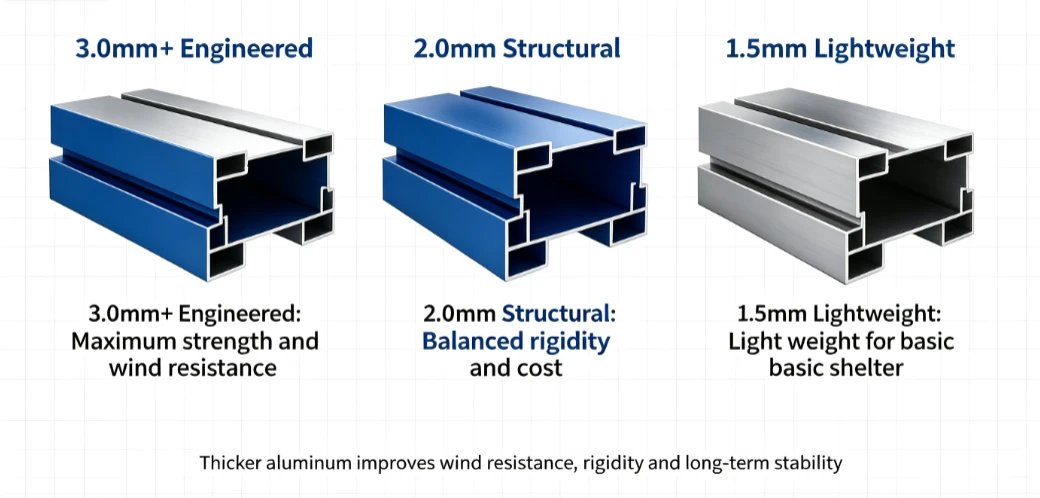
A common pitfall in project bidding is accepting residential grade profiles disguised as commercial grade patio furniture. Residential pergolas frequently rely on a 1.5mm wall thickness. In a commercial zone, a 1.5mm post will buckle under the twisting force generated by a powerful internal motor operating a massive motorized louvered canopy.
To support heavy spans without mid-posts, commercial architectural plans strictly require a wall thickness between 2.0mm and 3.5mm for load-bearing columns.
📊 Wall Thickness vs. Structural Performance Limits (100mm x 100mm Post Baseline)
| Wall Thickness (mm) | Max Safe Height Limit (m) | Max Unsupported Span (m) | Wind Velocity Resistance | Deflection Risk Under Load | Commercial Project Compliance Status |
| 1.5mm | 2.5 | 3.5 | Up to 75 km/h | High Risk | ❌ Failed (Residential Only) |
| 2.0mm Structural Profile | 3.0 | 5.0 | Up to 105 km/h | Low | Approved (Standard Commercial) |
| 2.5mm Heavy Duty Profile | 3.5 | 6.0 | Up to 120 km/h | Very Low | Approved (High Wind Areas) |
| 3.0mm+ Engineered Profile | 4.0+ | 7.0+ | Up to 140+ km/h (Hurricane) | Negligible | Approved (Coastal / Rooftop Level) |
Why does this matter? Moment of inertia. As the thickness increases from 1.5mm to 3.0mm, the structural resistance to bending moments increases exponentially. If your project features a custom outdoor pavilion over a large restaurant deck, utilizing a 3.0mm post ensures the entire structure remains rigid when the louvers are fully closed during a downpour, trapping water and wind loads simultaneously.
🛡️ Wind Load Demands & International Certifications
Engineers don't guess; they verify. When specifying a commercial motorized pergola for a municipal or corporate bid, you must demand verified third-party laboratory certifications.
A premium framework must undergo rigorous SGS wind load testing to validate structural integrity up to Beaufort Scale 11 gales. Furthermore, look for TUV Rheinland validation concerning motorized mechanical endurance, ensuring the louver drive system can withstand over 10,000 opening/closing cycles without gear stripping.
Beyond structural stability, environmental exposure will ruin non-certified coatings. Ensure your supplier implements a powder coating line certified by Qualicoat Class 2 or Intertek weathering testing. This guarantees the surface will resist salt spray, UV fading, and chalking in punishing seaside commercial layouts. The entire assembly must proudly carry the CE Certification mark to clear European and global commercial building safety codes.
🏭 Sourcing From a Top-Tier Structural Manufacturer
Purchasing direct from a verified outdoor furniture factory that manages its own aluminum extrusion and aging ovens allows you to control these variables. Cheap trading companies often shave off 0.2mm of aluminum thickness to cut costs, a hidden deficit that can cause your entire system to sway in light winds.
When sourcing commercial grade patio furniture, request raw material mill certificates. A reputable mill certificate will explicitly show the chemical breakdown of the 6063-T5 aluminum alloy, proving the silicon and magnesium content matches ASTM or EN standards. By securing these verified structural components, your outdoor venue transforms into a safe, permanent asset.
❓ FAQs:
Q1: Why can't we use standard 1.5mm residential aluminum profiles for commercial rooftop projects?
Rooftops experience severe wind shear and microbursts. A 1.5mm wall thickness lacks the necessary structural mass and moment of inertia, meaning the frame will warp or crack at the anchor joints under high-altitude wind uplift forces.
Q2: What is the main difference between 6063-T5 and 6061-T6 for motorized louvers?
6063-T5 aluminum alloy delivers a far smoother surface finish after extrusion, making it perfect for premium powder coating. 6061-T6 is stronger but leaves a rougher, industrial finish that is highly susceptible to surface blemishes and uneven coating.
Q3: Does a 3.0mm thickness mean the pergola can span any length without center columns?
No. While a 3.0mm wall thickness significantly increases load capacity, the maximum unsupported span for a premium commercial motorized pergola is typically capped at 7 to 8 meters. Spans beyond this require intermediate structural beams to prevent horizontal sagging.
Q4: How does Qualicoat Class 2 certification protect the structure?
Qualicoat Class 2 signifies a high-durability powder coating that uses super-durable polyester resins. It offers three times the gloss retention and weathering resistance of standard Class 1 coatings, preventing the frame from corroding in coastal or high-pollution commercial environments.
Q5: Can the motorized drive mechanism handle a roof built with heavy 3.0mm profiles?
Yes, provided the system utilizes premium internal motors (such as Somfy or specialized high-torque linear actuators) that are calibrated to match the total weight of the bioclimatic louvered roof. Heavy-duty profiles actually reduce motor strain by preventing frame distortion that causes louver binding.
Q6: What certifications should I submit to local building departments for commercial permits?
You will typically need to provide an SGS wind load testing report, CE Certification compliance documents, and localized structural engineering calculations validating that the concrete anchors can handle the maximum overturning moment of the posts.


