
For resort directors, commercial purchasing agents, and outdoor venue managers, specifying shade structures is rarely just an aesthetic decision. When an offshore breeze or localized gust sweeps across a coastal terrace or rooftop lounge, an under-engineered shade system transforms into a high-liability projectile hazard.
Understanding commercial patio umbrella wind speed thresholds requires looking beyond simplistic catalog promises. A standard commercial shade canopy may handle light breezes of 15 to 25 MPH, but high-exposure commercial environments demand heavy-duty, engineered solutions capable of staying stable in wind speeds reaching 50 to 60+ MPH (80 to 96+ km/h).
Determining the exact wind rating for your commercial space involves evaluating structural frame mechanics, canopy aerodynamics, anchoring ballast, and official testing certifications.

Wind Speed Ratings & The Beaufort Scale
Wind force does not increase in a simple linear fashion-as wind speed doubles, the overturning force exerted on an outdoor umbrella increases quadruply. This exponential increase in aerodynamic load is why commercial buyers must evaluate umbrella wind tolerance against recognized meteorological frameworks like the Beaufort Wind Scale.
To prevent frame deformation or joint failure, commercial operators should establish clear wind management protocols based on velocity categories:
Commercial Umbrella Wind Resistance & Operational Threshold Matrix
| Beaufort Scale | Wind Speed (MPH) | Wind Speed (km/h) | Environmental Indicators | Standard Commercial Class Action | High-Wind Engineered Class Action |
| Force 3–4 | 8 – 18 MPH | 12 – 29 km/h | Leaves and small twigs in constant motion; light flags extended. | Safe operational zone for all commercial umbrellas. | Normal operation. |
| Force 5 | 19 – 24 MPH | 30 – 38 km/h | Small trees in leaf begin to sway; crested wavelets on inland waters. | Upper limit for entry-level market umbrellas; monitor closely. | Fully stable; no stress on reinforced frame. |
| Force 6 | 25 – 31 MPH | 40 – 50 km/h | Large branches in motion; whistling heard in overhead wires. | Mandatory closure for standard commercial umbrellas. | Safe operation; canopy vent active. |
| Force 7 | 32 – 38 MPH | 51 – 61 km/h | Whole trees in motion; resistance felt walking against wind. | Risk of structural failure if open or unanchored. | Upper safe limit for reinforced center-pole structures. |
| Force 8–9 | 39 – 54 MPH | 62 – 87 km/h | Twigs break off trees; structural damage occurs to temporary shelters. | Extreme hazard zone; closed & secured tightly with tie straps. | Specialized commercial umbrella for high wind areas remain structurally intact (closed/pinned). |

Structural Engineering & Material Science in High Winds
A shade canopy acts as a sail. How it handles wind energy depends on how its structural components distribute dynamic load.
Frame Alloys & Rib Flexibility
Cheap steel frames bend permanently under stress, while soft wood poles snap under sudden torque. High-spec commercial shade structures utilize extruded aluminum alloy 6063-T6, which offers an exceptional strength-to-weight ratio and elevated structural engineering yield strength.
To absorb severe turbulence without snapping, modern high-wind systems combine rigid aluminum main poles with heavy-duty fiberglass umbrella ribs. Fiberglass acts like a fishing rod: it flexes under localized wind gusts to shed air pressure and snaps back to its original shape once the pressure drops.
Canopy Fabric & Aerodynamic Vents
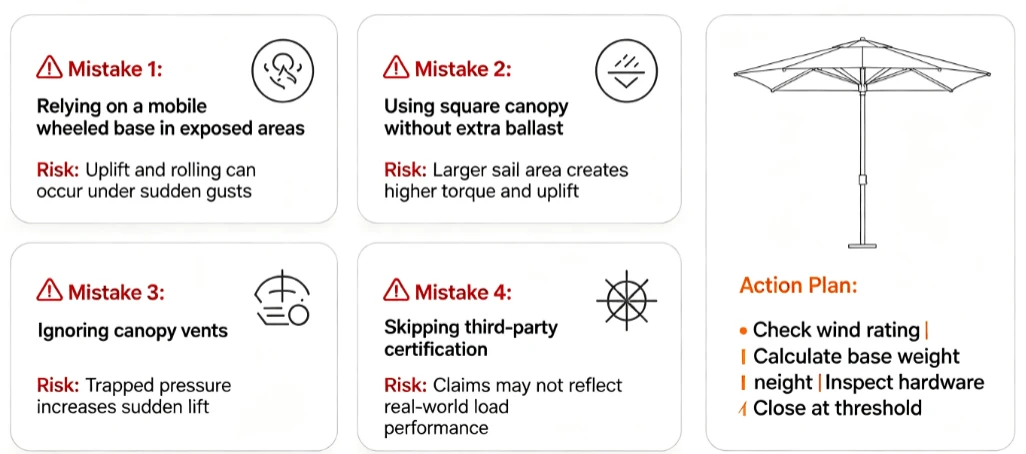
A solid, non-vented canopy traps high-pressure air pockets underneath, causing sudden upward lift. Incorporating a dual or triple canopy wind vent system creates an escape path for trapped air, equalizing pressure differentials above and below the fabric.
For the canopy material itself, industrial-grade solution-dyed acrylic fabric is essential. Unlike standard polyester which degrades rapidly under coastal UV exposure, premium solution-dyed acrylic retains high tensile strength, resisting canopy tearing during strong wind flutter.
All critical connection points-including hub joints, rib end pockets, and crank mechanisms-should be reinforced with stainless steel 316 hardware to eliminate marine-environment salt corrosion and micro-cracking under stress.

Structural Configurations: Center-Pole vs. Cantilever
The geometry of an umbrella fundamentally alters its center of gravity and mechanical leverage under wind loading.
A center-pole heavy-duty market umbrella transfers vertical downforce and lateral wind load directly into the center of its foundation. This direct line of force makes center-pole designs inherently stable in high-wind conditions.
Conversely, a heavy duty wind resistant cantilever umbrella places the support mast to the side, creating a long lever arm. When wind pushes against a side-post canopy, it generates rotational torque that tries to twist the main pole off its base. To survive severe coastal winds, offset models require heavy-gauge internal steel gussets, heavy-duty rotational locks, and substantially higher ballast weight.
tructural Performance Comparison by Design Architecture
| Engineering Parameter | Commercial Center-Pole Umbrella | Commercial Cantilever / Offset Umbrella |
| Load Distribution | Direct inline vertical and lateral force transfer. | Asymmetric rotational torque along offset lever arm. |
| Max Safe Wind Speed (Open) | Up to 45 – 55 MPH (with fixed ground mount). | Up to 35 – 45 MPH (engineered heavy-duty models). |
| Base Weight Requirement | Moderate to High (80 – 200+ lbs). | Extremely High (250 – 500+ lbs or structural bolt-down). |
| Failure Point Under Extreme Load | Pole bending at hub collar or rib socket shear. | Arm pivot joint shear or base plate rotation. |
| Ideal Application | Open-air dining terraces, windy pool decks. | Luxury lounge seating where obstacle-free space is mandatory. |
Anchoring Mechanics: Base Weight & Ground Foundations
No matter how strong the aluminum frame is, an outdoor umbrella with base configuration will fail if the ballast is insufficient to counteract wind uplift.
⚠️ Commercial Field Rule: Never rely on free-standing mobile bases for unmonitored high-wind locations. Always recalculate base weight requirements based on canopy surface area and local wind exposure.
Base Types & Securing Methods
Free-Standing Mobile Base: Suitable for sheltered courtyards or lower wind zones. Must feature a tall steel neck tube with dual locking knobs.
Surface Mount Plate: Heavy steel plate bolted directly into concrete or timber decking using expansion anchors.
In-Ground Anchor Socket: The ultimate high-wind foundation. An in-ground anchor socket is cast directly into a concrete footing below ground level. When the umbrella is removed, a flush cap covers the socket, leaving zero tripping hazard.
Minimum Recommended Ballast Weight Matrix by Canopy Size
| Canopy Size & Shape | Low Wind Area (Up to 15 MPH) | Medium Wind Area (16–28 MPH) | High Wind Exposure (29–40+ MPH) |
| 9 ft (2.7m) Round / Octagon | 75 lbs (34 kg) | 120 lbs (54 kg) | In-ground anchor socket or 180+ lbs plate |
| 11 ft (3.3m) Round / Octagon | 100 lbs (45 kg) | 150 lbs (68 kg) | Bolt-down plate / 250+ lbs weighted outdoor umbrella stand |
| 10 ft x 10 ft (3x3m) Square | 120 lbs (54 kg) | 200 lbs (90 kg) | Structural concrete anchor / 300+ lbs ballast |
| 13 ft (4.0m) Round or Square | 150 lbs (68 kg) | 250 lbs (113 kg) | Fixed floor bolt-down or heavy steel frame ballast (400+ lbs) |
Testing Standards & Quality Certifications
To ensure shade systems withstand commercial demands, buyers should verify that products have undergone rigorous third-party structural testing and hold internationally recognized certifications.
🛡️ Key Industry Certifications & Standards:
TÜV Rheinland Certification: Verifies overall mechanical safety, structural stability, and build quality under real-world load conditions.
SGS ISO 9001 certification: Ensures consistent manufacturing quality management, material traceability, and structural integrity across production batches.
EN 581 European standard: Specifies safety, strength, and stability requirements for outdoor furniture and shade structures used in commercial contract environments.
ASTM G154 UV resistance testing: Accelerated weathering testing that verifies fabric tensile strength retention and colorfastness after thousands of hours of intense UV light exposure.
BIFMA commercial durability standard: Validates mechanical hardware cycles, crank lift endurance, and structural joint fatigue resistance.
In addition to laboratory testing, top-tier commercial manufacturers subject their complete units to multi-directional wind tunnel testing. These tests simulate real atmospheric wind shear, verifying exactly at what velocity the structure experiences elastic deformation, canopy flutter, or anchor lift.

Operational Guidelines for High-Wind Hospitality Venues
Even a fully certified wind rated umbrella requires a disciplined operational protocol to prevent accidents during sudden storms.
When outfitting open beachfronts or high-rise rooftops, investing in an engineered cantilever patio umbrella or a heavy-duty center-pole unit designed for contract environments pays off in reduced replacement costs, lowered liability risks, and long-term peace of mind.
FAQ
Q1: What is the maximum wind speed a commercial patio umbrella can handle before it must be closed?
Standard commercial umbrellas should be closed when wind speeds reach 25–30 MPH (40–48 km/h). Reinforced, heavy-duty engineered commercial umbrellas can remain open safely in wind speeds up to 40–50 MPH (64–80 km/h), provided they are anchored using concrete floor bolts or in-ground sockets.
Q2: Why are square commercial umbrellas more vulnerable to wind than round ones?
A square canopy has roughly 25% to 30% more surface area than a round canopy of the same nominal width. This additional surface area catches significantly more wind volume, generating higher uplift forces and greater torque on the frame and base.
Q3: Can a mobile weighted base support an umbrella in high-wind conditions?
Mobile bases with wheels are designed for convenience, not extreme wind resistance. In high-wind locations like rooftops, oceanfront resorts, or elevated terraces, mobile bases can roll or tip over. Fixed bolt-down plates or in-ground sleeves are strongly recommended for high-wind areas.
Q4: How does a dual wind vent improve canopy stability?
A dual wind vent allows high-pressure air that collects underneath the umbrella canopy to vent upward through overlapping fabric layers. This pressure release reduces canopy uplift force and minimizes frame swaying during sudden wind gusts.
Q5: What is the difference between residential and commercial wind-rated umbrellas?
Residential umbrellas typically feature light aluminum, wood, or thin steel frames with push-pin or light crank mechanisms designed for light breezes (under 15 MPH). Commercial-grade units use heavy-wall 6063-T6 extruded aluminum, thick fiberglass ribs, 316 stainless steel hardware, and engineered base anchor systems designed to withstand daily commercial use and higher wind loads.
Q6: How do I know if my patio umbrella base is heavy enough?
A general rule of thumb for commercial use is 10 lbs of base weight per foot of canopy width for sheltered areas, and 15–20+ lbs per foot of canopy width for exposed or windy areas. If your umbrella sways excessively, lifts slightly off the deck, or turns in the base neck tube during moderate gusts, your base ballast is inadequate.
Q7: Should cantilever umbrellas be avoided in high-wind regions?
Not necessarily, but standard residential cantilevers should be avoided. If a cantilever design is required for outdoor lounge layout flexibility, you must select a heavy-duty, wind-engineered commercial cantilever that incorporates heavy-wall aluminum masts, flexible fiberglass support struts, and heavy floor bolt-down plates.
Q8: What maintenance steps keep wind-rated umbrellas safe over time?
Regularly inspect all structural bolts, rib-to-hub connectors, and base locking knobs for signs of loosening or fatigue. Replace worn canopy tie straps immediately, clean sand or salt residue off friction locks, and ensure in-ground sockets remain clean and free of water buildup or debris.