
When procurement directors, hotel project managers, and restaurant owners furnish outdoor venues, structural integrity is not merely a preference-it is a legal and operational safeguard. A critical question facing every commercial buyer is: what safety and stability standards (e.g., ASTM, BIFMA, EN 581) must commercial patio furniture meet for hospitality use?
Specifying residential-grade items for heavy-duty commercial environments regularly leads to frame buckling, weld fractures, tipping accidents, and severe public liability claims. Whether installing heavy-duty outdoor wicker furniture on a resort pool deck or placing a compact 4 chair outdoor dining set across a busy patio, understanding international testing protocols ensures your venue remains safe, compliant, and structurally durable.
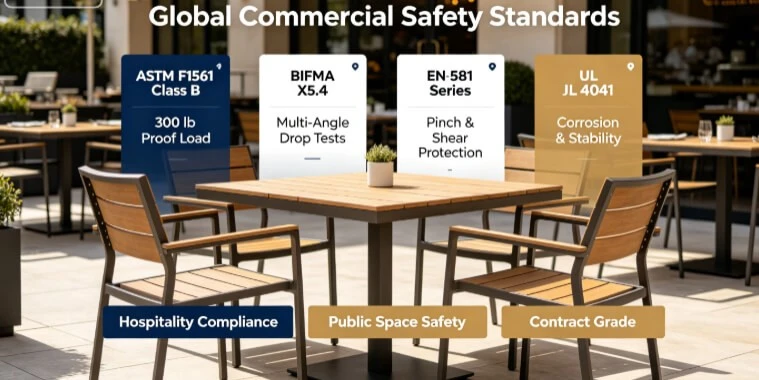
1. Global Commercial Safety Standards: ASTM, BIFMA, and EN 581
Commercial outdoor furniture undergoes significantly higher usage frequency and weight stress than residential seating. International standardizing bodies have established rigorous testing benchmarks to simulate years of heavy commercial use in months.
North American Standards: ASTM and BIFMA
In North America, commercial furniture compliance hinges primarily on standards established by ASTM International and the Business and Institutional Furniture Manufacturers Association (BIFMA):
ASTM F1561: The standard performance specification for commercial outdoor plastic and composite armchairs. It classifies seating into Class A (light commercial) and Class B (heavy commercial, rated for user weights up to 300 lbs plus dynamic impact safety factors).
BIFMA X5.4: Focuses on public space and lounge seating. It measures vertical static loads, seat drop impacts, arm strength, and backrest durability under continuous multi-shift usage.
UL 4041: The safety standard specifically created for outdoor furniture by Underwriters Laboratories, covering mechanical stability, shear and pinch points, and corrosion resistance.
European Standards: EN 581 Series
For international hospitality brands and European contract projects, compliance with the EN 581 series is mandatory. The standard is divided into three comprehensive parts:
EN 581-1: General safety requirements, covering freedom from sharp edges, tubular caps, and shear/pinch hazards during folding or setup.
EN 581-2: Mechanical safety and test methods for contract seating, applying rigorous dynamic load cycles.
EN 581-3: Mechanical safety requirements and testing protocols for outdoor tables.
Primary Commercial Standards Comparison
| Standard Code | Origin / Region | Primary Application Scope | Weight Capacity & Load Criteria |
| ASTM F1561 (Class B) | North America | Commercial plastic/composite outdoor chairs | 300 lb proof load / 400+ lb ultimate static load |
| BIFMA X5.4 | North America | High-traffic public & lounge seating | Multi-angle drop tests up to 300 lbs repeatedly |
| EN 581-1 | Europe / Global | General safety & ergonomic hazard protection | Pinch/shear elimination, burr-free joint inspection |
| EN 581-2 | Europe / Global | Contract outdoor seating mechanical performance | 200 kg seat static load / 100,000 fatigue cycles |
| EN 581-3 | Europe / Global | Contract outdoor tables stability & strength | Vertical center/edge load & anti-tipping force |
| UL 4041 | Global | Comprehensive outdoor furniture safety | Mechanical durability, corrosion & wind tipping |
2. Critical Mechanical Testing Protocols: Load, Fatigue, and Stability
Passing commercial certification requires furniture samples to survive destructive testing in accredited laboratories.
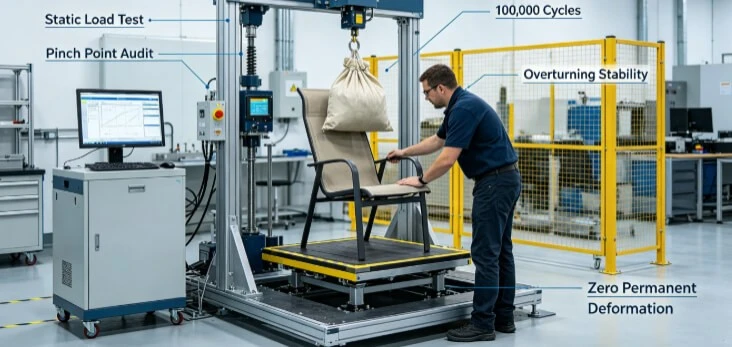
Static Load Testing
In a static load testing procedure, hydraulic actuators apply a continuous downward force onto the seat pan or table surface for a specified duration. For heavy-duty commercial contract chairs, a static proof weight exceeding 400 lbs is applied to verify that structural welds, frame tubing, and leg joints show zero permanent deformation.
Dynamic Fatigue Testing
Unlike static loads, dynamic fatigue testing simulates the real-world impact of a guest sitting down abruptly. A heavy bag or mechanical plunger drops onto the seat surface 100,000 consecutive times. This tests the resilience of internal structural framing, woven synthetic PE rattan, and structural leg gussets.
Overturning Stability & Pinch Point Audits
Tipping accidents represent a major public liability risk in commercial dining spaces. Stability tests apply lateral forces to table edges and chair armrests at steep angles:
Table Edge Loading: Verifies that lean-on pressure from guests on one edge does not cause the table base to flip over.
Chair Leg Clearance: Ensures the chair resists backward tipping when a guest leans back on two legs.
Shear Hazard Clearance: Eliminates gaps where fingers or clothing could become trapped during stacking or folding operations.
Specifying certified sidewalk cafe outdoor furniture sets prevents stability failures on uneven cobblestone streets or sloped urban pavements.
3. Environmental Degradation Mechanics and Material Endurance
Mechanical strength alone is insufficient if weather exposure degrades the underlying material structure. Commercial outdoor furniture must withstand intense solar radiation, temperature swings, and corrosive moisture.
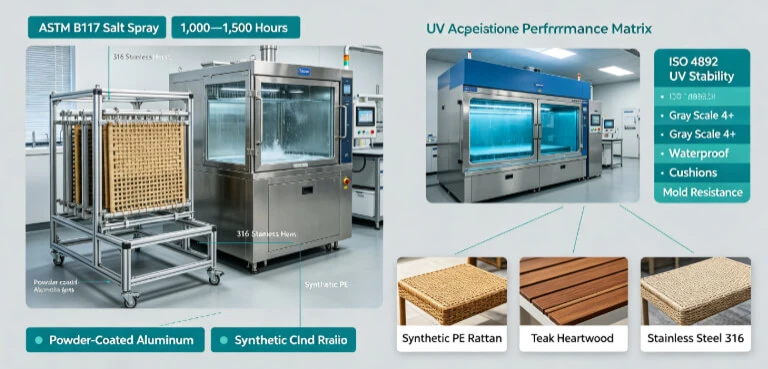
Corrosion Resistance: Structural frames crafted from powder-coated aluminum or stainless steel 316 hardware undergo ASTM B117 neutral salt spray testing. High-grade commercial finishes must survive 1,000 to 1,500 hours of continuous salt fog exposure without blistering or peeling.
UV Stability and Colorfastness: Synthetic weaves and fabrics are exposed to accelerated weathering chambers under ISO 4892 xenon-arc light standards. Commercial synthetic wicker must achieve a Gray Scale rating of 4 or higher after 2,000 hours of UV irradiation to ensure it does not crack or become brittle.
Waterproofing and Mold Resistance: Specifying restaurant outdoor furniture waterproof uv resistant materials ensures that cushions, webbing, and wicker cores repel moisture, preventing internal frame corrosion and mold colonization.
Material Performance Matrix
| Material Type | Corrosion Resistance | UV Resistance Rating | Mechanical Impact Fatigue |
| Powder-Coated Aluminum | Superior (Immune to rust) | Excellent (TGIC Polyester coating) | High strength-to-weight ratio |
| Synthetic PE Rattan | Highly Resistant | UV Stabilized (2,000+ hrs) | Flexible, absorbs dynamic impact |
| Teak Heartwood | High (Natural oils) | Natural Patina (Silvery-grey) | Outstanding structural rigidity |
| Stainless Steel 316 | Marine-Grade Excellence | Impervious to UV rays | Maximum static load capacity |
4. Financial Risk Analysis & Return on Investment (ROI)
For hotel operators and restaurant owners, purchasing certified commercial patio furniture is a financial strategy that balances capital expenditure against operational risk.
Capital Expenditure vs. Liability Expenditure
While uncertified residential furniture carries a lower initial purchase cost, its long-term total cost of ownership is far higher due to rapid structural failure and safety hazards.
Injury Risk Mitigation: A single structural collapse involving a restaurant guest can lead to costly medical bills, legal settlements, and increased insurance premiums. Certified EN 581 or ASTM furniture serves as documentary evidence of legal due diligence.
Operational Continuity: Certified furniture avoids mid-season failures, eliminating out-of-service dining tables during peak operating periods.
Commercial Investment & Risk Breakdown
| Investment Dimension | Certified Commercial Outdoor Furniture | Uncertified Residential Alternative |
| Initial Procurement Cost (Capex) | Standard Commercial Investment | Low Upfront Price |
| Expected Operational Service Life | 5 to 7+ Years | 6 to 18 Months |
| Commercial Warranty Coverage | 3 to 5 Year Commercial Warranty | Residential Only (Void in commercial use) |
| Public Liability Insurance Risk | Low Risk (Meets ASTM / EN standards) | High Risk (Susceptible to weld failure) |
| Annual Structural Replacement Cost | Near Zero | High (Continuous replacement cycles) |
5. Third-Party Certification Bodies and Quality Assurance
Procurement managers should never rely solely on a vendor's self-declaration of quality. Authentic compliance requires official test reports issued by accredited third-party laboratories.
Recognized Testing & Certification Agencies
SGS: Global leader in mechanical load testing, material composition analysis, and salt spray exposure.
TÜV Rheinland: Specializes in European safety mark certifications, ergonomic testing, and structural stability audits.
Intertek: Provides comprehensive ASTM, BIFMA, and UL safety testing certificates.
Bureau Veritas: Conducts factory audits, raw material verification, and container loading inspections.
Facilities that maintain ISO 9001 quality management systems demonstrate standardized manufacturing processes, ensuring every production batch matches the structural integrity of laboratory-tested samples.
FAQ:
What is the main difference between residential and commercial outdoor furniture standards?
Commercial outdoor furniture standards require significantly higher static load capacity, rigorous dynamic fatigue cycling (often 100,000+ impacts), stricter anti-tipping stability ratios, and higher resistance to UV degradation and salt fog corrosion compared to residential products.
Does residential furniture warranty cover commercial use in a hotel or restaurant?
No. Almost all residential furniture manufacturers explicitly void their warranties if the product is installed in a commercial, hospitality, or public environment. Commercial project buyers must specify products backed by dedicated commercial warranties.
What static load weight should a commercial outdoor chair be rated to support?
For heavy-duty commercial contract applications, chairs should meet or exceed ASTM F1561 Class B or EN 581-2 standards, supporting a proof load of at least 300 to 400 lbs without permanent frame deflection or joint cracking.
What testing standard applies to outdoor umbrellas and shading structures?
Outdoor commercial umbrellas are evaluated under UL 4041 and specific wind-tunnel stability protocols. Testing evaluates canopy frame strength, crank mechanism fatigue, corrosion resistance, and wind overturning thresholds up to specified force ratings.
Why is salt spray testing important for outdoor furniture located inland?
While essential for coastal resorts, salt spray testing (ASTM B117) also measures the overall durability and adhesion of powder coatings. Furniture that passes 1,000+ hours of salt fog testing easily resists pollution, rain acidity, chlorine poolside splashes, and cleaning chemical corrosion.
How can procurement managers verify that a supplier's test report is genuine?
Request full, unredacted test reports directly from accredited testing agencies such as SGS, TÜV Rheinland, or Intertek. Check that the report number, product model name, frame dimensions, and testing dates match the exact supplier quotation.