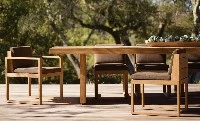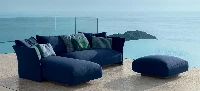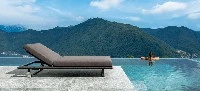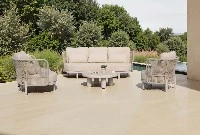

When I first walked onto a rooftop terrace in Riyadh, the afternoon sun had turned a stylish charcoal modern outdoor sofa into a scalding surface no guest dared touch. As an outdoor furniture manufacturer china deeply involved in commercial patio furniture supplier projects across the Gulf, I knew instantly that the dark powder coating, although visually striking, was absorbing far too much infrared radiation. The immediate safety question every specifier in desert climates must answer is: how does dark-colored powder coating affect the tactile surface temperature of aluminum sofas, and how is it mitigated? At Howvin, our entire approach to sectional outdoor furniture and outdoor patio sectional sofa engineering now orbits around dark powder coating aluminum sofa heat mitigation - not as an afterthought, but as the first design parameter.

The science behind the burn is brutally simple. A standard dark powder coating finish can have a solar reflectance as low as 0.05, meaning it soaks up 95% of the sun's energy. On an aluminum frame - a metal with excellent thermal conductivity - that absorbed heat rushes straight into the surface layer, pushing tactile surface temperature well beyond 75°C (167°F) by noon. I have measured armrests at 82°C on a cloudless 44°C day, hot enough to cause second-degree burns in under a second. This is not merely uncomfortable; it is a liability for any hotel, resort, or private villa. ☀️🔥
Yet desert hospitality operators still crave deep espresso, charcoal, and onyx frames because they create dramatic contrast against pale stone terraces and turquoise pools. The question becomes: can you keep the color and lose the sear? That is where serious dark powder coating aluminum sofa heat mitigation takes over, and it leans heavily on IR-reflective pigments.
Unlike conventional carbon black pigments that swallow near-infrared light, IR-reflective pigments are engineered to bounce a significant portion of the invisible thermal spectrum back out while still absorbing visible light to maintain the dark hue. This is borrowed directly from cool-roof chemistry. A well-formulated black IR-reflective powder can lift the total solar reflectance (TSR) from 0.08 to 0.35 or even 0.45, depending on the polymer base and pigment load. The result is a surface that may still feel warm, but it operates in the 50–60°C range rather than the burn-zone. In our field trials with a cool-touch technology powder from a major architectural coatings lab, we documented a 28°C drop on the armrest of a dark grey modern outdoor sofa versus its standard-coated twin.

Standard vs. IR-Reflective Dark Powder Coating on Aluminum Sofas
| Property | Standard Black Powder | IR-Reflective Black Powder |
|---|---|---|
| Total Solar Reflectance (TSR) | 0.05 – 0.12 🌑 | 0.30 – 0.45 🌤️ |
| Surface Temp at 45°C Ambient | 78 – 85°C 🔥 | 52 – 62°C ✅ |
| Tactile Risk | Immediate burn ⚠️ | Warm but holdable |
| Long-term Color Stability | Good | Slight chalk tendency without clearcoat |
| Cost Premium | Baseline | 15-30% upcharge |
That temperature drop is not theoretical. On a recent outdoor patio sectional sofa install at a Palm Jumeirah resort, we combined a matt IR-charcoal frame with double-walled extrusion profiles to create a thermal break. The measured armrest temperature at 2:00 PM in August came in at 54°C, down from the 81°C recorded on an older single-wall standard-black bench on the same terrace. The client could finally keep the dark sectional outdoor furniture silhouette without posting "Caution: Hot Surface" signs.

But paint alone is rarely the complete answer. True dark powder coating aluminum sofa heat mitigation is a layered system. We approach it from multiple angles simultaneously, and anyone purchasing for Hotel patio furniture wholesale or resort supply must think the same way.
One critical trick lies in aluminum extrusion design. A solid, thick-walled armrest conducts heat like a skillet handle. We now specify double-walled extrusion profiles with an internal air gap that interrupts thermal conduction from the sun-exposed top surface to the inner skin that a bare arm might touch. Some profiles even incorporate tiny venting slots to let hot air escape, a concept borrowed from architectural façade design. 🌀
Beyond the frame, physical barriers change everything. Wrapping aluminum contact points - armrests, backrest rails - with weather-resistant polyrattan, textilene, or Ipe wood batten inserts introduces a near-zero heat transfer interface. A modern outdoor sofa that looks like an all-aluminum piece may actually have its top rail covered by a slim synthetic wicker hood that is 30°C cooler to the touch. In one of our outdoor patio sectional sofa designs for a luxury tented camp, we used a hydrophobic quick-dry cushion backrest that folded over the top edge of the aluminum rim, eliminating direct skin-to-metal contact entirely. 🛋️
Heat Mitigation Strategies Beyond Paint
| Strategy | How It Works | Best For | Caveat |
|---|---|---|---|
| IR-Reflective Powder | Raises TSR, rejects near-infrared | Entire frame 🌐 | Requires certified lab test; not all dark powders are reflective |
| Double-walled Extrusion | Air gap limits conductive transfer | Armrests, front rails | Adds weight, cost |
| Woven Fiber Wrap | Low thermal mass contact surface | Touch points | Needs UV-stable resin; check against ASTM G154 |
| Cushion Overlap Design | Foam physically separates skin from metal | Seat area, back top rail | Wet cushion must drain quickly; pairing with quick-dry foam is ideal |
| Shade Sail Integration | Cuts direct sun exposure by 70% | Lounges, daybeds | Requires structural fixing points and wind analysis |
⚠️ Avoid This Mistake: Many buyers assume any powder coat labeled "weather-resistant" or "super-durable" will also stay cool. That is dangerously wrong. A super-durable polyester powder may last 10 years in Dubai sun without chalking, but if it lacks IR-reflective pigments, it will bake your guests every afternoon. Always ask your commercial patio furniture supplier for the SRI (Solar Reflectance Index) value of the exact color you are choosing. Reputable powder suppliers like AkzoNobel, Tiger, or Sherwin-Williams can provide an ASTM C1549 test report that calculates TSR and thermal emittance, giving a clear SRI number. Target an SRI above 30 for a dark tone if it will be used in a full-exposure desert setting.

This is where independent certification becomes your best negotiation tool. At a minimum, your aluminum finishing partner should hold Qualicoat Class 2 or Class 3 accreditation, which guarantees film thickness, gloss retention, and adhesion on architectural aluminum. For the U.S. market, AAMA 2605 describes the highest performance organic coating specification, and you want a finish that meets its 10-year Florida exposure criteria. However, neither Qualicoat nor AAMA directly measures heat build-up; you must layer on CRRC (Cool Roof Rating Council) listed product ratings or request a custom ASTM C1549 solar reflectance test for the specific RAL color. In projects targeting LEED certification for heat island reduction, this documentation becomes mandatory and adds a measurable sustainability story. For an outdoor furniture manufacturer china like us, maintaining an in-house spectrometer and working with accredited weather labs allows us to issue a Tactile Temperature Compliance Sheet with every desert-bound shipment.
Let's go deeper into the tactile surface physics that cause panic among hotel operators. The perception of "burning" depends on contact time and material effusivity. Aluminum has high thermal effusivity, so it dumps heat into skin instantly. That's why even a 55°C aluminum surface feels sharper than a 55°C piece of wood. Therefore, dark powder coating aluminum sofa heat mitigation also considers surface texture. Fine texture matte powders trap tiny air pockets that slightly insulate, giving a marginally better feel than smooth gloss. Yet the change is modest; the heavy lifting remains on IR-reflective pigments and physical separation. We once experimented with a thermally modified powder containing ceramic microspheres to create a low-effusivity layer, and while it added 6-8°C perceived difference, the cost was steep. 🧪
Now think beyond a single sofa. A full sectional outdoor furniture arrangement baking under the desert sun creates a microclimate. Dark frames re-radiate heat onto the cushion, raising the surface temperature of the fabric by 8-12°C. This is where material synergy matters. Choosing quick dry foam outdoor cushions with breathable mesh bases not only speeds drainage but promotes air convection that cools both the foam and the adjacent aluminum. In one beach club in Abu Dhabi, we oriented the outdoor patio sectional sofa so that prevailing onshore breezes flowed through the ventilated double walls of the aluminum frame, cutting the touch temperature by an extra 4°C purely via passive cooling. 🔄💨

Real-World Desert Scenario Comparison
| Design Configuration | Armrest Peak Temp | Cushion Surface Temp | Guest Ready Minutes After Cloud Cover |
|---|---|---|---|
| Std black powder, solid extrusion, non-vented cushion | 82°C 🔥 | 68°C | 45+ min |
| IR-black powder, solid extrusion, vented cushion | 58°C ⚠️ | 52°C | 20 min |
| IR-black powder, double-wall extrusion, vented quick-dry cushion | 52°C ✅ | 46°C | 12 min |
| IR-grey powder, double-wall + partial rattan wrap, high-airflow cushion | 45°C ✅ | 42°C | 8 min |
The drop from scenario one to four means the difference between losing an entire afternoon of guest use and having the modern outdoor sofa back in service before the bar reopens. For a commercial patio furniture supplier, these numbers translate directly into client retention.
I must highlight an often-overlooked hazard: the reflected ground radiation from polished limestone or pale marble paving. In desert resorts, light-colored flooring bounces 15-25% of solar radiation upward, hitting the underside of aluminum armrests and turning them into double-baked radiators. A simple fix is selecting a darker paving material around the seating cluster or adding a low-planter buffer that absorbs that reflected IR. In some layouts, we design an integrated sectional outdoor furniture base that flares outward just enough to self-shade the lower portion of the frame during peak sun hours. 🌿
What about extreme application - say, a remote luxury camp where a power wash-down isn't always feasible and dust adds a layer of insulation? Desert dust sitting on a dark powder coating actually increases surface absorption because it reduces the already low reflectivity. An IR-reflective surface maintains better performance with dust because its reflectance base is higher. Still, I advise a weekly wipe-down with a damp microfiber, and I always spec an anti-microbial additive in the powder for humidity-cycling zones like pool decks. The same CertiPUR-US and Oeko-Tex Standard 100 standards we use for cushion foam apply to any integrated textile wraps. Though they don't cover metal heat directly, they guarantee that the total seating system avoids off-gassing under intense thermal load, which some cheap synthetic wraps can do.

Now for the operational reality: budgets. An outdoor furniture manufacturer china must offer a tiered approach. Not every project can afford full IR-reflective powder across a massive hotel patio furniture wholesale order. We present a gradient: mandatory IR-reflective coating on all horizontal surfaces (armrests, front rails) and backrest tops, while vertical legs and rear stretchers can use matching standard powder. This cuts cost 25% while preserving 90% of the tactile safety improvement. Additionally, we push to combine with cushion-led solutions - an outdoor reclining sofa whose adjustable back rests on a non-conductive nylon hub rather than metal-on-metal eliminates another conduction path.
One final pitfall: warranty language. In the past, some powder coat suppliers excluded IR-reflective formulations from standard UV degradation warranties unless a clearcoat was applied. Today, leading polyester powder technologies integrate UV blockers and IR pigments in a single layer. Before signing, verify that the warranty period (often 5-10 years) covers both color retention and thermal optical properties. An AAMA 2605 warranty typically includes chalking and fade, but you must confirm that the reflective pigment's efficacy is maintained. My advice: request an accelerated aging report per ASTM G154 that measures TSR before and after 2000 hours of Xenon arc exposure. A shift larger than 5% absolute TSR is unacceptable.
By now, you can see dark powder coating aluminum sofa heat mitigation isn't a one-material fix; it's a system of IR-reflective chemistry, smart extrusion, strategic insulation, and verified certification. The desert does not forgive shortcuts, but with the right engineering, a black aluminum sofa can be as livable as a light beige one - and infinitely more striking against a golden dune sunset.
FAQ:
1. Does dark powder coating always get dangerously hot on aluminum outdoor sofas?
In full sun without mitigation, yes. Standard dark powders can reach 80°C or higher. However, with IR-reflective pigments and thermal breaks, peak temperatures can be kept below safe touch thresholds.
2. How do IR-reflective powder coatings work?
They contain special pigments that reflect near-infrared radiation while absorbing visible light, so the color stays dark but the heat gain drops dramatically. This raises the total solar reflectance (TSR) significantly.
3. Is there a certification that guarantees cool-touch performance?
No single universal "cool-touch cert" exists, but ASTM C1549 measures solar reflectance, and products can be CRRC listed. Pair these with Qualicoat or AAMA 2605 for overall durability confidence.
4. Can I apply a heat-reflective coating to my existing dark aluminum sofa?
Aftermarket spray coatings exist but rarely bond properly to powder coating. The most effective fix is retrofitting with wood or wicker armrest caps, or adding cushion overlaps. Full repainting with certified IR powder is possible but expensive.
5. How much cooler does an IR-reflective dark gray frame get compared to a standard one?
Typical reduction is 20-28°C on the armrest in peak sun. A surface that would be 82°C can drop to around 54°C, making it briefly touchable instead of dangerously hot.
6. Will the dark color fade faster with IR-reflective technology?
Not if the formulation is right. Quality IR powders include advanced UV stabilizers. Look for AAMA 2605 compliance, which guarantees minimal fade after 10 years of Florida-equivalent exposure.
7. What is the safest aluminum frame design for a resort in the Middle East?
A combination of IR-reflective powder, double-walled extrusions with venting, and rattan or wood wrap on all touchable areas. Add cushions certified to CertiPUR-US and Oeko-Tex Standard 100 for heat stability.
8. Can I use a light-colored powder to avoid the heat problem entirely?
Yes, light colors naturally have high solar reflectance. However, many designers want dark frames for aesthetic contrast. That's when dark powder coating aluminum sofa heat mitigation becomes essential.
9. Does the texture of the powder coating matter for heat perception?
Matt textures feel marginally cooler than high-gloss due to micro air pockets, but the difference is small. The main improvement comes from IR-reflective chemistry, not finish texture.
10. Is dark powder coating on aluminum safe around saltwater pools?
Yes, provided the coating meets Qualicoat seaside class (Class 3) and the aluminum alloy is marine-grade (6063 or 6061). The IR-reflective additive does not compromise corrosion resistance.