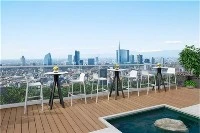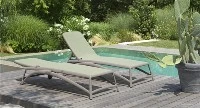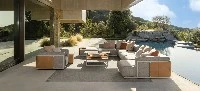

High stackability is valuable in hospitality because outdoor furniture is often moved, stored, cleaned, and redeployed throughout the operating day. But a chair that can be physically piled high is not automatically a good commercial stacking chair.
For buyers sourcing wholesale pool lounge chairs, the better question is how efficiently the product stores while protecting the frame, upholstery, hardware, and visible finish during repeated handling.

A B2B outdoor furniture supplier should therefore describe more than stack count. The technical discussion should include nesting geometry, contact points, protective components, handling, environmental exposure, and replacement parts.
The same principle applies to commercial resort pool furniture, where sand, sunscreen, moisture, salt, and frequent movement can create more wear than a chair experiences in a sheltered restaurant terrace.
For a commercial pool furniture supplier, the most useful specification is not simply "stackable." It is:
How many units can be stacked in the intended operating method while maintaining stable nesting, manageable handling, and acceptable finish condition?
And that distinction changes how a buyer should compare products.
The Short Answer: Look at the Stacking Interface, Not Just the Stack Count
Current commercial product literature shows examples of outdoor side chairs designed for stacks of six, eight, or ten units, while contract lounge chairs and chaise-style products can use different frame geometries to achieve higher stacking density. One outdoor lounge model specifies an eight-high stack, while another sled-base lounge system specifies stacking as a core feature.
The number itself, however, is only one part of the specification.
A strong high-stack design normally has:
🧩 Controlled contact points
🛡️ Non-marking or sacrificial protection
📐 Guided nesting
🪑 Repeatable stack alignment
🛒 Practical handling
🔧 Serviceable wear components
That is why two chairs made from the same aluminum alloy can perform very differently in real storage conditions.
A useful distinction
Stackability asks:
How efficiently can these units nest?
Finish protection asks:
What happens where they touch?
Operational suitability asks:
Can staff move, clean, store, and redeploy them without excessive damage or labor?
All three belong in the same buying decision.

What Actually Prevents Frame Finishes from Scratching?
When one chair is lowered onto another, several forms of wear can happen:
direct metal-to-metal contact
painted edge contact
sliding friction
trapped sand or grit
pressure at a narrow point
impact during careless stacking
misalignment between frames
A durable powder-coated aluminum frame can still show localized wear if the stacking design repeatedly forces a sharp or abrasive contact point against the coating.
That is why the first thing to inspect is not the finish sample.
Inspect the stacking path.
Where should the chairs touch?
Ideally, the product has a deliberate contact zone.
The contact may use:
rubber bumpers
nylon guides
polymer spacers
plastic glides
molded stack stops
protected rails
other replaceable wear elements
The exact material varies by construction. The principle does not:
Control the contact instead of asking the coating to absorb every contact event.
Why a Harder Coating Is Not the Whole Answer
ASTM D4060 is a recognized method for evaluating abrasion resistance of organic coatings using a Taber Abraser on coatings applied to rigid surfaces such as metal panels. ASTM D3363 evaluates coating-film hardness with the pencil test. ASTM D3359 evaluates adhesion of coating films to metallic substrates using a tape test.
These methods are useful because they tell a buyer something about the coating itself.
They do not reproduce the exact mechanical event of:
chair A → chair B → repeated stacking → misalignment → dust / sand contamination → unstacking → restacking
Therefore:
A good coating test supports the finish specification, but it does not replace product-level stacking evaluation.
This distinction should be written into technical submittals.

Which Chair Construction Usually Works Best for High Stackability?
The answer depends on how the chair is engineered.
Molded Polymer Chairs
A polypropylene shell can reduce the problem of painted-metal frames rubbing against each other because the shell itself forms much of the seating structure.
Current commercial examples include one-piece molded chairs designed for repeated commercial stacking, including products specified for stacks of up to ten units.
Typical advantages include:
relatively low weight
predictable nesting
fewer exposed painted-metal contact zones
easy washing
replaceable or interchangeable components in some designs
The trade-off is that the buyer shifts more attention toward:
UV stability + color retention + polymer durability + heat exposure
instead of focusing primarily on coating abrasion.
Powder-Coated Aluminum Frames
Powder-coated aluminum remains one of the most flexible choices for hotel, resort, and restaurant seating.
It is lightweight, widely adaptable to different styles, and commonly used in outdoor contract products.
But the finish is only part of the system.
A chair can have a strong exterior coating and still scratch when:
the frame rubs against another frame;
an exposed weld becomes a high-contact area;
the stacking guide shifts;
sand becomes trapped between surfaces;
arms collide during loading.
This is why aluminum chairs with carefully engineered stacking guides can outperform seemingly similar products with less controlled contact geometry.
Steel Frames
Powder-coated steel can also provide good stacking performance, particularly where designers want a rigid frame and heavier physical presence.
Some commercial outdoor chair collections specify steel frames and stack counts in the six-to-eight range, while other metal-frame collections offer higher stacking through geometry and seat construction.
The main consideration is environmental exposure.
For coastal or highly humid sites, corrosion protection, coating integrity, drainage, and hardware selection become more important.
A heavier frame also changes how staff handle a full stack.
Lounge Chairs and Chaise Lounges Are a Different Problem
Large lounge chairs have more depth and surface area than dining chairs.
That makes high stacking more difficult.
However, purpose-designed stacking lounge chairs do exist.
One current contract product specifies an eight-high stack for an outdoor steel lounge chair, while another outdoor sled-base lounge design is described as stacking fifteen high on the ground. These examples illustrate how strongly frame geometry affects storage density.
The lesson is not that "fifteen high is better."
It is that:
A high stack usually comes from the furniture's geometry, not from material selection alone.
Commercial Lounge Chairs and Dining Chairs: Compare the Architecture, Not Only the Material
| Chair architecture | Typical stacking potential | Finish-risk profile | Main strength | Main consideration |
|---|---|---|---|---|
| One-piece molded shell | High | Lower painted-frame contact | Efficient nesting | UV and polymer durability |
| Aluminum frame + polymer guides | Moderate to high | Lower when contact is controlled | Lightweight, flexible design | Guide durability |
| Steel frame + protected nesting | Moderate to high | Depends on contact design | Rigidity and robustness | Weight and corrosion |
| Sled-base lounge chair | High potential | Can be well controlled | Smooth nesting path | Handling weight |
| Exposed metal-on-metal frame | Variable | Higher | Simple construction | Repeated rubbing |
This table should be interpreted as a design framework, not as a universal ranking.
A well-engineered aluminum chair can outperform a poorly designed polymer chair in a particular operating environment.

What the Stacking Contact Should Look Like
A good stack often has a predictable sequence:
Lift → align → guide → rest → separate
A poor stack often behaves like:
Lift → collide → slide → twist → scrape → settle
The difference may be visually subtle.
But after repeated use, it becomes visible.
Ideal contact behavior
🟢 Guided
The upper chair naturally settles into the correct position.
🟢 Separated
Sensitive finish surfaces do not continuously rub against one another.
🟢 Repeatable
Staff can stack chairs the same way each time.
🟢 Serviceable
High-wear components can be replaced.
Risky contact behavior
🔴 Sharp edge against finish
🔴 Uncontrolled side-to-side movement
🔴 Painted surface as the primary wear surface
🔴 Sand trapped between contact areas
🔴 Loose or easily displaced protective pieces
Why Poolside Conditions Are Harder on Stacking Furniture
Pool and resort furniture faces several exposures at once:
☀️ UV radiation
💧 water
🧴 sunscreen
🏖️ sand
🧂 salt in coastal locations
🧼 cleaning chemicals
👥 frequent guest contact
The combination matters.
For example, sand may not look dangerous on its own. But trapped sand can become an abrasive particle when two frames repeatedly move against each other.
Likewise, moisture can enter joints or remain around protective components.
The furniture should therefore be designed for both:
weather exposure
and
operational contamination
That is especially relevant for pool decks where furniture may be moved several times in one day.

Commercial Resort Pool Furniture: What Changes Near the Pool?
For commercial resort pool furniture, the storage cycle is often inseparable from the cleaning cycle.
Furniture may be:
placed outside → exposed to sunscreen and water → moved for cleaning → rinsed → stacked → stored → redeployed
Every step can affect the finish.
A chair designed for a restaurant terrace may therefore need a different operational specification when used beside a resort pool.
Pool-specific priorities
💦 Easy rinsing
🏖️ Minimal sand traps
🧴 Resistance to common contamination
☀️ UV stability
🧂 Corrosion control
🛒 Easy movement in stacks
🔧 Replaceable wear parts
The more frequently the furniture is moved, the more important the stack interface becomes.
How a Commercial Pool Furniture Supplier Should Specify Stackability
For a buyer, "stackable" is not enough.
A commercial pool furniture supplier should ideally document:
Recommended stack height
Not just the maximum physical number of units that can be piled.
Contact points
Where do the chairs touch?
Protective materials
Are those points polymer, rubber, nylon, or another material?
Stack direction
Does the chair slide, rotate, nest, or drop vertically?
Handling guidance
Should staff move one unit at a time or use a trolley?
Cleaning procedure
How should sand, chlorine residue, and debris be removed before stacking?
Replacement parts
Can damaged bumpers, feet, guides, or glides be replaced?
This is the kind of information that belongs in a commercial technical sheet.
Why Stack Count Alone Can Mislead a Hotel Buyer
Imagine two chairs.
Chair A stacks ten high but requires workers to manually align each frame and has painted metal contact points.
Chair B stacks eight high but nests quickly, uses replaceable polymer guides, and moves safely as one trolley load.
The second system may be easier to operate.
This illustrates an important procurement principle:
Useful stackability is measured by the complete storage workflow, not by the tallest possible stack.
Didi's original article follows the same logic: a benefit must be evaluated together with the operating responsibility it creates rather than treated as a standalone advantage.
What About Dining Chairs with Arms?
Armchairs are generally more difficult to stack densely than armless side chairs because the arms create additional interference points.
Current commercial catalog examples show side chairs reaching higher stack counts than armchairs within the same product families.
That suggests a useful rule for restaurants and hotels:
Do not assume that an armchair can achieve the same stack performance as its matching side chair.
Arm protection should also be considered.
An armrest can become:
a contact point
a leverage point
a scratch point
a snag point
a packaging problem
The design should make the arm structure clear of sensitive finish zones where possible.
What Materials Are Most Suitable for Repeated Outdoor Stacking?
| Material | Stacking advantage | Main weakness | Best-fit environment |
|---|---|---|---|
| Polypropylene | Light and easy to nest | UV / heat / polymer ageing must be considered | Pool, resort, restaurant |
| Powder-coated aluminum | Lightweight and adaptable | Finish can be damaged by uncontrolled contact | Hotels, terraces, resorts |
| Powder-coated steel | Rigid and robust | Higher weight and corrosion considerations | Restaurants, events, sheltered outdoor areas |
| 316 stainless steel | Strong corrosion resistance in demanding conditions | Higher cost; still needs finish/contact consideration | Coastal hospitality |
| Textilene / outdoor mesh | Light, breathable, comfortable | Requires careful textile-to-frame interface | Poolside and resort seating |
| Teak | Premium appearance, strong natural presence | Heavier and maintenance-dependent | Luxury hospitality |
The material is only half the answer.
The other half is how the material is arranged in the stacking mechanism.
What Environmental Conditions Should Influence the Specification?
Coastal Properties
🌊 Salt deposits
💨 Wind
☀️ Strong UV
🏖️ Sand
The key concerns are corrosion control, finish durability, easy cleaning, and protected contact points.
Pool Decks
💦 Water
🧴 Sunscreen
🧼 Chlorinated or cleaning environments
👥 Frequent movement
Here, stain resistance, corrosion control, drainage and handling become particularly important.
Rooftop Restaurants
☀️ UV
💨 Wind
🌧️ Rain
🔥 Heat
The stability of the furniture stack and individual chair becomes more important alongside finish protection.
Urban Terraces
🏙️ Pollution
🌧️ Rain
☀️ Intermittent UV
🚶 High guest movement
Appearance retention and easy housekeeping may become the main priorities.
Environmental selection should therefore happen before the final stackability specification.

Testing and Certification: What Evidence Should a Buyer Request?
Outdoor furniture should be evaluated through the relevant evidence for the failure mode.
UL Solutions' outdoor-furniture program covers product evaluations related to corrosion, stability, strength, shear and pinch points, endurance, and durability, with the specific testing determined by product type. The program references EN 581 for applicable outdoor seating and table products.
For finishes, ASTM methods can add supporting evidence.
ASTM D4060 addresses abrasion resistance of organic coatings.
ASTM D3363 addresses film hardness.
ASTM D3359 addresses adhesion of coatings to metallic substrates.
These tests answer different questions. None of them should be presented as a universal "scratch-free stacking certification."
BIFMA's outdoor-furniture guidance likewise treats outdoor use as a broader performance problem involving environmental exposure such as UV, heat, humidity, cold, and moisture. BIFMA describes that whitepaper as informative guidance rather than a formally approved consensus standard.
A better way to read the documentation
| Evidence | What it helps answer | What it does not automatically answer |
|---|---|---|
| UL 4041 | Outdoor furniture safety and defined performance characteristics | Scratch-free stacking |
| EN 581 | Relevant mechanical and safety requirements for outdoor seating/tables | Complete lifecycle performance |
| ASTM D4060 | Abrasion resistance of an organic coating | Chair-to-chair stacking behavior |
| ASTM D3363 | Relative coating-film hardness | Long-term stack-interface durability |
| ASTM D3359 | Coating adhesion to metal | Resistance to rubbing or impact |
| Product-specific stacking test | Actual stacking behavior | Performance in every possible environment |
This distinction should remain visible in a serious RFQ.
How a Real Stacking Test Should Be Designed
A generic coating panel does not represent a complete chair.
For a hospitality project, the more useful product-level validation is to evaluate the actual furniture configuration.
Step 1 - Stack
Use the intended stacking arrangement.
Step 2 - Inspect
Record the locations that naturally contact other units.
Step 3 - Repeat
Repeat the stacking and unstacking process under controlled conditions.
Step 4 - Evaluate
Check the finish, protective components, glides, guides, frame geometry, and visible surfaces.
Step 5 - Recheck after cleaning
Where relevant, clean the product and inspect it again.
The important part is not merely "we stacked it."
It is:
Which areas were subjected to repeated contact, and what evidence shows the finish remained within the project's acceptable condition?

Why Replaceable Protective Parts Matter
A small polymer guide, bumper or glide may receive much more mechanical wear than the main frame.
That makes replaceability an important lifecycle feature.
Imagine two chairs:
Chair A
The frame itself becomes the wear surface.
Chair B
A replaceable polymer component receives the repeated contact.
Chair B may have the stronger lifecycle strategy even if both chairs have similar frame coatings.
This is why the procurement team should ask:
Which component is intended to wear first?
That may sound counterintuitive.
But a deliberately replaceable wear component can protect a much more expensive structural frame.
The Five-Gate Stackability Model
The original Didi article uses a five-gate model to decide what should be rejected before procurement rather than after installation.
The same logic works well for commercial furniture.
Gate 1 - Stack
Does the chair provide useful storage density?
Gate 2 - Contact
Are the stacking contact points controlled?
Gate 3 - Finish
Is the finish appropriate for repeated contact and the intended environment?
Gate 4 - Handling
Can staff safely move and store the stacks?
Gate 5 - Lifecycle
Can wear parts, hardware, glides, cushions, or protective components be replaced?
A chair that fails Gate 2 should not be "fixed" by simply adding a harder coating.
A chair that fails Gate 4 may need a lower operational stack.
A chair that fails Gate 5 can become expensive even when the initial purchase price is attractive.

ROI: Is a Higher Stack Count Always Better?
No.
The benefit of a higher stack depends on what happens around it.
A high stack may reduce storage footprint.
But it can also increase:
stack weight
staff handling effort
trolley requirements
risk of impact during unstacking
contact pressure
wear at protective components
Therefore, the right ROI question is not:
"How many chairs can we stack?"
It is:
"What storage, labor, maintenance, and replacement value do we gain from the chosen stacking system?"
That is the same trade-off logic that makes Didi's article commercially useful. It repeatedly connects a benefit to the operating burden created by that benefit.
Lifecycle ROI Comparison
| Approach | Storage efficiency | Finish-risk control | Handling burden | Lifecycle value |
|---|---|---|---|---|
| Basic stackable chair | Moderate | Variable | Low to moderate | Good for lighter-duty storage |
| Molded polymer contract chair | High | Generally favorable | Low | Strong for frequent handling |
| Aluminum chair with controlled guides | High | Strong when designed correctly | Low to moderate | Strong for appearance-focused hospitality |
| High-stack lounge / chaise system | Very high | Depends on contact design | Moderate | Valuable where storage is operationally important |
| Fully custom stacking design | Potentially very high | Can be optimized | Depends on engineering | Best where project constraints justify customization |
The highest technical specification is not automatically the best investment.
A simpler chair with a reliable stacking interface can outperform a more expensive product that is difficult to handle or maintain.
What a B2B Outdoor Furniture Supplier Should Put in the Technical Sheet
For a B2B outdoor furniture supplier, the ideal product sheet should make stackability easy to audit.
At minimum, show:
📐 Overall dimensions
📦 Recommended stack height
🪑 Stacked dimensions
🧩 Contact points
🛡️ Protective components
⚙️ Frame material
🎨 Finish specification
🛒 Trolley compatibility
⚖️ Product weight
🌦️ Intended environment
🧼 Maintenance instructions
🔧 Replacement-part availability
📑 Relevant test evidence
A product photograph alone does not show most of these things.
A technical drawing that clearly identifies contact points is often more useful to a procurement team than a paragraph stating:
"Scratch resistant."

What Should a Hotel RFQ Ask?
A stronger RFQ should include:
Product type
Dining chair, armchair, lounge chair, chaise, or bar stool.
Storage objective
Required storage situation and preferred stacking method.
Contact protection
Required guides, bumpers, spacers, or wear components.
Finish
Frame material, coating system, color, and project exposure.
Environment
Poolside, beachfront, rooftop, restaurant terrace, or sheltered hospitality space.
Handling
Whether a trolley, cart, lift, or manual movement is expected.
Maintenance
Cleaning method and how abrasive debris should be removed.
Evidence
Applicable standards, tests, report identifiers, and scope.
Lifecycle support
Availability of glides, bumpers, hardware, cushions, covers, and replacement units.
This makes it much easier for multiple suppliers to quote the same technical requirement.
Which Chair Type Should a Buyer Prioritize?
For restaurant dining
Look first at:
high stacking + low weight + protected contact points
For hotel terraces
Look at:
appearance retention + stacking + easy handling
For pool decks
Prioritize:
water / sand management + UV stability + corrosion protection + stacking
For coastal resorts
Prioritize:
corrosion strategy + protected interfaces + maintenance access
For lounge areas
Look for:
controlled nesting + frame protection + comfort + manageable stack weight
For event operations
Prioritize:
stack density + trolley compatibility + rapid setup and breakdown
The best chair depends on the operating environment.
When a High Stack Count Should Actually Be Rejected
A supplier should not automatically celebrate a higher stack number.
Reconsider the configuration when:
❌ the full stack is too heavy for normal staff handling
❌ contact points scrape visible finishes
❌ sand is trapped between frames
❌ the chair becomes unstable when stacked
❌ protective components move out of position
❌ replacement components are unavailable
❌ the storage room cannot accommodate the stack safely
❌ the chair requires awkward manual alignment
❌ the stack blocks doors or service access
This is the difference between:
maximum physical stack
and:
maximum useful stack
The second is the number that matters to hospitality operations.
Six Questions Hotel, Resort, and Restaurant Buyers Should Ask
1. Which commercial lounge chairs and dining chairs can stack the highest?
Ask for the manufacturer-recommended operational stack rather than assuming the maximum physical pile is the correct storage configuration. Current commercial examples show side chairs at six, eight, and ten-high ranges, while purpose-designed lounge systems can go higher.
2. What actually touches when the chairs are stacked?
Request a drawing or close-up photograph of the contact interface.
3. What protects the frame finish?
Ask whether contact is made through polymer, rubber, nylon, plastic glides, a wear rail, or another controlled component.
4. Do coating tests prove that the chairs will not scratch?
No. Coating abrasion, hardness, and adhesion tests provide useful evidence, but real stack-interface behavior should be evaluated at the product level.
5. Can the protective parts be replaced?
A replaceable bumper or guide can protect the much more expensive frame over the furniture's service life.
6. Is the stack practical for hotel staff?
Check the weight, trolley compatibility, door and elevator access, cleaning process, storage configuration, and the procedure for stacking and unstacking.
Frequently Asked Questions
1. Which type of outdoor chair is best for high stackability?
There is no universal winner. Molded polymer chairs often provide efficient nesting, while aluminum or steel contract chairs can also achieve high stackability when the frame geometry and contact points are engineered for repeated use. Purpose-designed sled-base lounge chairs can offer particularly high stacking density.
2. Can powder-coated aluminum chairs be stacked without scratching?
They can be designed to minimize scratching, but the coating alone does not guarantee it. The stacking interface should control contact through suitable geometry, guides, bumpers, glides, or other protective components.
3. Are polypropylene chairs better for poolside stacking?
They can be a practical choice because molded construction can reduce exposed painted-metal contact and simplify cleaning. The buyer still needs to consider UV stability, heat, structural durability, color retention, and the exact stacking design.
4. Do UL 4041 or EN 581 certify a chair as scratch-proof?
No. These standards address defined safety and mechanical/performance areas for outdoor furniture. They should not be interpreted as a universal guarantee against visible finish damage during repeated stacking.
5. What should coastal hotels consider before choosing stackable outdoor chairs?
Review corrosion resistance, hardware, coating system, salt and sand exposure, drainage, cleaning, stack interfaces, and replacement components. A chair suitable for a sheltered terrace may need a different material and maintenance specification beside the sea.
6. Is the highest stack count always the best commercial choice?
No. A high stack can save storage space but may create more weight, handling effort, or contact wear. The useful choice is the stacking system that balances storage density, staff handling, finish protection, maintenance, and replacement value.