


For commercial buyers purchasing minimalist white, stark black, or charcoal grey outdoor shade systems, a hidden anxiety remains after the technical drawings are signed: solar degradation. Will thousands of hours of punishing sunlight turn that clean, corporate white into a sickening shade of yellow? Will that sleek, matte charcoal grey degenerate into a chalky, washed-out grey?
To answer this honestly, you have to look past marketing claims and dig straight into the physics of industrial coating engineering. Achieving true, long-term aluminum pergola UV fade resistance is not an accidental byproduct of manufacturing; it is a calculated choice in chemical formulation.
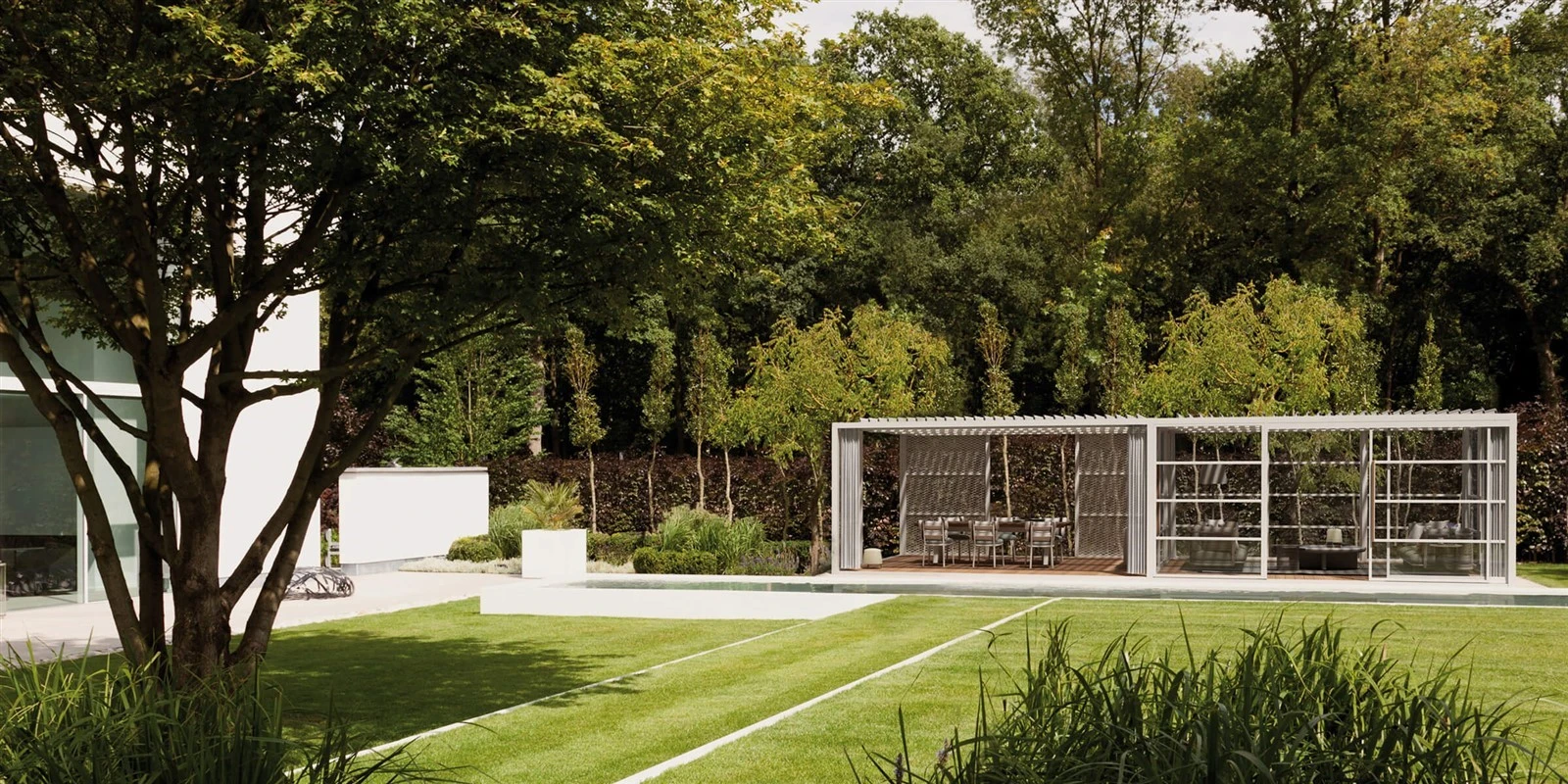
When designing high-exposure pool decks or oceanfront terraces, matching architectural coating resilience with high-performance fabrics is paramount. As shown in the modern coastal layout of image_cfd561.jpg, structural shading frames face a non-stop bombardment of UV radiation and reflected solar glare. For procurement officers dealing with B2B patio furniture wholesale supply lines, matching a premium louvered roof or an expensive aluminum cabana with an equally resilient outdoor pavilion requires verifying the exact grade of resin matrix applied at the factory.
If a factory cuts corners by using low-grade interior TGIC (Triglycidyl Isocyanurate) powders on a heavy-duty motorized pergola, the sun will break down the molecular bonds within 24 months. This breakdown manifests as a dulling of the surface gloss, followed by severe yellowing on white profiles and a powdery white residue-known as chalking-on black and grey profiles. This ruins the premium aesthetic expected from a top-tier Modular outdoor sofa manufacturer supplying the hospitality layout below.

☀️ 1. The Science of Photodegradation: Why Finishes Yellow and Chalk
The root cause of color failure is photodegradation driven by solar UV-A and UV-B radiation. When these high-energy photons hit the surface polymer, they break the carbon-to-carbon chemical chains within the paint resin.
Yellowing: This is primarily a problem for white or light-cream structures. When standard polyester resins degrade under heat and UV rays, their chemical structure shifts into a conjugated form that absorbs blue light, reflecting a yellow hue to the human eye. Furthermore, if cheap titanium dioxide ($\text{TiO}_2$) anatase pigments are used instead of high-grade rutile types, the pigment itself accelerates this yellowing reaction.
Chalking: This occurs when the resin binder completely erodes away under solar stress, exposing loose, un-bonded pigment particles on the surface. When you rub your hand across a faded black or grey structural column and a milky white powder comes off, the coating has failed structural weatherability parameters.
📊 2. Color Performance Matrix: How White, Black, and Grey React
Different architectural color groups show distinct failure modes when exposed to prolonged outdoor weathering.
Color-Specific UV Degradation Profiles
| Base Profile Color | High-Exposure Failure Mode | Chemical Catalyst | Aesthetic Impact on Project |
| Pure White / Cream | Sub-surface yellowing and loss of reflectivity | Matrix resin shifting, unstable organic cross-linkers | Structure looks aged, dirty, and fails to match surrounding cool-toned design palettes. |
| Matte Black | Severe chalking, turning into a dull, flat charcoal tone | Micro-cracking of the top layer, freeing inorganic carbon black particles | Loses its high-end, crisp, architectural silhouette; picks up highly visible water spots. |
| Charcoal / Anthracite Grey | Fading toward a blueish or light-grey cast, blotchy patchy patterns | Inconsistent UV absorption across mixed pigments (titanium white mixed with black) | The structure looks unwashed and develops an uneven, weathered finish across high-sun sections. |
🧪 3. Industrial Standards: AAMA 2604/2605 vs. Qualicoat Tiers
To ensure your aluminum pergola UV fade resistance holds up over ten years without major yellowing or gloss loss, stop asking suppliers if their products fade. Instead, demand their certified testing data from independent labs like SGS or TUV Rheinland.
Architectural powder coat performance is universally categorized by two dominant international frameworks: the North American AAMA specifications and the European Qualicoat standard.
📊 International Weathering Standards for Aluminum Profiles
| Evaluation Parameter | AAMA 2603 / Qualicoat Class 1 | AAMA 2604 / Qualicoat Class 2 | AAMA 2605 / Qualicoat Class 3 |
| Resin System Quality | Standard Polyester | Super-Durable Polyester | PVDF / Hyper-Durable Fluoropolymer |
| South Florida Testing Duration | 1 Year real-world exposure | 5 Years real-world exposure | 10 Years real-world exposure |
| Gloss Retention Baseline | No specification enforced | Minimum 30% retention after 5 years | Minimum 50% retention after 10 years |
| Max Color Shift Limit ($\Delta E$) | No specification enforced | Less than $5.0$ units variance | Less than $5.0$ units variance |
| Chalking Resistance Rating | Low resilience threshold | High compliance (ASTM D4214 Class 8) | Ultimate compliance (ASTM D4214 Class 8) |
For luxury resort projects or high-end residential installations, Qualicoat Class 2 or AAMA 2604 is the absolute baseline specification. These formulations utilize super-durable polyester matrices that resist chemical weathering, locking in color consistency for a decade.
🔬 4. Quantifying Color Shift: The Delta E ($\Delta E$) Equation
In professional material labs, color degradation isn't measured by human eye evaluation. It is calculated precisely using a spectrophotometer following the CIE76 color differential formula. The total color shift, denoted as Delta E ($\Delta E$), tracks three independent visual axes:
$$\Delta E^* = \sqrt{(\Delta L^*)^2 + (\Delta a^*)^2 + (\Delta b^*)^2}$$
Where:
$\Delta L^*$ represents the shift in lightness (white vs. black).
$\Delta a^*$ represents the shift along the red vs. green spectrum.
$\Delta b^*$ represents the critical yellowing axis (positive shifts indicate direct yellowing).
When a structure possesses certified aluminum pergola UV fade resistance, its $\Delta E$ value remains under $2.0$ after years of intense weathering. To the untrained human eye, a color shift of $\Delta E < 2.0$ is completely imperceptible, meaning a white structure stays white, and a dark charcoal frame keeps its depth.
🛠️ 5. B2B Verification Guide: How to Avoid Substandard Coatings
When sourcing outdoor structures for real estate developments or commercial projects, protect your investment by enforcing this engineering audit checklist prior to procurement:
Audit the Powder Brand: Cross-verify that the production line uses premium, ultra-weatherable architectural powders from Tier-1 global chemical companies, such as Tiger Drylac or AkzoNobel Interpon.
Request Gloss Tracking Records: Ensure the factory provides documentation from an ASTM D523 gloss-meter test after a minimum of 1,000 hours in an accelerated UV weathering chamber.
Check for Curing Consistency: Uneven baking temperatures in massive industrial ovens leave zones under-cured. Under-cured areas break down down to a chalky mess rapidly. Insist on checking the factory's daily oven temperature logger readouts.
Confirm the Cross-Linker Technology: Ensure the powder formula relies on premium hydroxyalkylamide (HAA) or stable polyurethane cross-linkers instead of cheap aromatic curing agents, which crack when exposed to solar radiation.
❓ Industry-Focused FAQ
Q1: Will a white aluminum pergola turn noticeably yellow after 5 years of intense desert sun?
❌ Not if it is coated with certified Qualicoat Class 2 or AAMA 2604 powder. These specialized formulas use super-durable polyester resins that do not undergo the molecular changes that cause yellowing. If a white structure turns yellow, it means the factory used low-grade interior powder or a cheap Class 1 finish to cut costs.
Q2: Why does matte black aluminum framing sometimes develop a chalky white film?
💨 That white film is caused by a process called chalking. When low-grade resin binders are degraded by solar UV radiation, they erode away and leave behind un-bonded white titanium or calcium carbonate pigment particles. To prevent this, ensure your black frames use a super-durable formulation that meets ASTM D4214 chalking resistance standards.
Q3: Does gloss level affect how fast a pergola fades or changes color over time?
✨ Yes, significantly. High-gloss finishes reflect a larger percentage of incoming UV rays, which can slow down resin degradation slightly compared to ultra-matte or textured coatings. However, ultra-matte finishes are better at hiding micro-scratches and minor surface chalking, making them a popular choice for modern commercial settings.
Q4: How can a B2B procurement manager verify a factory's UV resistance claims?
🔬 Do not rely on basic digital brochures. Demand independent, third-party laboratory verification certificates issued by recognized agencies like SGS. The documentation must explicitly prove the extrusion finish has passed intensive weathering tests, such as the ASTM G154 accelerated UV exposure cycle.
Q5: Can a faded or yellowed aluminum pergola frame be repainted on-site?
🖌️ While you can restore the appearance using marine-grade liquid polyurethane paints or specialized architectural field-applied coatings, it is a complex process. On-site painting requires deep mechanical sanding and chemical etching to ensure adhesion. The repaired finish will never equal the durability of the original, electrostatically applied, factory-baked powder coat.
Q6: Are custom wood-grain finishes more prone to fading than solid grey or black colors?
🍂 Yes, if they use a low-grade sublimation process. Wood-grain finishes are typically made by applying a base powder coat, wrapping the profile in a printed film, and transferring the ink via heat sublimation. If the inks or base powders lack high-grade UV inhibitors, the wood pattern will fade much faster than a solid Class 2 architectural color. Always demand a super-durable sublimation certificate for wood-grain profiles.


