
Engineering Brief at a Glance
For commercial hospitality operators and project buyers, selecting metals for coastal environments is a multi-million-dollar decision. Ocean air carries microscopic chloride droplets that cause pitting and crevice oxidation on improper alloys within months.
When evaluating aluminum outdoor furniture alongside metal frame structures for beachfront properties, engineering teams frequently ask: Is 304 or 316 stainless steel necessary for seaside resort outdoor furniture to prevent corrosion?
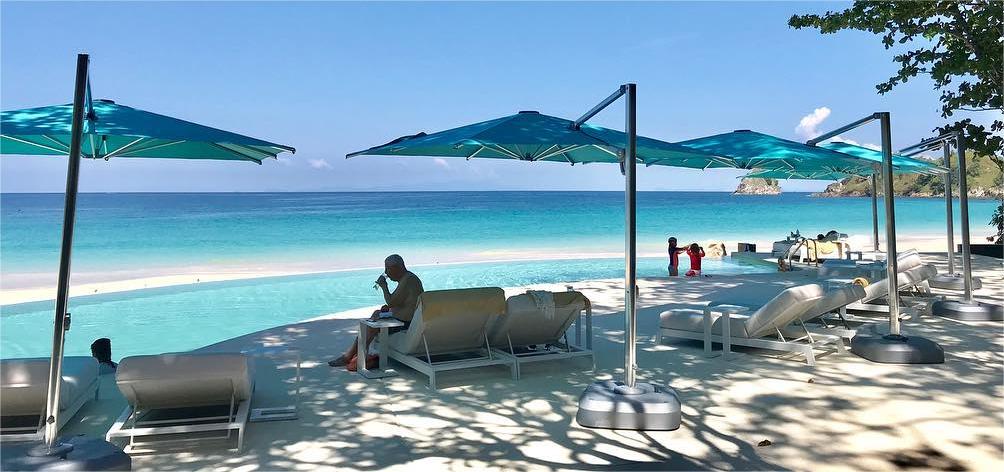
The short answer: Grade 304 stainless steel is generally suitable for sheltered inland zones, but direct beachfront, oceanfront overhangs, and coastal pool decks strictly require Grade 316 stainless steel (or specialized marine treatments) to avoid premature tea-staining, structural fatigue, and costly replacement cycles. Pairing steel chassis elements with a modern sofa outdoor module or weather-resistant cushions requires an understanding of metallurgy, salt exposure zones, and total cost of ownership.
1. Understanding Coastal Corrosion: Why Ocean Air Destroys Metal
Seaside resort environments represent one of the most aggressive natural climates for exterior FF&E (Furniture, Fixtures, and Equipment). Marine atmospheres carry coastal salt spray, high relative humidity, intense UV radiation, and windborne sand particles.
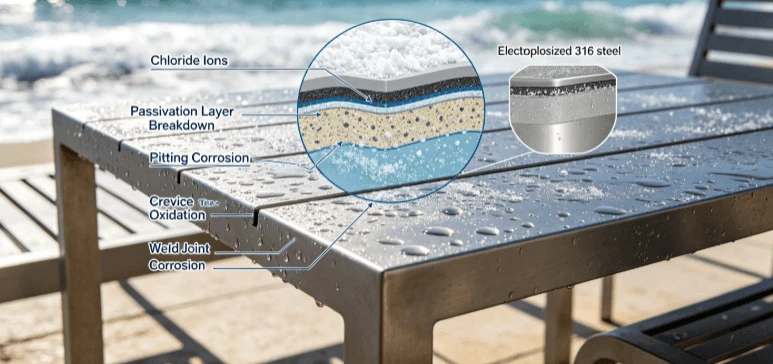
When salt aerosols deposit onto metal surfaces, chloride ions penetrate the microscopic passivation layer-the ultra-thin chromium oxide film that gives stainless steel its stain-resistant properties. Once this barrier breaks down, chloride pitting corrosion forms deep, localized cavities beneath the surface. What starts as cosmetic "tea-staining" (brown surface discoloration) quickly progresses to structural intergranular corrosion around welds and joint fasteners.
While high-grade architectural aluminum outdoor furniture utilizes a self-healing aluminum oxide layer backed by protective powder coating, raw steel alloys react drastically to marine microclimates. Understanding the chemical differences between steel grades is essential prior to issuing tender specifications.
2. Metallurgy Comparison: 304 vs 316 Stainless Steel
To determine whether 304 or 316 stainless steel is necessary for seaside resort outdoor furniture to prevent corrosion, procurement officers must examine chemical compositions and performance indicators.
The foundational difference lies in the addition of molybdenum in Grade 316 steel. This critical alloying element dramatically elevates the alloy's resistance to chloride attack, preventing micro-pitting in high-salinity zones.
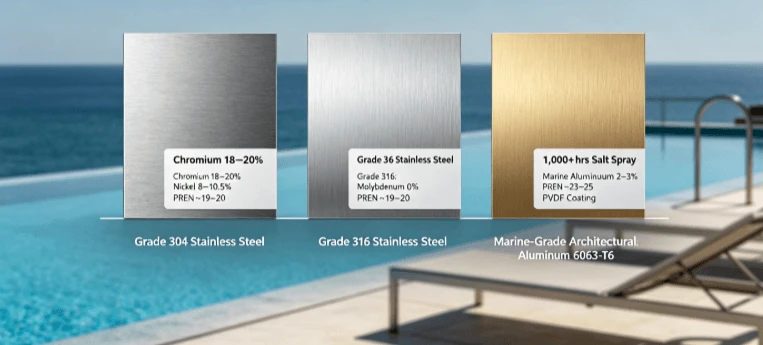
| Chemical & Physical Metric | Grade 304 Stainless Steel | Grade 316 Stainless Steel | Marine-Grade Architectural Aluminum (6063-T6) |
| Chromium Content | 18.0% – 20.0% | 16.0% – 18.0% | N/A (Traces) |
| Nickel Content | 8.0% – 10.5% | 10.0% – 14.0% | N/A |
| Molybdenum Addition | 0.0% (None) | 2.0% – 3.0% | 0.0% |
| Pitting Resistance (PREN) | ~19.0 – 20.0 | ~23.0 – 25.0 | N/A (Non-ferrous protection) |
| Salt Spray Rating (ASTM B117) | Moderate (Pitting within 300–500 hrs) | Exceptional (1,000+ hrs without pitting) | High (when coated with Fluorocarbon / Tiger Drylac) |
| Primary Corrosion Hazard | Severe tea-staining & pitting in marine air | Minor surface haze if unwashed; zero structural pitting | Filiform corrosion if powder finish is chipped |
| Typical Use Case | Inland terraces (>500m from ocean), indoor spas | Direct oceanfront, yacht decks, coastal infinity pools | All-weather lounge frames, modular sofa bases |
Surface Finishes Matter: Electropolishing vs Brush Finishing
Raw metal composition represents only half the equation. Surface topography dictates where salt crystals accumulate:
Mechanical Brush Finish (Satin): Creates microscopic directional grooves that trap airborne salt particles, accelerating oxidation even on Grade 316 steel.
Electropolishing: An electrochemical process that strips surface iron, enriches chromium and nickel content, and leaves a mirror-smooth surface. Electropolishing reduces surface friction, allowing rainwater to flush away chloride deposits automatically.
For high-use hotel poolside furniture sets, specifying electropolished 316 steel or high-gauge powder-coated frames ensures the frame remains pristine despite splash-zone chlorine and ocean breezes.
3. Zonal Placement Matrix: Matching Metallurgy to Microclimates
Is 304 or 316 stainless steel necessary for seaside resort outdoor furniture to prevent corrosion across the entire resort property? Not always. Commercial procurement strategies optimize Capex by mapping material selection directly to distance from the ocean baseline.
Zonal Material Specification Protocol
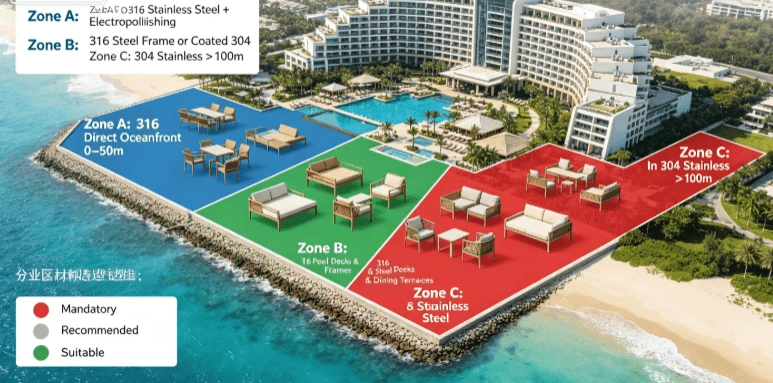
Zone A: Direct Oceanfront & Beach Clubs (0 – 50 Meters)
Environmental Risk: Extreme constant salt fog, direct wave mist, active sand scouring.
Mandatory Metallurgy: 316 stainless steel with electropolishing treatment, or structural marine aluminum finished with PVDF coating.
Avoid: Grade 304 steel will develop visible red rust and tea-staining within 60 to 90 days.
Zone B: Resort Pool Decks & Dining Terraces (50 – 500 Meters)
Environmental Risk: Intermittent marine air combined with pool splash chemicals (chlorine / saltwater chlorination systems).
Recommended Metallurgy: Grade 316 steel for structural legs and main frames. Grade 304 can be utilized only if treated with specialized outdoor powder coating or paired with premium teak wood accents.
Product Application: Ideal for heavy-duty sun loungers, cabana frames, and modular modern sofa outdoor seating configurations.
Zone C: Inland Gardens, Roofed Pavilions & Sheltered Balconies (>500 Meters)
Environmental Risk: Low chloride concentration, shielded from windborne ocean mist.
Suitable Metallurgy: 304 stainless steel with standard passivation or electromechanical polishing.
Cost Benefit: Reduces initial procurement budgets without sacrificing long-term aesthetics.
For resort developers seeking cohesive aesthetic language across all zones, partnering with a commercial outdoor furniture design service allows custom material specification per zone while maintaining uniform visual design.
4. B2B Investment & Life-Cycle Cost Analysis (ROI)
When purchasing commercial outdoor furniture for luxury hotels, calculating the true return on investment requires looking beyond the initial purchase order (Capex) to evaluate ongoing maintenance and replacement cycles (Opex).
10-Year Lifecycle Cost Comparison (Per 100 Outdoor Dining Units)
| Financial & Operational Metric | Specifying Grade 304 Steel (Zone A) | Specifying Grade 316 Steel (Zone A) | Specifying Marine Aluminum (Zone A) |
| Initial Capital Expenditure (Capex) | Baseline ($) | +25% to 30% ($$) | +10% to 15% ($) |
| Expected Structural Lifespan | 2 – 3 Years (Corrosion failure) | 8 – 12+ Years | 8 – 10+ Years |
| Annual Maintenance Cost (Opex) | High (Constant rust removal & repainting) | Minimal (Freshwater wash-down only) | Minimal (Mild soap wash) |
| Replacement Cycle Frequency | 3 Times in a 10-Year Period | Zero (or 1 Minor Refurbishment) | Zero (or 1 Re-cushioning) |
| Guest Review & Brand Risk | High (Rust stains ruin luxury impression) | Zero (Maintains 5-star aesthetic) | Zero (Pristine appearance) |
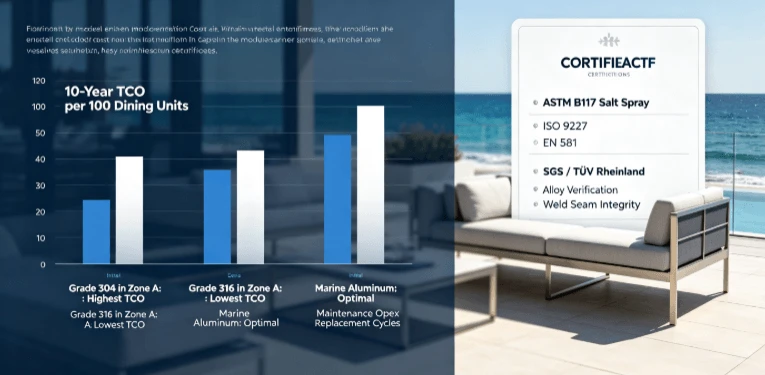
| 10-Year Total Cost of Ownership | Highest (Initial Capex × 3.5) | Lowest (Initial Capex × 1.25) | Optimal (Initial Capex × 1.20) |
A 5-star coastal resort that installs Grade 304 steel furniture on a direct beachfront deck will face tea-staining within months. The labor required for chemical acid washing and manual rust buffing rapidly exceeds the 25% price difference of upgrading to Grade 316 steel at the time of manufacture.
5. Compliance Standards, Quality Testing & Certifications
To verify whether 304 or 316 stainless steel is necessary for seaside resort outdoor furniture to prevent corrosion, commercial specs should require independent third-party lab testing certificates before approving production samples.
Critical Testing Protocols to Specify
ASTM B117 Salt Spray Testing:
Specimens are placed in an enclosed chamber exposed to a 5% continuous salt fog at 35°C.
Pass Criteria for Coastal Grade 316 Steel: 1,000 continuous hours with zero blistering, rust penetration, or pitting.
Pass Criteria for Powder-Coated Aluminum: 1,500 continuous hours with zero cross-hatch adhesion failure.
ISO 9227 Corrosion Resistance Assessment:
International benchmark evaluating atmospheric corrosion in salt spray environments. Certifications issued by SGS or TÜV Rheinland provide definitive proof of alloy purity and seam-weld integrity.
EN 581 Commercial Mechanical & Weathering Safety:
Ensures that structural joints, cantilever legs, and welds withstand heavy commercial usage in hospitality settings without structural fatigue or failure under salt exposure.
6-Point Resort Procurement Checklist
At Howvin Outdoor Furniture, engineering teams utilize rigorous chemical passivations, marine-grade aluminum, and 316 stainless steel frameworks engineered specifically to pass international commercial standards.
FAQ:
Can powder coating protect 304 stainless steel in direct seaside environments?
Powder coating provides a protective physical barrier, but it does not alter the underlying chemical susceptibility of Grade 304 steel. If sand abrasion, moving furniture, or guest impact creates a hairline scratch in the coating, salt spray will penetrate beneath the paint layer, triggering filiform corrosion and bubbling paint from within. For direct oceanfront exposure, Grade 316 steel or powder-coated marine aluminum remains mandatory.
What is "tea-staining" and does it mean the metal is structurally failing?
Tea-staining is a superficial brown discoloration that forms on stainless steel surfaces exposed to salt fog and humidity. While tea-staining itself is cosmetic rather than immediate structural failure, it indicates that the chromium oxide passivation layer has failed. If unaddressed, tea-staining quickly evolves into deep pitting corrosion and intergranular structural decay.
How often should seaside resort outdoor furniture be washed down?
For furniture located within 500 meters of the coastline, fresh water wash-downs should be scheduled every 2 to 4 weeks. Rinsing removes accumulated surface salt crystals, preventing chloride buildup and drastically extending the life of both Grade 316 steel and powder-coated aluminum frames.
Why is marine-grade aluminum often specified alongside stainless steel for hotel poolside furniture sets?
High-grade extruded aluminum alloys (such as 6063-T6) do not rust when exposed to moisture or salt spray. When combined with advanced powder coatings, aluminum offers lightweight handling, high corrosion resistance, and lower initial Capex compared to heavy stainless steel, making it ideal for sun loungers and large outdoor dining layouts.
What maintenance products should resort housekeeping staff use on coastal stainless steel?
Staff should clean surfaces using fresh warm water, mild non-abrasive detergents, and microfiber cloths. Never use steel wool, wire brushes, or harsh cleaners containing bleach or muriatic acid, as iron particles and chlorine compounds strip the protective passivation layer instantly. Neutral passivating sprays or specialized marine stainless steel polishes can be applied quarterly to replenish the protective oxide film.
How does a commercial outdoor furniture design service help optimize procurement costs?
A specialized commercial design service evaluates the resort's precise geographic layout, wind corridors, distance to high-tide lines, and functional requirements. By specifying heavy-duty Grade 316 steel for direct oceanfront lounge zones and high-durability aluminum or teak for sheltered courtyard dining areas, designers balance aesthetic continuity with maximum capital efficiency and long-term durability.