
When procurement directors and hospitality project engineers source seating for high-traffic commercial venues, the single most critical material specification is often invisible from the surface: what density and type of foam (e.g., reticulated Quick Dry Foam) should be specified for commercial outdoor cushions?
Selecting the wrong cushion core leads directly to water retention, sagged seating profiles, mold accumulation, and premature capital replacement. For a luxury resort or beach club, a soggy cushion isn't just a maintenance headache-it's lost food and beverage revenue and a damaged guest experience.
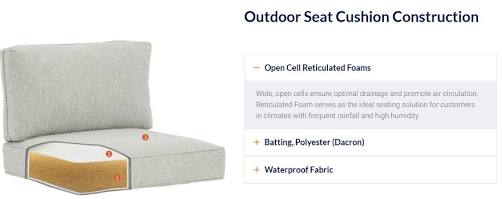
1. Foam Core Architecture: Reticulated vs. Standard Polyurethane
In commercial hospitality environments, cushion foam experiences severe environmental and mechanical stress. Understanding core chemistry is essential before issuing purchase orders.
Reticulated Quick Dry Foam
Reticulated Quick Dry Foam undergoes a specialized thermal or chemical explosion process during manufacturing that removes the cell membranes, leaving a 97% open void matrix.
Drainage Mechanism: Water flows directly through the open pore structure rather than trapping moisture inside micro-cells.
Air Circulation: Rapid air velocity through 30–45 PPI (Pores Per Inch) matrices eliminates internal humidity, rendering the cushion dry within 20–30 minutes after heavy rainfall.
Antimicrobial Integration: Infused with an EPA-registered antimicrobial treatment during polymerization to resist fungus and mildew formation.
High-Resiliency Polyurethane Foam
Standard high-resiliency foam relies on closed or semi-open cellular walls. While providing superior initial tactile softness, moisture becomes trapped within the cellular chambers through capillary action. Without sunlight, damp cushions suffer hydrolytic degradation, causing internal crumbling and permanent sagging.
Closed-Cell EVA Foam
Closed-cell EVA foam completely resists water absorption because its cell walls are sealed. However, it lacks breathability, offers minimal seating yield, and traps heat-making it unsuitable for deep-seating lounge cushions.

Material Performance Matrix
| Core Specification | Reticulated Quick Dry Foam | High-Resiliency Polyfoam | Closed-Cell EVA Foam |
| Cellular Matrix | 97% Open Pore Matrix | Closed / Semi-Open Micro-Cell | Completely Sealed Cell |
| Water Drainage Rate | > 98% Water Discharge in 5 Min | Retains 40–70% Water Volume | Zero Water Penetration |
| Drying Time (Post-Rain) | 15 – 30 Minutes | 24 – 48 Hours | Immediate Surface Wipe |
| Sagging Resistance | Exceptional (High Elasticity) | Medium (Degrades when Wet) | High (Rigid Surface Feel) |
| Primary Hospitality Use | Pool Decks, Rooftops, Beach Clubs | Enclosed Covered Patios | Marine Seating, Pool Floats |
2. Demystifying Foam Density vs. Indentation Load Deflection (ILD)
A common mistake in commercial FF&E specifications is confusing density rating with firmness.
Foam Density (lbs/cu.ft or kg/m³): Measures solid polymer mass per unit volume. Higher density directly correlates with structural longevity, cell wall strength, and resistance to fatigue.
Indentation Load Deflection (ILD): Measures the weight in pounds required to compress a 4-inch thick foam block by 25%. ILD defines firmness, not durability.
For heavy-duty hospitality seating-such as a deep-seating outdoor sectional sofa-procurement teams should specify a density of 2.8 to 3.2 lbs/cu.ft paired with an ILD rating between 32 and 40 lbs. This configuration prevents bottoming-out while maintaining comfort for guests weighing up to 300 lbs.

3. Environmental Degradation Mechanics in Coastal & Tropical Venues
Commercial outdoor furniture faces continuous exposure to environmental stressors. Specifying cushion materials requires matching foam parameters to regional conditions:
Ultraviolet Radiation & Thermal Oxidation: Sun exposure triggers photo-oxidation in untreated polymers. High-grade reticulated foam incorporates UV stabilizers to prevent premature embrittlement.
Hydrolysis & Moisture Trapping: In humid coastal environments, trapped moisture breaks down polyol bonds in low-grade polyurethane.
Chlorine & Saltwater Exposure: Poolside splash zones introduce saline and chlorinated water. The foam must allow swift flushing without retaining chemical salts that crystallize and tear internal pore walls.
4. Hospitality Application: Sectionals & Poolside Furniture Engineering
Designing high-traffic hotel poolside furniture sets requires an integrated cushion engineering strategy:
Multi-Layer Cushion Sandwich: A high-density reticulated core (3.0 lbs/cu.ft) wrapped in a thin layer of dacron fiber yields immediate plush comfort while permitting unimpeded water drainage.
Drainage Enclosure System: Upholstering with solution-dyed acrylic fabric on top and sides paired with a batyline mesh or drainage mesh underline base allows gravity to evacuate excess water instantly.
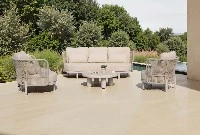
Sectional Module Stability: A modular Commercial outdoor sectional sofa system benefits from unified cushion densities across all seat modules to prevent uneven wear across lounge zones.
When evaluating supplier proposals, working with an established commercial patio furniture supplier ensures cushion specs match specific frame geometries and local climate demands.

5. B2B Investment & Lifecycle Analysis (Capex vs. Opex)
In commercial procurement, selecting foam purely based on initial unit price leads to higher operational costs over time.
Capex vs. Opex Financial Comparison
| Cost & Operational Factor | Standard Polyurethane Foam (1.8 lbs/cu.ft) | Reticulated Quick Dry Foam (3.0 lbs/cu.ft) |
| Initial Procurement Cost (Capex) | Lower Initial Investment | Premium Initial Investment |
| Expected Service Lifespan | 12 – 18 Months | 5 – 7+ Years |
| Replacement Frequency (5-Yr Window) | 3 to 4 Full Cushion Replacements | 0 Replacements Required |
| Maintenance / Drying Labor (Opex) | High (Manual removal during rain) | Minimal (Stays outdoors year-round) |
| Out-of-Service Lounge Loss | High (Cushions unusable for 24h+ post-rain) | Near Zero (Dries in under 30 min) |
Investing in high-density reticulated quick dry foam typically yields a full ROI payback within 14 to 18 months purely by eliminating cushion labor handling and premature replacement cycles.

6. International Testing Standards & Certification Agencies
To verify that cushion specifications meet commercial building codes and fire safety regulations, independent lab certifications are non-negotiable.
Critical Engineering Standards
| Testing Standard / Certification | Governing Body / Testing Agency | Technical Focus & Compliance Scope |
| ASTM D3574 | SGS / Intertek | Evaluates foam density, tensile strength, tear resistance, and compression set fatigue. |
| CAL 117 | TÜV Rheinland | California Technical Bulletin 117-2013 flammability testing for resilient filling materials. |
| BS 5852 | SGS | British Standard crib 5 fire retardancy test required for commercial UK/EU hospitality venues. |
| ISO 845 | ISO | International standard determination of apparent density for cellular plastics. |
| CertiPUR-US | Alliance for Flexible Polyurethane Foam | Certifies foam is made without ozone depleters, heavy metals, or toxic flame retardants. |
| OEKO-TEX Standard 100 | OEKO-TEX Association | Ensures fabric and foam encasements are free from harmful chemical substances. |
FAQ:
What pore size (PPI) is optimal for commercial quick dry foam cushions?
For commercial hospitality seating, 30 PPI to 45 PPI (Pores Per Inch) is the ideal specification. A 30 PPI foam offers faster water evacuation for pool deck loungers, while a 45 PPI foam provides slightly firmer structural feedback suitable for dining chairs and deep-seating sectionals without sacrificing air circulation.
Can reticulated foam be washed or pressure cleaned?
Yes. Reticulated quick dry foam can be flushed directly with fresh water and mild antimicrobial cleansers to remove accumulated salt, chlorine, or organic residue. Pressure washing should be kept under 1200 PSI using a wide fan nozzle to avoid tearing internal cell reticulations.
How do you calculate the correct foam firmness for heavy-duty lounge seating?
Foam firmness is calculated via indentation load deflection (ILD). For commercial seat cushions thicker than 4 inches, specify a core ILD of 35 to 40 lbs. For backrest cushions where soft comfort is prioritized over structural weight bearing, specify an ILD of 20 to 25 lbs.
Why do standard indoor polyurethane cushions fail rapidly outdoors?
Standard polyfoam absorbs water into small closed micro-cells through capillary action. Trapped water combined with UV heat triggers hydrolytic degradation, breaking polymer chains down into soft powder and causing mold colonization within internal foam cavities.
What fabric backing should be paired with quick dry foam cushions?
To allow quick dry foam to function correctly, the underside of the cushion cover must feature a high-flow open mesh material, such as batyline mesh or a dedicated drainage mesh underline. Using fully sealed vinyl backing on quick dry foam blocks water exit paths and negates the foam's self-draining properties.
What flammability standards apply to outdoor cushions in commercial venues?
Most global commercial properties require compliance with CAL 117 (in North America) or BS 5852 Crib 5 (in the UK and Europe). Third-party testing by agencies like SGS or TÜV Rheinland ensures the reticulated foam contains non-toxic flame retardants that pass ignition tests without compromising quick-drying capabilities.