
Let's be blunt. A crisp, vibrant logo printed on a restaurant umbrella is one of the most cost-effective marketing tools in hospitality. Until it isn't. Nothing erodes a brand's outdoor aesthetic faster than a cracked, peeling, or sun-bleached logo flapping above a dining terrace. The question we hear at Howvin, usually halfway through a property manager's second glass of iced tea, is always the same: Can commercial umbrellas be custom printed with brand logos without fading?
The short answer is yes, absolutely-but only if the printing process is engineered for punishment. A logo that looks perfect indoors can self-destruct within 90 days of UV exposure, salt spray, and repeated folding. When a client orders an Offset Patio Umbrella With Base for a windy rooftop bar, then anchors it with a 300 lb heavy duty cantilever umbrella base, they've handled structural safety. The visual brand asset, however, lives or dies by something much thinner: the ink film on the canopy.
Before anyone starts picking Pantone codes, the first conversation needs to be about how that logo will physically survive. Outdoor printing isn't graphic design. It's materials chemistry coated onto Polyester fabric or Solution-dyed acrylic, then thrown into a slow-motion war with the sun.

The Three-Way Fight: UV Radiation, Thermal Shock, and Mechanical Abrasion
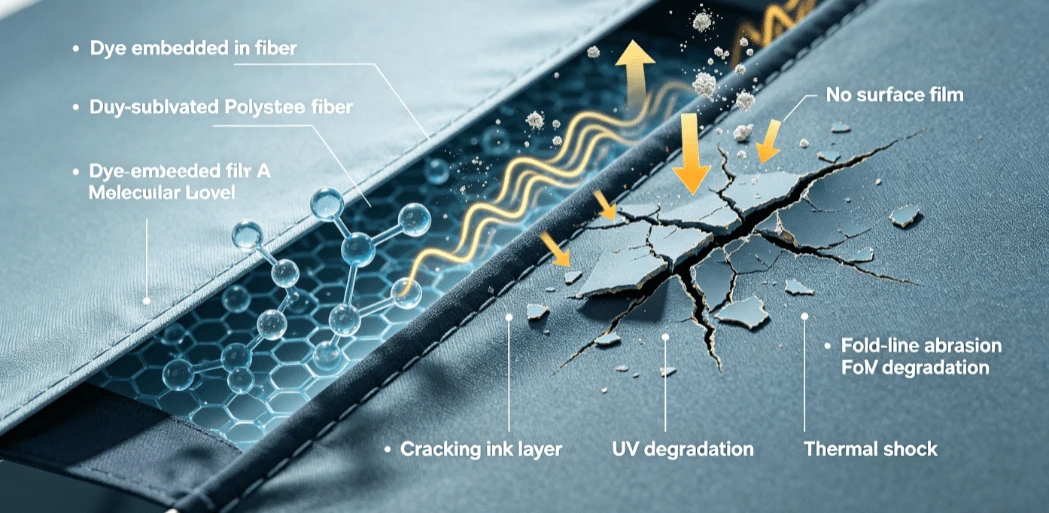
Fading is the symptom everyone notices. But the disease is usually a combination of three forces. First, Ultraviolet degradation breaks down the chemical bonds in pigment molecules-this is standard Photodegradation, driven by the UV-B and UV-A spectrum. Second, daily thermal expansion and contraction cause the ink layer and the fabric substrate to flex at different rates; eventually, the logo starts micro-cracking like a dried riverbed. Third, when that printed canopy is folded, stacked, or flapped against the umbrella ribs, you get Crocking-dry or wet rubbing that physically erases color from the surface.
I've pulled canopy samples from a five-star resort where the logo lettering simply turned to dust along the fold lines after six months. Their in-ground mounting system was flawless-a proper in ground anchor base for commercial umbrella ensuring zero wobble-but no anchor stops the fabric from rubbing against itself every time the umbrella is furled. That's an ink adhesion problem, not a shade problem.
📊 Logo Printing Technologies and Their Real Outdoor Staying Power
| Printing Method | Typical Ink System | UV Resistance (Xenon-Arc) | Abrasion Resistance | Recommended for Permanent Commercial Logos? |
|---|---|---|---|---|
| Screen printing | Solvent-based or UV-curable | ✅ High (Grade 4-5 at 500 hrs) | ✅ Good | ✔️ Best for large solid logos, multi-year durability |
| Digital UV printing | UV-curable inkjet | ✅ High (Grade 4 at 400 hrs) | ⚠️ Moderate | ✔️ Good for complex gradients; requires overprint clear coat |
| Dye-sublimation | Disperse dye into polyester | ✅ Excellent (Grade 5) | ✅ Excellent | ✔️ Gold standard for polyester canopies; zero surface film |
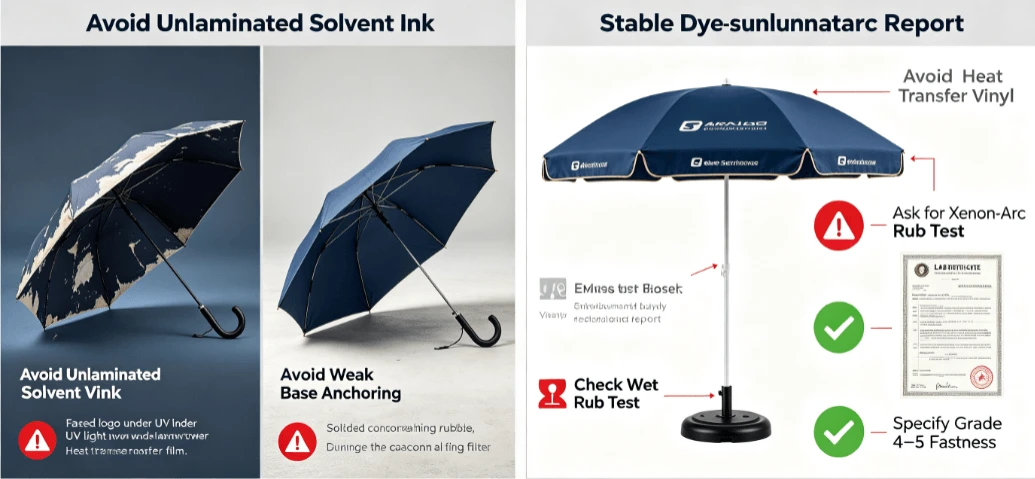
| Heat transfer vinyl | Solid polyurethane film | ❌ Poor to Moderate | ⚠️ Film peel risk | ❌ Avoid for permanent outdoor use |
| Solvent inkjet (uncoated) | Mild solvent | ❌ Low | ❌ Low | ❌ Fades within 3-6 months without lamination |
🔍 Icons: ✅ - High resistance ⚠️ - Conditional ❌ - Not recommended for commercial heavy-use
Dye-sublimation deserves a special callout. Because the dye becomes part of the polyester fiber at a molecular level, not a layer on top, there's essentially nothing to peel, crack, or separate. A UV Protection Patio Umbrella canopy printed via sublimation can retain near-original color saturation through multiple seasons, assuming the base fabric has been UV-stabilized. But sublimation only works on polyester-rich materials. For Solution-dyed acrylic, which refuses to take sublimation dyes, you'll need a high-bond UV-curable ink system with an Adhesion promoter pre-treatment.
The Tests That Separate Marketing Claims from Procurement-Ready Data
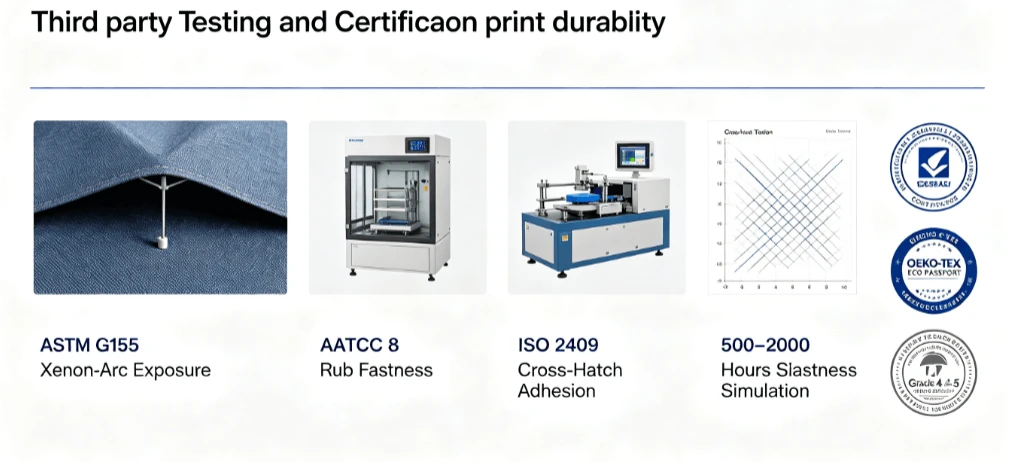
If a supplier says "our logos don't fade," ask for the lab report. Not a sunlight simulation photo, but a test certificate from an accredited body. The non-negotiable standards for outdoor print durability are ASTM G154 (fluorescent UV exposure) and ASTM G155 (xenon-arc exposure), often run for 500, 1000, or even 2000 hours. The corresponding color fastness grading uses AATCC 16.3 or ISO 105-B02, where Grade 4–5 is the commercial baseline.
But UV fastness is just one piece. You also need AATCC 8 or ISO 105-X12 for Crocking resistance. A logo that survives 1000 hours of Xenon-arc testing but fails the wet rub test after pool water contact is useless on a UV Protection Patio Umbrella that will be touched, wiped down, and folded daily. Additionally, check for ISO 2409 cross-hatch adhesion; it scores how well that ink grips the fabric after thermal cycling.
Here's where third-party oversight earns its keep. You'll want a report from SGS, Intertek, or TÜV Rheinland that specifically references the ink-on-fabric combination, not just the bare canvas. Ask if the Ink chemistry carries an OEKO-TEX ECO PASSPORT certification-this validates that the pigments and binders are free from hazardous substances, which matters enormously for ESG-focused restaurant groups. If the umbrella base is a 300 lb heavy duty cantilever umbrella base anchored next to a resort pool, you should also verify the print's resistance to chlorinated water, which sometimes appears as an addendum note on an Intertek report.
🧪 Key Certifications and Test Standards for Fade-Proof Commercial Umbrella Printing
| Test Focus | Standard to Demand | What It Proves |
|---|---|---|
| Accelerated UV weathering | ASTM G155 / ISO 4892-2 (Xenon-arc) | Color retention after simulated years of sun |
| Color fastness to light | AATCC 16.3 / ISO 105-B02 | Grade level (4-5 needed) for fading resistance |
| Rub fastness (dry/wet) | AATCC 8 / ISO 105-X12 | No color transfer or logo erosion from contact |
| Coating adhesion | ISO 2409 (cross-cut) | Ink won't flake after repeated folding and wind flutter |
| Substance safety | OEKO-TEX ECO PASSPORT | Ink safe for use in hospitality and public spaces |
| Flammability (optional) | NFPA 701 / CPAI-84 | Fabric-and-print combo meets fire code for commercial venues |
The Canopy Material Dictates the Print's Lifespan
It's easy to obsess over ink, but the fabric substrate is the silent partner. A PVC-coated polyester canopy offers a smooth, sealed surface that takes screen-printed Solvent-based ink beautifully-until the plasticizer migration makes the entire print tacky and dirt-attracting after a single hot season. A woven Textured polyester provides better mechanical adhesion but can scatter light, reducing perceived color brilliance. And a top-tier Solution-dyed acrylic requires a carefully matched UV-curable ink system that bonds to the hydrophobic fiber surface without delaminating under tension.
A restaurant group that deploys a dozen Offset Patio Umbrella With Base units across multiple locations must also think about consistency. Dye-sublimated logos on polyester canopies will look identical frame to frame. Screen-printed logos on acrylic might show subtle variation in ink thickness-a detail that only matters when the umbrellas are photographed together for a brand campaign. Little stuff. Big consequences.
Why the Umbrella Support System Affects Logo Wear
Here's a connection most purchasing agents miss. A flimsy base that wobbles in the wind creates a harmonic flutter along the canopy edges. That flutter is repetitive mechanical stress focused precisely on the printed areas near the ribs. Over weeks, micro-abrasion peels the logo from the edges inward. Using a 300 lb heavy duty cantilever umbrella base minimizes oscillation, thereby reducing unintended canvas movement and preserving the ink film. Similarly, a correctly installed in ground anchor base for commercial umbrella locks the center pole, preventing the twisting motion that causes the typical spiral abrasion pattern around a center-printed logo. The base is part of the print durability equation.
And when the worst happens-a sudden gust snaps a rib and tears the printed panel-you don't need to junk the entire umbrella. Smart commercial buyers stock Patio Umbrella Replacement Parts, including pre-printed canopy replacements from the original manufacturer. That way the brand asset can be restored without renegotiating art files or re-certifying the ink system. It's continuity planning, not just maintenance.
A Real-World Note on Custom Colors and Brand Matching
Coca-Cola red. Tiffany blue. These are non-negotiable. But outdoor UV exposure will shift almost any pigment over time, so specifying a Delta E tolerance after 500 hours of Xenon-arc testing is a more sophisticated approach than just looking at a pantone swatch indoors. A reputable custom umbrella manufacturer should be able to provide a weathered color sample alongside the virgin one. If your UV Protection Patio Umbrella has a silver reflective underside for heat rejection, the logo printed on the top surface must also tolerate the back-heat buildup. Request a Thermal cycling report where the printed panel is heated to 70°C, then cooled, repeatedly, with adhesion checks after each cycle.
FAQ:
1. Can commercial umbrellas really be printed with brand logos that won't fade?
Yes, using dye-sublimation on polyester or UV-curable ink systems on solution-dyed acrylic, backed by independent lab testing to AATCC 16.3 Grade 4-5.
2. What is the most durable printing method for a restaurant patio umbrella?
Dye-sublimation is the most permanent on polyester canopies. For acrylic, screen printing with UV-curable inks and an adhesion promoter provides multi-year durability.
3. How many hours of UV testing should a custom printed umbrella pass?
Request a minimum of 500 hours under ASTM G155 xenon-arc, with a color fastness grade of 4 or higher. Premium offerings test beyond 1000 hours.
4. Does the umbrella fabric affect logo fading differently?
Absolutely. Polyester works with sublimation for zero surface film. Solution-dyed acrylic needs special UV-curable inks. PVC-coated fabrics risk plasticizer migration that degrades the print.
5. Can I wash a custom printed commercial umbrella without damaging the logo?
Use mild soap and water with a soft cloth. Avoid pressure washing and harsh solvents. Ensure the print has passed wet Crocking tests (AATCC 8 wet) before purchase.
6. What certifications prove the ink is safe and durable for outdoor hospitality use?
Look for OEKO-TEX ECO PASSPORT for ink safety, plus durability reports from SGS, Intertek, or TÜV Rheinland referencing ISO 105-B02 and ISO 2409.
7. How long should a commercial umbrella logo last before noticeable fading?
With proper technology and a heavy-duty support system like a 300 lb heavy duty cantilever umbrella base to reduce flutter, expect 3–5 years of vibrant color before gradual, uniform fading begins.
8. Is it possible to re-print a faded umbrella canopy?
Re-printing a used canopy is rarely successful due to contamination and fiber degradation. Better to order pre-printed replacement canopies through Patio Umbrella Replacement Parts from your supplier.
9. Does the type of umbrella base impact how quickly the logo wears?
Yes. An unstable base increases wind-induced canvas flapping, causing edge abrasion and cracking at rib lines. An in ground anchor base for commercial umbrella provides the rigidity that protects the print.
10. Can digital UV printing match the durability of traditional screen printing for outdoor logos?
With a protective clear overprint and proper curing, digital UV can approach screen print longevity, but demands strict process control and is best validated with a sample weathering report.