
Quick Summary
Commercial umbrella types differ mainly in where the support stands and how the canopy works around furniture. Choose between centre-pole, cantilever and shared-mast arrangements by comparing the occupied layout, opening movement and service-hour shade-not canopy size alone. The final selection also needs a model-specific support arrangement and operating instructions suitable for the site.
A large canopy can look right on a terrace drawing and still be awkward in service. Its base may occupy the route between tables; its ribs may need space that disappears once guests are seated; its afternoon shadow may fall beside the loungers rather than over them.
For a hotel, restaurant or resort, the useful starting question is: where can the support go without compromising the way this space works? Answer that before choosing the canopy shape, colour or branding.
Start with Three Spaces, Not Just One Canopy
Draw the umbrella into the furniture plan in three conditions:
Occupied: chairs pulled out, guests seated and loungers in their intended positions.
Operating: the space needed to open, close or make permitted adjustments, including access to the controls.
Closed or stored: the position of the folded canopy and any equipment that remains on the terrace.
These are different checks. An umbrella can fit above a dining group when open yet conflict with it during closing. A base can sit outside the seating area but obstruct the route staff actually use.
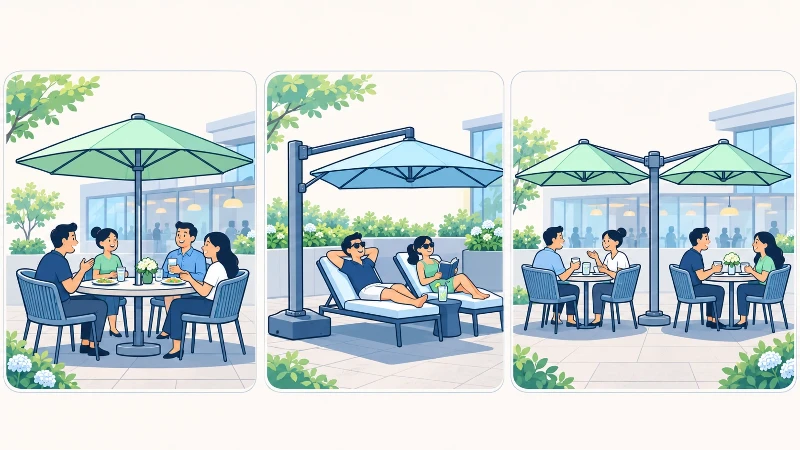
The following comparison covers support and canopy arrangements, not a rigid classification system. A multi-canopy system may also use side-supported canopies; "cantilever" and "multi-canopy" are not necessarily competing labels. Rotation, tilt and telescopic or retracting movement are separate model features.
Centre-Pole Umbrellas: A Good Fit When the Furniture Can Accommodate the Mast
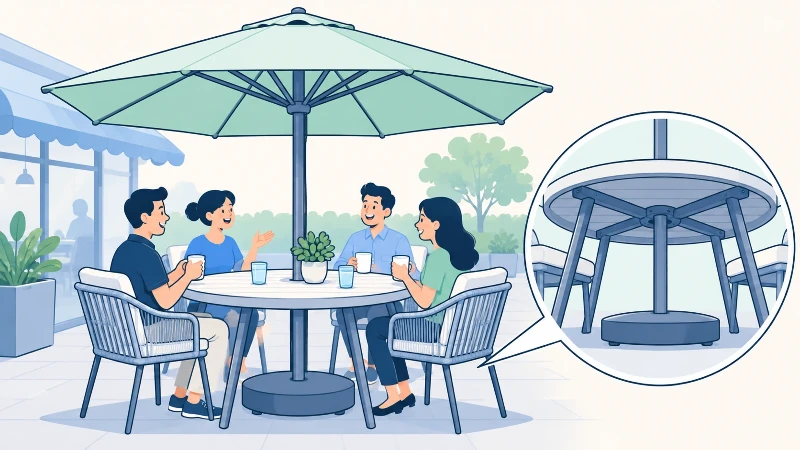
Use the centre deliberately
A centre-pole umbrella positions its mast at the centre of the canopy. It can pass through a compatible table or stand between furniture groups where the selected support and layout allow it.
For an established dining arrangement, a through-table mast can place the support inside the furniture group rather than beside a service route. But that advantage disappears if the table cannot accommodate the pole and support, or if the arrangement makes seating uncomfortable.
Centre-pole patio umbrellas therefore deserve consideration where the dining layout is relatively settled. They are not automatically the least expensive, easiest to move or most wind-resistant choice. Those comparisons belong to specific products, not the type name.
Look below the tabletop
An umbrella hole is only the first compatibility check. Compare the proposed pole, table opening, underframe and base together. A cross-brace or pedestal may occupy the space needed for the support; a base that fits beneath the table may still interfere with guests' feet or chair positions.
If the tables are being purchased at the same time, coordinate the umbrella arrangement with the outdoor dining tables and chairs before either order is finalised. Do not assume that two items described as suitable for outdoor dining will fit together.
A table opening is not a substitute for the umbrella's specified support. Nor does a photograph of a pole through a table establish the complete installation arrangement.
Reconsider the choice when the room needs to keep changing
For example, a restaurant may combine smaller tables for group bookings. This is a layout exercise, not a reported project: a mast through one table may restrict which combinations work, while a mast positioned between groups may create a different circulation problem.
Test the layouts the venue will actually use. If each changeover requires inconvenient umbrella handling, a visually tidy through-table arrangement may not be the best operational choice.
Cantilever Umbrellas: Clear the Centre Without Ignoring the Side
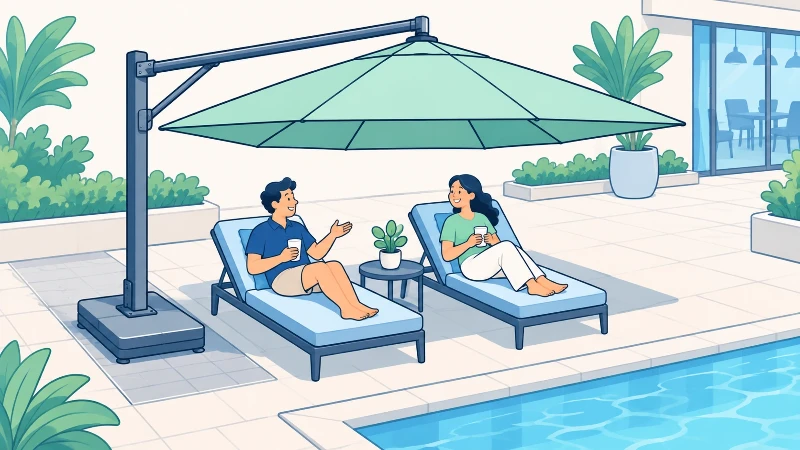
The support moves; it does not disappear
A cantilever umbrella, also called an offset or side-post umbrella, carries its canopy from a support positioned to one side. It is worth considering when a central mast would interrupt a lounge group, an uninterrupted tabletop or the intended position of poolside seating.
The trade-off is the side footprint. The mast, base and projecting parts still need somewhere to go. Putting them behind a lounger does not resolve the issue if that is also the access route, the adjustment area or the space required when the lounger is used.
When comparing cantilever umbrellas for hotels, start with the side-support position and work back towards the furniture. If there is no suitable side location, the apparent benefit of a clear centre may not survive the full layout review. It does not automatically create extra seats.
Separate an adjustable canopy from a movable system
Rotation or tilt may help a particular model serve different positions, but neither feature should be assumed from the word "cantilever." Establish the permitted range and operating conditions for the actual model.
Also distinguish adjusting the canopy from relocating the complete assembly. A venue that wants to move umbrellas between breakfast service and an evening event needs an approved handling arrangement-not simply a canopy that rotates.
A cantilever umbrella may suit a changing furniture layout while its support remains in one place. Whether that works depends on which layouts remain usable around it.
Multi-Canopy Systems: Coordinate the Whole Seating Zone
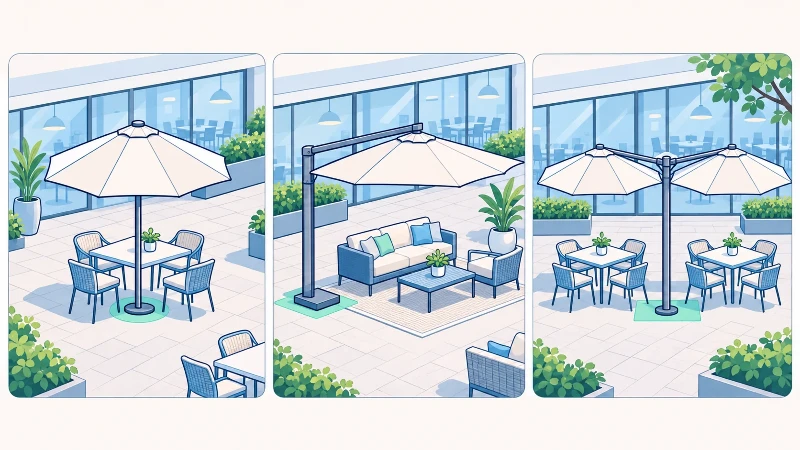
Shared support can simplify one layout and complicate another
Multi-canopy umbrella systems carry more than one canopy from a common mast or support arrangement. They may be useful when adjacent seating groups need shade and several separate posts would conflict with the plan.
Count the entire support footprint, not just the number of masts. A shared base can occupy a strategically important part of the terrace. The arrangement also needs to work for every seating group it serves, rather than fitting one group at the expense of another.
This makes shared-mast systems worth exploring for a coordinated zone. They require more thought where adjoining areas are frequently rearranged or managed separately.
Do not assume independent operation or a continuous roof
Whether individual canopies may operate separately is model-specific. A picture showing several heads does not establish that any combination of open and closed heads is permitted.
Agree who checks and closes the system when different teams use the adjoining areas. A single support should not leave responsibility for individual canopies unclear.
Likewise, adjacent canopy edges do not establish a watertight roof. If rain protection is part of the brief, assess the documented arrangement for that purpose rather than inferring performance from the visual coverage.
Turn the Comparison into a Shortlist
| Arrangement | A reason to shortlist it | A reason to reconsider it |
|---|---|---|
| Centre-pole | The mast and support fit within or between the intended furniture groups | Table compatibility, legroom or regular table recombination makes that position inconvenient |
| Cantilever or side-post | The centre needs to remain clear and a suitable side-support position is available | The displaced base or mast conflicts with access, service routes or neighbouring furniture |
| Shared-mast, multi-canopy | Adjacent groups can be planned and operated as one coordinated zone | The shared support, permitted operating combinations or divided responsibilities do not suit the venue |
Use this to narrow the support arrangement, then compare actual commercial patio umbrellas within that shortlist. It is not a price, durability or wind-performance ranking.
Check the Shade During Service, Not Just at Noon
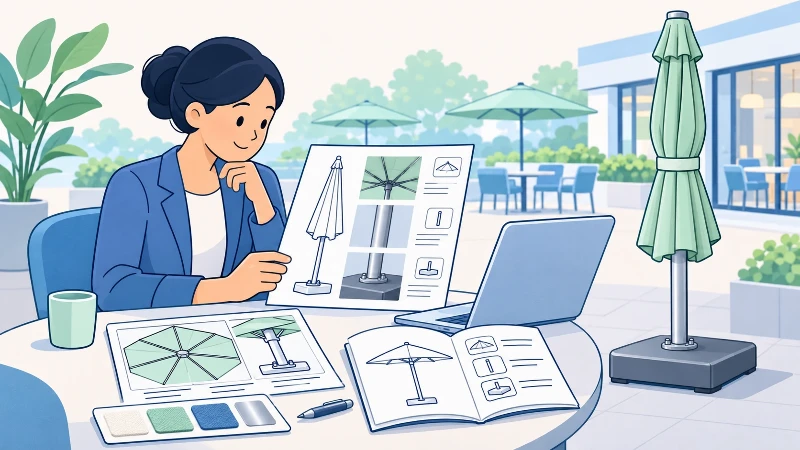
The canopy outline is not the shadow
Map the positions that matter during the venue's real service periods. For a restaurant, that may mean lunch and late-afternoon dining. For a resort pool, consider the occupied lounger positions and the hours in which those areas are intended to provide shade.
The Australian Radiation Protection and Nuclear Safety Agency explains that shade coverage depends on the positions of the structure, person and sun, with scattered and reflected UV also affecting protection. Its guidance on sun protection using shade supports an important distinction: a canopy's dimensions do not describe the protection experienced throughout the seating area.
Use a site-specific shade study or observations to compare the proposed positions. A larger canopy is not a substitute for checking where its shadow falls.
Keep shape, adjustment and fabric claims separate
A square, rectangular or round canopy may fit the furniture plan differently. Shape alone does not prove all-day shade, just as a fabric UV result does not establish complete protection across a terrace.
An adjustment feature is useful only if it addresses the service-hour problem and can be used in the model's permitted configuration. Do not specify tilt merely because it appears on a feature list.
Watch a Complete Opening-and-Closing Cycle
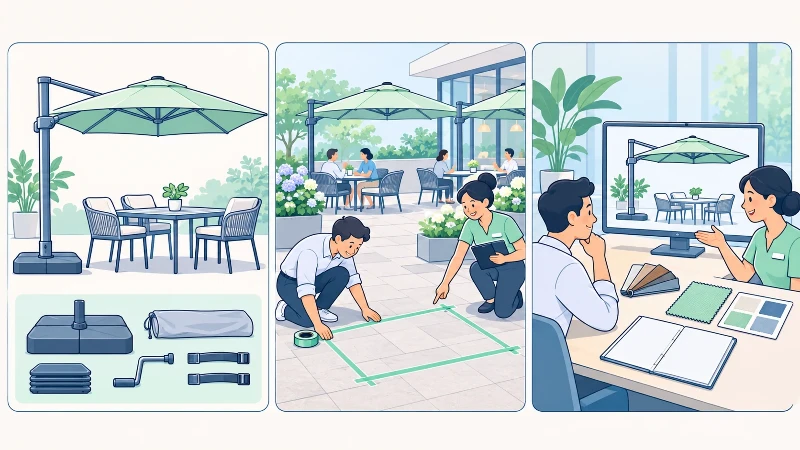
Demonstrate the movement around representative furniture
An open umbrella is only one point in its operating cycle. Before committing to quantities, ask for a demonstration or sufficiently detailed model information showing how the canopy opens and closes around the proposed arrangement.
Look for interference with tabletops, chair backs and nearby canopies. Include access to the crank, handle or other controls. If furniture must be moved first, decide whether that is realistic during the venue's closing routine.
Telescopic or retracting movement may address particular clearance problems, but the feature name does not guarantee that every table can stay in place. The relevant result is clearance for the selected model and furniture combination.
Check what remains after closing
Consider the folded canopy, remaining support and any approved storage or handling equipment. Does the closed arrangement still allow the space to be cleaned, accessed and prepared for the next service?
This check can change the preferred umbrella type. A venue may reasonably choose an arrangement that is less visually striking but easier to operate within its actual layout and staffing routine.
Keep Mounting and Wind Evidence Attached to the Actual Configuration
Umbrella type is not a wind rating. ASTM F3512-21(2026) is an active test method concerning wind safety and durability of market umbrellas. That catalogue entry does not establish that a proposed product has been tested, or that every cantilever or shared-mast system falls within the same scope.
For procurement, examine how any supplied report relates to the quoted umbrella, size and base or mounting components. Do not assume a result carries over to a different assembly. Separately obtain the operating instructions: a test result is not automatic permission to leave the umbrella open in service.
Once the type is shortlisted, the detailed base, mounting and operating questions become the next task. The Gulf hotel umbrella specification guide provides a region-specific example of that next-stage review; its regional context should not be treated as a worldwide requirement.
Safety Constraints & What NOT to Do
WARNING: Do not substitute ballast or fixings based on canopy size or appearance alone. Obtain the requirements for the selected umbrella and support configuration before deciding whether it is suitable for the site.
Do not proceed with roof, deck or building fixings without the relevant project review and approvals. Supporting construction, waterproofing interfaces and responsibility for installation need site-specific resolution; this article does not provide fixing details.
Do not operate outside the supplied instructions or assume an unconfirmed position is permitted. Opening, closing, tilt, rotation and combinations of open canopies must follow the documentation for the actual system.
Do not promise complete UV protection from shade or a fabric rating. Keep the limits of the installed shade arrangement clear in guest information and project specifications.
Important operating restrictions belong in the selection and handover process, not only in a warning noticed after installation.
Practical Buying Tips That Avoid an Awkward Fit
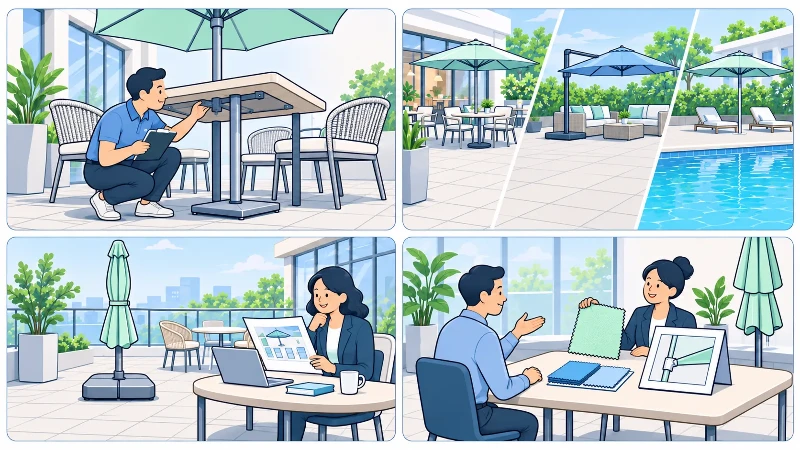
Compare a complete arrangement, not a headline umbrella price
Identify which canopy, mast, base or mounting components, controls and accessories each quotation includes. Otherwise, two apparently similar prices may cover different arrangements.
Mark the support footprint before placing the order
Use the proposed model's dimensions to mark the support on site or in a scaled furniture plan. Include furniture in use, not just tucked-in chairs. This is a useful way to expose a layout conflict before buying multiple units.
Record the configuration you actually approve
Keep the agreed size, canopy form, support, finish and selected features together in the approval record. If one component changes during procurement, revisit the affected fit and documentation rather than assuming the earlier approval still answers the question.
FAQ
Can we retain existing dining tables when buying new umbrellas?
It may be possible, but retaining the tables requires a compatibility check rather than an assumption. Provide table dimensions and underframe details when considering a through-table mast. A cantilever or between-table arrangement may avoid the need for a hole, provided its support and occupied layout work. Do not drill or modify an existing table without its supplier's confirmation.
Should a resort use the same umbrella model in every outdoor area?
Not necessarily. Shared finishes or canopy colours may provide visual consistency while different support arrangements suit dining, lounge and pool areas. Standardisation is useful only where the same model actually fits the relevant layouts and operating needs; a simpler ordering list should not override those differences.
Can a leased terrace use umbrellas without permanent fixings?
A manufacturer-specified freestanding arrangement may be an option, but "no drilling" does not establish site suitability or permission. Resolve the proposed support, occupied footprint and applicable landlord or venue requirements before ordering. Do not improvise a weighted substitute for an arrangement that requires a different installation.
Can replacement fabric or branding be decided after the main order?
Discuss it before approval, even if replacement is a future purchase. Confirm the compatible canopy dimensions, attachment details and material specification, and ask whether printing or another fabric changes any supplied claims or documentation. Do not assume that replacement canopies are interchangeable between models or that a supplier has confirmed future stock.
For an umbrella enquiry, include the furniture plan, intended service hours, proposed support locations and site restrictions. Those details help make the discussion about an arrangement that works-not simply the largest canopy that fits on a drawing.