

Key Takeaways
Patio umbrella fit requires three separate checks: useful shade, a clear path through the table and a manufacturer-supported pole-and-base arrangement. For centre-pole umbrellas used through hospitality dining tables, the finished hole, underframe openings, receiver geometry and operating movement must work as one combination. A pole that slides through a hole has passed only one of those checks.
A mismatch can hide below the tabletop. The pole may pass through the top but meet a cross-brace underneath. The base may accept the pole but leave no room for the table's pedestal. Or every diameter may appear compatible while the canopy cannot close over the table.
This guide concentrates on through-table, centre-pole arrangements for restaurant patios, hotel terraces and similar commercial dining spaces. Offset umbrellas still need an appropriate support and layout, but their fit should not be assessed by pretending they follow the same route through a table hole.
Read the Assembly in Plan and in Section
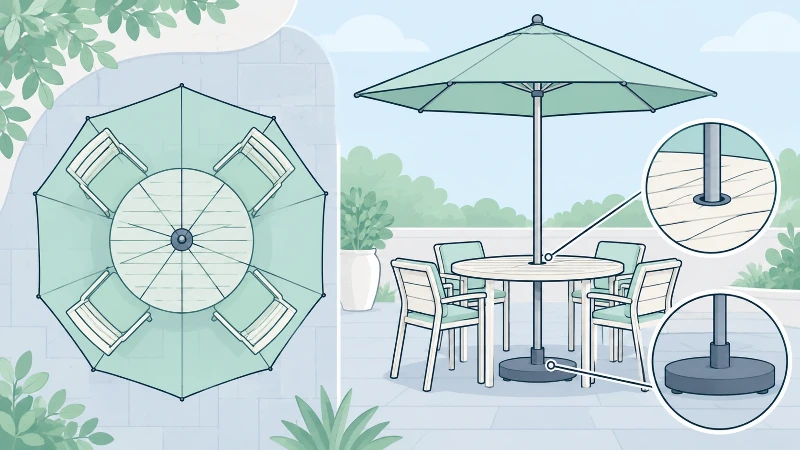
A plan view helps position the canopy, occupied furniture and base footprint. A vertical section explains how the pole passes through the table and enters its support. Use both when coordinating outdoor dining tables and chairs with an umbrella package.
The key is to record one proposed combination, not four unrelated product descriptions. The following is a purchasing coordination record-not a table of industry-standard dimensions.
| Part of the combination | Record for the actual products | What it resolves |
|---|---|---|
| Canopy | Shape, stated measuring method, open width/depth and intended shade positions | Whether the selected canopy suits the furniture arrangement |
| Pole | Finished outside diameter and relevant joints or fittings along the insertion path | What must pass through each opening |
| Tabletop | Cut-out dimensions, specified insert and effective opening with that insert fitted | Whether the completed tabletop accepts the pole |
| Underframe | Any lower guide, brace or pedestal; opening alignment and available space | Whether the route continues below the visible hole |
| Base and receiver | Base footprint/height, receiver position, outside dimensions and internal compatibility range | Whether the base fits the table and accepts the intended pole |
| Engagement and retention | Manufacturer's insertion requirement, specified reducers and retaining components | Whether the pole can be held as the system requires |
| Operating envelope | Open/closed dimensions, movement between them and access to controls | Whether staff can operate the assembled combination |
Leave an unresolved field marked "required from supplier." Substituting a commonly quoted dimension would make the schedule look complete without resolving the fit.
Umbrella Size Starts with the Seats, Not Just the Tabletop

Establish what the size label measures
Record the canopy's actual shape and dimensions. A diameter, the side of a square and the dimensions of a rectangle are different descriptions; a headline size without its measuring basis is not enough for a furniture plan.
Position the canopy over the seats in use, including pulled-out chairs. Then consider neighbouring canopies, structures and the space needed for operation. A canopy that fits above the table may still conflict with the surroundings.
There is no universal canopy-to-table overhang that establishes suitability for every commercial terrace. The table dimensions are one input, not the entire sizing brief.
Distinguish canopy coverage from useful shade
The Australian Radiation Protection and Nuclear Safety Agency's guidance on sun protection using shade explains that coverage depends on the positions of the structure, person and sun, with scattered and reflected UV also affecting protection.
For procurement, translate that into a review of occupied positions during the venue's important service periods. A larger canopy does not remove the need to check where the shadow falls. Nor does a fabric rating establish complete protection for every diner underneath.
Follow the Pole Through Every Opening
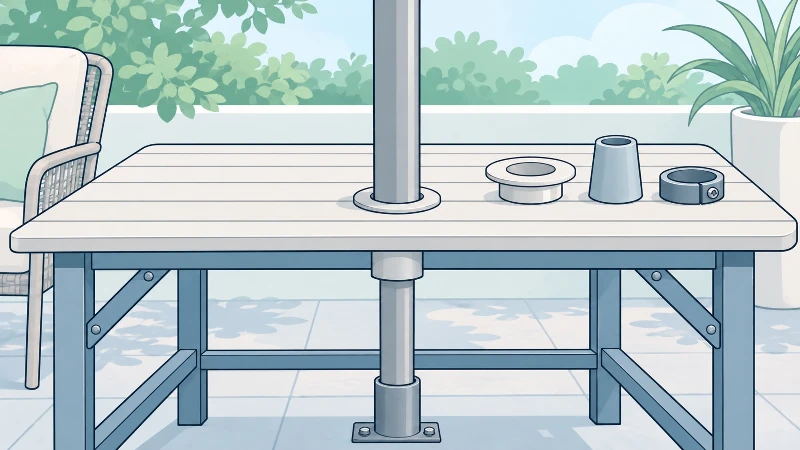
Use the actual pole profile, not "standard diameter"
The patio umbrella pole diameter needs to be identified for the particular model. Record the finished outside diameter of the section entering the base, together with any joint or fitting that must pass through the table during the instructed assembly sequence.
Do not compare a rounded catalogue label with another supplier's nominal hole size and assume the difference is an approved clearance. Ask for the compatibility dimensions and permissible arrangement. Matching units does not resolve uncertain tolerances or a change in profile along the pole.
Measure the opening with its specified insert installed
For an outdoor table with an umbrella hole, distinguish the raw cut-out from the usable opening after the designated ring or grommet is fitted. The pole must suit the completed arrangement, not merely fit through a larger unfinished opening.
A table-hole grommet may protect the opening or serve another purpose specified by the table manufacturer. A reducer inside a base tube addresses the pole-to-base interface. A retaining screw, collar or other specified device performs a further role in securing the pole.
Those parts should be identified separately. A neat fit at the tabletop does not establish that the pole is properly retained below it. Likewise, a suitable base reducer does not resolve an incompatible tabletop opening.
Continue below the visible hole
Inspect the underside drawing or the actual table. There may be another guide or support ring to align with the tabletop opening. A cross-brace or pedestal can obstruct the path even when the top hole is generous enough.
Be clear about which component passes through each opening. In one arrangement that may be the pole alone; another design may position a receiving component differently. Do not assume every lower opening must accept the outside of the entire base tube.
Also keep two meanings of "base" separate. The table base supports the tabletop; the umbrella base or mounting supports the umbrella. An integrated design needs its own documentation. For a separately sourced tabletop and pedestal, tabletop and table-base compatibility is an additional coordination task, not a substitute for checking the umbrella support.
The Receiver Must Fit the Pole-and Fit Beneath the Table

Check inside fit and outside interference independently
The receiver's internal dimensions concern the pole and any specified reducer. Its outside dimensions concern the table structure around it. Base plate height, receiver height and position can matter as much as width.
Consider a hypothetical fit check: the pole passes through the tabletop, and the receiver accepts that pole, but the receiver meets a lower table support before the base can sit in its intended position. Both diameter comparisons have passed; the assembled geometry has not.
The solution is a compatible, documented combination of components. Cutting a receiver or removing a table brace to make the parts meet is a proposed alteration, not a normal fit adjustment.
Include chair positions and guests' feet in the review. A base that can physically be placed beneath a table is not necessarily convenient in an occupied dining arrangement.
Tube height is not the insertion requirement
Obtain the required engagement and retaining arrangement for the actual base. The overall height of a tube does not tell you how far the pole must enter it or which reducers, collars or fasteners the manufacturer specifies.
Check that the supplied lower pole can reach the intended position without an incompatible joint or fitting obstructing the assembly. Staff also need the access required to use the specified retaining parts according to the instructions.
If the documentation does not identify the required engagement, the fit remains unresolved. This guide does not supply a substitute minimum insertion depth or an improvised tightening method.
Check the Movement Between Open and Closed

Open height, closed height and overall height answer different questions. They also describe endpoints, not necessarily the whole path the canopy follows.
Review the selected model's complete opening-and-closing movement around the proposed table, chairs and nearby objects. Pay attention to moving ribs, fabric and controls as they pass the furniture-not only to where they finish.
A canopy may clear the table when fully closed yet still need additional space during the closing movement. Conversely, a model-specific retracting or telescopic mechanism may resolve a particular interference. Neither conclusion should be assumed from the feature name.
Decide before ordering whether any required furniture movement fits the venue's operating routine. If the through-table combination cannot be made workable, compare a different umbrella support arrangement rather than continuing to search for an unspecified "universal" adaptor.
Physical Fit Does Not Establish Base Capacity

Patio umbrella base weight should be assessed within the manufacturer's specified support configuration. A weight on a product page does not establish compatibility with every canopy, pole, mounting method or site.
For a fillable system, distinguish the supplied empty item from the required completed arrangement. For a multi-part support, identify the specified components rather than assuming that extra plates, different stems or substitute fittings are interchangeable.
The same distinction applies to test evidence. ASTM F3512-21(2026) identifies an active test method concerning wind safety and durability of market umbrellas. Naming that method does not demonstrate that a particular quoted product has been tested.
As a procurement check, establish which umbrella and support assembly any supplied report covers, and obtain the applicable operating instructions. A successful physical fit check is not a wind-performance test, a site installation approval or permission to use the umbrella in every condition.
Approve the Combination, Not Each Component in Isolation

When shortlisting commercial patio umbrellas, ask for the model information needed to complete the fit record alongside the table and support details. A complete package should identify the canopy/frame, lower pole, table, inserts and base or mounting arrangement being assessed.
For a representative combination, follow the applicable assembly instructions and review the physical path, required engagement, retention, operating access and complete canopy movement. Record any mismatch against the actual component references. Photographs can help document what was assembled, but they do not prove dimensions, support capacity or site suitability.
The useful result is a combination record that says what has been checked, what remains outstanding and which exact parts it covers. Keep dimensional fit separate from any technical or site approval still required.
Safety Constraints & What NOT to Do

WARNING: Do not enlarge the table opening, remove specified protection, cut a receiver or extend a pole simply to make the parts fit. Obtain the relevant manufacturers' confirmation and any required project review before approving an altered combination.
Do not force a pole past an obstruction or replace specified reducers and retaining parts with improvised packing. Resolve the component mismatch using an arrangement supported by the product documentation.
Do not treat the table hole or a snug fit as proof of adequate support. The umbrella still needs its specified base or mounting arrangement and operating instructions.
Do not approve a changed canopy, support or use configuration on the basis of the old fit record alone. Identify the affected dimensions and evidence before releasing the changed arrangement for service.
Small Ordering Details That Prevent a Fit Dispute

Give accessories their own references
"Base included" may leave the receiver, reducer or other required parts unidentified. List the specified accessory references and quantities with the main components so that the intended combination is clear.
Keep actual and nominal dimensions distinguishable
Use one coordinated schedule with consistent units. Preserve the supplier's stated dimensions and identify any values requiring clarification rather than rounding them until they appear to match.
Keep the approved sample tied to the production parts
A substitute underframe, lower pole or insert can change the interface even if the finished products look similar. Record approved component references and review affected fit points when a substitution is proposed.
FAQ
Can one umbrella and base specification cover every table in a hotel?
Only if the relevant table combinations have been assessed. Similar-looking tables can have different heights, openings and underframes. A practical purchasing schedule lists the accepted table–umbrella–base combinations, rather than treating one successful sample as approval for every table model.
Who should coordinate fit when tables and umbrellas come from different suppliers?
Nominate a project coordinator to bring the drawings and component requirements together. Each supplier should identify the requirements for its own product; the project then needs a review of the complete combination. Keep unresolved interfaces explicit instead of accepting separate statements that the pole fits the hole and the base accepts the pole.
Can a dining-height umbrella be used with a bar-height table?
It may be possible for a particular model, but the lower-pole arrangement, canopy movement and operating access need checking at that table height. Use a manufacturer-supported configuration where one is offered. The existence of a dedicated extension for one product does not justify splicing or extending another pole.
What should be specified if the hotel wants both through-table and freestanding use?
Ask the supplier to identify the permitted arrangement for each application, including any different base, stem or other components. Record the two configurations separately if they differ, and include their operating instructions in the handover. Do not assume that removing the table leaves the original support arrangement suitable for freestanding use.
An effective enquiry includes more than a preferred canopy size. Send the table drawing or measured interface details, the proposed pole and base references, the intended application and any known site restrictions. That gives the purchasing discussion a specific combination to resolve.